The 2026 answer for Amazon sellers
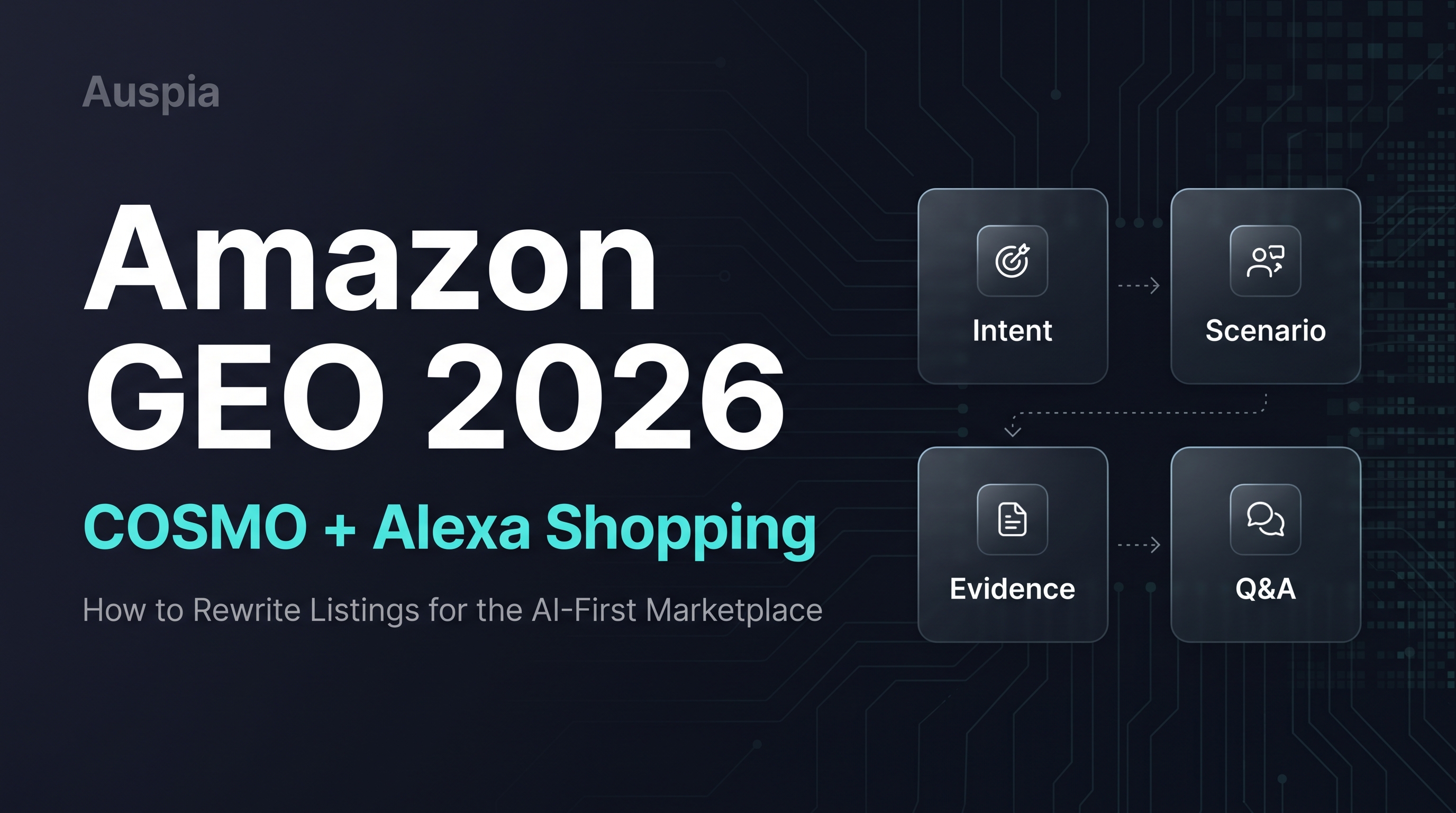
Amazon GEO in 2026 means writing listings so Amazon's AI systems can understand who the product is for, when it should be recommended, and what proof supports the recommendation. Keywords still matter, but they are no longer enough on their own.
The practical shift is simple: stop treating the listing as a keyword container. Treat it as a product knowledge page for Amazon search, COSMO-style semantic matching, and Alexa Shopping conversations.
That means every important part of the listing should answer four questions:
AI question | What the listing should make clear |
|---|---|
Who is this for? | User type, household, task, buying situation |
What problem does it solve? | Pain point, desired outcome, constraint |
Where does it fit? | Use case, room, routine, device, season, category context |
What proof supports it? | Materials, compatibility, reviews, Q&A, images, tests |
Amazon has publicly described Rufus, its generative AI shopping assistant, as using product catalog data, customer reviews, community Q&A, and web information to answer shopping questions. Amazon Science has also explained that the system can create search queries and refine product recommendations from conversational requests. In 2026, Amazon has also been moving shopping assistance under Alexa for Shopping in the US, which makes conversational product discovery even more important for sellers. Sources checked for this piece include Amazon Science on Rufus technology, About Amazon on Rufus personalization, and CNBC coverage of the Alexa Shopping shift.
The seller takeaway: a listing that only repeats "food storage container" five different ways gives AI very little to work with. A listing that explains meal prep, fridge organization, leak resistance, commuting, child-safe storage, and cleaning gives Amazon more retrieval paths.

What changed: from A9 habits to AI-readable product meaning
Old Amazon SEO was mostly a discipline of coverage. Sellers tried to cover every keyword variation in the title, bullets, backend terms, and ads. That worked better when search relied more heavily on literal matching.
The new operating model is closer to semantic merchandising. COSMO-style systems try to connect products to common-sense shopping needs. Alexa Shopping-style assistants take conversational questions and turn them into product shortlists. A shopper may not type "airtight BPA-free stackable meal prep boxes 30 oz." They may ask, "What containers won't leak in my work bag?" or "What should I buy to organize leftovers for a family of four?"
That is a different matching problem.
Old listing habit | 2026 Amazon GEO habit |
|---|---|
Repeat the same keyword cluster | Cover distinct intents and situations |
Lead with specs only | Connect specs to real buyer outcomes |
Use bullets as feature dumps | Use bullets as answer blocks |
Treat images as decoration | Use images as machine-readable evidence |
Ignore Q&A until questions appear | Seed natural buyer questions before they block conversion |
The most useful mental model is this: Amazon's AI does not only need the product name. It needs enough surrounding context to decide whether the product belongs in a recommendation.
The listing rewrite map
Start with the four surfaces Amazon can easily read and shoppers can easily scan: title, bullets, images, and Q&A. Reviews matter too, but sellers cannot rewrite reviews directly. They can, however, set up the listing so the right buyers purchase the product and leave reviews that reinforce the same use cases.
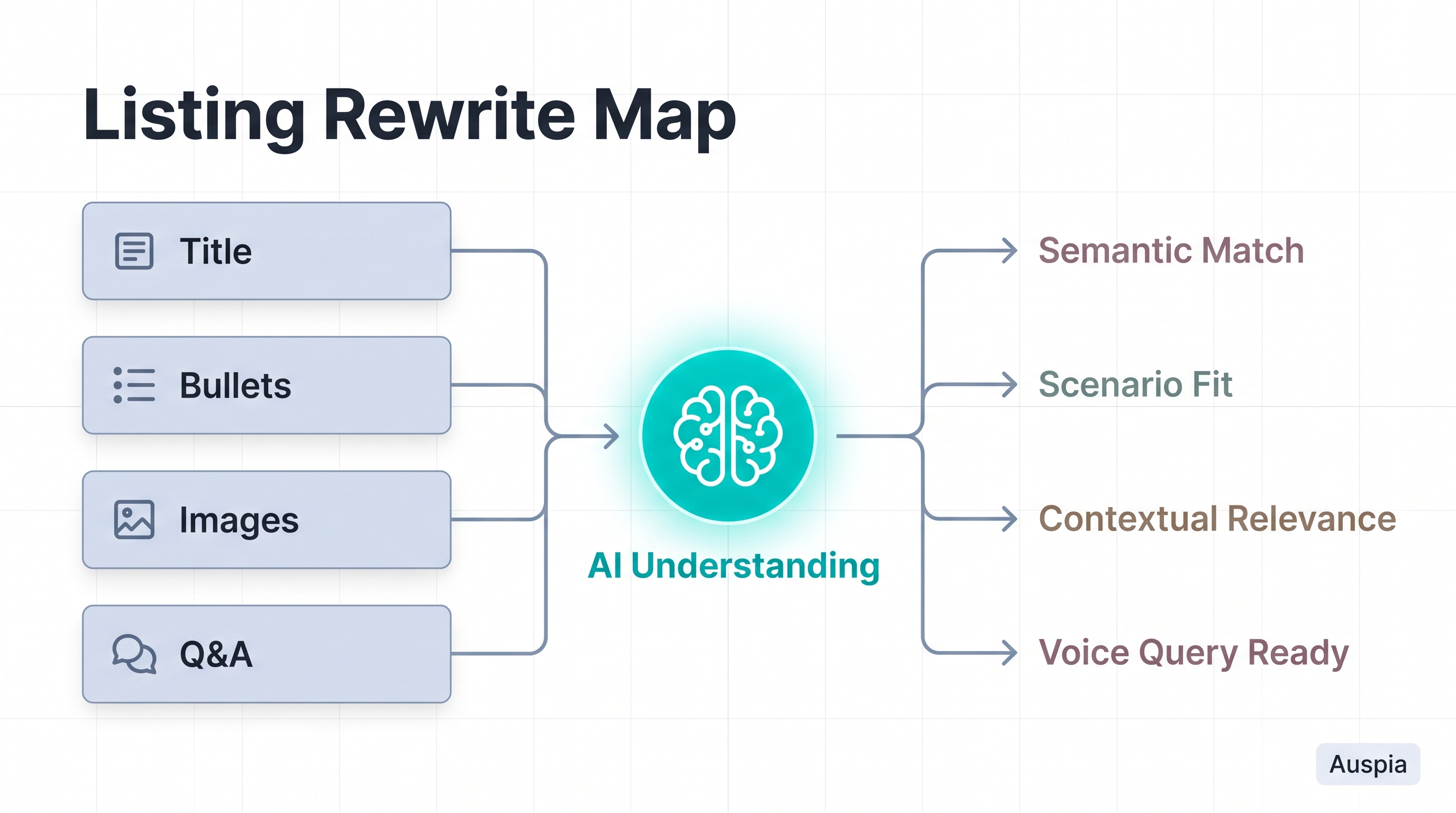
Title: stop stacking synonyms, start naming the buying situation
A weak 2026 title tries to include every phrase:
Food Storage Containers, Plastic Meal Prep Boxes, Airtight Lunch Box, Leakproof Refrigerator Organizer, BPA Free Stackable
A stronger title still includes the core keyword, but it adds attributes and situations in a sentence Amazon can parse:
Airtight Food Storage Containers, Leakproof Stackable Meal Prep Boxes, BPA-Free Set for Refrigerator Organization, Family Leftovers, and Office Lunch
Why it works better:
- "Airtight" and "leakproof" describe the product promise.
- "Stackable" and "refrigerator organization" explain the storage scenario.
- "Family leftovers" and "office lunch" add user contexts.
- The title reads like a product description, not a keyword spill.
Do not turn the title into a paragraph. The goal is not length. The goal is clear product identity plus two or three high-intent scenarios.
Bullets: use pain, feature, outcome, scenario
Most bullet points fail because they name features without explaining why those features matter. "BPA-free, leakproof, stackable, microwave safe" is easy to skim, but it does not answer the shopper's real question.
A better bullet follows this pattern:
- Name the buyer problem.
- Explain the feature that addresses it.
- State the practical outcome.
- Anchor the outcome in a real use case.
Example:
Keep soup, sauces, and chopped fruit where they belong. The snap-lock lid and silicone seal help prevent leaks in a lunch bag or fridge drawer, so meal prep stays clean during commutes, school lunches, and weekly leftover storage.
This is not just nicer copy. It gives Amazon's systems more semantic handles: soup, sauces, lunch bag, fridge drawer, commutes, school lunches, meal prep, leftover storage.
Use the same structure across the remaining bullets, but do not repeat the same situation. Each bullet should add a new retrieval path.
Bullet theme | Weak copy | Stronger Amazon GEO copy |
|---|---|---|
Safety | BPA-free material | BPA-free food-grade material for fruit, cooked meals, baby snacks, and raw ingredient prep |
Storage | Stackable design | Stackable rectangular shape helps organize crowded refrigerator shelves and small apartment cabinets |
Heating | Microwave safe | Vent-friendly reheating for office lunches and busy weeknight leftovers, with lid guidance stated clearly |
Cleaning | Easy to clean | Smooth corners and dishwasher-safe parts reduce odor buildup after sauces, soups, and oily meals |
Images: show the use case, not only the product angle
Amazon's AI shopping layer is becoming more multimodal. Even without making claims about exactly how each model weighs each image, sellers should assume that image content, alt-like context from A+ modules, and visible use cases help both shoppers and AI systems understand the product.
For a food container listing, a useful image set would include:
Image slot | What it should communicate |
|---|---|
Main image | Clear product identity, quantity, shape, lid style |
Lifestyle image | Fridge organization or kitchen meal prep context |
Proof image | Leak test, seal close-up, dishwasher or microwave guidance |
Use-case image | Office lunch, school snack, picnic, family leftovers |
Comparison image | Stackable storage before/after, size guide, portion guide |
Avoid fake-looking lifestyle images that do not teach anything. The best product images act like visual answers. If a shopper asks, "Will this fit in a fridge drawer?" one image should make the answer obvious.
Q&A: write for natural shopping questions before the assistant asks them
Conversational shopping assistants are question machines. They work best when product data already contains clear answers to buyer concerns.
A seller should collect questions from:
- Amazon's own search suggestions and product Q&A in the category.
- Customer service tickets and return reasons.
- Review language from top competing products.
- Ads search terms that imply a concern, such as "does not leak" or "safe for baby food."
Then turn those concerns into direct Q&A and supporting listing language.
Example Q&A:
Q: Are these containers safe for storing fresh fruit, cooked meals, and baby snacks? A: Yes. The containers are made with BPA-free food-grade plastic and are designed for everyday storage of fruit, vegetables, cooked meals, and snacks. For best results, follow the heating and dishwasher instructions on the product page.
Notice the restraint. The answer is useful, but it does not overclaim. It gives Alexa Shopping-style systems a clean extractable answer.
A 60-minute Amazon GEO rewrite sprint
Use this sprint when a listing has traffic but weak organic lift, or when a new product has been built around old keyword habits.
Time | Action | Output |
|---|---|---|
0-10 min | Pull 20 shopper questions from search suggestions, Q&A, reviews, and support tickets | Question list grouped by intent |
10-20 min | Pick the top five use cases | Scenario map: user, problem, context, proof |
20-35 min | Rewrite title and bullets | One title plus five scenario-rich bullets |
35-45 min | Map images to missing proof | Shot list for use case, comparison, proof, size, compatibility |
45-55 min | Add or update Q&A | 5-8 natural-language answers |
55-60 min | Check repetition and risk | Remove keyword stuffing, unsupported claims, and vague promises |
This is the minimum viable version. A larger brand should add review mining, competitor answer analysis, category-level prompt testing, and a monthly visibility dashboard.
Example: before and after for a meal prep container
Here is the difference between a keyword-stuffed listing and an AI-readable listing.
Listing element | Before | After |
|---|---|---|
Title | Food Storage Containers, Meal Prep Boxes, Airtight, Leakproof, BPA Free | Airtight Food Storage Containers, Leakproof Stackable Meal Prep Boxes for Fridge Organization, Office Lunch, and Family Leftovers |
Bullet 1 | Leakproof design | Snap-lock lid and silicone seal help prevent soup and sauce leaks in lunch bags, fridge drawers, and picnic totes |
Bullet 2 | Stackable boxes | Rectangular stackable shape keeps weekly meal prep organized in small refrigerators and apartment cabinets |
Bullet 3 | BPA-free plastic | BPA-free food-grade plastic for storing fruit, cooked meals, snacks, and fresh ingredients for everyday family use |
Q&A | Can it store food? | Is this safe for storing fresh fruit, cooked meals, and baby snacks? Yes, the BPA-free food-grade plastic is designed for everyday food storage when used as directed. |
The revised version still contains keywords. The difference is that the keywords now sit inside a useful explanation. That makes the listing better for shoppers and easier for AI systems to classify.
Alexa Shopping readiness checklist
Before publishing or refreshing a listing, ask these questions:
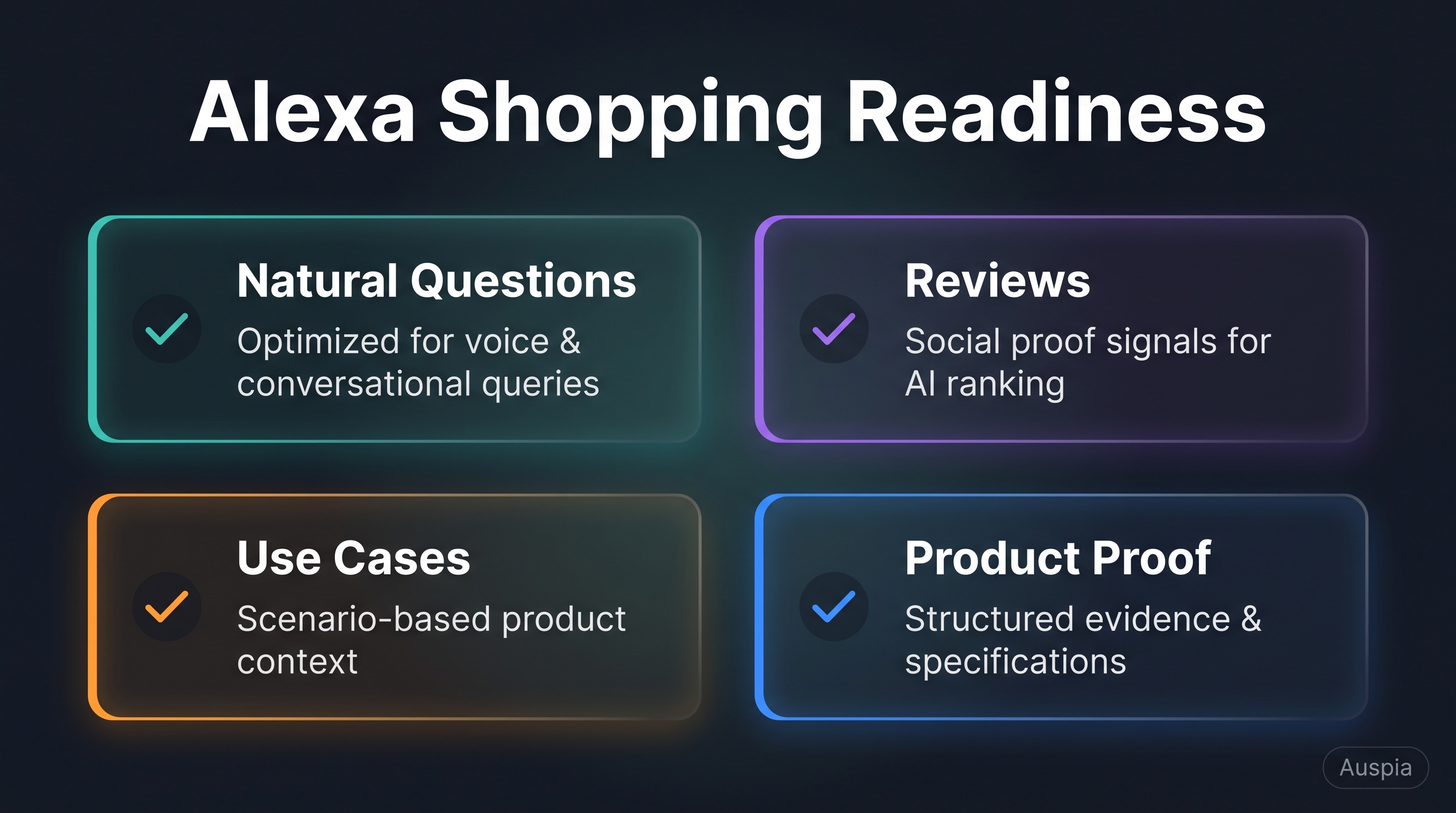
- Can a shopping assistant answer "who is this best for?" from the listing alone?
- Do the bullets cover at least five distinct buyer intents instead of repeating one feature?
- Do images prove the claims made in the copy?
- Does the Q&A answer natural spoken questions, not only technical details?
- Are reviews likely to mention the same use cases the listing promises?
- Are safety, compatibility, sizing, and care instructions written plainly?
- Have unsupported claims been removed or softened?
If the answer is no, the listing is not ready for Amazon GEO. It may still index for keywords, but it will struggle in conversational recommendation flows.
What sellers should not overclaim
There is a lot of noisy advice around COSMO, Rufus, and Alexa Shopping. Keep the work practical.
Do not claim that adding a phrase will guarantee Rufus or Alexa recommendations. Do not stuff Q&A with unnatural questions. Do not invent certifications, safety claims, review patterns, or performance tests. Do not assume every marketplace behaves the same way at the same time.
A safer claim is also a better operating principle: listings with clearer use cases, cleaner answers, stronger proof, and more natural buyer language are easier for both humans and AI systems to interpret.
That is enough reason to rewrite them.
Auspia view: Amazon GEO is product knowledge management
Amazon sellers often separate SEO, listing copy, images, reviews, ads, and support. AI shopping systems collapse those surfaces. They look for a coherent product story across all of them.
That is why Amazon GEO should be managed like product knowledge management:
- The title defines the product identity.
- Bullets explain the main intent clusters.
- Images prove the scenarios.
- Q&A answers conversational concerns.
- Reviews confirm whether the promise is real.
- Ads data reveals the language buyers actually use.
If you already track AI visibility across Google AI Overviews, ChatGPT, or Perplexity, extend the same discipline to Amazon. Build a prompt set for marketplace discovery: "best container for office lunch that won't leak," "storage boxes for small fridge," "safe meal prep containers for kids," and similar natural questions. Then compare which products appear, what evidence is cited, and which listing surfaces seem to feed the answer.
For broader AI search work beyond Amazon, Auspia's AI Search Visibility Checker can help teams think in prompts instead of only keywords.
FAQ
Is Amazon GEO the same as Amazon SEO?
No. Amazon SEO usually focuses on keyword indexing, relevance, conversion, and ranking signals inside Amazon search. Amazon GEO adds a layer for generative and conversational discovery: natural-language questions, semantic product understanding, assistant recommendations, and evidence across listing content, reviews, images, and Q&A.
Does keyword research still matter for Amazon listings in 2026?
Yes. Keyword research still helps sellers understand demand and category language. The mistake is stopping there. Use keywords as inputs, then rewrite them into scenario-rich copy that explains user intent, product fit, and proof.
What is the difference between COSMO and Alexa Shopping for sellers?
COSMO is commonly discussed as Amazon's semantic and common-sense approach to matching products with shopper intent. Alexa Shopping is the customer-facing conversational assistant layer that can answer questions and help shoppers find products. Sellers should not optimize for one name only. They should make listings clearer for semantic matching and conversational answers.
How many Q&A entries should a seller add?
Start with 5-8 high-intent questions that buyers actually ask. Cover safety, fit, compatibility, sizing, use case, care, and limitations. More is not automatically better. The answers should be specific, accurate, and useful.
Can better listing copy double organic traffic?
It can improve visibility and conversion, but no serious team should promise a guaranteed traffic multiple. Results depend on category competition, price, reviews, inventory, ads, ranking history, and product-market fit. Treat the rewrite as a controlled test and track organic sessions, conversion rate, search query performance, and assistant-driven question patterns.
Author: Ryan Chen, Senior Amazon Operations Expert with 10 Years in Marketplace Growth at Auspia. Ryan writes about Amazon GEO, marketplace search behavior, AI-assisted product discovery, and operational playbooks for sellers.