Seller Takeaway
Amazon Alexa GEO is not a shortcut to forcing a voice assistant to recommend your product. For sellers, it is the discipline of making product discovery clearer across the places a voice-driven shopping journey may depend on: Amazon search relevance, product detail pages, reviews, Q&A, shopping-list behavior, and repeat-purchase signals.
The practical shift is simple: buyers do not speak like they type. A typed Amazon search might be dishwasher tablets bulk. A spoken shopping query is more likely to sound like, "What dishwasher tablets should I buy for hard water?" or "Reorder the lemon dishwasher pods I bought last time." That difference changes the questions your listing, content, and evidence need to answer.
This guide is for Amazon sellers who want to understand Alexa GEO without hype. It uses DataForSEO keyword signals, Amazon listing guidance, and voice-shopping query patterns to build a seller-friendly question map.
What Amazon Alexa GEO Means For Sellers
Amazon Alexa GEO means optimizing your marketplace presence so voice, AI, and assistant-style discovery systems can understand what your product is, who it is for, when it should be considered, and what evidence supports it.
For a seller, that usually means five workstreams:
Workstream | What it affects | Seller asset to improve |
|---|---|---|
Query language | How buyers describe the need | Keyword map, product title, bullets, backend terms |
Product understanding | Whether the product is easy to classify | Category, attributes, title, images, A+ Content |
Answer quality | Whether the listing resolves spoken questions | Bullets, description, comparison tables, Q&A |
Trust evidence | Whether the product looks safe to recommend | Reviews, ratings, review themes, returns, policy clarity |
Repeat behavior | Whether buyers can add, remember, and reorder | Pack size, naming consistency, Subscribe & Save, replenishment cues |
This is different from generic Amazon SEO. Traditional listing optimization often starts with the keyword field and product title. Alexa GEO starts with the buyer's spoken task: "find," "compare," "add," "buy," "reorder," "turn off," "share," or "where is my list?"
DataForSEO Signals: Where Demand Already Exists
The strongest commercial signals are not always the most obvious Alexa terms. DataForSEO research for this series showed that broad voice and Amazon optimization terms carry meaningful advertiser demand, while direct Alexa shopping phrases are smaller but useful for intent modeling.
Keyword signal | Approx. volume | Approx. CPC | What it tells sellers |
|---|---|---|---|
voice search optimization | 720 | $56.65 | Marketers already pay for voice-search strategy terms. |
voice search marketing | 90 | $52.18 | Commercial education demand exists around voice-led discovery. |
amazon product listing optimization | 140 | $28.77 | Listing quality remains a paid, high-intent seller problem. |
amazon seo | 1,000 | $22.87 | Sellers still search for marketplace search fundamentals. |
amazon sponsored products | 1,900 | $14.53 | Paid visibility can support learning and demand capture. |
voice commerce | 110 | $7.42 | Smaller volume, but directly relevant to the buying behavior shift. |
amazon a10 algorithm | 110 | $6.34 | Sellers look for marketplace ranking explanations. |
amazon product reviews | 2,400 | $3.87 | Review quality and trust remain central evidence signals. |
alexa shopping list | 1,600 | $0.81 | Consumer list behavior creates category and reorder clues. |
alexa voice shopping | 110 | $0.00 | Low CPC does not mean low strategic value; it is a behavior signal. |
Use this table carefully. It does not prove that one keyword makes Alexa recommend a product. It shows where sellers, agencies, and shoppers already express demand: voice search, listing optimization, Amazon SEO, reviews, shopping lists, and reorder behavior.
Why Voice Shopping Is Not Just Shorter Amazon Search
Voice changes discovery because it compresses the screen. On a search results page, a buyer can scan ten listings, compare images, read snippets, and change the query. In a voice-led interaction, the assistant has to reduce ambiguity much faster.
That creates four seller implications:
- The product must be classifiable. A vague title or incomplete attribute set makes it harder to match the product to a spoken need.
- The listing must answer use-case questions. Voice queries often include context such as household size, compatibility, skin type, room size, dietary preference, or replacement cycle.
- Evidence matters more when choice is compressed. Reviews, ratings, Q&A, return concerns, and trust language influence whether a product feels safe to surface.
- Reorder paths favor remembered products. Consumables, household goods, supplements, pet supplies, and office supplies have a stronger repeat-purchase angle than one-time discretionary products.
Amazon's own seller education on SEO emphasizes product titles, descriptions, bullet points, backend search terms, images, price, and keyword research. Its Manage Your Experiments feature also supports testing assets such as titles, images, bullet points, descriptions, and A+ Content. Those are still the seller levers. Alexa GEO changes the questions those assets must answer.
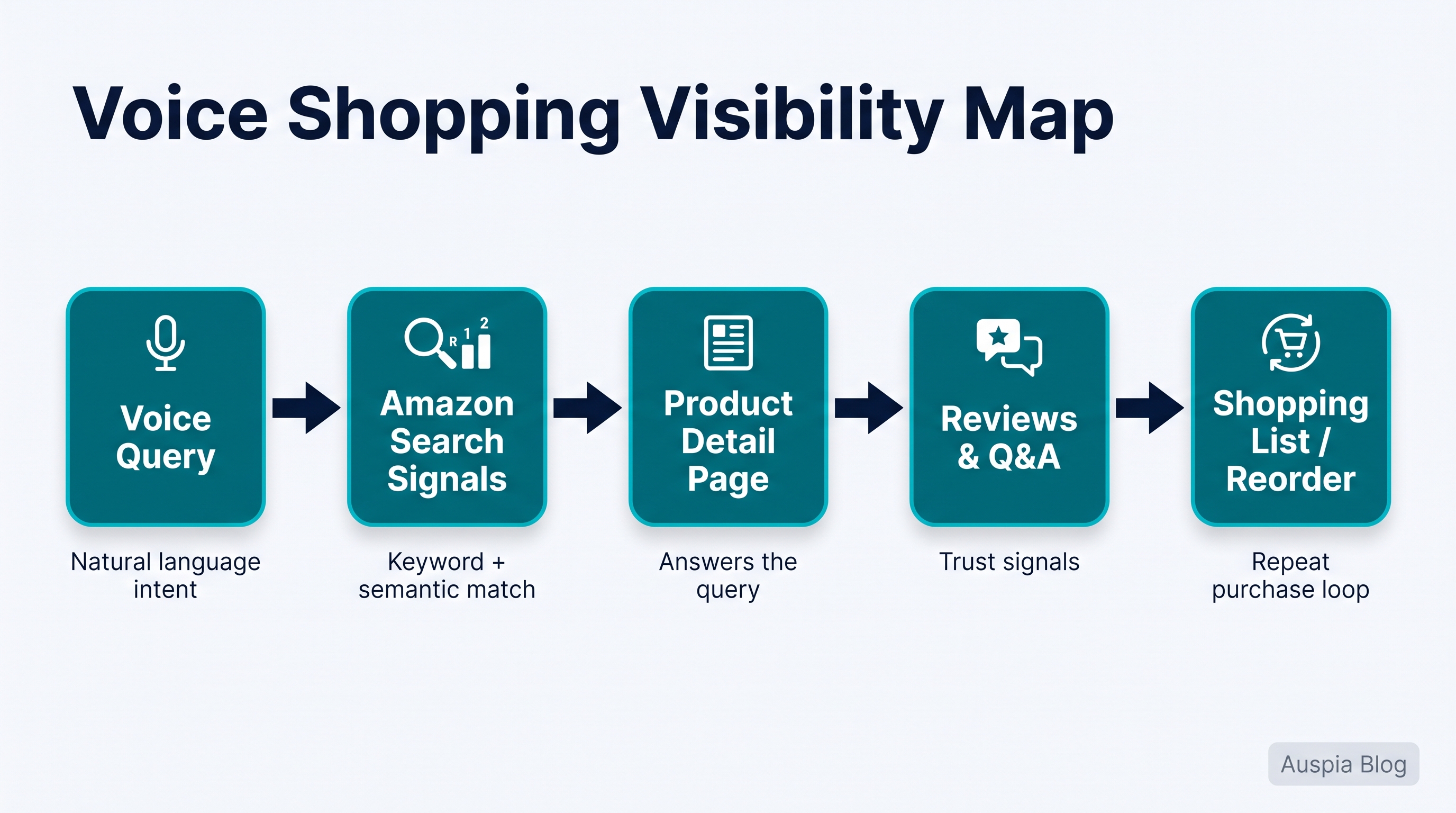
The Visibility Map Sellers Should Use
Think of Alexa GEO as a visibility map, not a single ranking factor.
Stage | Buyer behavior | Seller question | Optimization move |
|---|---|---|---|
Spoken need | "Find a quiet air purifier for a bedroom." | Does the listing include the use case and constraint? | Add natural-language use cases to bullets and A+ Content. |
Product selection | Buyer expects a short recommendation set. | Is the product clearly differentiated? | Clarify size, compatibility, materials, pack count, and benefits. |
Trust check | Buyer asks if it is good, safe, or worth it. | Do reviews and Q&A support the claim? | Mine review themes; answer recurring objections. |
Shopping list | Buyer adds a category or brand to a list. | Is the product name easy to remember? | Keep naming consistent across pack sizes and variants. |
Reorder | Buyer asks for the same item again. | Is the replenishment path obvious? | Use clear variant names, subscriptions, and replacement-cycle cues. |
For sellers, the goal is to reduce uncertainty at every stage. A listing that only repeats high-volume head terms may rank for typed search but still fail spoken, task-based evaluation.
100 Amazon Alexa GEO Questions Sellers Can Start With
Use these as a research library, not as copy-paste keyword stuffing. Pick the questions that match your category, then answer them naturally in product content, Q&A, A+ Content, comparison assets, and support material.
Voice Discovery And Category Intent
- What is the best product for this specific use case?
- What should I buy for a small apartment?
- What should I buy for a large family?
- What is a good budget option in this category?
- What is a premium option in this category?
- Which product is easiest to use for beginners?
- Which product is safest for kids or pets?
- Which product works for sensitive skin?
- Which product works for hard water?
- Which product works in a small kitchen?
- Which product works in a dorm room?
- Which product is travel-friendly?
- Which product has the least noise?
- Which product has the longest battery life?
- Which product is easiest to clean?
- Which product is compatible with my existing device?
- Which product is best for daily use?
- Which product is best for occasional use?
- Which product is best for heavy use?
- Which product should I choose if I want fewer refills?
Product Listing And Attribute Questions
- What size is this product?
- What dimensions does it have?
- What materials is it made from?
- How many items are in the pack?
- How long does one pack last?
- Does it come in different colors?
- Does it come in different scents or flavors?
- Is it fragrance-free?
- Is it waterproof?
- Is it machine washable?
- Is it dishwasher safe?
- Is it reusable or disposable?
- Is it compatible with model X?
- Is it compatible with older versions?
- Does it require batteries?
- Does it include the charger or adapter?
- Does it include replacement parts?
- Is assembly required?
- What is included in the box?
- What is not included in the box?
Comparison And Decision Questions
- How is this different from the cheaper version?
- How is this different from the larger pack?
- How is this different from the brand-name option?
- How is this different from the generic option?
- Which variant should I buy?
- Which pack size is the best value?
- Should I buy the single pack or multipack?
- Should I buy this or subscribe?
- Is this better for beginners or advanced users?
- Is this better for home or professional use?
- Is this better for small spaces or large spaces?
- Is this better for adults, kids, or pets?
- Is this a replacement for another product?
- Can this replace two separate products?
- What product should I buy with this?
- What accessory do I need with this?
- What product should I avoid mixing with this?
- What is the main tradeoff of this product?
- What is the most common buyer complaint?
- What is the reason people choose this product?
Trust, Reviews, And Objection Questions
- Is this product reliable?
- Is this product safe?
- Does this product have verified reviews?
- What do buyers like most about it?
- What do buyers complain about most?
- Does it break easily?
- Does it leak, fade, crack, or clog?
- Does it work as advertised?
- Does it have a strong smell?
- Does it cause irritation?
- Does it arrive damaged?
- Is the packaging easy to open?
- Is it easy to return?
- Is customer support responsive?
- Is the warranty clear?
- Are the instructions easy to follow?
- Are replacement parts available?
- Does it have quality-control issues?
- Is the rating consistent across variants?
- Are reviews specific enough to support the main claim?
Shopping List, Reorder, And Repeat-Purchase Questions
- Can a buyer add this product to an Alexa shopping list?
- Is the product name easy to say aloud?
- Is the brand name easy to pronounce?
- Is the variant name clear enough for voice search?
- Can buyers distinguish the scent, flavor, size, or color by voice?
- Can buyers reorder the same item without confusion?
- Does the product have a predictable replacement cycle?
- How often should the buyer replace it?
- How long does a bottle, pack, or box last?
- Is the multipack easier for families?
- Is Subscribe & Save appropriate for this product?
- What reminder should a buyer set for reordering?
- Can the product be bought in bulk?
- Can the product be stored easily?
- Does the product expire?
- Is the product seasonal?
- Is the product a routine household staple?
- Does the listing reduce accidental wrong-variant purchases?
- Does the packaging make reorders easy to identify?
- What exact phrase would a satisfied buyer use to reorder it?
Where To Put The Answers
The mistake is trying to place all 100 questions into one title, one bullet set, or one backend keyword field. That creates unnatural copy and can hurt conversion.
Instead, map question types to the asset where they belong:
Question type | Best location | Example seller action |
|---|---|---|
Core category and use case | Title, first bullet, category attributes | Put the primary use case near the front without bloating the title. |
Specifications | Bullets, comparison table, images | Answer dimensions, pack count, compatibility, materials. |
Objections | Q&A, bullets, A+ Content | Address leakage, scent, fit, setup, durability, returns. |
Differentiators | A+ Content, brand story, comparison table | Explain why this variant exists and who should choose it. |
Reorder logic | Title consistency, variant names, subscription info | Make pack size, scent, flavor, and model names voice-friendly. |
Evidence | Reviews, review mining, support content | Encourage specific reviews; update Q&A around repeated questions. |
A strong Alexa GEO page feels more helpful, not more stuffed. It gives the assistant and the buyer less work to do.
A 30-Day Seller Sprint
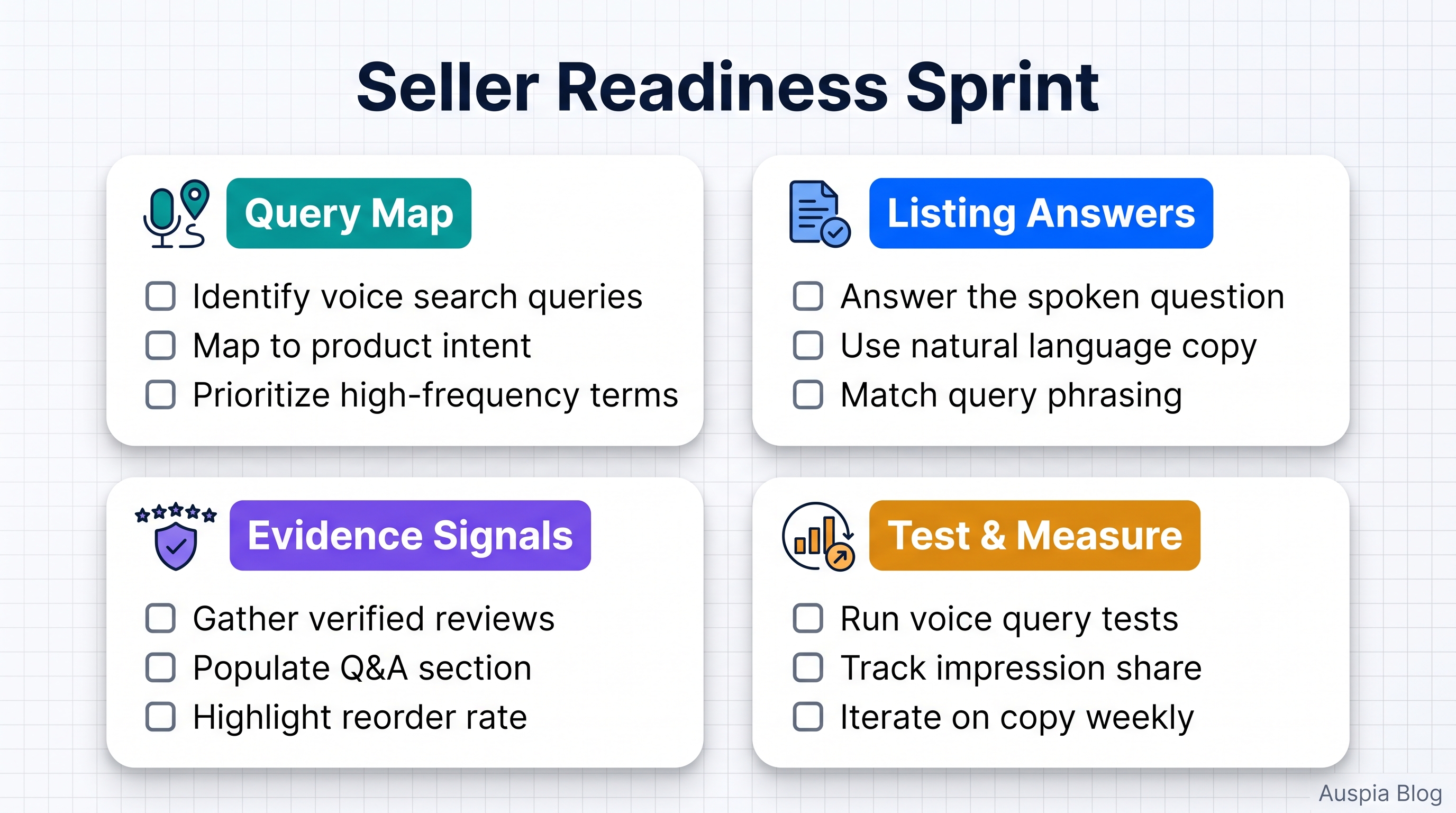
Use this sprint for one product family before scaling it across your catalog.
Days 1-5: Build The Query Map
Collect query language from Amazon search suggestions, DataForSEO terms, product reviews, Q&A, support tickets, competitor listings, and ads data. Separate typed keywords from spoken questions. Label each query as discovery, comparison, objection, shopping-list, or reorder intent.
Days 6-12: Rewrite The Listing For Answers
Improve the title only where clarity is missing. Use bullets to answer use cases, constraints, and compatibility. Use images and A+ Content for comparisons that would be too dense in bullets. Keep backend terms for relevant synonyms, not random variants.
Days 13-20: Strengthen Evidence Signals
Mine reviews for recurring proof and objections. Update Q&A with direct, factual answers. If shoppers repeatedly ask about size, fit, scent, ingredients, compatibility, or warranty, the listing is under-answering the query.
Days 21-30: Test And Measure
Use Amazon's experimentation tools where available to test titles, images, bullets, descriptions, or A+ Content. Watch conversion rate, click-through rate, ad search term performance, review themes, return reasons, and branded vs non-branded query growth.
For a broader AI visibility review beyond Amazon, sellers can also use Auspia's AI Search Visibility Checker to inspect how product-category language appears across AI answer surfaces.
Common Mistakes To Avoid
Mistake 1: Treating Alexa GEO as a magic keyword field. Voice discovery depends on product understanding, evidence, and buyer context, not just a hidden list of terms.
Mistake 2: Writing titles for algorithms only. Overloaded titles may match more terms but reduce human trust. A voice assistant also needs the product to be easy to name and distinguish.
Mistake 3: Ignoring Q&A and review language. These are often the closest public source to real buyer questions. If your Q&A is thin, your listing may not answer the questions shoppers actually ask.
Mistake 4: Assuming every product has the same voice opportunity. Replenishable goods, household staples, grocery items, pet supplies, personal care, and compatible accessories usually have clearer voice-shopping paths than complex one-time purchases.
Mistake 5: Measuring only rankings. For voice and AI shopping, sellers should also monitor conversion rate, repeat purchase, return reasons, review specificity, and ad query patterns.
FAQ
Is Amazon Alexa GEO the same as Amazon SEO?
No. Amazon SEO focuses on marketplace search visibility and listing relevance. Amazon Alexa GEO uses those same foundations but adds spoken queries, assistant-style answers, shopping-list behavior, and reorder paths.
Can sellers guarantee Alexa will recommend their product?
No. Sellers should not treat Alexa GEO as a guarantee of assistant recommendation. The controllable work is to improve listing clarity, evidence, relevance, review quality, and repeat-purchase readiness.
Which products are best suited for Alexa GEO?
Products with repeat demand usually have the clearest opportunity: household consumables, grocery, pet supplies, health and personal care, office supplies, batteries, filters, compatible parts, and other replenishable items.
Should I add voice-search questions directly into my Amazon title?
Usually not. Titles should stay clear, readable, and compliant. Put natural-language answers in bullets, images, descriptions, A+ Content, Q&A, and comparison tables instead.
How should I use the 100 questions in this article?
Use them as a mapping exercise. Choose 15-30 that fit your category, group them by intent, then decide which listing asset should answer each question.
Auspia Takeaway
Amazon Alexa GEO is a practical extension of Amazon SEO, not a separate trick. The seller who wins is usually the seller whose product is easier to understand, easier to trust, easier to compare, and easier to reorder.
Start with one product family. Map the questions. Rewrite for clarity. Strengthen evidence. Test changes. Then scale the pattern across the catalog.
Author: Ryan Chen, Senior Amazon Operations Expert with 10 Years in Marketplace Growth at Auspia. Ryan writes about Amazon GEO, marketplace search behavior, AI-assisted product discovery, and operational playbooks for Amazon sellers.