The seller memo for 2026
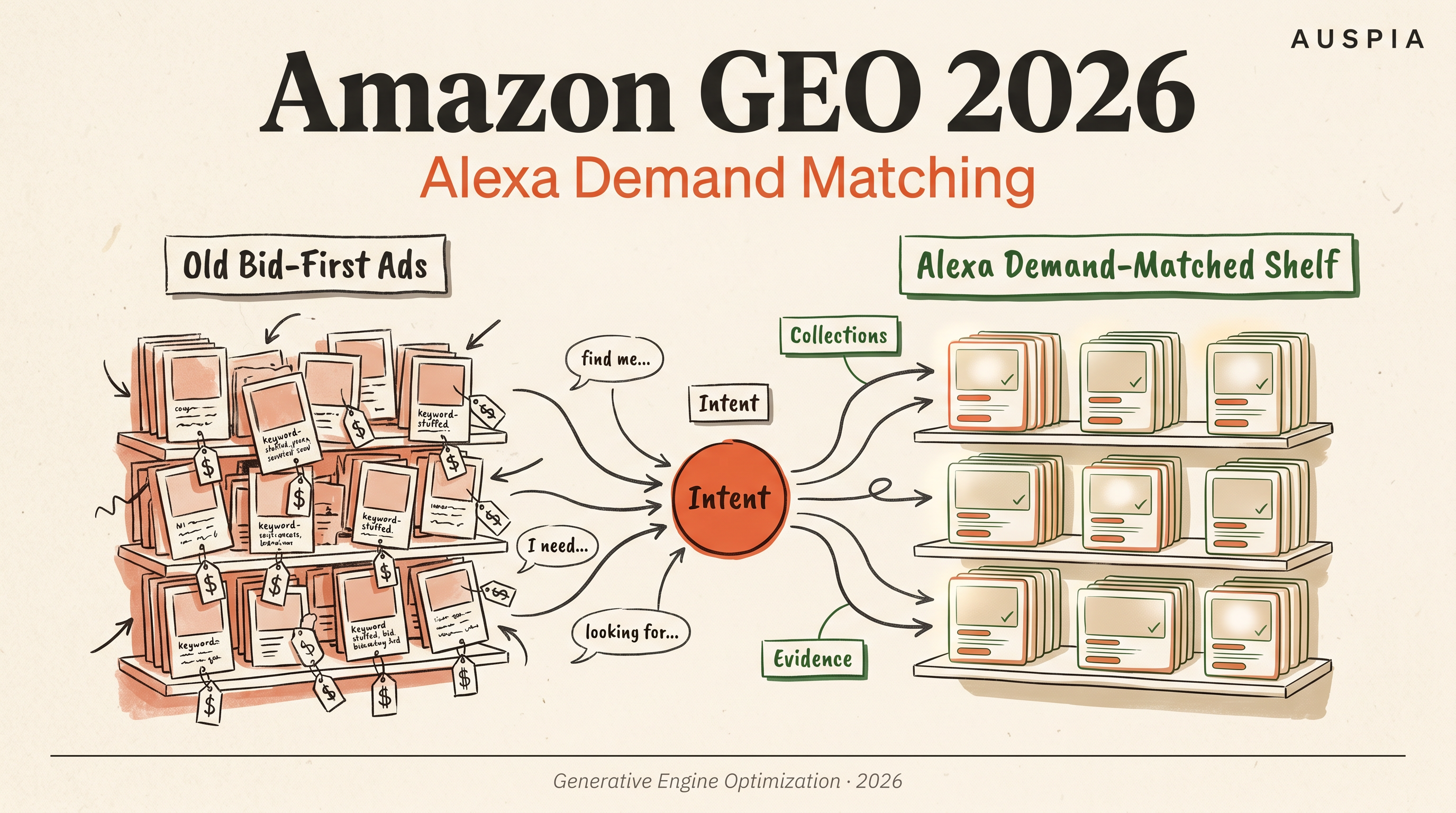
Amazon GEO in 2026 is no longer only about ranking one ASIN for one keyword. Amazon Ads is pushing two related ideas into the marketplace: Alexa for Shopping can turn a natural-language need into a product conversation, and Sponsored Brands collections can use AI to select a relevant set of products from a catalog.
That changes the seller job. Bids still matter, but the weaker part of many campaigns is now the evidence layer around the product: whether the listing, reviews, catalog structure, and product family explain why this item fits a specific use case.
The short version: stop treating Sponsored Brands as a prettier search ad. Treat it as a demand-matching surface.
What Amazon changed
Two official Amazon Ads updates matter here.
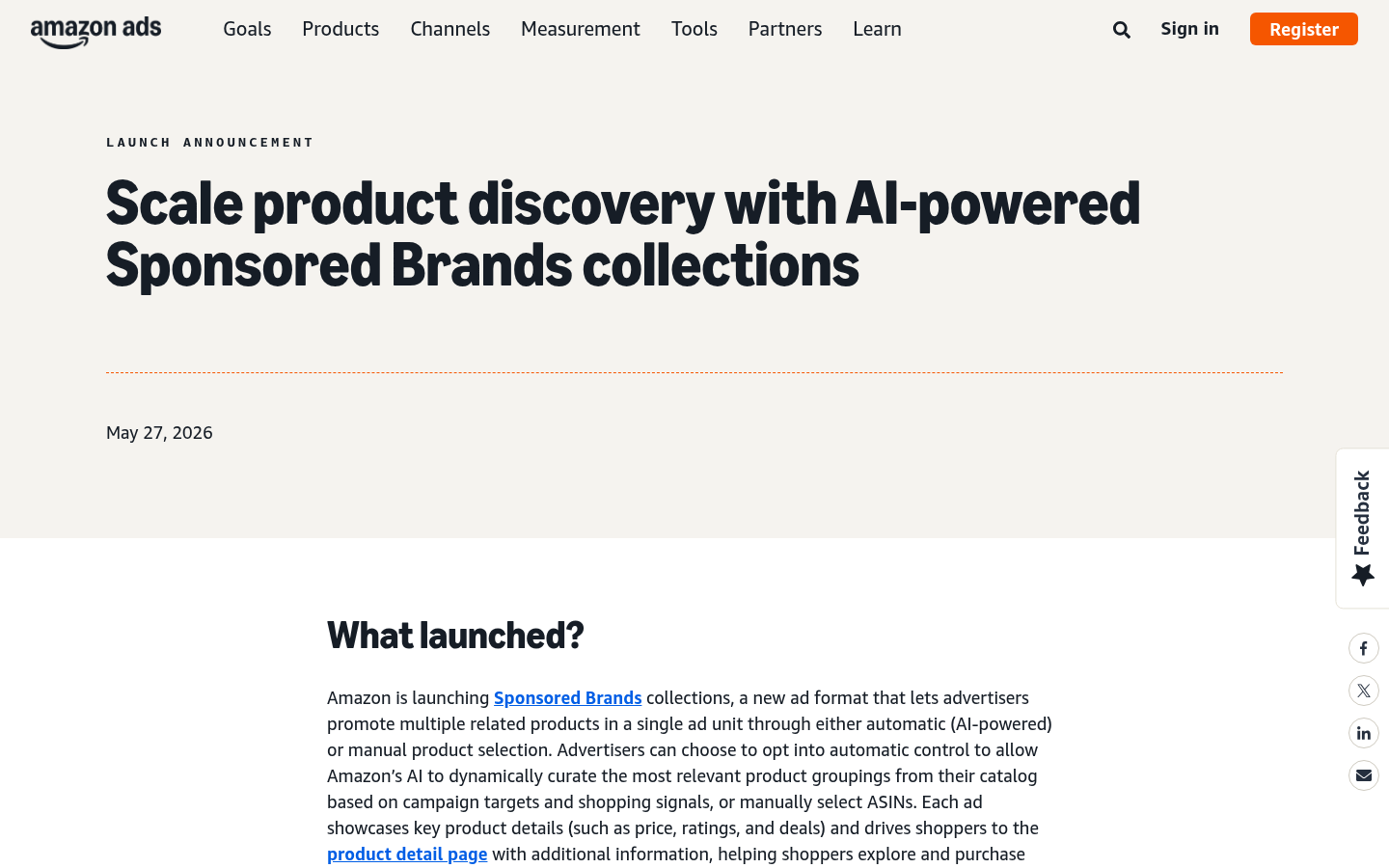
On May 27, 2026, Amazon announced AI-powered Sponsored Brands collections. The format lets advertisers promote multiple related products in one ad unit, with either automatic AI-powered product selection or manual product selection. Amazon says the AI can surface relevant products based on search intent, product context, and browsing behavior. Automatic control can curate products from the advertiser's catalog, while advertisers can still exclude specific ASINs and monitor campaign metrics.
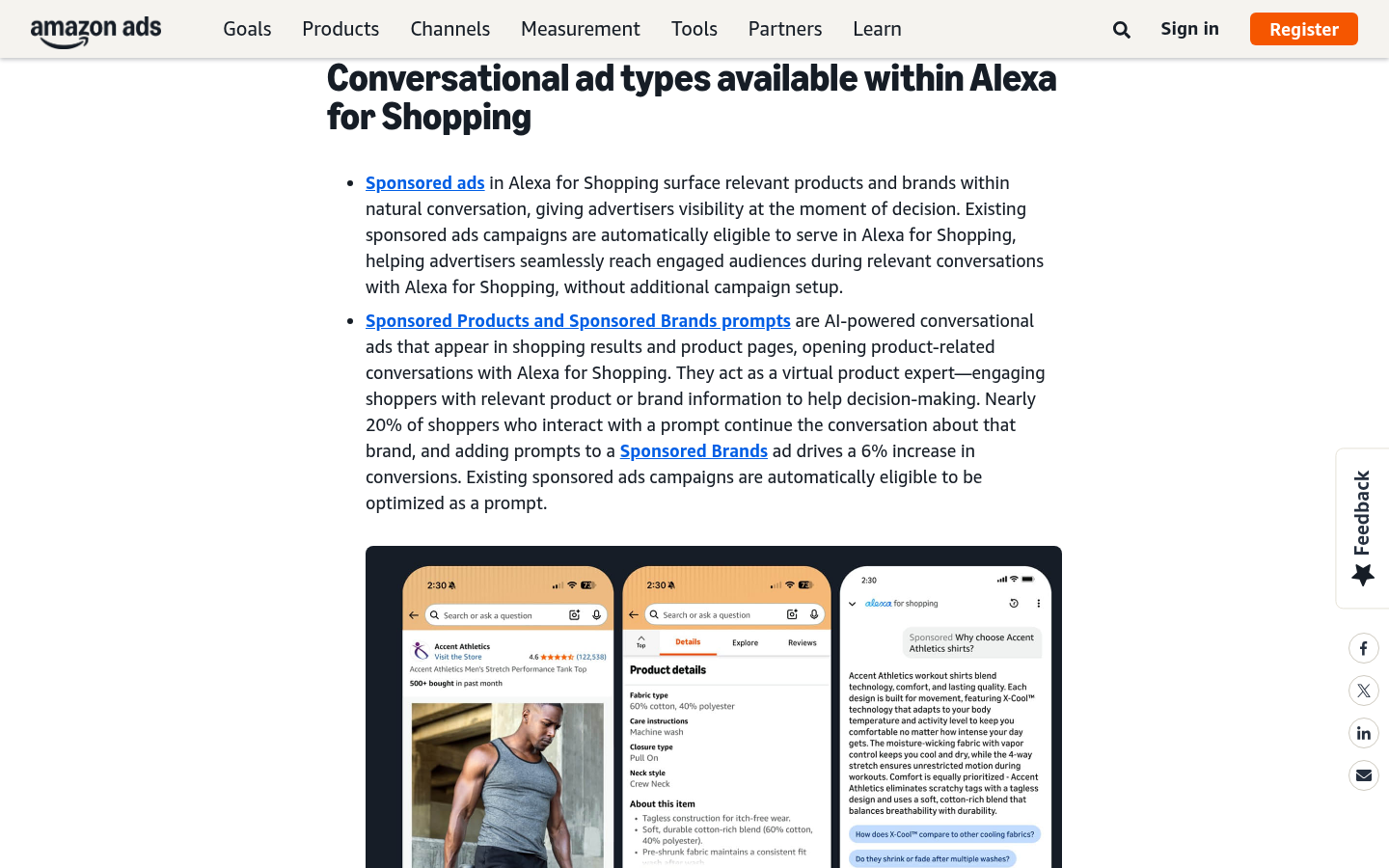
On June 11, 2026, Amazon Ads described agentic shopping experiences around Alexa for Shopping and Alexa+. The article says Rufus was used by over 300 million customers in 2025, and that Amazon brought Rufus together with Alexa+ for a shopping assistant experience. It also states that Sponsored Products and Sponsored Brands prompts can appear in Alexa for Shopping, including in shopping results and product detail pages, where shoppers can open product-related conversations.
These are not small UI tweaks. The more useful read is that Amazon wants advertisers to think less about a fixed ad slot and more about how a product is selected inside a live shopping context.
Why this is a GEO problem, not only an ads problem
Classic Amazon advertising asks: "Which keyword should we bid on, and how much?"
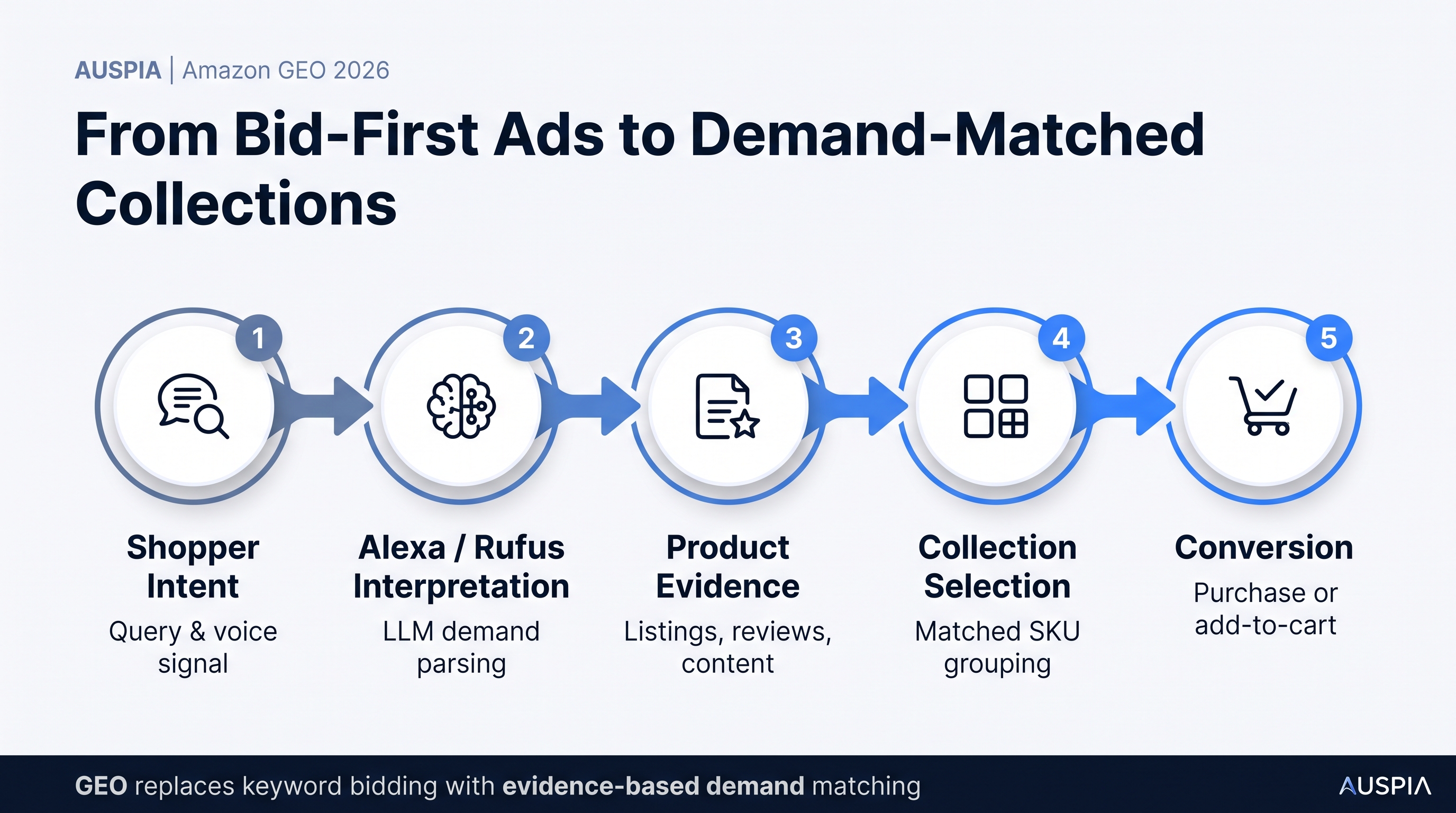
Amazon GEO asks a different question: "When an AI shopping layer interprets a customer's need, does our product have enough structured evidence to be selected, grouped, and explained?"
That evidence can come from familiar places:
Evidence area | What Alexa/Rufus-like shopping systems need | Seller action |
|---|---|---|
Listing title | Category, core attribute, use case, compatibility | Remove vague modifiers and put the decision facts up front |
Bullet points | Fit, constraints, buyer scenario, proof | Write bullets that answer natural shopping questions |
A+ content | Comparison, use cases, product family logic | Show how products relate instead of repeating the title |
Reviews | Real buyer language, objections, repeated use cases | Mine reviews for phrases customers actually use |
Catalog structure | Related SKUs, bundles, variants, accessories | Keep product families clean enough for AI selection |
Sponsored Brands setup | Automatic or manual collection logic | Match ad mode to catalog quality and campaign intent |
The operating method has to change. A seller who only raises bids may still lose the moment when Alexa asks, "Which related products actually solve this request?"
The old playbook breaks in four places
The old Sponsored Brands routine was simple enough: choose keywords, pick a few products, write a headline, manage bids, then prune waste. That still works for some campaigns, but it is thin for 2026.
First, keyword coverage no longer captures the whole query. A shopper might ask for "a quiet humidifier for a nursery that is easy to clean," not just "humidifier." The listing has to carry the words "quiet," "nursery," and "easy to clean" only if they are true and supported.
Second, a single hero SKU is not always the best answer. A product collection can work like a small shelf: main product, premium alternative, refill, accessory, or starter kit. If the catalog is messy, automatic selection can expose that mess.
Third, ad efficiency depends on product relationships. Sponsored Brands collections are strongest when the products make sense together. A random group of unrelated ASINs may get impressions but teach the system very little about demand.
Fourth, measurement needs to include discovery quality, not only ACOS. If AI-powered collections are showing the wrong products, the fix may be listing clarity or catalog cleanup rather than another bid adjustment.
A practical operating model for Sponsored Brands collections
Use this workflow before scaling budgets. It is slower than turning on every automatic option at once, but it gives the system a cleaner catalog to work with.
1. Build an intent map before touching bids
Pick 20 to 50 shopping prompts that sound like real customers. Do not stop at short keywords.
Examples:
- "best travel stroller for a small car trunk"
- "desk lamp for eye strain and video calls"
- "coffee grinder for espresso beginners"
- "waterproof dog bed for large dogs that chew"
For each prompt, map the required product facts: size, compatibility, material, use case, pain point, proof, and likely accessory. This becomes the checklist for the listing and collection.
2. Clean the product family
Automatic Sponsored Brands collections can be useful when a catalog is coherent. They are risky when the catalog is a pile of unrelated SKUs.
Group products by buyer mission, not by internal inventory logic:
Buyer mission | Strong collection | Weak collection |
|---|---|---|
"Start making espresso at home" | grinder, tamper, scale, cleaning tablets | grinder, unrelated mug, random kettle |
"Set up a nursery sleep corner" | humidifier, night light, thermometer | humidifier, adult desk fan, pet bowl |
"Pack for a weekend hike" | backpack, rain cover, hydration bladder | backpack, office tote, laptop sleeve |
Manual collections are better when you know the bundle logic. Automatic collections are better when the catalog already has clean relationships and enough SKUs for Amazon's AI to choose from.
3. Rewrite listings for demand matching
A demand-matched listing is not stuffed with every possible phrase. It is specific in the places an assistant is likely to inspect.
Weak bullet:
High quality portable blender for daily use, great for many situations.
Stronger bullet:
16 oz portable blender for smoothies, protein shakes, and travel. Fits most car cup holders, charges by USB-C, and includes a leak-resistant lid.
The second version gives a shopping assistant more to work with. It has product type, serving size, use cases, compatibility, power detail, and risk reducer.
If you want to run a quick page-level check, Auspia's AI Search Visibility Checker can help teams think through whether a page gives AI systems clear enough facts to summarize and compare.
4. Choose automatic or manual collections by catalog maturity
Do not pick automatic mode because it sounds modern. Pick it when the catalog is ready.
Situation | Better mode | Why |
|---|---|---|
Large catalog with tight category focus | Automatic | AI has enough related products to choose from |
Small catalog with 3 to 10 clear complementary SKUs | Manual | You can control the shelf logic |
New product launch attached to a known bestseller | Manual first | Use the bestseller to frame the new SKU |
Messy multi-category store | Manual or cleanup first | Automatic selection may mix weakly related products |
Seasonal campaign | Manual | The theme matters more than raw catalog breadth |
5. Measure the match, not just the spend
ACOS, conversion rate, and click-through rate still matter. But add a match-quality review every week:
- Which products appeared together?
- Did the collection match the query or prompt theme?
- Which ASINs received impressions but weak clicks?
- Are shoppers clicking accessories but not the main product?
- Do reviews mention use cases missing from the listing?
This review catches problems that bid reports often hide.
The 2026 Amazon Alexa GEO readiness check
Before scaling Sponsored Brands collections, score each product family against five checks.
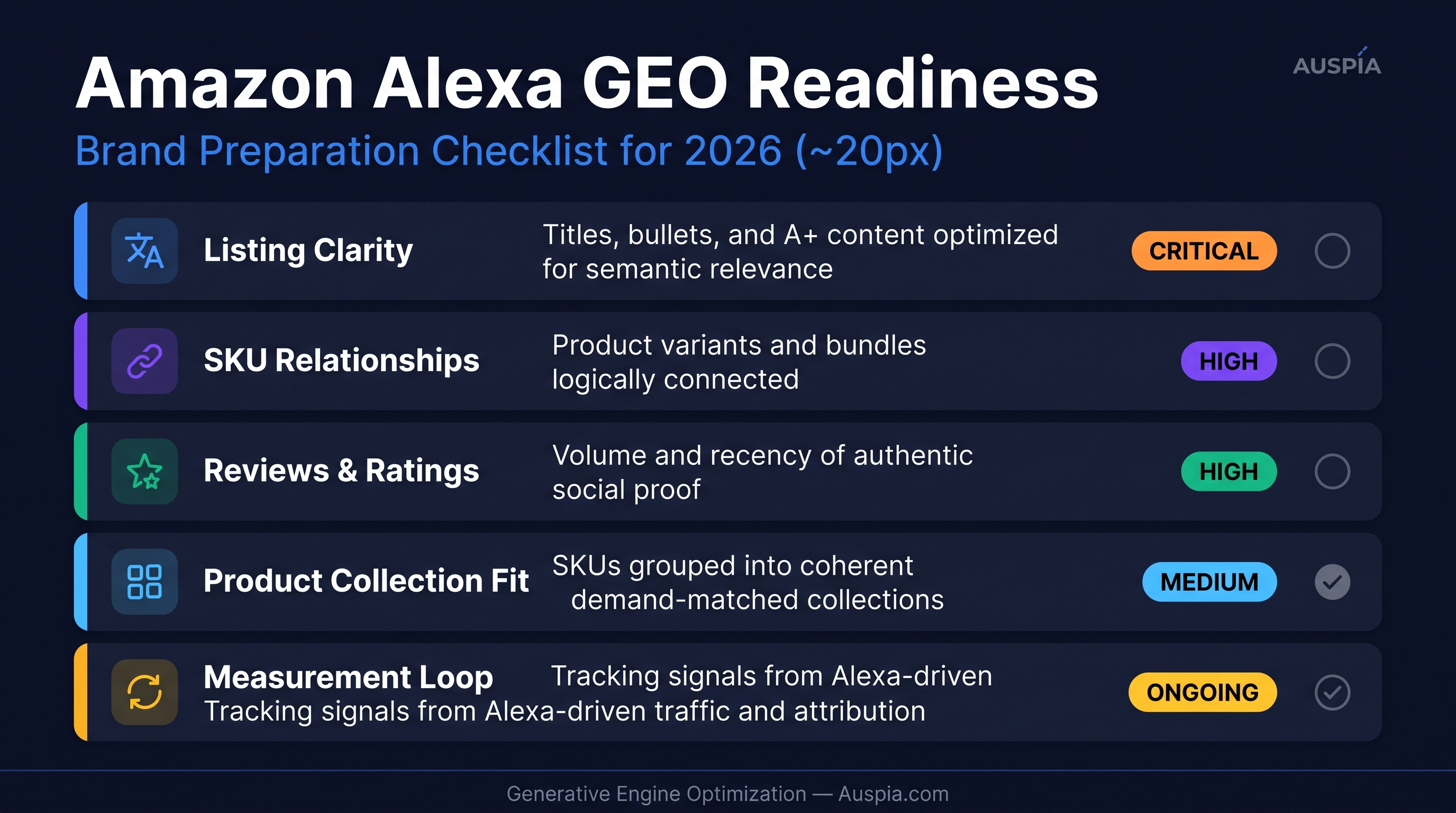
Check | Pass condition | Fix if weak |
|---|---|---|
Listing clarity | A shopper can understand the product, use case, and constraints in 10 seconds | Rewrite title and first two bullets around decision facts |
SKU relationships | Products in the same collection solve one buyer mission | Split mixed catalogs into tighter campaign groups |
Review evidence | Reviews repeat the same use cases and objections | Add true review language to bullets, A+ modules, and FAQ |
Collection fit | Every product in the set has a reason to sit beside the others | Remove filler SKUs and add accessories or variants with real fit |
Measurement loop | Weekly review separates bid issues from evidence issues | Track match quality, not only ACOS |
A seller does not need a perfect score. But if listing clarity and SKU relationships are both weak, automatic collections are likely to amplify the problem.
What to do this week
Start with one product family, not the whole store.
- Pick a category with enough sales history to learn from.
- Write 20 natural-language shopping prompts for that category.
- Audit the top 5 SKUs against those prompts.
- Rewrite titles, bullets, and A+ modules where the product evidence is unclear.
- Build one manual Sponsored Brands collection around a real buyer mission.
- Test automatic collections only after the catalog group is coherent.
- Review the search terms, collection behavior, CTR, conversion rate, and ACOS after the campaign has enough data.
The boring work is the advantage. Clean catalog relationships, specific listing facts, and realistic prompts give Amazon's AI more reasons to match the product to the shopper.
Common mistakes
Do not treat AI-powered collections as a shortcut around weak listings. If the listing does not explain the use case, the collection has less to work with.
Do not mix unrelated SKUs just to fill the unit. More products can mean more confusion.
Do not copy customer language into claims you cannot support. Review mining is useful, but only when the listing stays accurate.
Do not measure only campaign averages. A collection can look acceptable at the campaign level while one ASIN is dragging down relevance.
Do not assume Alexa traffic behaves like traditional search traffic. Conversational shopping starts with context, not only a keyword.
FAQ
What is Amazon GEO?
Amazon GEO is the practice of making Amazon listings, product families, and brand evidence easier for AI shopping systems such as Alexa for Shopping and Rufus to interpret, compare, and recommend.
Are Sponsored Brands collections replacing keyword ads?
No. Keyword targeting and bids still matter. The change is that Amazon is adding more AI-assisted product selection and conversational shopping surfaces, so listing evidence and catalog relationships matter more than before.
Should sellers use automatic Sponsored Brands collections?
Use automatic collections when the catalog is coherent and products are clearly related. Use manual collections when you need tighter control, especially for launches, bundles, seasonal themes, or small catalogs.
What should sellers optimize first for Alexa-driven demand matching?
Start with listing clarity and SKU relationships. If a product's use case, constraints, compatibility, and proof are unclear, raising bids will not fix the core matching problem.
How often should teams review Amazon GEO performance?
Weekly is a reasonable cadence for active campaigns. Review search terms, product combinations, click quality, conversions, ACOS, and whether the visible collection matched the shopper's likely intent.
Author: Ryan Chen, Senior Amazon Operations Expert with 10 Years in Marketplace Growth at Auspia. Ryan writes about Amazon GEO, marketplace search behavior, AI-assisted product discovery, and practical operating playbooks for sellers.