The short version
Answer engine optimization (AEO) is the work of making your brand, pages, data, and third-party footprint easy for AI answer systems to understand, trust, and reuse. Traditional SEO still matters because answer engines need crawlable pages and credible sources. The difference is the output: you are no longer optimizing only for a blue-link ranking. You are also optimizing for a sentence, citation, comparison, recommendation, or spoken answer.
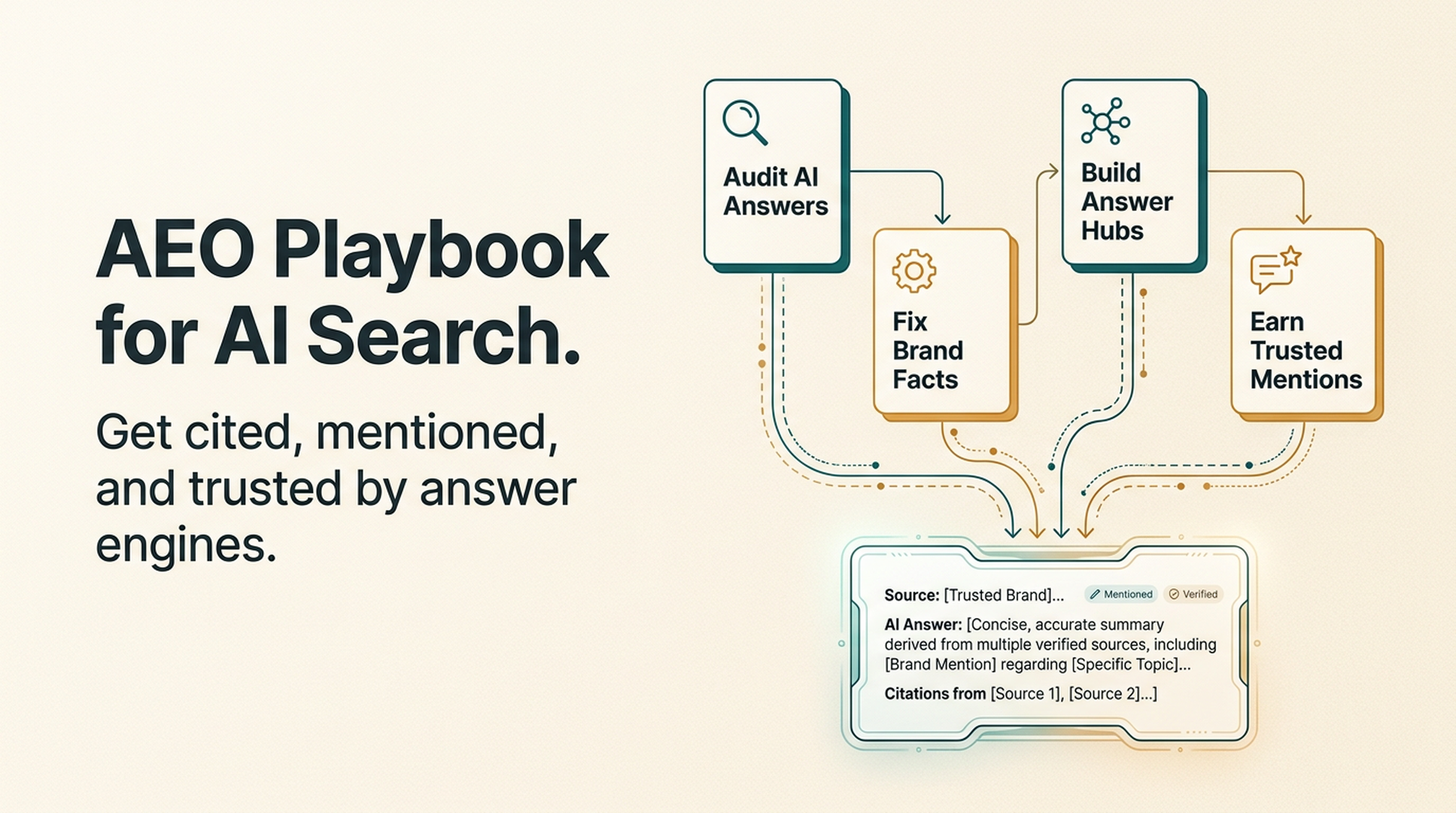
For growth teams, the practical move is simple: keep your SEO foundation, then add an answer layer. Audit what AI systems already say about your brand, fix wrong or thin information, create answer-ready pages for high-intent questions, strengthen off-site entity signals, and measure AI mentions alongside rankings and traffic.
If you only do one thing this month, do this: search your most important customer questions in Google AI Overviews, ChatGPT, Perplexity, Gemini, and Copilot. Record which sources they cite, which competitors they mention, and where your brand is absent or misrepresented. That list becomes your AEO roadmap.
What answer engine optimization means
Answer engine optimization is the practice of shaping your content and brand evidence so AI-driven systems can use it in direct answers. These systems include Google AI Overviews, Perplexity, ChatGPT browsing experiences, Gemini, Copilot, voice assistants, and the answer boxes inside many vertical search products.
AEO does not mean writing for robots and ignoring readers. It means writing in a way that a person can scan and a machine can parse without guessing.
A good AEO asset usually has five traits:
- The page answers a specific question near the top.
- The entity behind the answer is clear: company, product, author, date, method, location, or dataset.
- The content uses clean structure: headings, short definitions, tables, FAQs, and stable URLs.
- The claim is supported by proof, such as examples, screenshots, benchmarks, reviews, case studies, documentation, or third-party citations.
- The same facts appear consistently across your website, profiles, directories, review pages, and partner mentions.
That last point is where many teams stumble. AI answer systems do not only read your website. They also compare your site with the rest of the web. If your pricing page says one thing, your G2 profile says another, and five outdated listicles describe a product you no longer sell, the model may blend those signals into a messy answer.
AEO versus SEO
AEO and SEO share the same foundation, but they optimize for different moments in the search journey.
Area | SEO | AEO |
|---|---|---|
Main goal | Rank pages in organic search results | Become part of an AI-generated answer |
Primary user action | Click a result, then evaluate the page | Read, ask a follow-up, compare, or click a cited source |
Content shape | Comprehensive page built around search intent | Extractable answer blocks supported by deeper evidence |
Query pattern | Keywords, modifiers, local and commercial searches | Natural-language questions, comparisons, workflows, recommendations |
Technical focus | Crawlability, indexation, metadata, internal links, performance | Crawlability plus structured facts, schema, clean HTML, answer-ready sections |
Measurement | Rankings, impressions, clicks, conversions | Mentions, citations, answer accuracy, share of AI voice, downstream assisted demand |
SEO asks, "Can the page rank?" AEO adds, "Can the answer engine safely reuse this page without distorting it?"
That is why AEO works best when it is layered on top of solid SEO, not treated as a replacement. If your pages are blocked, slow, duplicated, thin, or unclear, AI visibility will be fragile too.
Why AEO matters now
Search behavior is becoming less linear. A buyer might discover a vendor through a Perplexity comparison, validate it with a Google AI Overview, ask ChatGPT for alternatives, then visit the site only after the shortlist is mostly formed.
This changes the value of visibility. A brand can lose influence before the user ever reaches a website.
Three shifts make AEO worth treating as its own operating layer.
First, zero-click discovery is normal now. AI answers often resolve simple informational queries without a visit. That does not make the mention worthless. If your product is named in a credible answer, the user has still been exposed to your brand at the exact moment they are forming a preference.
Second, brand accuracy has become a conversion issue. If an AI answer describes your product incorrectly, recommends an outdated alternative, or misses a core use case, the damage can show up later as lower demo quality, confused sales calls, or fewer branded searches.
Third, AI systems reward consistency. A clear answer on your own site helps. The same answer repeated in documentation, review platforms, partner pages, YouTube descriptions, comparison articles, and community discussions helps more.
For Auspia, this is the useful mental model: AEO is not "prompting the internet." It is building an evidence trail that answer engines can follow.
Step 1: audit what AI already says about your brand
Start with the answers that already exist. Do not begin by publishing ten new posts.
Create a small tracking sheet with these columns:
Prompt or query | Platform | Answer summary | Is your brand mentioned? | Cited sources | Accuracy issue | Next action |
|---|---|---|---|---|---|---|
"best tools for checking AI search visibility" | Perplexity | Lists several monitoring tools | No | Competitor blogs, review pages | Missing category fit | Create comparison page and seek relevant third-party mentions |
"what does [brand] do" | Google AI Overview | Gives old positioning | Yes | Old directory profile | Outdated tagline | Update website, directory, and partner descriptions |
"[competitor] alternatives" | ChatGPT browsing | Names three alternatives | No | SaaS listicles | Brand absent | Build alternative page and pitch refreshed listicles |
Run at least four query groups:
- Branded queries: "what is [brand]," "[brand] pricing," "[brand] reviews," "[brand] alternatives."
- Category queries: "best [category] tools," "how to solve [problem]," "[category] software for [audience]."
- Competitor queries: "[competitor] alternatives," "[competitor] vs [brand]," "tools like [competitor]."
- Decision queries: "how to choose [category]," "what features matter in [category]," "is [category] worth it."
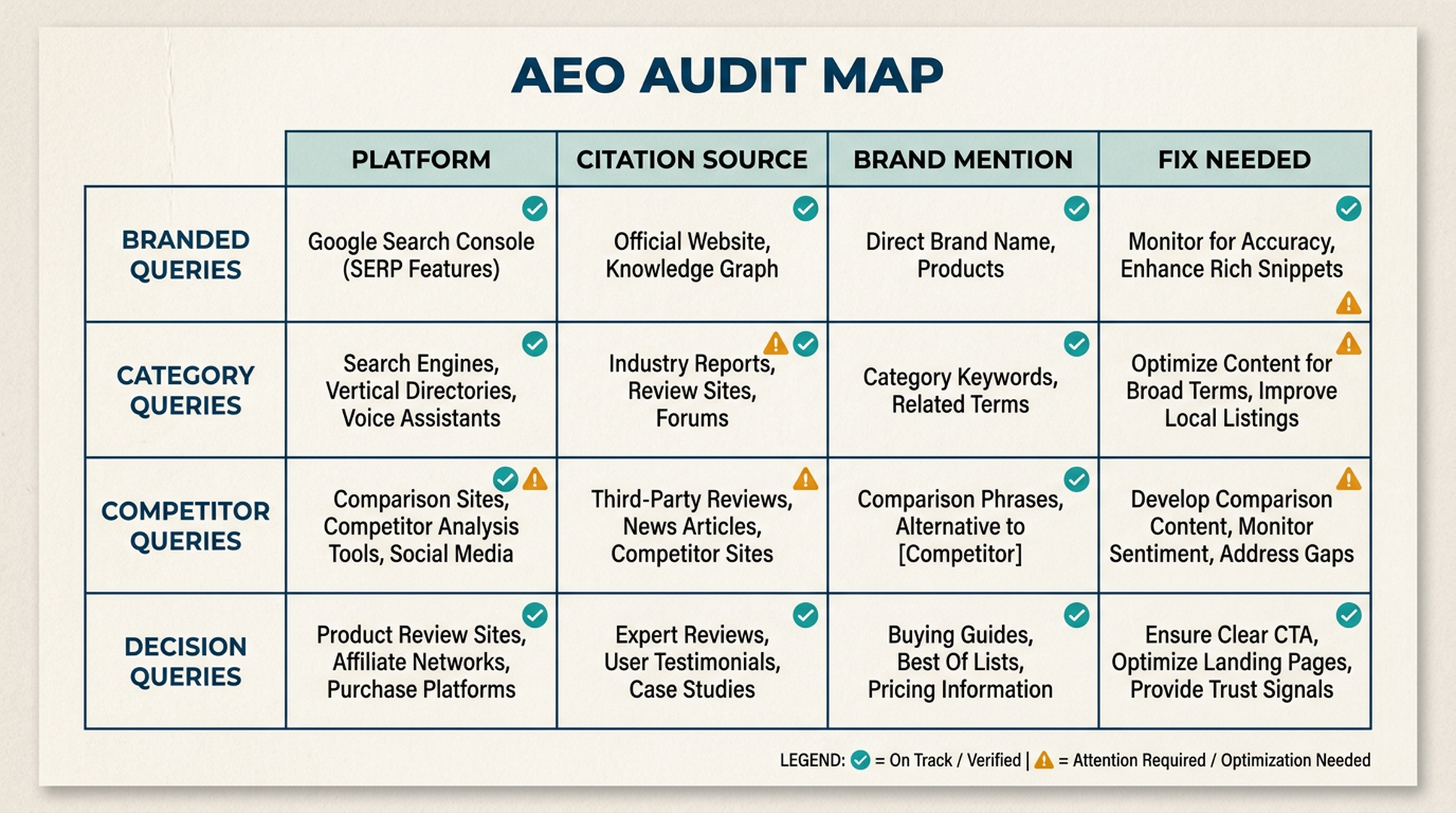
An AEO audit starts by mapping prompts to platforms, citations, brand mentions, and the fix each answer needs.
The goal is not to prove that one platform is right or wrong. The goal is to find patterns. Which sources appear again and again? Which competitor is treated as the default? Which facts about your company are missing? Which pages are cited even though they are outdated?
Auspia's AI Search Visibility Checker can help teams turn this audit into a repeatable workflow instead of a one-off spreadsheet.
Step 2: fix misinformation before chasing new visibility
Wrong answers are usually easier to fix than missing answers, and they often matter more.
Most brand misinformation comes from one of four places:
- Your own site does not answer the question directly.
- Your entity facts are inconsistent across the web.
- Old third-party pages are still being cited.
- Your pages are technically hard to crawl or extract.
Start with facts that affect trust and conversion: product category, audience, pricing model, core use cases, locations served, integrations, security posture, and company name variations.
Then add direct answer blocks to the pages that already rank or get cited. If AI systems misanswer "What does Acme Analytics do?" do not bury the correction in a brand story. Add a short section like this:
Acme Analytics is a product analytics platform for B2B SaaS teams. It helps product and growth teams track activation, retention, funnel drop-off, and account-level usage without building a custom data warehouse.
That paragraph is boring in a good way. It has a clear subject, a clear category, a clear audience, and specific use cases.
After updating your own site, update the places answer engines may use as corroboration: Google Business Profile, LinkedIn, G2, Capterra, GitHub, YouTube, Crunchbase, app marketplaces, partner pages, help docs, and high-ranking comparison pages.
Step 3: map the questions where competitors appear and you do not
Once the brand facts are clean, look for answer gaps.
A useful AEO gap is not just "a keyword we do not rank for." It is a question where an AI answer already exists, the answer influences buying behavior, and your brand has a credible reason to be included.
Group gaps into three buckets:
Gap type | Example | Best content response |
|---|---|---|
Definition gap | "What is agent readiness for websites?" | Clear glossary page with examples, schema, and internal links |
Comparison gap | "Auspia vs traditional SEO audit tools" | Honest comparison page with use cases, limits, and proof |
Workflow gap | "How do I make my site citable by AI answers?" | Step-by-step playbook with checklist, screenshots, and downloadable template |
Do not chase every prompt. Some AI answers are too broad, too low-intent, or dominated by sources you cannot realistically displace. Prioritize gaps where you can add information gain: original data, clearer explanations, better examples, stronger documentation, or a more useful workflow.
This is where many AEO programs become content spam. They see hundreds of AI prompts and produce hundreds of shallow pages. A better approach is to build a smaller set of answer hubs, then support them with precise sections, FAQs, tools, examples, and third-party evidence.
Step 4: write answer-ready content without making it robotic
Answer-ready writing is direct, but it should not read like a glossary dump.
Use this pattern for important sections:
- Put the question in the heading.
- Answer it in one or two plain sentences.
- Add context, examples, edge cases, or proof.
- Use a table or list only when it makes the answer easier to extract.
- Link to deeper supporting pages when the reader may need more detail.
For example:
How long does AEO take?
AEO can produce small corrections in a few weeks when the issue is a wrong or missing brand fact. Broader visibility usually takes months because answer engines need to find consistent evidence across your site and third-party sources.
A mature website with strong SEO, useful documentation, and existing brand mentions can often improve faster. A new brand may need a longer runway because it has to build crawlable content, authority, reviews, mentions, and category associations from scratch.
That answer is compact enough for an AI system to reuse, but it still gives a human reader the nuance they need.
A few rules help:
- Use declarative sentences when stating facts.
- Avoid vague claims like "industry-leading" unless you can prove them.
- Put definitions, ranges, and criteria near the beginning of a section.
- Use examples from global products and platforms rather than region-specific references unless the article is local.
- Keep stories and opinion after the direct answer, not before it.
The best AEO writing feels calm. It does not beg to be quoted. It simply makes quoting easy.
Step 5: make the technical layer easy for answer engines
AEO still depends on technical basics. If a page is hidden behind heavy JavaScript, blocked by robots rules, or filled with ambiguous markup, the answer layer will be weaker.
Review these items first:
Technical item | What to check | Why it matters for AEO |
|---|---|---|
Crawl access | Robots.txt, noindex tags, canonical tags, blocked assets | Answer engines need stable access to the page |
HTML clarity | Server-rendered content, logical headings, readable tables | Extractors need to identify the main answer |
Schema | Article, FAQPage, HowTo, Product, LocalBusiness, Organization, Speakable where appropriate | Structured data helps machines identify entities and answer blocks |
Internal links | Hubs, supporting pages, breadcrumbs, related guides | Links clarify topical relationships |
Page performance | Fast load, limited layout shifts, clean mobile rendering | Poor performance can reduce crawling and user trust |
Source freshness | Updated dates, changelog notes, versioned docs | AI answers often mix old and new sources unless freshness is explicit |
You do not need exotic markup for every page. You do need pages that can be fetched, parsed, understood, and trusted.
Step 6: build off-site evidence, not random mentions
Off-site signals matter because answer engines compare sources. A brand that is described consistently across trusted places is easier to recommend than a brand that only talks about itself.
Good off-site AEO work includes:
- Review platforms that match your category and market.
- Partner pages that explain the real integration or customer use case.
- Comparison articles where your product belongs on merit.
- Community answers that solve real problems without astroturfing.
- Documentation, GitHub repositories, templates, or public datasets that other pages can cite.
- YouTube videos or webinars with clear titles, descriptions, transcripts, and timestamps.
The quality of the mention matters more than the quantity. A throwaway brand name in a weak listicle rarely changes an answer. A detailed mention in a frequently cited guide, category page, or practitioner workflow can.
Before outreach, inspect the sources AI systems already cite for your target queries. If the same five pages keep appearing, read them carefully. Find the natural place where your product, data, or expert view would improve the page. Then pitch that improvement, not just your homepage.
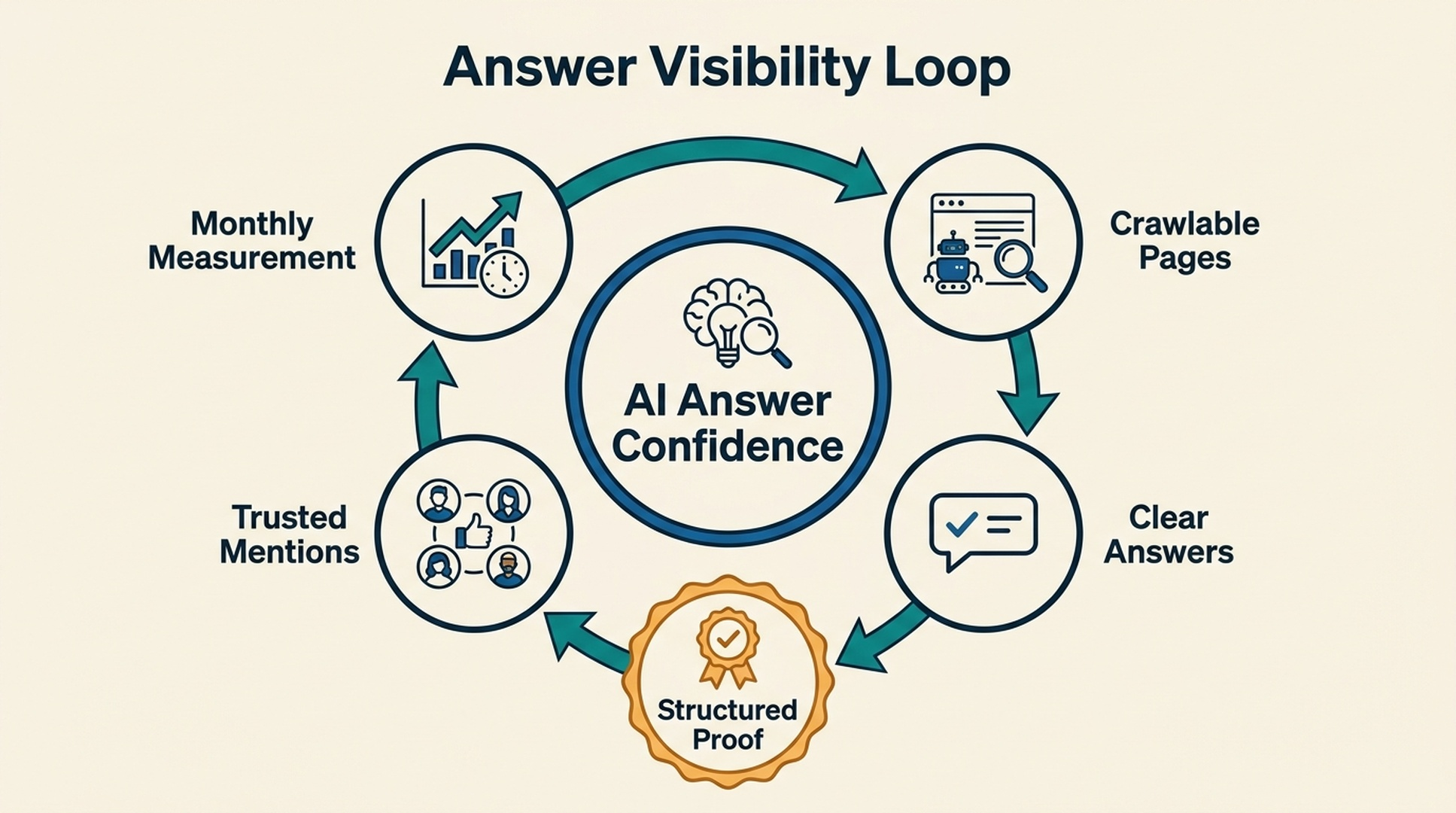
Answer visibility improves when technical access, answer clarity, proof, third-party trust, and measurement work as one loop.
Step 7: measure answer visibility as a living system
AEO measurement is still messy. Platforms change interfaces, personalization affects answers, and citations can appear or disappear without warning.
That does not mean you should ignore measurement. It means you should track directional signals with discipline.
Use a monthly scorecard:
Metric | What it tells you |
|---|---|
Brand mention rate | How often your brand appears across tracked prompts |
Citation rate | How often your pages are cited, linked, or named as sources |
Answer accuracy | Whether AI systems describe your brand correctly |
Competitor co-mentions | Which competitors appear beside you |
Source overlap | Which third-party pages influence multiple answers |
Assisted demand | Changes in branded search, direct traffic, demo notes, sales call language |
For small teams, 25 to 50 carefully chosen prompts are enough to start. Track the same set over time, then add new prompts when products, competitors, or search behavior changes.
AEO is not a one-time optimization sprint. It is closer to reputation management, technical SEO, content strategy, and digital PR working from the same source of truth.
A practical 30-day AEO starter plan
Here is a realistic first month for a team that already has a functioning website.
Week | Work | Output |
|---|---|---|
1 | Run AI answer audit across branded, category, competitor, and decision queries | Prompt tracker with citations, gaps, and errors |
2 | Fix core brand facts on website and key third-party profiles | Updated entity facts and direct answer blocks |
3 | Build or refresh two answer hubs for high-intent gaps | Definition, comparison, or workflow pages with schema |
4 | Start source outreach and measurement | List of cited sources to update, monthly AEO scorecard |
Do not overcomplicate the first month. The goal is to create a baseline, correct obvious problems, and publish a few pages that answer engines can reuse confidently.
Common mistakes
The most common AEO mistake is treating AI visibility as a trick. Teams look for a special schema tag, a hidden file, or a prompt-engineering shortcut. Those things may help at the margin, but they cannot replace clear facts and real authority.
Other mistakes show up often:
- Publishing FAQ spam instead of useful answer sections.
- Writing only for AI summaries and making the page painful for humans.
- Tracking AI answers once, then assuming the result is stable.
- Ignoring third-party pages that answer engines cite more than your own site.
- Using the same generic company description everywhere, even when each platform needs a more specific explanation.
- Measuring only clicks, while missing brand mentions that happen before the click.
The fix is to slow down. Build pages that deserve to be cited. Keep your entity facts consistent. Watch how answers change. Improve the evidence trail month by month.
FAQ
Is AEO replacing SEO?
No. AEO depends on many SEO basics: crawlable pages, clear structure, authority, internal links, fast performance, and useful content. The difference is that AEO also optimizes for AI-generated answers, citations, and brand mentions.
What pages should I optimize for AEO first?
Start with pages that already influence trust or revenue: homepage, product pages, pricing, comparison pages, help docs, glossary pages, case studies, and high-ranking informational guides. Then add new pages for AI answer gaps where competitors appear and you do not.
Does schema guarantee AI citations?
No. Schema helps machines understand a page, but it does not guarantee citation. Answer engines still weigh relevance, authority, freshness, source quality, and consistency across the web.
How often should we check AI answers?
For most teams, monthly tracking is enough at the start. Track important prompts more often during a launch, rebrand, pricing change, or reputation issue.
What is the best first AEO metric?
Answer accuracy is the best first metric. If AI systems cannot correctly explain what your brand does, broader visibility will not help much. After accuracy improves, track mentions, citations, competitor co-mentions, and assisted demand.
Auspia takeaway
AEO rewards teams that make their expertise easy to verify. That is less glamorous than chasing a hack, but it is more durable.
Build a crawlable site. Answer real questions clearly. Keep brand facts consistent. Earn mentions in the sources answer engines already trust. Then measure whether AI systems describe you more accurately over time.
That is the work. It is not magic, and it is not separate from SEO. It is the next layer of search visibility.