Google: Low-Quality AI Content → "Crawled - Currently Not Indexed"
If a few URLs appear as "Crawled - currently not indexed" in Search Console, do not leap straight to an AI-content verdict. Google has crawled those pages and has not put them in the index for now. There can be many reasons.
But Google Search Relations makes an important distinction in its discussion of the Page Indexing report: when that state appears as a large pattern across a site and there is no clear technical cause, the work is no longer to find a setting that forces indexing. The work is to take a hard look at the site's overall quality and ask whether the pages give people something they cannot get from a hundred similar pages.
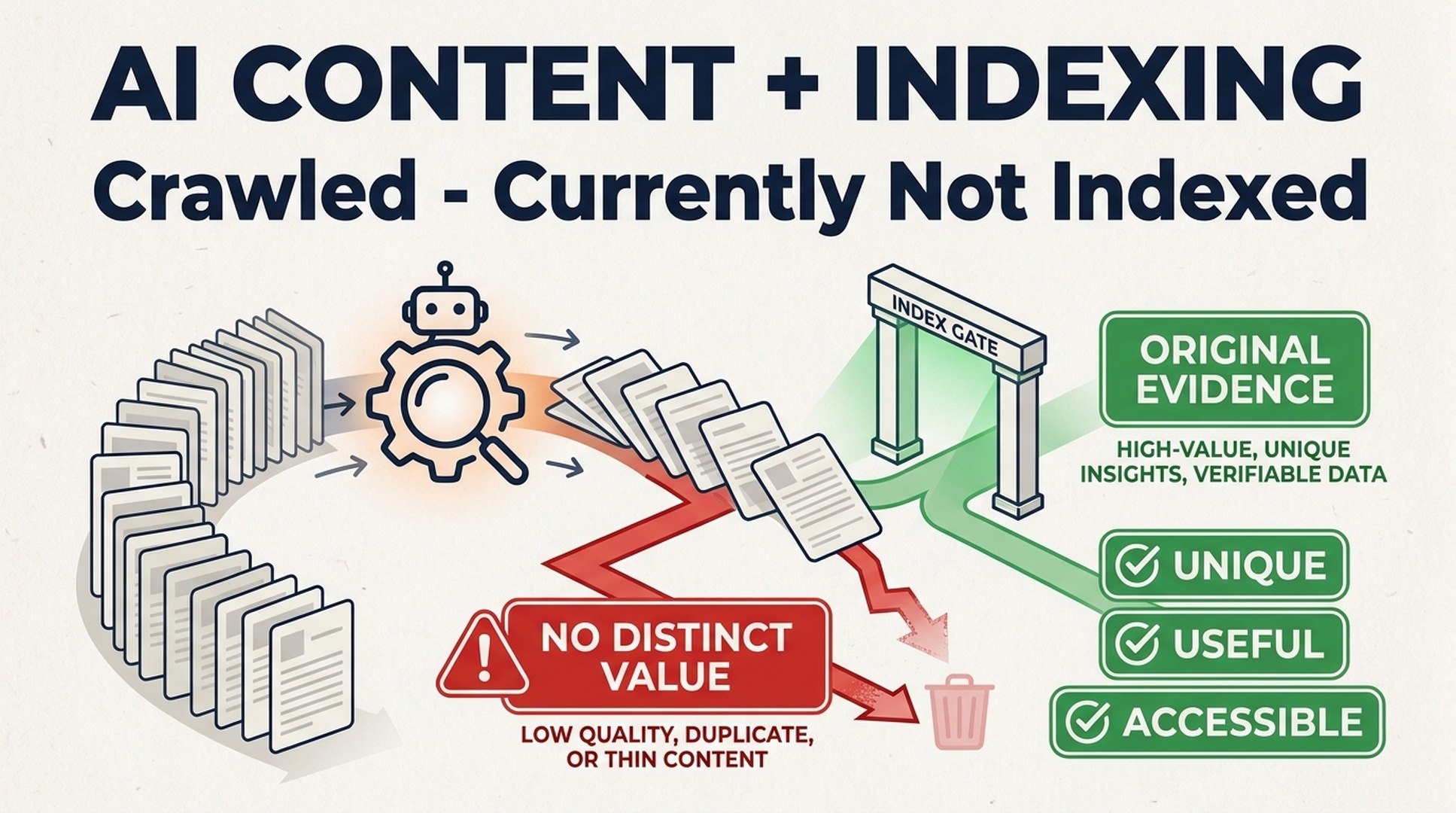
That is where low-quality AI content enters the picture. Google did not say that all AI-generated content is bad or that every AI-written page will be excluded. It said something more useful: a site made mostly of AI-generated pages can struggle when readers can tell the content is generated and find nothing unique or valuable in it.
This article focuses on that section of Google Search Relations' video "How to read the Indexing Report," featuring John Mueller and Martin Splitt. The relevant discussion runs from about 20:45 to 25:30.
The practical reading: "Crawled - currently not indexed" is not a technical defect label. At scale, and after technical checks pass, it can be evidence that Google has not found enough reason to index more pages from the site right now.
What Google actually said about AI content and indexing
At about 20:45, the conversation separates two states that are commonly treated as one problem:
Search Console status | What it says | What it does not say |
|---|---|---|
Discovered - currently not indexed | Google knows the URL exists but has not yet visited it | The page was rejected for quality |
Crawled - currently not indexed | Google visited the URL but has not indexed it at this point | There is a single technical switch that will force inclusion |
John Mueller then explains that if Google's systems have serious concerns about a website's overall quality, they may crawl and index less of it. In that situation, the report is effectively saying: Google knows these pages exist and has looked at them, but it will reconsider later if it sees enough reason to do so.
The video is careful about the implication. Google does not say that every page in this status is poor, or that a crawler status diagnoses a specific quality defect. It says that a broad, unexplained pattern is a reason to step back from URL-by-URL troubleshooting and assess the site as a whole.
The central question is not "How do I make this URL index?" It is "Why would this version of this page deserve a place in the index when similar information is already available?"
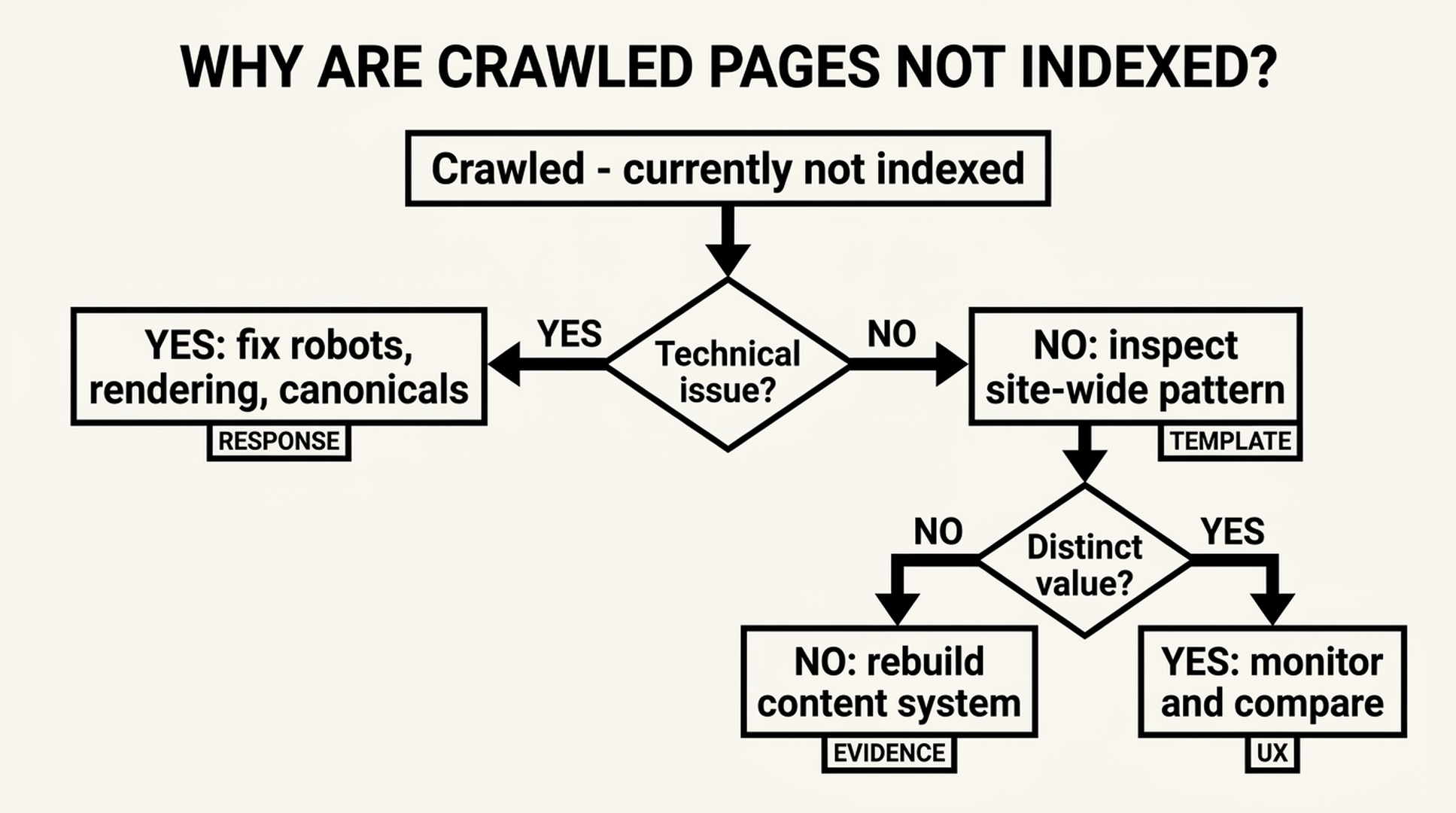
Start by ruling out technical blockers. If they do not explain a wide pattern, move from URL debugging to a site-level value review.
AI-generated does not mean low-quality. Interchangeable does.
At roughly 22:50, Google gives a useful example. An AI-generated site may work for a while, but readers can reach a point where they recognize the material as generated and find nothing unique or valuable in it. The video immediately qualifies that statement: it is not saying all AI-generated content is bad.
That distinction matters. A page can use AI for outlining, extraction, drafting, translation, editing, or formatting and still be the best result for a query. The problem begins when the final page is indistinguishable from a cheap rewrite of the same public source material, with no tested experience, original data, specific judgment, useful comparison, or task completion benefit.
Think of AI as a production method, not a quality category. Searchers do not care whether the first draft came from a model. They care whether the page answers their question better than the next result.
Page pattern | Why it may be weak | What makes it stronger |
|---|---|---|
A generic AI rewrite of an existing article | It repeats information readers can get elsewhere | Add original reporting, primary sources, or a clear synthesis that changes the reader's decision |
Hundreds of programmatic pages with swapped keywords | The page template does not solve a distinct query | Give each page specific data, eligibility, examples, and a reason it exists independently |
A product comparison built from marketing copy | It does not help a buyer choose | State evaluation criteria, show constraints, and explain who should not choose each option |
A how-to page that lists obvious steps | It lacks proof that the steps work in the real world | Include screenshots, edge cases, validation steps, and observed outcomes |
A page with decent text buried under friction | The page experience makes the answer hard to use | Put the answer first, reduce interruption, and make the main task easy to complete |
The test is blunt but productive: if another publisher used the same prompt and public sources, would their page be materially different? If the answer is no, you have found a content risk that no amount of internal-link sculpting will solve.
The video's real warning is about site-wide patterns
The status by itself is too broad to support a verdict on one page. A new URL can be crawled and wait for indexing. A duplicate can be consolidated under a different canonical. A page can have rendering, robots, response-code, or internal-linking problems. All of those need normal technical checks.
The advice changes when these conditions appear together:
- A material group of important pages enters "Crawled - currently not indexed."
- The pages share a template, directory, or publishing workflow.
- Technical inspection does not reveal blocking robots rules, malformed canonicals, broken rendering, or incorrect responses.
- The pages are thin variations of information that competitors already cover well.
At that point, treating each URL as an isolated indexing request will miss the signal. Google is suggesting a wider quality review because the indexing decision may reflect how the system sees the site, not a broken tag on one page.
This is also why publishing more near-duplicate AI pages to "build topical authority" can backfire. Volume can increase the sample size of a problem. It does not automatically create a reason for each new URL to be indexed.
Quality is the full page experience, not just the text field
The most overlooked part of the video comes around 23:55. Google says quality is not only the text. A publisher might argue that its article is unique, while the actual page makes that article difficult to reach: heavy scripts make the device struggle, ads and interstitials sit over the content, or a long block of filler delays the answer the reader came for.
Users do not visit a page in a hypothetical "text only" mode. They get the full experience. So does any serious quality assessment.
That changes what an AI-content audit should include. Do not stop at running the copy through an originality checker or asking whether the wording sounds human. Look at the rendered page, on a normal mobile connection, with the elements users actually encounter.
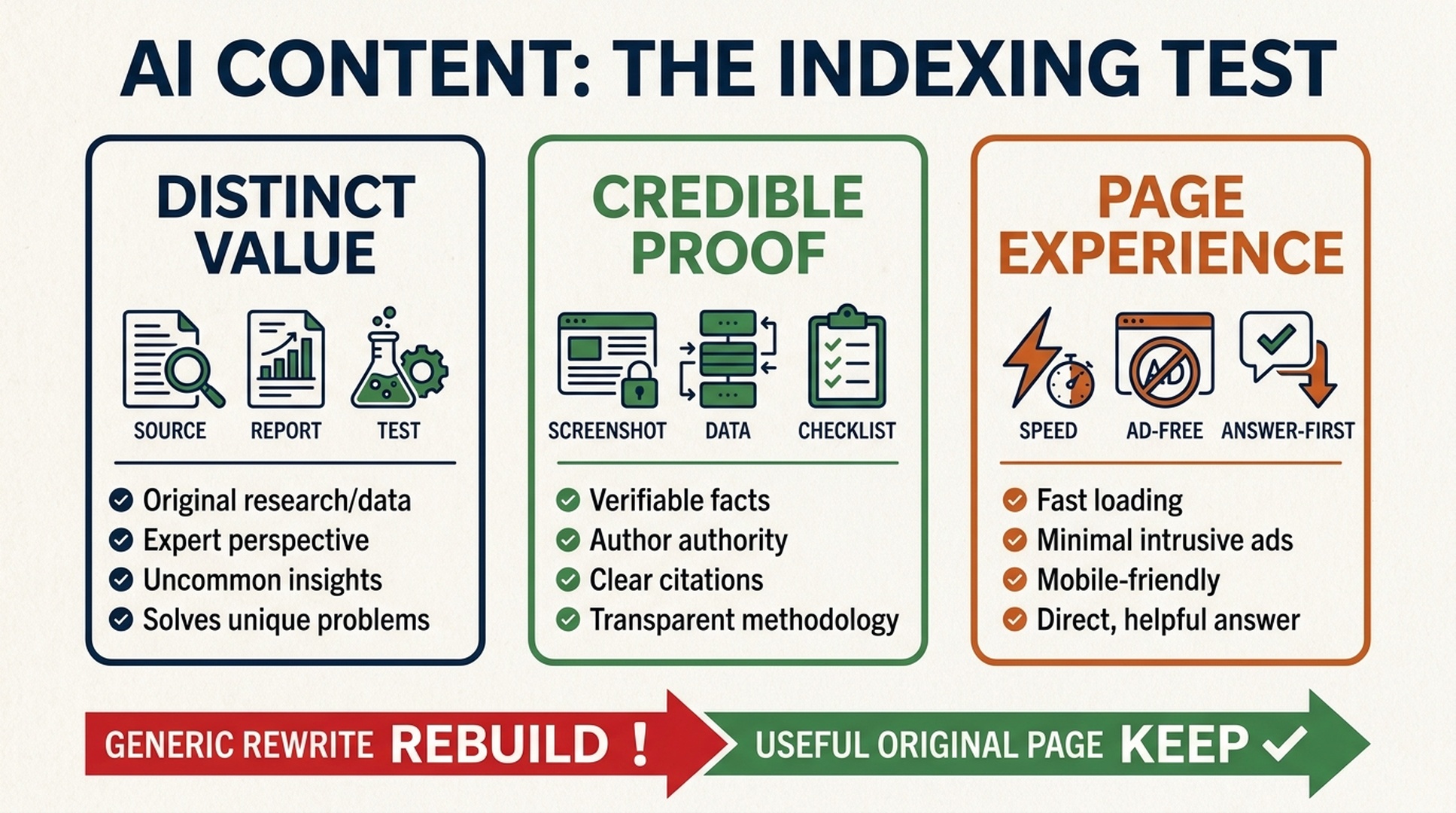
A useful audit evaluates the final experience: distinct information, credible evidence, and an accessible page, not merely the wording in the editor.
A practical audit for a site with many non-indexed AI pages
Start with a representative sample, not every URL. Choose 10 to 20 pages from the affected pattern and compare them against pages that are indexed and receiving impressions. Then use the following review.
1. Clear the technical floor first
Verify the basics before making a quality claim:
- Googlebot can fetch the page and receives the intended HTML, status code, and rendered content.
- The page is not blocked by
robots.txt, anoindexdirective, login wall, CDN challenge, or accidental WAF rule. - The declared and Google-selected canonical make sense.
- The page has internal links from relevant, crawlable locations.
- The URL is not a shallow duplicate, parameter variant, or accidental pagination artifact.
If these checks reveal a clear failure, fix it and observe the pattern again. Do not use the phrase "low-quality AI content" as a shortcut around a technical investigation.
2. Find the page's non-interchangeable contribution
For each sampled page, write one sentence that completes this prompt: "A reader should choose this page because it provides ______ that the generic results do not."
If the blank is hard to fill, the page likely needs more than a copy edit. The answer may be first-hand testing, original data, screenshots from a real workflow, an expert decision rule, a verified source collection, a localized constraint, a calculator, a downloadable template, or a real point of view backed by evidence.
Do not confuse a longer page with a more useful one. Extra headings, expanded definitions, and paraphrased background make a page larger. They do not necessarily make it more worth indexing.
3. Compare the template, not only the prose
When many URLs share a status, their shared template is a better starting point than the individual sentences. Review how the template handles titles, intros, main content, data sources, internal links, FAQs, ads, calls to action, schema, and page speed.
For programmatic or AI-assisted publishing, an editorial gate should block pages that only change entity names while preserving the same generic explanation. It should also flag pages whose main answer cannot be understood without scrolling through unrelated copy or interface friction.
4. Rebuild a small cohort before scaling again
Pick a meaningful but limited group, perhaps 20 pages from one template. Give them a distinct evidence layer and a cleaner reader path. Do not change everything at once. Then track crawling, indexing, impressions, and user engagement over a reasonable period.
This is not a guarantee that Google will index every rebuilt page. It is a more honest test of whether the old production system was creating pages without enough independent value.
What not to conclude from the report
Google's own examples push against several tempting but weak conclusions.
"All AI content is bad"
Google does not say this. Automation can support genuinely useful content. The real concern is content that feels replaceable and does not add value for readers.
"This URL has a technical error"
Not necessarily. "Crawled - currently not indexed" means Google visited the page. A broad pattern may require a quality review after technical explanations have been excluded.
"A low indexing ratio proves the site is low quality"
Also no. Near 25:30, Google explicitly says that the ratio of indexed to non-indexed pages is not a quality score. Sites can have intentional noindex pages, old versions, redirects, 404s, and technical URLs. The meaningful question is whether the pages that matter are indexed under the correct URL.
"Request indexing until it works"
Repeatedly submitting individual URLs does not supply the missing reason to index a large cohort. Fix the underlying technical issue if one exists. If it does not, improve the page and publishing system that created the pattern.
A better operating rule for AI-assisted content
Before publishing an AI-assisted page, require three answers:
- What is new here? Name the original information, judgment, tool output, or task the page gives the reader.
- Why is this page separate? Explain why this topic deserves its own URL rather than being a subsection, filter, or duplicate variation.
- Can a reader reach the answer cleanly? Check that the primary answer is visible, the page performs reasonably, and ads or interstitials do not obscure the job to be done.
This is a better release gate than "Does the draft have enough words?" It directs AI toward the repetitive parts of production while preserving human responsibility for evidence, usefulness, and editorial judgment.
For a structured review of crawlability, rendering, and page accessibility, Auspia's technical SEO resources can support the technical side of this audit. The content decision still has to be made at the page and template level.
The takeaway from Google
Google's discussion does not provide a one-click remedy for "Crawled - currently not indexed." It provides a better diagnosis:
- First, do not assume every non-indexed URL needs repair.
- Next, rule out the technical causes that can produce the same status.
- When a large AI-produced cohort remains unexplained, assess the site's overall value and reader experience.
- Improve the reason each page exists before producing more of the same template.
The hard part is admitting that a technically accessible page may still not earn its place in the index. That is also the useful part. It moves the team away from cosmetic fixes and toward the work readers can actually feel.
FAQ
Does Google say AI-generated content causes "Crawled - currently not indexed"?
No. Google does not present AI authorship as an automatic cause. It says a broad pattern of crawled but non-indexed pages can call for a site-wide quality review, and notes that AI-generated sites may have a problem when they offer nothing unique or valuable to readers.
Can a high-quality page still be "Crawled - currently not indexed"?
Yes. The status is not a quality verdict on one URL. Review technical access, canonical selection, duplication, internal links, and timing before judging the content.
What is the fastest way to improve AI content for indexing?
There is no safe shortcut. Start with a representative cohort, remove technical blockers, then add information or utility that cannot be reproduced through a generic rewrite. Real evidence, tested workflows, clear decision criteria, and a usable page experience are more useful targets than adding words.
Should I delete every AI-written page that is not indexed?
No. Audit the pattern first. Some pages may need a technical fix, consolidation, or a stronger evidence layer. Remove pages only when they have no useful role and cannot reasonably be improved or merged into a better resource.
Author: Clara Bennett, 10-Year Content Strategy Practitioner at Auspia. Clara writes about editorial systems, topic maps, repeatable content operations, and SEO/GEO production workflows.
Source note
- Source video: Google Search Relations, "How to read the Indexing Report" (YouTube ID:
1-PcVLHplwc). - The AI-content and quality discussion summarized here begins at approximately 20:45; Google discusses AI-generated sites around 22:50, page experience around 23:55, and indexing ratios around 25:30.
- This is an original editorial synthesis of the English CC transcript, not a transcript or a line-by-line rewrite.