Short answer
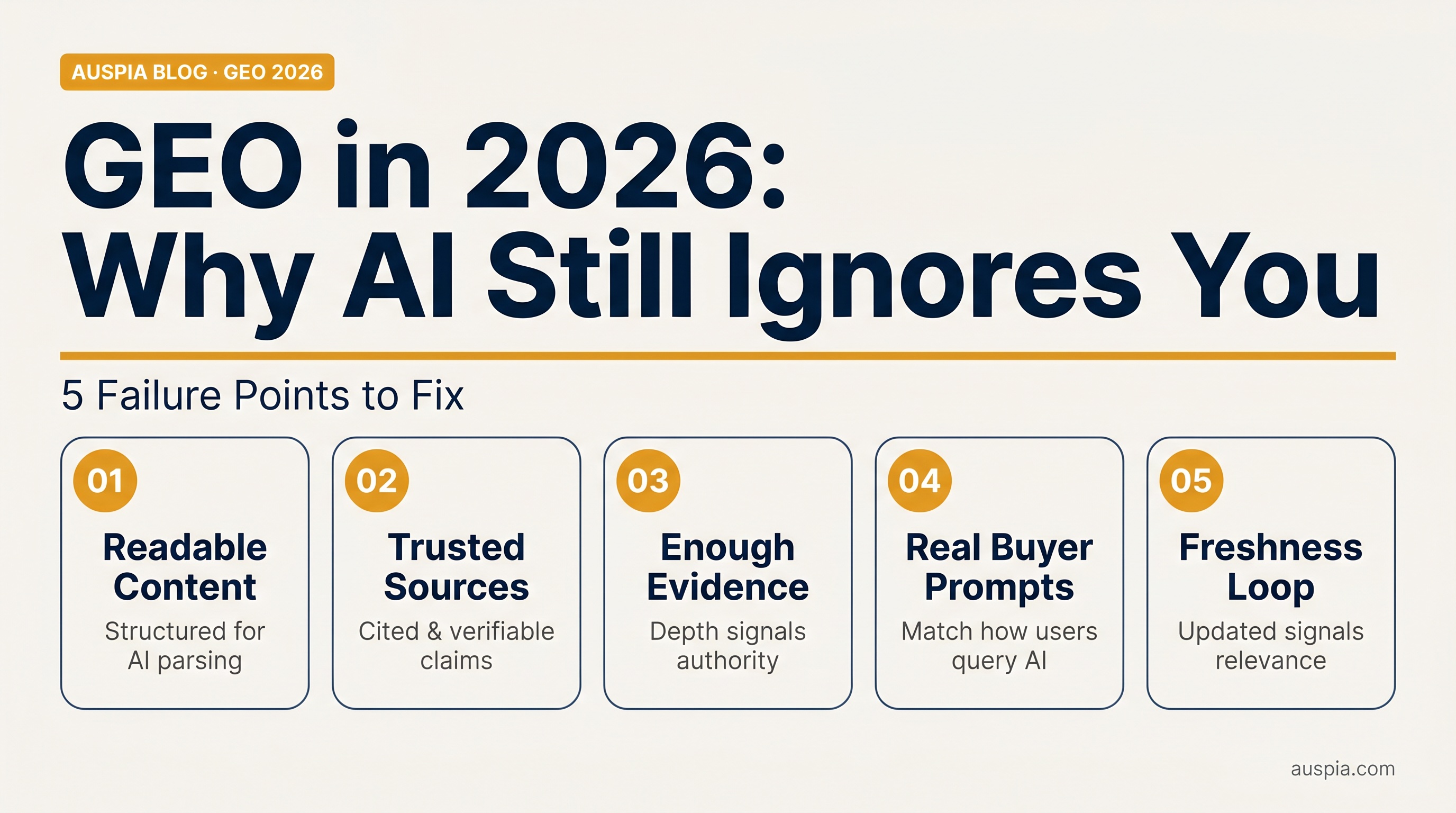
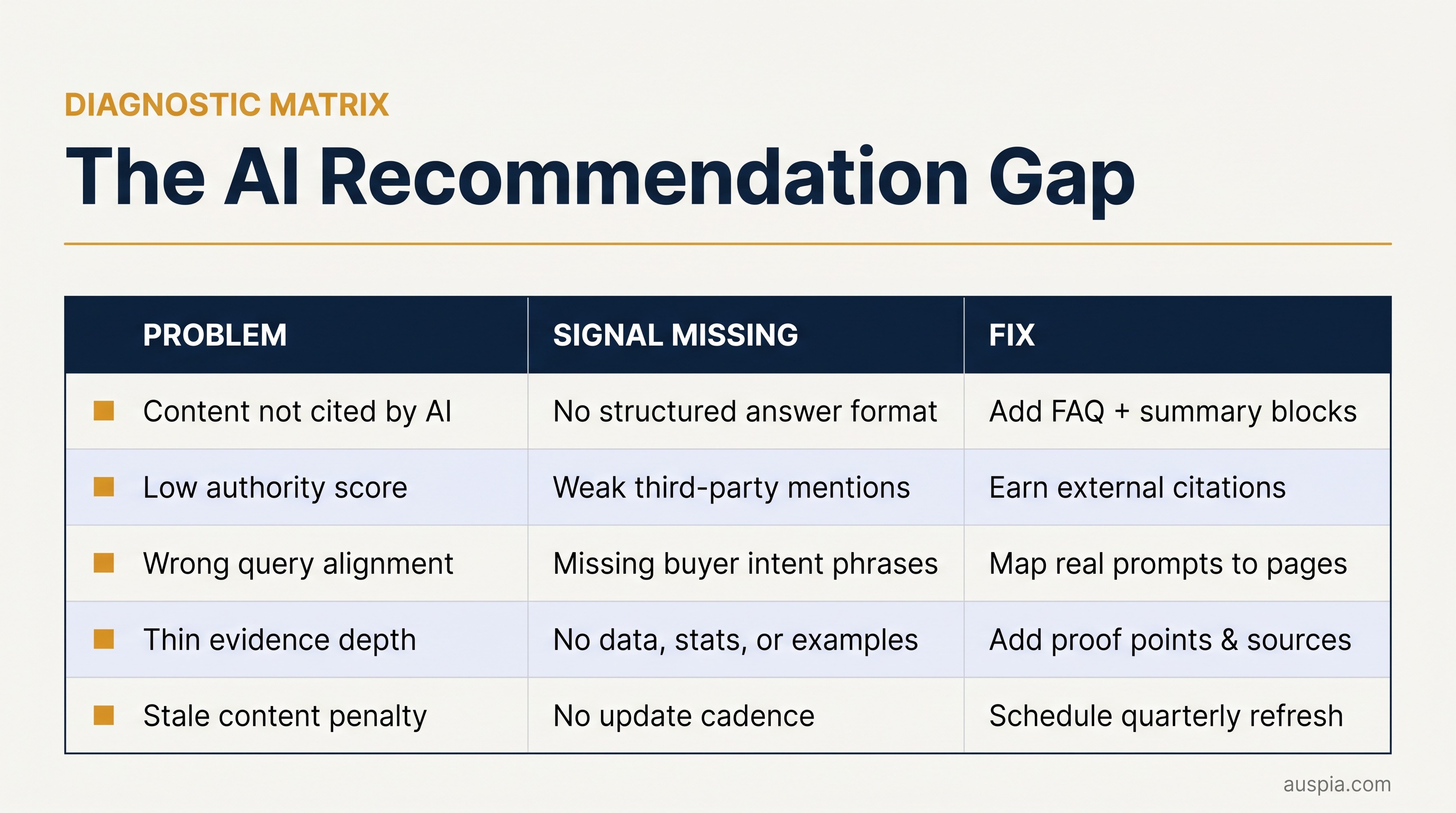
If you have "done GEO" and AI systems still do not mention your brand, the work probably has not crossed the recommendation threshold yet. In 2026, the problem is rarely that GEO is useless. More often, one of five signals is missing: the page is hard to extract, the source is not trusted, the evidence is too thin, the prompts do not match real buyer questions, or the content has gone stale.
That is uncomfortable, because it means ten new posts may not be enough. It also means the fix is practical. GEO works best when your content gives AI systems a clear reason to retrieve you, understand you, trust you, and match you to a specific user need.
Why this still happens in 2026
GEO used to be sold as a content volume game: publish articles, mention the brand, wait for AI answers to pick them up. That was already weak advice in 2024. By 2026, it is worse.
AI answer systems are more selective now. ChatGPT Search, Perplexity, Gemini, Google AI Overviews, and other answer surfaces do not behave like a simple directory of pages. They pull from crawled pages, indexed pages, third-party references, structured snippets, reviews, documentation, and fresh web results. Google's own guidance for AI features still points site owners back to the basics that matter: make pages eligible, crawlable, high quality, and useful for people first.
So if your brand is invisible, do not start by asking "Why didn't the AI like us?" Start with a more boring question: "What signal did we fail to provide?"
Mistake 1: the content exists, but AI cannot extract a clean answer
This is the most common failure.
A page can be perfectly readable to a loyal customer and still useless to an AI answer system. The page might open with a soft brand story, hide key facts in images, use vague language, or talk about the company without saying when it should be recommended.
Weak version:
"Northline Studio helps ambitious brands grow with creative digital solutions and a customer-first approach."
That sentence sounds fine in a brochure. For AI retrieval, it is fog. What does Northline Studio do? For whom? In what market? What problem does it solve? What proof supports the claim?
Stronger version:
"Northline Studio is a conversion-focused Webflow agency for B2B SaaS teams in North America. It builds product marketing websites, pricing pages, demo landing pages, and SEO content hubs for teams with 10 to 200 employees. Typical projects take 4 to 8 weeks and include analytics setup, copywriting, design, and Webflow development."
Now the AI system has hooks: category, audience, geography, service scope, page types, company size, timeline, deliverables. That does not guarantee a recommendation, but it gives the system something to retrieve.
A quick test: remove your brand name from the page and ask whether a stranger could still answer these questions:
Question | Good GEO content should answer |
|---|---|
What category are you in? | "SOC 2 automation software", "Shopify SEO agency", "AI meeting notes app" |
Who is the right customer? | Industry, company size, role, location, budget, use case |
What problem do you solve? | A plain-language pain point, not a slogan |
Why should you be trusted? | Specific proof, sources, comparisons, reviews, or examples |
When should you not be chosen? | Clear constraints, so the answer feels honest |
If those answers are missing, publishing more pages will mostly create more fog.
Mistake 2: all the proof comes from your own website
AI systems do not treat every mention the same. A claim on your own site is useful, but it is still a self-claim. A mention from an independent review site, a respected industry publication, a standards body, a customer case study, a GitHub repository, a marketplace listing, or a comparison page carries a different kind of weight.
This is where many GEO campaigns stall. They publish twenty brand-owned articles and expect answer engines to behave as if those articles are independent evidence.
For a global B2B software company, stronger proof might include:
- G2, Capterra, Product Hunt, AWS Marketplace, Shopify App Store, Chrome Web Store, or another category-relevant profile
- customer stories with names, roles, company context, screenshots, or measurable outcomes
- documentation pages that explain integrations, security, pricing logic, and limitations
- comparison pages that fairly explain when the product is and is not a fit
- expert roundups or niche industry blogs that mention the brand alongside alternatives
For a local service business, proof may come from Google Business Profile reviews, local directories, chamber listings, local press, event pages, partner pages, and real project galleries.
The point is not "get media coverage at any cost." That is how teams drift into low-quality PR spam. The point is to build a body of third-party evidence that a retrieval system can cross-check.
Auspia's view: owned content explains your position. Third-party evidence makes that position safer to recommend.
Mistake 3: there is not enough accumulated evidence yet
GEO has a threshold effect. Before the threshold, the brand barely appears. After the threshold, visibility can rise quickly because the same facts start showing up across multiple surfaces.
That is why a team may publish 10 pages and see nothing. Then, after another month of better pages, third-party mentions, refreshed product pages, and prompt-level measurement, the brand finally starts appearing in AI answers.
The hard part is that the first phase looks like failure.
A more realistic 2026 GEO timeline for a new or under-documented brand looks like this:
Phase | Timeframe | What should happen |
|---|---|---|
Foundation | Week 1 to 2 | Fix crawl access, brand facts, category pages, core answer pages, schema, and basic entity consistency |
Evidence build | Week 3 to 6 | Publish use-case pages, comparison pages, case-style proof, directory profiles, reviews, and external references |
Prompt coverage | Week 5 to 8 | Test buyer prompts, competitor prompts, local/category prompts, and problem-aware prompts |
Refresh loop | Week 8+ | Update pages based on missing prompts, stale claims, new proof, and AI answer gaps |
Some brands move faster because they already have authority. Others need longer because nobody outside their own domain has described them clearly.
The wrong move is to quit at week three because "AI still does not mention us." The better move is to check whether the evidence graph is actually filling in.
Mistake 4: your keywords do not match how buyers ask AI questions
Most companies still write from the inside out.
They optimize for:
- the brand name
- the product name
- the category term they prefer
- the slogans used by the sales team
Buyers ask AI systems in a different language.
They ask:
- "best SOC 2 automation tools for a 30 person SaaS startup"
- "alternatives to Drata for a small finance team"
- "which Shopify SEO agency has experience with fashion brands"
- "how to choose an AI meeting notes app that works with Salesforce"
- "top Webflow agencies for B2B SaaS pricing page redesign"
These are not just keywords. They are recommendation prompts. They include constraints, comparisons, use cases, budgets, locations, integrations, and risk concerns.
A basic GEO prompt map should include at least six prompt families:
Prompt family | Example |
|---|---|
Category recommendation | "best tools for..." |
Problem-first | "how do I fix..." |
Comparison | "A vs B", "alternatives to X" |
Segment-specific | "for startups", "for enterprise", "for local clinics" |
Constraint-specific | "under $500/month", "works with HubSpot", "GDPR-ready" |
Trust-seeking | "which providers are reliable", "who has real case studies" |
If your content only repeats your preferred category label, you will miss most of the prompts where recommendations happen.
This is where tools such as Auspia's AI Search Visibility Checker are useful. You need to see the actual prompts where your brand is absent, not just whether your homepage ranks for your own name.
Mistake 5: you treated GEO as a one-time campaign
AI search visibility decays. Pages get old. Competitors publish better comparisons. Product facts change. Pricing changes. New reviews appear. Fresh documentation outranks old blog posts because it answers the question more directly.
One-time GEO work is better than nothing, but it is not a system.
A practical maintenance loop looks like this:
Cadence | Action |
|---|---|
Weekly | Check 20 to 50 priority prompts across ChatGPT, Perplexity, Gemini, and Google AI results |
Biweekly | Update pages that are mentioned incorrectly or not mentioned at all |
Monthly | Add missing proof: reviews, case examples, integrations, comparison details, directory profiles |
Quarterly | Rebuild the prompt map around new buyer questions, competitors, and product changes |
This is not busywork. It is how you keep the answer ecosystem current enough to trust you.
A simple diagnostic before you publish another 20 posts
Before adding more content, run this audit:
- Pick 30 buyer prompts where your brand should plausibly appear.
- Record which AI systems mention you, cite you, ignore you, or describe you incorrectly.
- For every missing prompt, identify the missing signal: extractability, trust, evidence volume, prompt match, or freshness.
- Fix the highest-value pages first: homepage, category page, comparison page, use-case page, docs, pricing, about page, and case studies.
- Add third-party proof only where it would be natural and credible.
- Re-test the same prompt set every two weeks.
This is the difference between "doing GEO" and operating a GEO program.
Auspia takeaway
GEO in 2026 is not a magic publishing trick. It is a recommendation-readiness system.
If AI still does not recommend your content, assume one of these is true:
- it cannot understand what you are a fit for
- it does not trust the source enough
- it has not seen enough consistent evidence
- your content misses the prompts buyers actually ask
- your pages are stale compared with newer answers
Fix those five issues before blaming the channel. More content helps only when each new page adds a clearer answer, a stronger source, or a missing proof point.
For a faster check, use Auspia's GEO Score Checker to review whether your site is structured for AI discovery, citations, and recommendation prompts.
FAQ
How long does GEO take to work in 2026?
For a brand with clean technical foundations and some existing authority, early movement can appear within a few weeks. For a newer or poorly documented brand, plan for 8 to 12 weeks of structured work before judging the program. The timeline depends on crawl access, content quality, third-party proof, and prompt coverage.
Does publishing more articles improve AI recommendations?
Only if the articles add useful signals. Ten vague posts can be weaker than one clear comparison page with evidence, constraints, FAQs, and third-party references. Volume helps after the structure is right.
Are backlinks still useful for GEO?
Yes, but think broader than classic backlink metrics. AI recommendation systems care about discoverable, credible evidence. A relevant review, directory listing, documentation mention, customer story, or industry citation can matter because it helps confirm what your brand is and when it should be recommended.
Should GEO content target brand keywords or user prompts?
Both, but user prompts matter more for discovery. Brand keywords help AI systems confirm identity. User prompts help them decide when to recommend you. A good GEO program maps category prompts, comparison prompts, problem prompts, and constraint prompts.
What is the fastest fix if AI describes my brand incorrectly?
Start with your own source of truth: homepage, about page, product page, pricing page, docs, schema, and social profiles. Make the same facts consistent across each page. Then update the third-party profiles that AI systems may use to cross-check you.
Author: Bennett Hayes, Applied GEO Analyst Across 400+ Implementation Reviews at Auspia. Bennett writes about practical GEO execution, readiness audits, and implementation notes for teams that need AI search visibility to turn into qualified traffic.