Short answer: AI recommends brands it can retrieve, verify, and explain
If you want AI systems to recommend your brand in 2026, do not start with "AI tricks." Start with evidence.
AI search and answer engines tend to mention brands when three conditions line up:
- The system can understand what your brand is, who it is for, and which problem it solves.
- It can retrieve pages or third-party sources that support that claim.
- The answer can explain why your brand belongs in the recommendation without inventing facts.
That is the bottom layer of GEO, or Generative Engine Optimization. Classic SEO still matters because crawlers, indexable pages, helpful content, and authority signals remain the entry ticket. GEO adds a second question: when an AI answer is assembled from retrieved sources, brand facts, citations, and learned category knowledge, is your brand easy to select?
The practical answer is simple but uncomfortable: your website alone is not enough. AI recommendation systems look for a pattern across your owned pages, independent mentions, reviews, comparison pages, forums, documentation, structured data, and recent evidence. A brand becomes recommendable when the same clear story appears in enough places that the system can trust it.
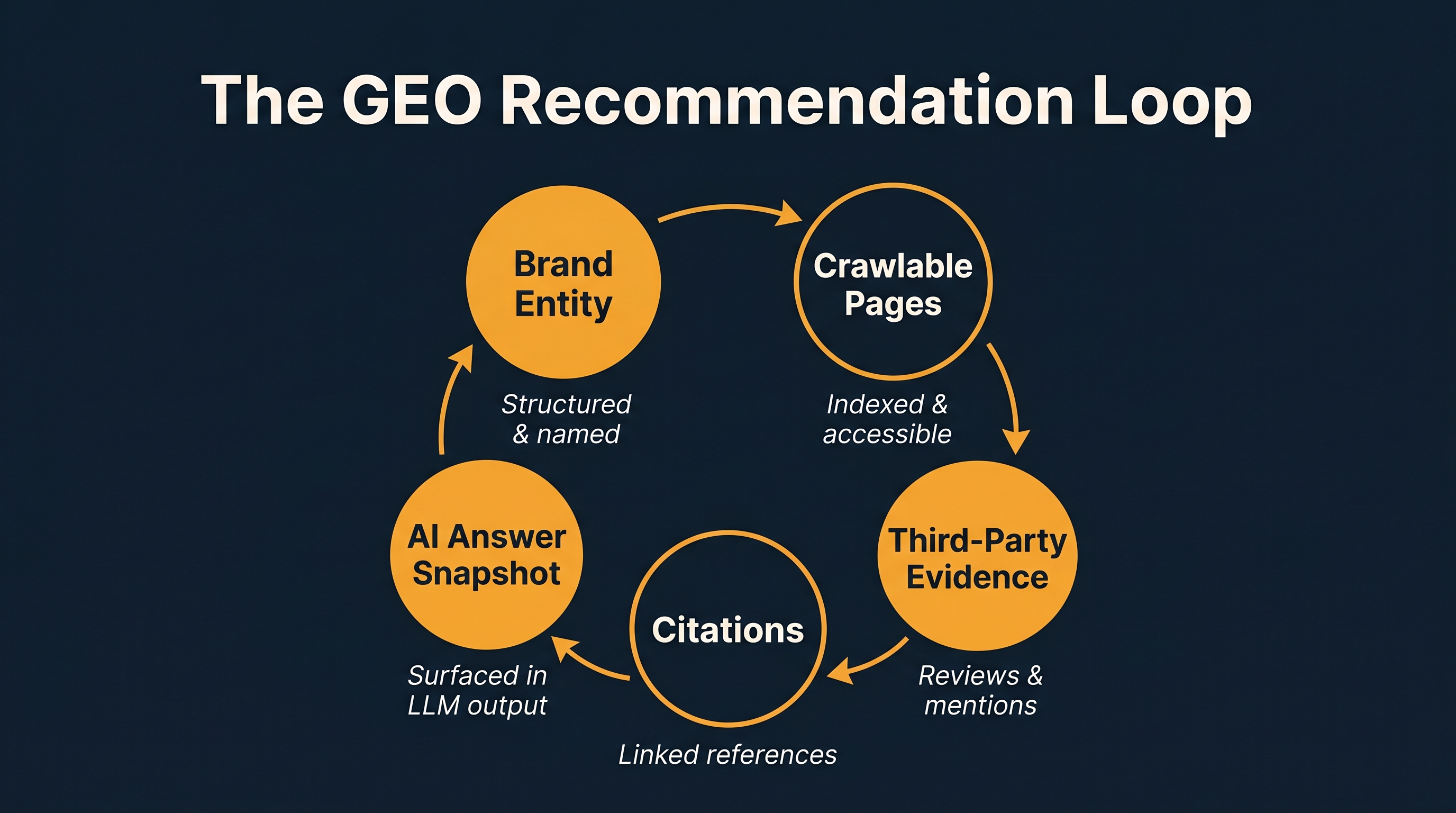
Caption: A simple GEO loop: clarify the brand entity, make sources accessible, earn third-party evidence, measure AI answers, then refresh the assets that matter.
What changed in 2026
For years, search visibility meant ranking on a results page. In 2026, buyers also ask ChatGPT, Perplexity, Gemini, Google AI features, Copilot, Claude, vertical AI tools, and ecommerce assistants for a short answer.
That changes the shape of competition.
A normal search result can show ten blue links. An AI answer may mention three products, one vendor, or no brand at all. Even when the answer includes citations, the user may never click. The brand has to win inside the answer, not only below it.
Google's own Search Central documentation now treats AI features as part of the search experience and points site owners back to the same fundamentals: make useful content, allow crawling, use preview controls where appropriate, and keep pages eligible for Search. Google also says its systems are designed to surface helpful, reliable, people-first information. Those two ideas matter for GEO because AI answers still need accessible source material.
The newer layer is not "write for bots." It is source engineering. You are making your brand easier to retrieve, compare, cite, and summarize.
The technical logic beneath GEO
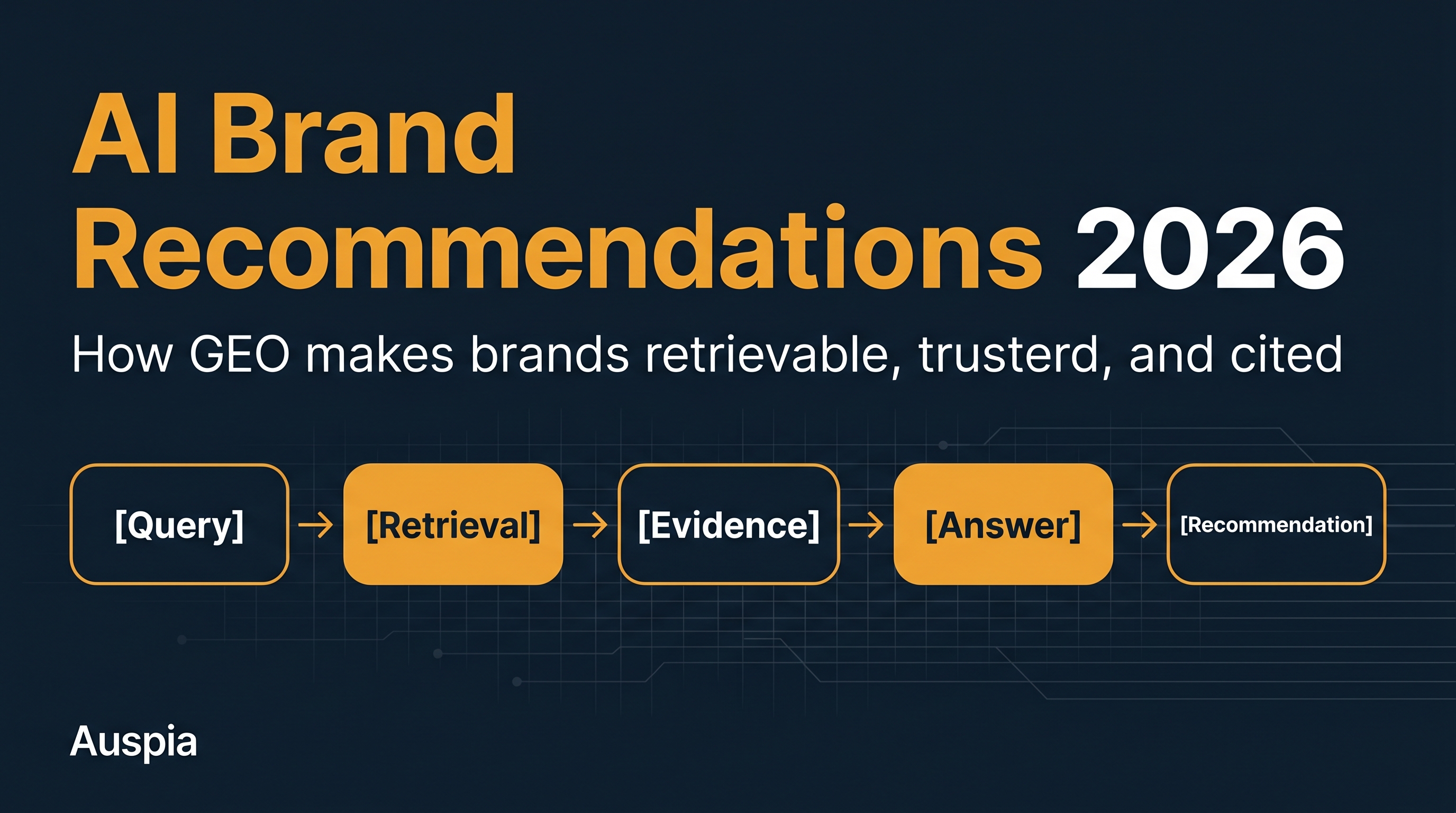
Most AI recommendation flows can be simplified into five stages. The exact systems differ by platform, but the pattern is useful for operators.
Stage | What happens | What your brand needs |
|---|---|---|
Query interpretation | The system rewrites or expands the user's question. | Clear category language and use-case wording. |
Retrieval | The system searches indexed web pages, documents, or internal knowledge. | Crawlable pages, structured content, third-party mentions, and fresh evidence. |
Reranking | Candidate sources are filtered by relevance, quality, consensus, and sometimes freshness. | Specific claims, trusted sources, comparison pages, reviews, and citations. |
Answer synthesis | The model turns evidence into a readable answer. | Extractable summaries, tables, FAQs, and concise brand facts. |
Recommendation | The answer includes a shortlist, buying advice, or a named brand. | A defensible reason to recommend you for a specific user, segment, or scenario. |
This is why vague brand copy fails. A paragraph like "we help teams unlock growth with AI-powered innovation" gives an answer engine almost nothing to work with. A sentence like "Auspia helps B2B teams automate SEO, GEO, and AEO audits, content briefs, technical checks, and AI search visibility tracking" is easier to retrieve and use.
The machine needs nouns, categories, constraints, proof, and relationships. The human does too.
Why AI engines recommend one brand and ignore another
AI engines do not "like" brands. They assemble answers from available signals. In practice, five signal groups matter most.
1. Entity clarity
Your brand must be legible as an entity. That means the same basic facts should appear across your site and the wider web:
- Brand name
- Product category
- Main use cases
- Audience
- Geography, if relevant
- Pricing model, if relevant
- Alternatives and competitors
- Proof points that can be verified
If your homepage says one thing, your LinkedIn page says another, your review profiles use old positioning, and your comparison pages avoid concrete language, AI systems may struggle to place you.
2. Source access
AI systems cannot recommend what they cannot access. Check the basics before writing more content:
- Important pages are indexable.
- Server-side content is visible without complex user interaction.
- Robots.txt does not block important crawlers by accident.
- Canonical URLs are clean.
- Product, Organization, FAQ, Article, and Review schema are used where they fit.
- Key pages are not hidden behind login walls.
This is where technical SEO and GEO overlap. If Google, Bing, or other retrieval systems cannot crawl and understand the page, the page has little chance of shaping AI answers.
3. Answer-ready owned content
Owned content still matters, but the format has changed. The best GEO pages are easy to quote, compare, and summarize.
Useful page types include:
- "What is" category explainers
- Use-case pages
- Alternative and comparison pages
- Industry pages
- Pricing and packaging explainers
- Integration pages
- Customer evidence pages
- FAQ pages with direct answers
- Methodology pages that explain how your product works
Do not bury the answer. Put the most useful summary near the top, then support it with details, tables, examples, and constraints.
4. Third-party evidence
This is the part many teams miss. AI recommendations often rely on the broader web, not only your site. For brand recommendations, independent evidence can be stronger than owned claims.
Look for sources that already appear in AI answers for your target prompts:
- Review sites
- Software directories
- Analyst-style lists
- Comparison blogs
- Community discussions
- Partner pages
- Integration marketplaces
- Podcasts and transcripts
- Public case studies
- GitHub, docs, or help-center references for technical products
The goal is not spammy link building. The goal is factual inclusion in places answer engines already trust.
5. Measurement by prompt, not just page
Traditional SEO asks, "Which pages rank?" GEO asks, "Which prompts mention us, cite us, compare us, or exclude us?"
Track prompts like:
- "Best [category] tools for [audience]"
- "What should I use instead of [competitor]?"
- "Which [category] platform is best for a small team?"
- "Compare [brand] vs [competitor]"
- "How do I solve [problem] without hiring an agency?"
Then record the answer, mentioned brands, citations, sentiment, and missing facts. This becomes your GEO backlog.
ChatGPT, Perplexity, and Google AI features do not behave the same way
Treat "AI search" as a category, not a single channel.
ChatGPT-style recommendations are often conversational. Users ask for a shortlist, a buying path, or a plain-English comparison. Your brand needs a clean entity profile and enough supporting evidence for the model to explain when you are a good fit.
Perplexity-style answers are more citation-led. Users expect visible sources. Your pages, third-party mentions, and recent explainers must be citation-worthy. Thin pages rarely help.
Google AI features are tied closely to the broader Search ecosystem. Google's public guidance still points site owners toward crawlable, helpful, reliable content and the same preview controls used in Search. That means technical SEO, structured data, and people-first pages remain central.
The mistake is optimizing for one surface and assuming the work transfers perfectly. Some assets transfer. Some do not. A comparison page may help ChatGPT and Google. A community thread may influence Perplexity. A clean Organization schema may help Google understand your entity but will not replace real evidence.
A practical GEO workflow for getting recommended
Use this workflow when the business goal is simple: "We want AI systems to mention us when buyers ask for recommendations."
Step 1: Build a prompt library
Start with 30 to 100 prompts. Group them by intent:
Intent | Example prompt | What to measure |
|---|---|---|
Category discovery | "Best tools for automating SEO audits" | Are you mentioned? Who is ahead? |
Problem solving | "How can a small team improve AI search visibility?" | Does the answer suggest your category? |
Comparison | "Auspia vs [competitor] for GEO" | Are facts accurate? |
Buying criteria | "What should I look for in a GEO platform?" | Do your differentiators appear? |
Risk reduction | "Can I do GEO without hiring an agency?" | Does the answer describe a workflow you support? |
Do not only test your brand name. Most buyers ask about problems before brands.
Step 2: Capture answer snapshots
Run the prompts across the AI surfaces your buyers actually use. For each answer, capture:
- Date
- Platform
- Prompt
- Brands mentioned
- Citations or source links
- Ranking or order of mention
- Sentiment
- Missing or incorrect facts
- Suggested next action
You are not looking for one perfect score. You are looking for repeated gaps.
Step 3: Map every gap to a source problem
Most GEO problems have a source-level cause.
AI answer problem | Likely source problem | Fix |
|---|---|---|
Your brand is missing | No trusted source connects you to the prompt intent. | Create a use-case page and earn mentions on already cited pages. |
Your brand is described incorrectly | Entity facts are inconsistent across the web. | Update About, schema, profiles, directories, and comparison pages. |
Competitors are recommended first | They have clearer category pages or more third-party evidence. | Publish comparison assets and improve proof density. |
AI cites old data | Your best sources are stale. | Refresh pages, update dates, add current examples. |
AI mentions you but does not recommend you | The system lacks a reason to choose you. | Add fit criteria, use cases, constraints, and proof. |
Step 4: Create answer assets, not just articles
A GEO asset is any page or source that helps an AI answer a buyer's question accurately.
Good GEO assets include:
- A short definition block at the top of the page
- A comparison table with honest fit criteria
- A "when to choose us / when not to choose us" section
- FAQs written in the language buyers use
- Evidence blocks with dates, methods, and sources
- Schema that matches the visible content
- Author and review information where relevant
This is also where GEO becomes operational. You need an asset backlog, not a one-time content campaign.
Step 5: Earn mentions in sources AI already uses
Search your own prompt results and list the URLs that appear again and again. Then ask:
- Can we contribute a quote or data point?
- Can we get listed in a relevant directory?
- Can we publish a comparison that another author would cite?
- Can a partner page describe the integration more clearly?
- Can a real customer story be made public?
- Can we correct outdated information on a third-party profile?
This is not the old link-building playbook with a new label. The best GEO mentions are factual, specific, and useful even if the user never clicks.
Step 6: Refresh quarterly, sometimes monthly
AI answer surfaces change quickly. Sources get replaced. Product pages drift. Reviews age. Competitors publish new evidence.
For high-value prompts, review snapshots at least monthly. For core pages, refresh the evidence, screenshots, claims, and examples every quarter. If the page targets a fast-moving topic, refresh faster.
What most teams get wrong
The most common GEO mistake is treating it as a content-format hack. Teams add FAQs, publish a "best tools" post, and wait for AI recommendations. That is too thin.
The real work is more like revenue operations for organic discovery:
- Decide which prompts matter.
- Measure current visibility.
- Identify source gaps.
- Fix owned pages.
- Improve third-party evidence.
- Re-test answers.
- Repeat.
Another mistake is over-optimizing for one model. A brand can look strong in ChatGPT and weak in Perplexity. It can appear in Google AI features for informational prompts but not buying prompts. GEO measurement has to separate surfaces, intents, and markets.
A 2026 readiness checklist
Before asking why AI does not recommend your brand, check these items.
Question | Pass condition |
|---|---|
Can an AI system explain your category in one sentence? | Your homepage, About page, schema, and profiles use consistent wording. |
Can it retrieve pages for your core use cases? | Each major use case has a crawlable page with direct answers and examples. |
Can it verify your claims outside your site? | Third-party pages, reviews, directories, partners, or public case studies support the claims. |
Can it compare you fairly? | You publish honest comparison and alternative pages. |
Can it cite fresh evidence? | Important pages show recent updates, current examples, and sourced data. |
Can you measure change? | You track prompts, mentions, citations, sentiment, and source URLs over time. |
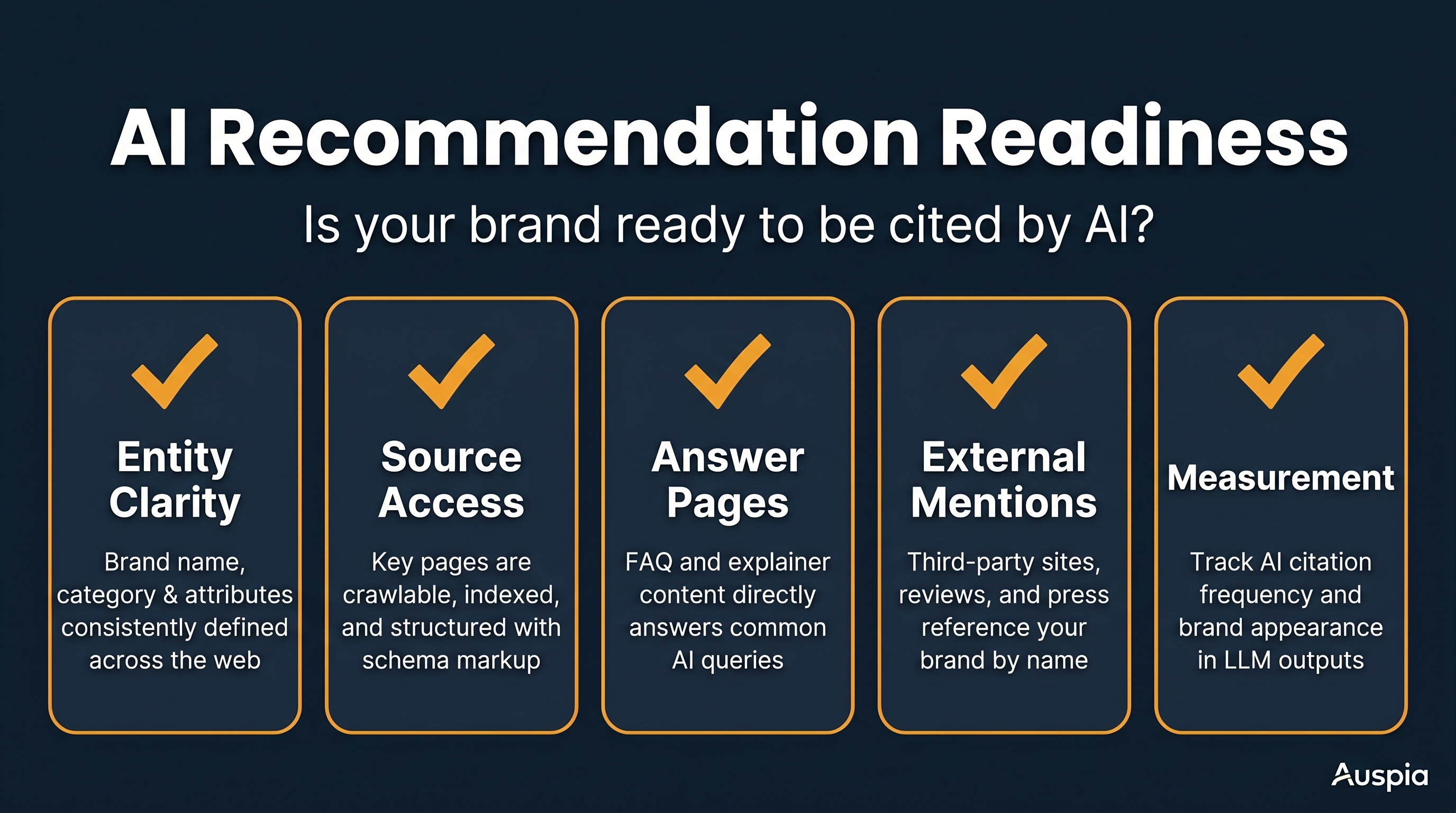
Caption: Use this checklist before creating more content. Most AI recommendation gaps start with missing facts, blocked sources, or weak evidence.
The Auspia view: make the brand easy to choose
The goal of GEO is not to manipulate AI answers. That is fragile and usually obvious. The better goal is to make your brand easy to choose when the recommendation is deserved.
That means writing clearer pages, fixing crawl and schema issues, building third-party evidence, and measuring the prompts that influence real buyers. The brands that win in 2026 will not be the ones that shout the loudest. They will be the ones with the cleanest entity, the strongest source trail, and the clearest fit for the user's problem.
If you want the faster route, Auspia.ai automates this work. It can run SEO, GEO, and AEO checks, inspect AI search visibility, find technical blockers, generate optimization tasks, and help teams build an intelligent SEO/GEO workflow without first becoming experts in every underlying method.
FAQ
How do I get ChatGPT to recommend my brand?
Start by making your brand facts consistent and easy to verify. Then create pages that answer buyer prompts directly, earn mentions on credible third-party sources, and test the prompts where your brand should appear. ChatGPT-style answers need a clear reason to include you.
Is GEO replacing SEO?
No. GEO builds on SEO. Crawlability, helpful content, structured data, authority, and freshness still matter. GEO adds prompt tracking, AI answer measurement, citation analysis, and third-party evidence work.
Do I need an llms.txt file for GEO?
An llms.txt file can help document important AI-readable resources, but it is not a replacement for crawlable pages, useful content, schema, and trusted mentions. Treat it as one supporting asset, not the whole strategy.
Why does AI recommend competitors but not us?
Usually because competitors have clearer category language, more third-party evidence, better comparison pages, or fresher sources. Run the same prompts across multiple AI engines and inspect which sources are shaping the answers.
How often should I measure AI brand visibility?
For important buying prompts, monthly measurement is a good starting point. For fast-moving categories, weekly checks may be useful. The key is to save answer snapshots so you can see whether source fixes actually change visibility.
What is the fastest GEO improvement?
Fix your entity clarity first. Update your homepage, About page, product pages, schema, and major profiles so they describe the brand in the same concrete language. Then look for third-party pages that AI engines already cite and work to get accurate mentions there.
Sources used: Google Search Central documentation on AI features and your website, Google's guidance on creating helpful, reliable, people-first content, Google's guide to optimizing for generative AI search, and live web research on 2026 GEO, AI citations, ChatGPT Search, Perplexity, and Google AI recommendation behavior.
Author: Maya Ellison, 12-Year GEO Strategy Researcher at Auspia. Maya writes about AI search visibility, brand entity clarity, and practical GEO operating systems for growth teams.