Quick answer
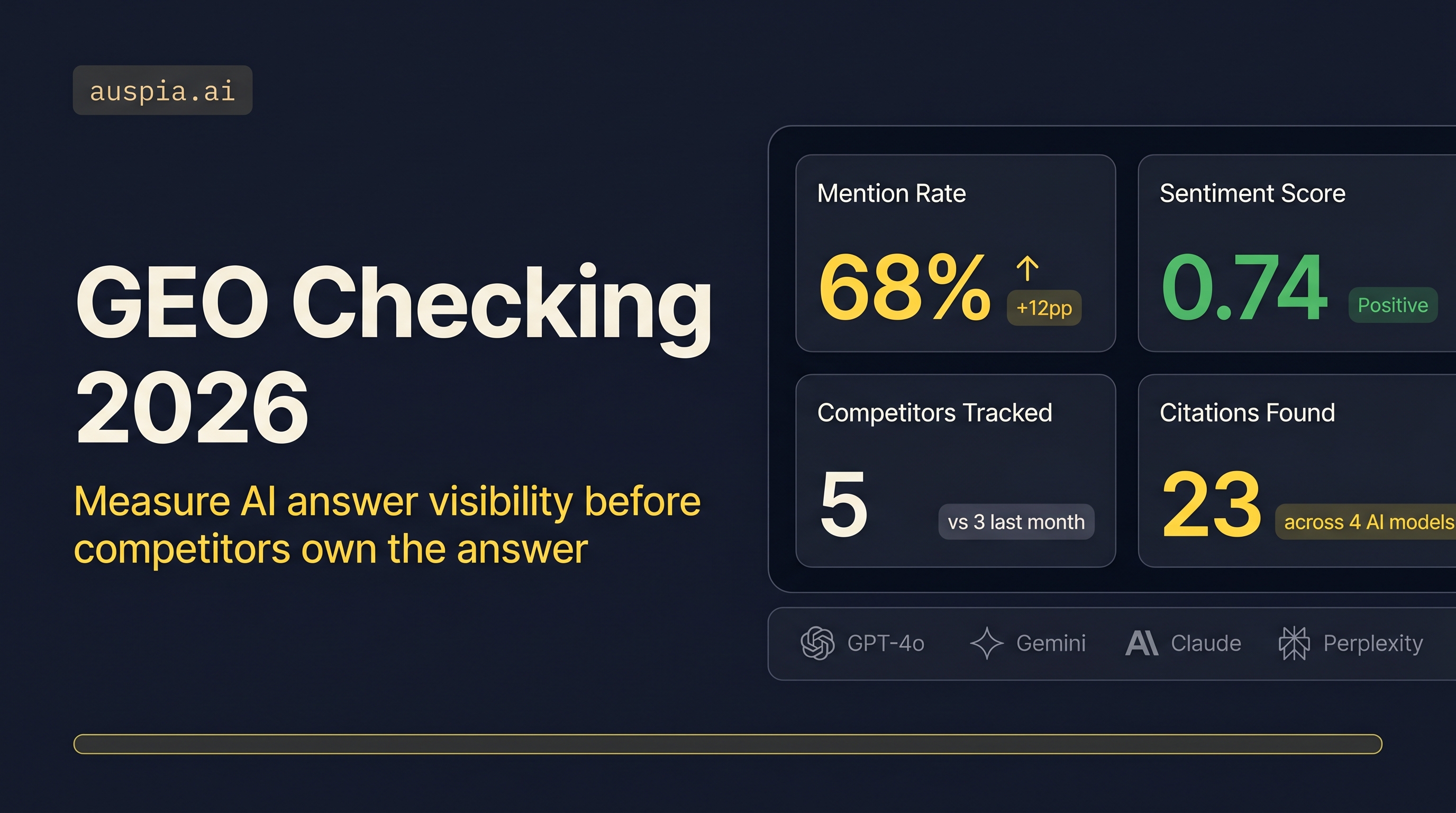
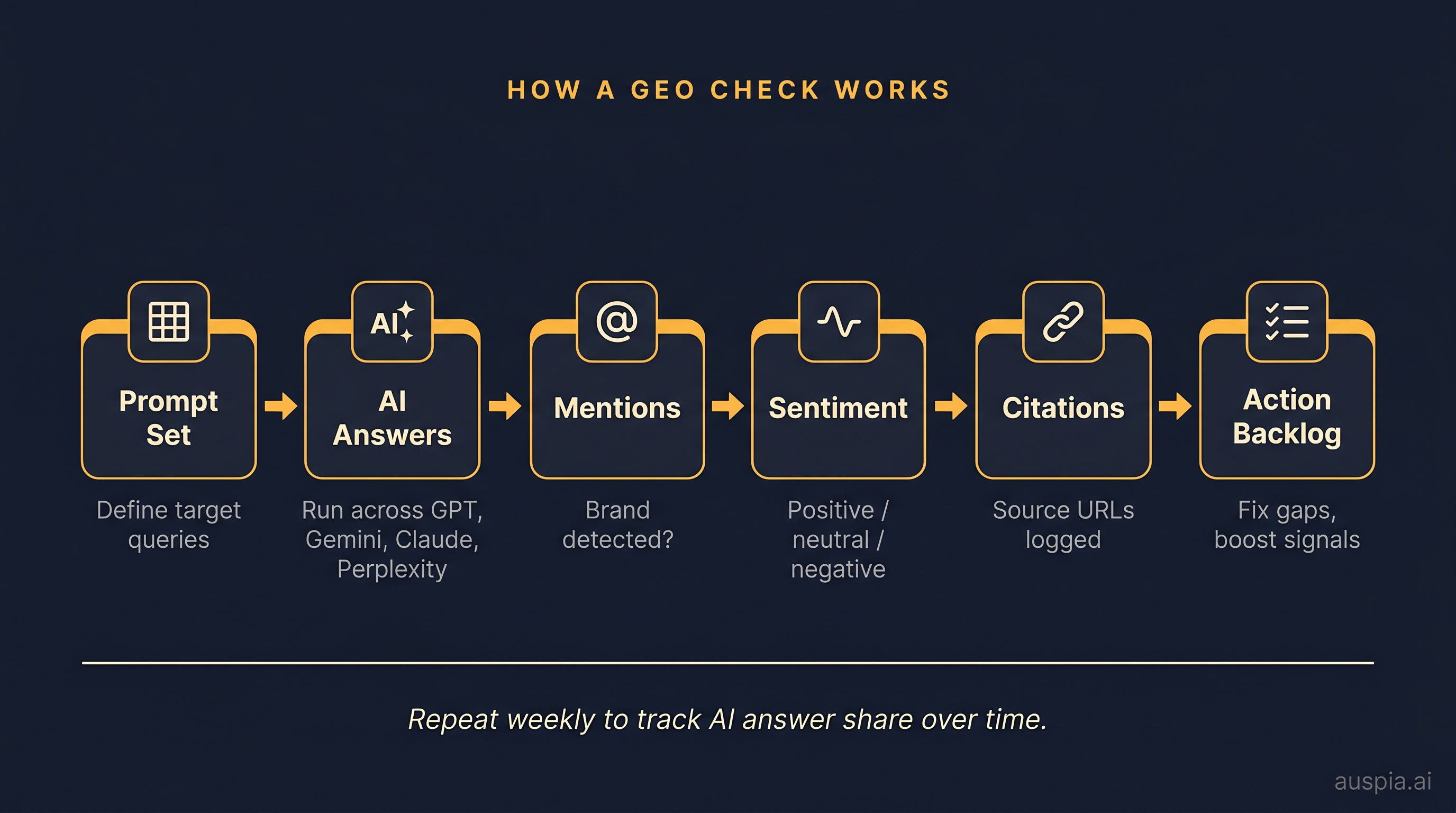
GEO checking is the practice of testing how your brand appears in AI-generated answers. In 2026, that usually means asking ChatGPT, Gemini, Claude, Perplexity, Google AI Overviews, and other answer surfaces the questions your buyers already ask, then measuring whether your brand is mentioned, how it is described, which competitors appear beside you, and which sources the answer cites.
The short version: SEO audits tell you how pages perform in search results. GEO checks tell you whether AI answer engines know when to recommend, compare, or cite your brand.
That gap matters because more buyers now use AI as a shortcut for research. They do not always click ten blue links. They ask, "Which tool should I use for this?" or "What are the best options for my team?" If the answer mentions three competitors and not you, your brand has already lost part of the evaluation before a visitor reaches your site.
What GEO checking means in plain English
GEO stands for generative engine optimization. It is the work of making your brand, content, and proof easier for AI systems to understand, retrieve, summarize, and cite.
GEO checking is the diagnostic step before the optimization work. It answers questions like:
- Do AI answers mention our brand for high-intent prompts?
- Are we described accurately, or with outdated positioning?
- Which competitors are recommended more often?
- Do answers cite our site, third-party reviews, documentation, comparison pages, or random sources?
- Are there negative or misleading statements we need to fix with better public evidence?
A useful GEO check does not ask one random prompt and call it research. AI answers vary by platform, prompt wording, geography, freshness, and retrieval mode. The point is to run a repeatable set of prompts, collect answers, and turn the messy result into a practical visibility report.
Why GEO checking became a 2026 priority
For years, many growth teams used a simple mental model: rank higher in Google, earn the click, convert the visitor. That model still matters. Search is not dead. But the path from question to decision has changed.
In February 2024, Gartner predicted that traditional search engine volume would drop by 25% by 2026 because of AI chatbots and other virtual agents. Whether your own category has moved that fast or not, the direction is hard to ignore: AI answers are becoming a discovery layer for software, services, local businesses, ecommerce products, and B2B vendors.
This creates a visibility problem that normal analytics tools often miss. You can have decent SEO traffic and still be absent from AI recommendations. You can rank for a keyword and still be skipped when the AI answer compresses the market into four named options. You can also be mentioned, but framed poorly: "expensive," "limited," "mostly for beginners," or "not well documented," even when that description is out of date.
GEO checking turns that invisible layer into a report. It does not replace SEO measurement. It adds a second view of demand: what answer engines say when buyers ask for help.
What a proper GEO check measures
A one-off screenshot is useful for a conversation, not for a strategy. A proper GEO check should track at least these five signals.
Signal | What it tells you | What to do with it |
|---|---|---|
Mention rate | How often your brand appears across target prompts | Find prompts and topics where you are invisible |
Sentiment and framing | Whether the answer describes you positively, neutrally, or negatively | Fix outdated claims, weak proof, or reputation gaps |
Competitor presence | Which alternatives appear more often than you | Study their cited pages, third-party mentions, and category language |
Citation/source quality | Which URLs or domains the AI answer relies on | Strengthen pages that can become citation-worthy sources |
Answer accuracy | Whether facts such as pricing, features, use cases, and audience are correct | Update owned pages and public profiles with clearer facts |
The most useful output is not a vanity score. It is an action backlog: prompts to monitor, pages to improve, proof assets to create, and competitor gaps to study.
GEO checking vs SEO auditing
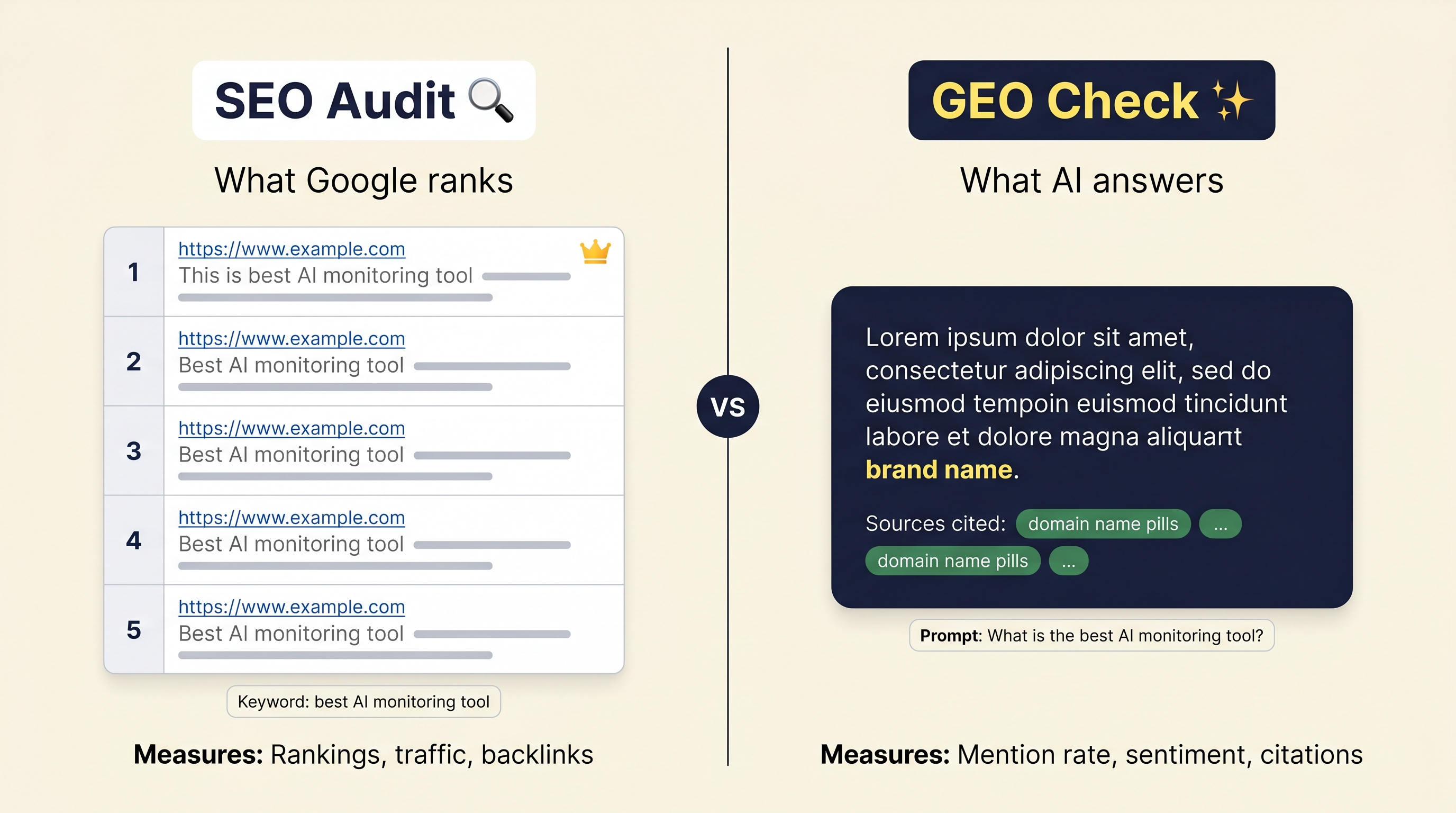
SEO audits and GEO checks look similar from a distance because both diagnose visibility. The difference is the surface being measured.
Question | SEO audit | GEO check |
|---|---|---|
Main object | Web pages in search results | Brand mentions inside generated answers |
Typical metric | Ranking, impressions, clicks, technical health | Mention rate, answer share, sentiment, citation quality |
User behavior | Search, scan results, click links | Ask, read synthesized answer, compare options |
Competitive view | Who ranks above or below your URL | Who gets recommended when your brand should be considered |
Tooling pattern | Rank trackers, crawl tools, Search Console | Prompt sets, answer sampling, citation extraction, visibility scoring |
The mistake is treating GEO as "SEO with a new name." It is not. SEO gives answer engines part of their raw material, but GEO checks whether that material gets used inside the final answer.
A practical 2026 GEO checking workflow
Start small. A messy spreadsheet with the right prompts is better than a polished dashboard with the wrong questions.
Step 1: Build a buyer prompt set
Write 20 to 50 prompts that sound like real customer questions. Include category prompts, comparison prompts, problem prompts, and recommendation prompts.
Examples:
- "Best tools for tracking AI search visibility"
- "How do I check if ChatGPT recommends my brand?"
- "Which GEO tools are useful for a small SaaS team?"
- "Alternatives to [competitor] for AI answer visibility tracking"
- "What should a B2B startup do to appear in AI search answers?"
Do not only test your brand name. Branded prompts tell you whether AI recognizes you. Non-branded prompts tell you whether AI recommends you.
Step 2: Choose the answer engines that matter
For a global English article in 2026, the usual set is ChatGPT, Gemini, Claude, Perplexity, and Google AI features when available in your market. Your exact list depends on audience behavior. A developer tool may care more about ChatGPT and Perplexity. A local service business may care more about Google AI Overviews and map-like recommendation flows.
Step 3: Record the answer, not just the rank
For every prompt, capture whether your brand appears, where it appears in the answer, the surrounding description, competitors mentioned, citations, and any factual errors. The surrounding wording matters. "Mentioned as a minor alternative" and "recommended as the best fit" are very different outcomes.
Step 4: Turn findings into fixes
A GEO check should produce work. Common fixes include rewriting comparison pages, improving about and product pages, adding clearer use-case pages, publishing evidence-rich guides, updating third-party profiles, and correcting inconsistent brand descriptions.
Step 5: Repeat on a schedule
Weekly is enough for many teams. Daily checks make sense for categories with fast product launches, active PR, reputation risk, or heavy competitor activity. The point is trend detection. One answer can be noisy. A pattern across 100 answers is harder to ignore.
What teams usually miss
Most first-time GEO checks are too narrow. Teams ask, "Does ChatGPT know our brand?" That is only the easiest question.
The better questions are sharper:
- Does AI recommend us for the problems we actually solve?
- Does it understand our current positioning?
- Does it cite our own pages or depend on old third-party summaries?
- Are competitors winning because they have better evidence pages?
- Which prompts are close enough to win if we improve one or two source pages?
GEO checking is useful because it exposes the distance between how a brand describes itself and how AI systems describe it. Sometimes the gap is small. Sometimes the AI answer is using a two-year-old version of the company. Either way, you need to see it before you can fix it.
How to interpret a GEO score
A GEO score is not a magic ranking number. Treat it as a snapshot of answer visibility across a defined prompt set.
If your score is low, ask which layer is failing. Maybe the brand is not mentioned at all. Maybe it is mentioned only for branded prompts. Maybe it appears in answers but competitors get stronger language. Maybe citations point to weak pages. Those are different problems.
If your score is high, do not stop. Check whether the prompts are too easy. A brand can look strong on branded and category prompts but disappear on buyer-comparison prompts. Good GEO measurement separates easy visibility from commercially useful visibility.
Simple GEO checking template
Use this lightweight template for your first audit.
Prompt | Engine | Brand mentioned? | Competitors mentioned | Sentiment | Citation URLs | Issue | Next action |
|---|---|---|---|---|---|---|---|
Best tools for AI search visibility | ChatGPT | Yes | 3 | Positive | Example URLs | Missing latest feature | Update product page and changelog |
Alternatives to [competitor] | Gemini | No | 4 | N/A | Example URLs | No comparison asset | Create competitor comparison page |
How to measure GEO performance | Perplexity | Yes | 2 | Neutral | Blog guide | Weak differentiation | Add clearer framework and examples |
This is basic, but it forces the right behavior: write prompts, collect answers, compare competitors, inspect citations, and decide what to improve.
Common mistakes
The first mistake is checking only one AI platform. Your brand can appear in Perplexity and be absent in Gemini. You need a small cross-platform sample.
The second mistake is using prompts no customer would ask. "Tell me about [brand]" is fine for entity recognition, but it will not show whether you win buyer discovery.
The third mistake is ignoring citations. If an answer cites a weak third-party source instead of your official page, that is a clue. The AI system may not trust, find, or understand your owned content well enough.
The fourth mistake is treating GEO checking as a one-time report. AI answers change. Competitors publish new proof. Search features shift. Run the same prompt set again so you can see movement.
Where Auspia fits
Auspia's view is simple: GEO work should begin with measurement, not guesswork. Before rewriting pages or publishing another batch of content, check what AI systems already say about your brand.
If you want a fast starting point, try the Auspia GEO Score Checker. It helps you evaluate AI answer visibility, spot weak areas, and turn GEO from a vague idea into a concrete audit workflow.
FAQ
Is GEO checking technical?
Not at the beginning. The hard part is choosing realistic prompts and interpreting the answers. Tools can automate collection, scoring, and reporting once the prompt set is clear.
How often should a brand run GEO checks?
Weekly is a good baseline for most teams in 2026. Run checks more often if you are launching a product, changing positioning, facing reputation risk, or competing in a fast-moving category.
Does GEO checking replace SEO audits?
No. SEO audits still matter because answer engines depend partly on crawlable, trustworthy, structured web content. GEO checking adds a second layer: whether that content shows up inside AI-generated answers.
Which AI platforms should I test first?
Start with the platforms your audience is likely to use. For many global B2B and SaaS teams, that means ChatGPT, Gemini, Claude, Perplexity, and Google AI answer surfaces.
What should I do if AI gives wrong information about my brand?
Document the prompt, platform, answer, and source if one appears. Then update the clearest public pages that should contain the correct fact, such as product pages, about pages, docs, pricing pages, comparison pages, and trusted third-party profiles.
Sources
- Gartner press release, February 19, 2024: "Gartner Predicts Search Engine Volume Will Drop 25% by 2026, Due to AI Chatbots and Other Virtual Agents." https://www.gartner.com/en/newsroom/press-releases/2024-02-19-gartner-predicts-search-engine-volume-will-drop-25-percent-by-2026-due-to-ai-chatbots-and-other-virtual-agents
Author: Ethan Marlowe, GEO Measurement Lead Across 500+ Prompts at Auspia. Ethan writes about prompt tracking, citation reports, visibility dashboards, and practical AI answer quality checks.