Start with the point where AI makes a user fail
Agent readiness is not a score you earn by adding llms.txt, schema, or WebMCP. The useful question is simpler: when a search engine, answer engine, or authorized agent reaches your site, can it find the right page, understand the facts, avoid misrepresenting the brand, and safely complete a task the user asks for?
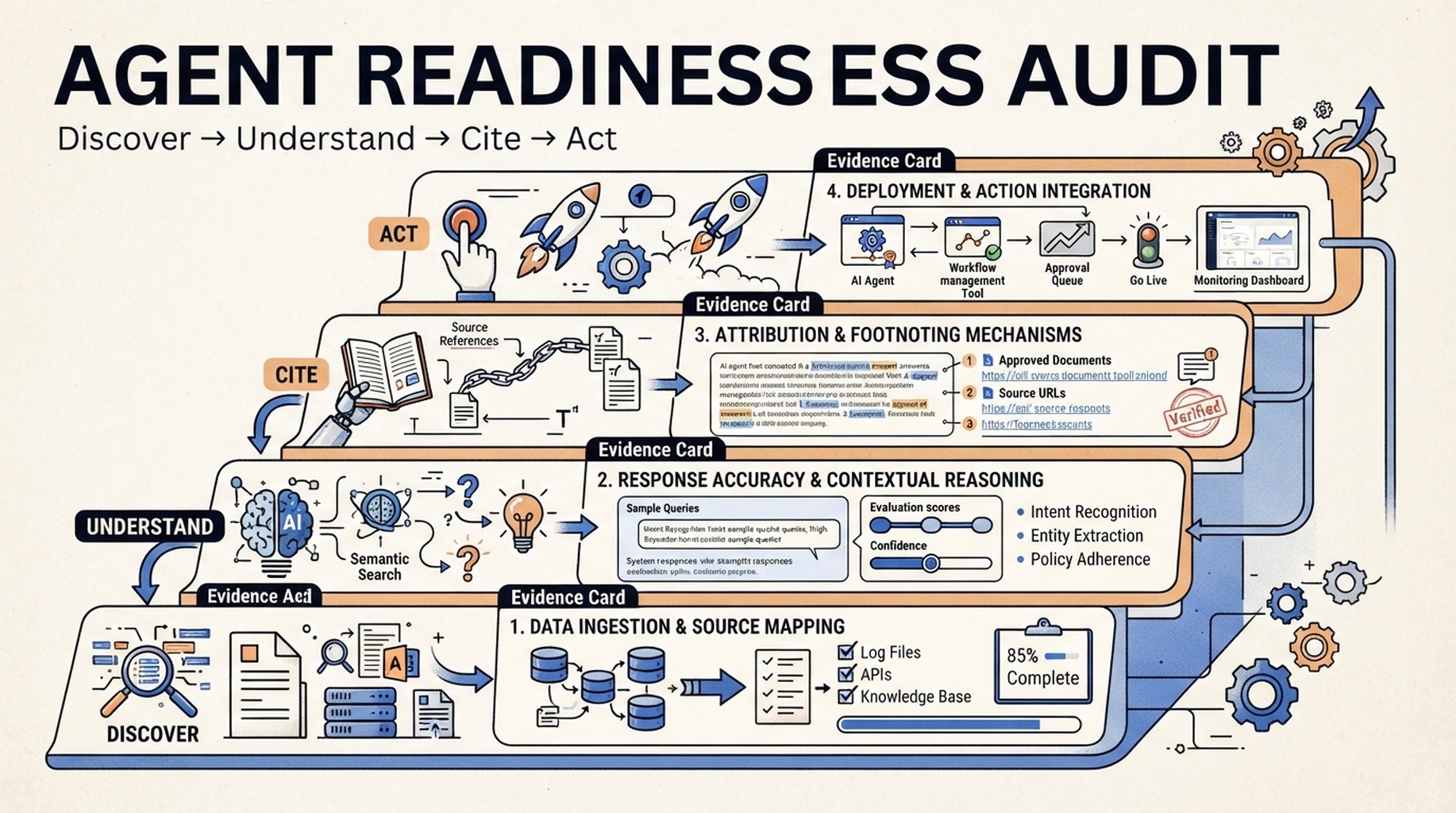
This audit has four layers: discoverable, understandable, citeable, and actionable. Fix them from the bottom up. A failure in a lower layer makes work in a higher layer fragile.
This is an audit and prioritization framework, not an argument for turning every website into an autonomous agent. For most companies, the first three layers solve the larger SEO and GEO problems. The fourth layer applies only when there is a real agent task, permission boundaries, and a meaningful confirmation experience.
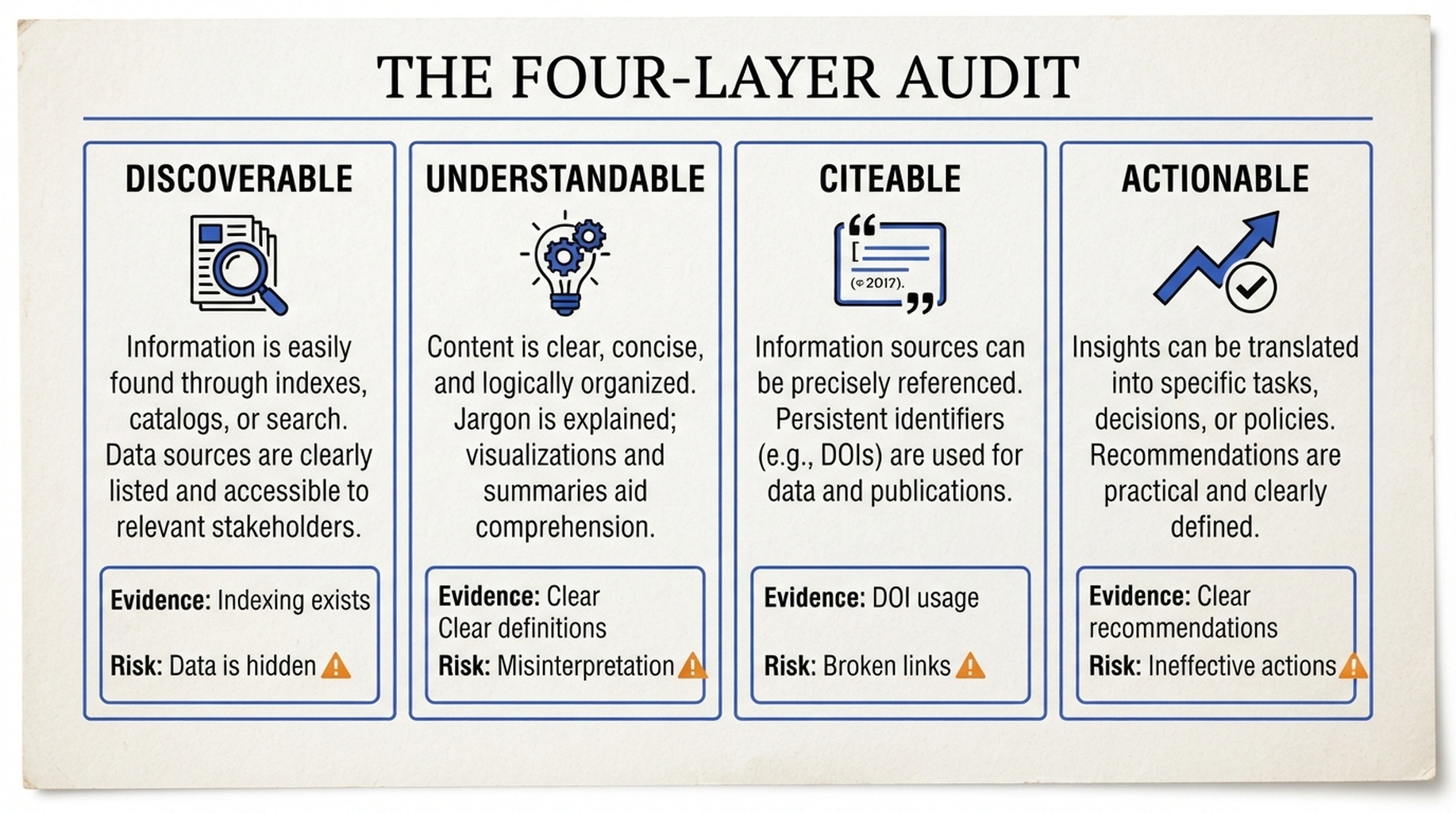
Fix from the bottom up. Discovery is the base, understanding establishes facts, citations earn answer eligibility, and action comes last.
Layer 1: Discoverable
This is still the SEO foundation. Appropriate crawlers need to reach, render, fetch, and index the page. Important pages need stable URLs, internal links, and sound canonicalization. Stable states, usable HTML, clear navigation, and predictable errors also help agents.
Check for:
- Stable, indexable URLs for important product, service, documentation, policy, and help pages.
- No accidental block from robots rules, authentication walls, JavaScript rendering, or canonicals.
- Critical facts that are not confined to images, video, or logged-in interfaces.
- Internal links between core task pages and supporting evidence pages.
- Explained fallback paths for load failures, empty states, and language or region changes.
Do not audit only blog indexability. Pricing, restrictions, returns, integrations, availability, and support-policy pages are often what an AI answer or agent decision needs to verify.
Layer 2: Understandable
Here the system should be able to tell who you are, what you offer, who it is for, and under which conditions. This is closer to entity and product-fact management than keyword coverage.
Every high-intent page needs an answer that stands alone: define the product or service, name the audience, state meaningful limitations, and point to evidence. Do not make people or models infer pricing conditions, geography, or compatibility from three paragraphs of marketing prose.
Page type | Facts that must be immediately clear | Common gap |
|---|---|---|
Product page | Category, intended user, capabilities, limits, price or pricing condition | A slogan with no boundaries |
Service page | Scope, location, deliverable, qualification, booking method | Location and fit hidden in FAQ |
Comparison page | Criteria, version date, common ground, real differences | Attacks on a competitor without evidence |
Help page | Problem, prerequisites, steps, failure modes | Steps cannot be completed independently |
Policy page | Effective date, region, exceptions, contact route | Old and new policies contradict each other |
Layer 3: Citeable
GEO is not merely getting a brand name mentioned. A better goal is to make a system able to reuse a clear, sourced, bounded part of your content when answering a specific question, without getting the brand or rule wrong.
Citation readiness does not come from adding a pile of FAQs. It comes from direct answers, verifiable facts, clearly named entities, evidence that supports the claim, distinct sections, and relevant dates, regions, and constraints.
Test 20 genuine buyer, support, or comparison questions rather than only asking for a generic recommendation. For each answer, record whether the brand appears, whether the correct URL is cited, whether the main fact is correct, and whether important constraints survive. Retest every two to four weeks, then map error patterns back to pages.
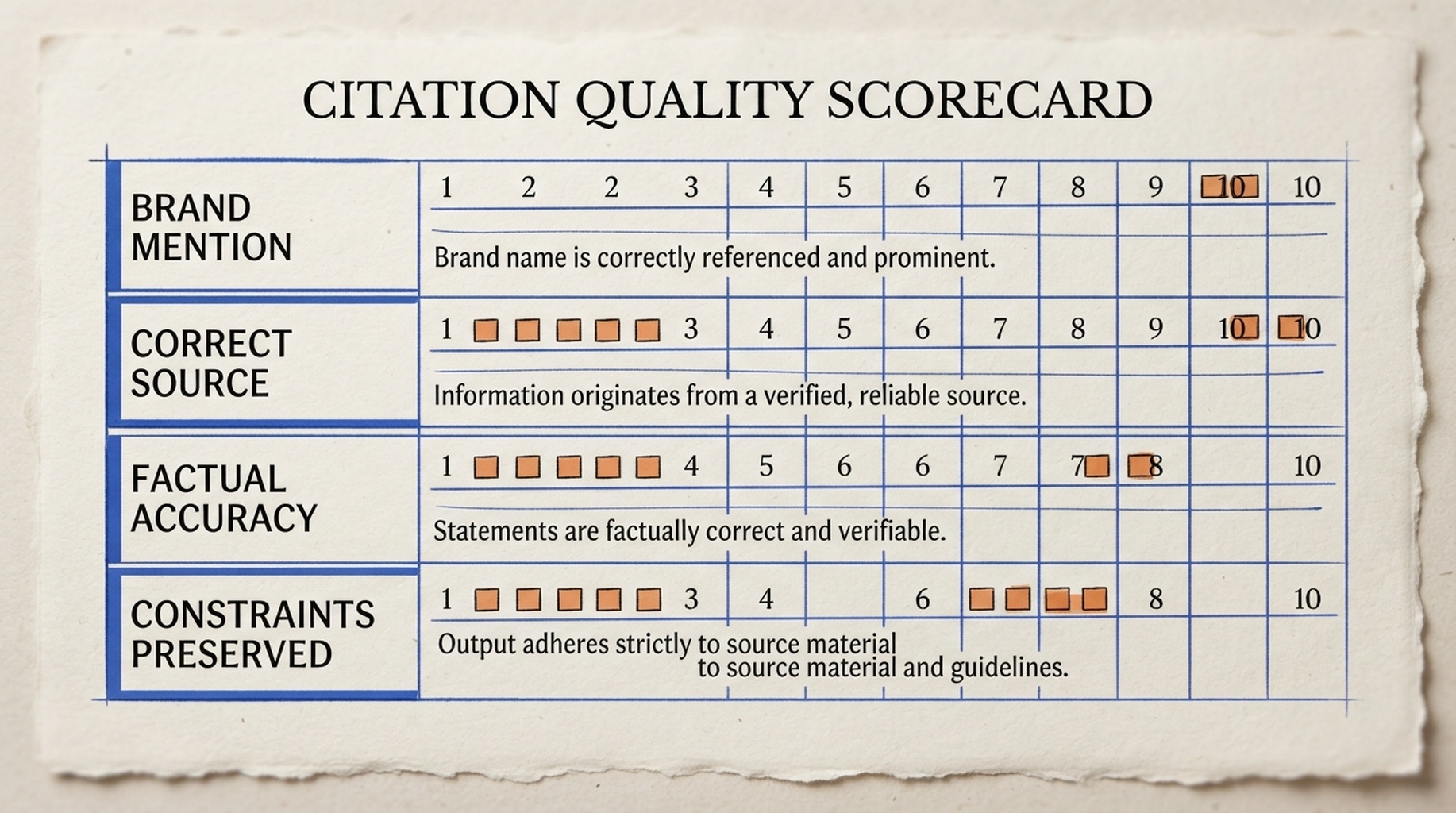
Citation is not binary. Brand mention, correct source, factual accuracy, and preserved constraints deserve separate records.
Layer 4: Actionable
Only this layer is the task side of agent readiness. A site needs to split a real task clearly: which input is needed, where permission comes from, how an outcome is previewed, where confirmation is mandatory, and how a user recovers from failure. The human interface must still work. An agent is an added collaborator, not a superuser that bypasses the ordinary security model.
WebMCP is one possible implementation. It can expose JavaScript functions or HTML forms in the browser as structured tools and reduce DOM guesswork. Do not add it to a roadmap simply because the protocol exists. First show that the task is worth automating and complete a threat model.
For the boundary between content, SEO, GEO, and tools, read WebMCP, SEO, and GEO: What AI Agent Website Optimization Actually Optimizes. If you are ready to prototype, use the trusted-origin, untrusted-content, read/write, and confirmation controls in the WebMCP Security Checklist.
The priority matrix: do not package a lower-layer failure as higher-layer innovation
Finding | Layer | Risk | Next move |
|---|---|---|---|
Product page renders as an empty shell to a crawler | Discoverable | High | Fix rendering and accessible content before GEO work |
Brand page omits audience, pricing condition, and limits | Understandable | High | Build a factual page module and review product/service templates |
AI answers mention the brand but omit regional limits | Citeable | Medium-high | Add a verifiable scope statement near the top, then retest prompts |
Agents choose the wrong filter during a search task | Actionable | Medium | Improve form state, labels, and errors before structured tools |
An agent can read reviews and create refunds | Actionable | Critical | Stop automation and threat-model permissions, UGC, and confirmation |
This is why "Does WebMCP affect SEO?" asks the wrong question. A crawl problem in layer one is not repaired by WebMCP. Missing facts in layer three do not become citeable because a tool exists. It can only improve one already validated task in layer four.
A 30-day plan that begins with evidence
Week 1: Choose scope and establish a baseline
Pick one product line or one valuable service, not the whole site. List ten key URLs, 20 genuine questions, and three high-frequency tasks. Record indexability and rendering, fact gaps, AI-answer error types, and the manual path for each task.
Week 2: Repair discovery and understanding
Fix blocked crawling, incorrect canonicals, empty-shell rendering, outdated policies, and broken internal links. Add clear definitions, audience, limits, evidence, and a next step to the most important pages. Do not use AI to mass-rewrite pages before facts have been reviewed.
Week 3: Build citation tests
Test the same question set in relevant answer surfaces. Record source URL, answer accuracy, retained constraints, competitor appearance, and likely user next step. Update pages based on error patterns, not brand-mention count alone.
Week 4: Select one safe task prototype
Only when the first three layers have no clear blocker should you choose a public, read-only, low-impact task. Define inputs and outputs, retain human confirmation and a failure fallback, and review UGC or third-party data before returning it to an agent. Google Chrome's WebMCP tool security guidance makes the ownership clear: untrustedContentHint, readOnlyHint, and precise origin exposure are the tool author's responsibility.
Use scores to queue work, not to replace judgment
You can use Auspia's Agent Readiness Score for a first pass, but a total score only helps you sort work. A site can have excellent content structure and still be unsafe if order lookup is exposed to an untrusted origin. Conversely, a site with no agent tool can be very strong in the first three layers and already have a solid SEO and GEO foundation.
Keep three forms of evidence for every layer: page samples, real test results, and a named owner. When an AI platform or web standard changes, the team can update evidence and process instead of chasing a new label.
FAQ
Do all four layers need to be complete for GEO?
No. GEO centers on understanding and citation readiness, built on discovery. The actionable layer applies only when agents need to complete a real task on the site.
Which layer does llms.txt belong to?
At most, it is a supplemental discovery or guidance signal. It does not replace accessible pages, clear facts, evidence, or testing. Confirm platform support and use empirically.
How should I choose 20 AI test questions?
Start with questions supported by search demand, sales calls, or support records: product fit, comparisons, pricing conditions, regional availability, setup, limits, and troubleshooting. Every question should map to a page with an owner.
Is WebMCP the only option in the actionable layer?
No. Better forms, stable APIs, accessible HTML, and clear confirmation may improve many tasks first. WebMCP is a candidate structured interface for browser agents and remains early-stage.
Sources
- Google Chrome: WebMCP overview
- Google Chrome: WebMCP tool security
- Google Chrome: WebMCP early preview
Author: Ethan Marlowe, GEO Measurement Lead Across 500+ Prompts at Auspia. Ethan writes about prompt tracking, citation reporting, visibility dashboards, and AI answer quality checks.