The short answer
SEO in 2026 is not "publish more articles," "trade backlinks," or "repeat the keyword until the page ranks." Those are tactics. Some are useful. Some are risky. None of them explain the job.
SEO is the work of making a website the most useful, accessible, and trustworthy answer for the searches that matter to the business. That means understanding search intent, fixing technical access, building content that helps users decide, earning credible references, tracking data, and now preparing the same content to be used by AI answer systems.
The shortcut version is this: SEO is not about tricking search engines. It is about becoming the result that a search engine, an AI answer engine, and a real buyer can all justify choosing.
Why the old definition of SEO is too small
Ask ten business owners what SEO means and you will still hear the same answers: blog posts, backlinks, keywords, rankings, Google traffic. They are not entirely wrong, but they are incomplete.
Saying SEO is "writing articles" is like saying cooking is "putting food in a pan." Technically related. Not enough to produce a good meal.
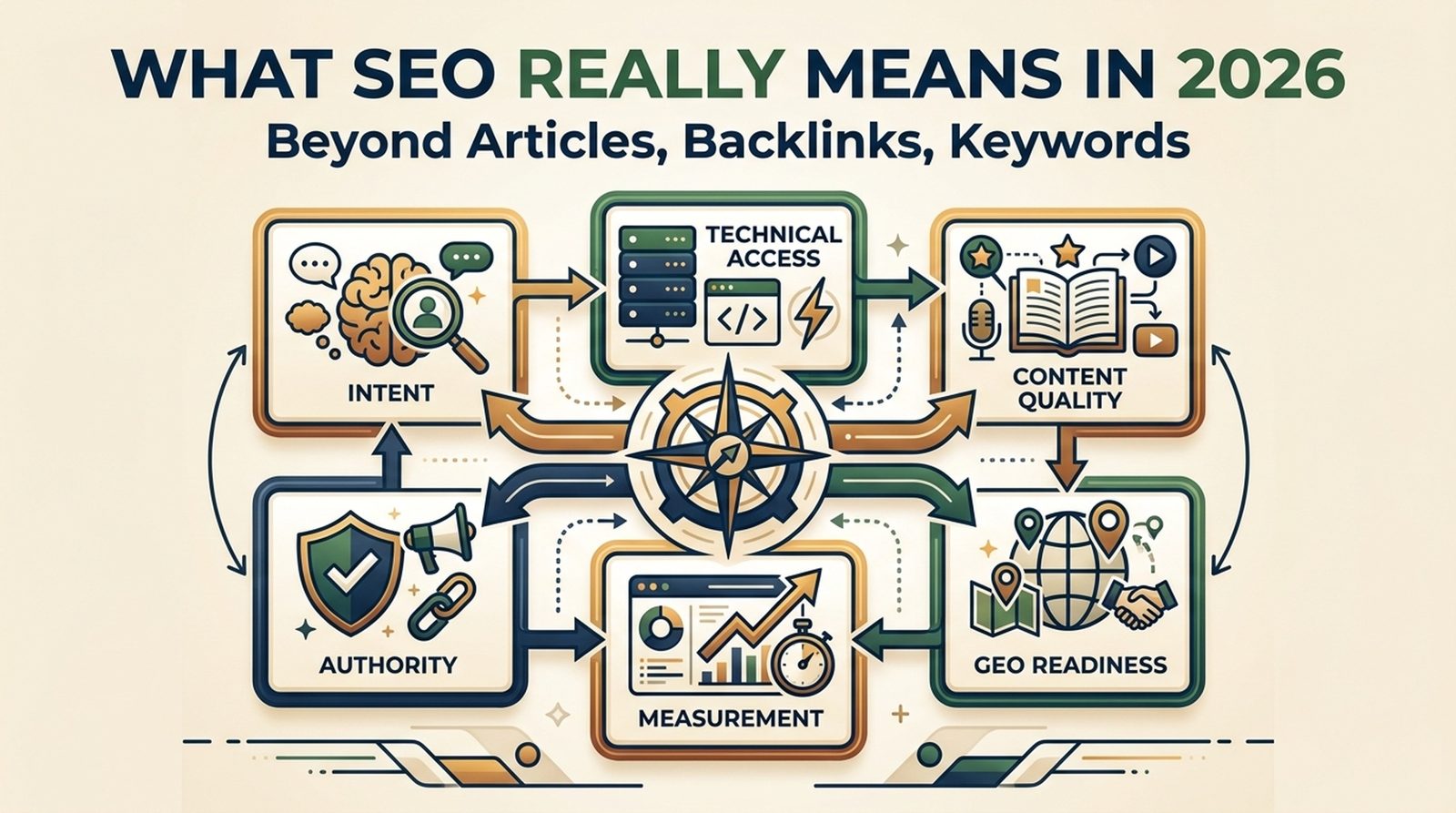
Modern SEO includes at least six jobs:
SEO job | What it means |
|---|---|
Intent research | Understand what users are trying to solve, compare, buy, or verify |
Technical access | Make sure pages can be crawled, rendered, indexed, and understood |
Content quality | Publish pages with specific, useful, experience-backed answers |
Authority building | Earn trust through links, mentions, reviews, data, and brand evidence |
Experience optimization | Make the page fast, clear, mobile-friendly, and conversion-aware |
Measurement | Use data to decide what to fix, expand, merge, or stop doing |
In 2026, there is a seventh job: GEO, or generative engine optimization. Your pages need to be useful for traditional search results and extractable enough for AI answers.
That does not replace SEO. It extends it.
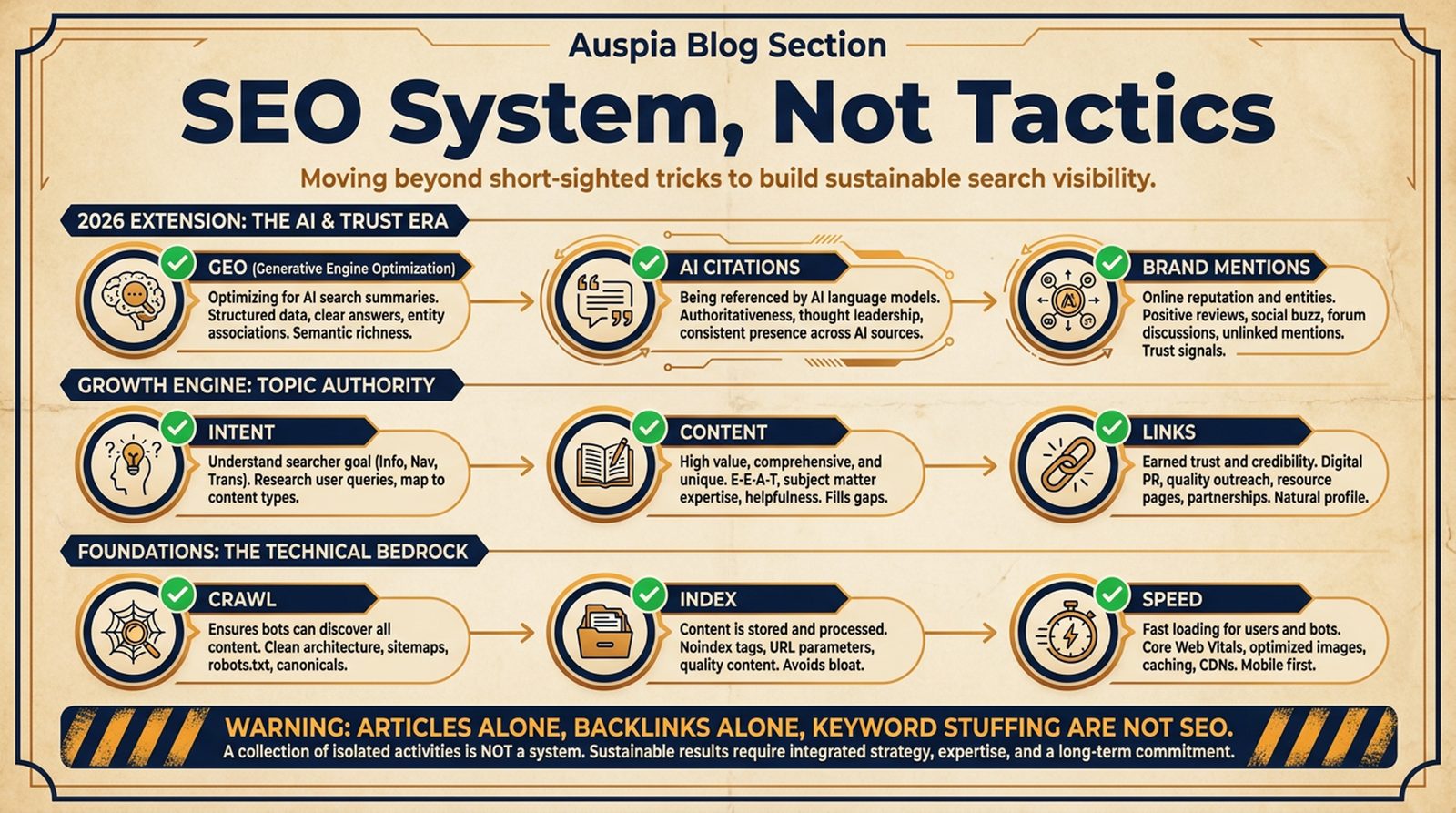
SEO in 2026 is a connected system, not a pile of isolated tactics like articles, backlinks, or keyword repetition.
What search engines are actually trying to do
Search engines have one basic job: help users find the most relevant and useful information quickly.
That sounds simple, but it explains almost every durable SEO principle. If a page is slow, thin, misleading, duplicated, stuffed with keywords, or disconnected from the user's real question, it is weaker. If a page is accessible, specific, accurate, easy to scan, and backed by evidence, it has a better shot.
This is true across Google, Bing, YouTube, Amazon, app stores, local search, and AI-powered answer systems. The interfaces differ. The user expectation is similar: show me the answer I can trust.
That is why SEO is not cheating. Black-hat tricks try to exploit the ranking system. Real SEO tries to make a page better aligned with what users and search systems already want.
The difference matters. Black-hat work may create a spike. White-hat work compounds.
Why SEO still matters when paid ads exist
Paid search and paid social are useful. They are also rented attention. When the budget stops, the traffic stops.
SEO is slower, but it builds owned visibility. Once a page earns durable rankings, citations, or brand visibility, it can keep producing qualified visits with lower marginal cost.
The important phrase is qualified visits. SEO traffic often comes from active intent. Someone searching "SOC 2 audit checklist for SaaS startups" or "best waterproof work boots for electricians" is not passively scrolling. They are trying to solve something.
That is the core value of SEO:
Channel logic | What happens |
|---|---|
Paid ads | You pay to interrupt or appear while demand exists |
SEO | You build assets that meet demand when users search |
GEO | You make those assets easier for AI systems to cite or recommend |
SEO is not free. It costs time, expertise, tools, content production, technical work, and patience. A new site may need months before meaningful results appear. But when it works, the cost per qualified visit often falls over time.
That is the compounding effect many teams underestimate.
SEO is not free traffic
Calling SEO "free traffic" has probably caused more bad planning than any other SEO phrase.
SEO has real costs:
- Research time
- Technical audits and fixes
- Content briefs, writing, editing, and expert review
- Design, diagrams, and product media
- Analytics setup and reporting
- Link earning, digital PR, and partnerships
- Ongoing updates when pages become stale
The better mental model is infrastructure. Paid ads are like renting a booth at a busy market. SEO is like building a road to your store. The road takes longer to build, but once it works, every new visitor is not priced like a fresh ad click.
That is why serious SEO work should be evaluated over months and quarters, not days.
The three pillars still matter: technical, content, and authority
Most SEO programs can still be explained through three pillars.
Technical SEO
Technical SEO is the foundation. It includes crawlability, indexability, site speed, mobile usability, HTTPS, URL structure, canonical tags, XML sitemaps, robots.txt, structured data, broken links, redirects, and rendering.
If technical access is broken, good content may never get a fair chance.
Content SEO
Content SEO is the work of matching search intent with useful pages. It includes keyword research, title and meta optimization, headings, answer blocks, internal links, image alt text, product copy, category copy, guides, comparisons, FAQs, and content refreshes.
The goal is not to cover a keyword mechanically. The goal is to answer the decision behind the query.
Authority SEO
Authority SEO includes backlinks, unlinked brand mentions, reviews, directory profiles, expert citations, partnerships, community references, digital PR, and topical reputation.
A link is not just a link. It is a signal that another source thought your page was worth referencing. Low-quality link schemes try to fake that signal. Real authority comes from assets and work worth citing.
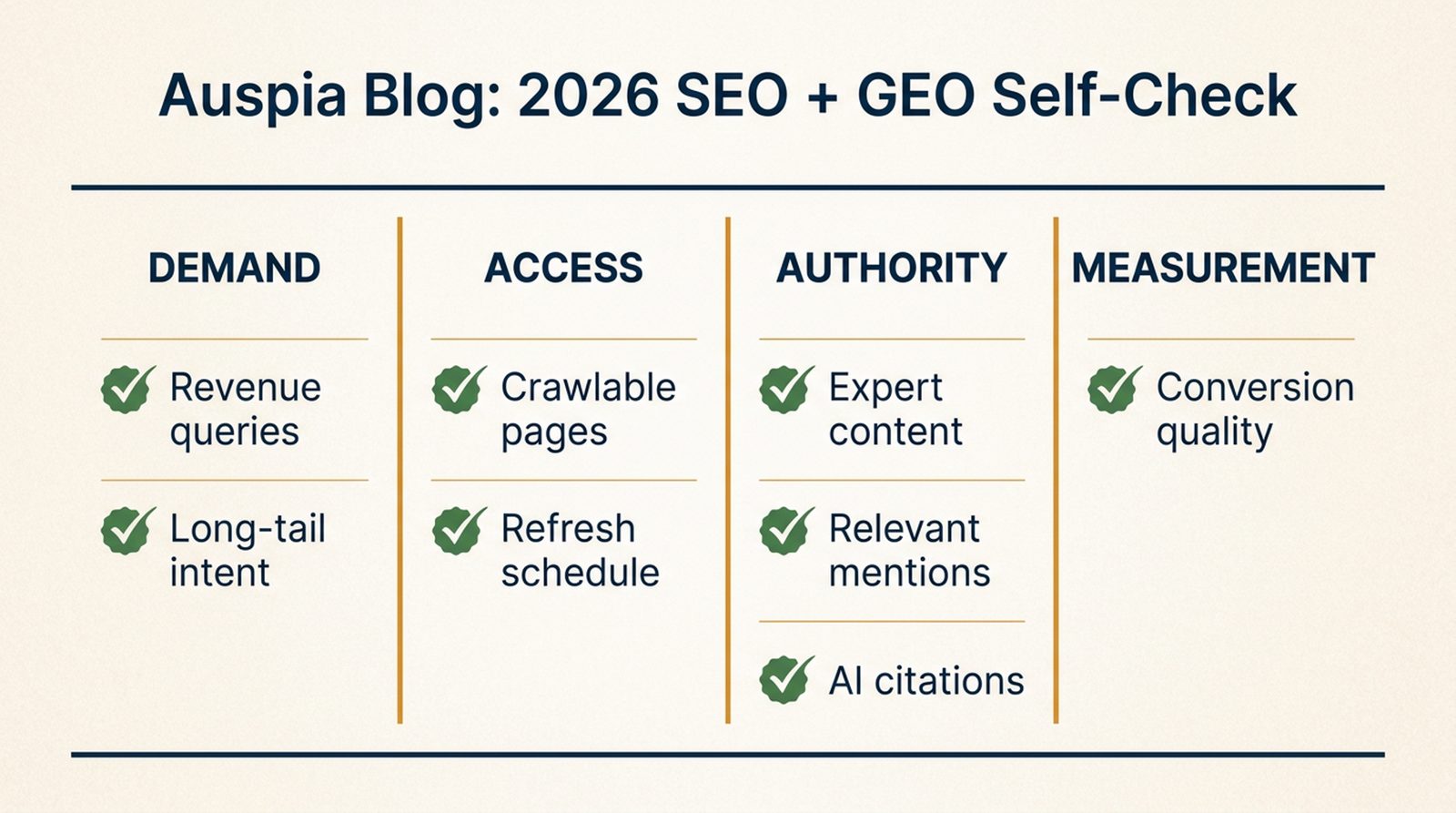
Use this self-check before buying SEO services, expanding content production, or chasing AI search visibility.
White hat, black hat, and the risk of shortcuts
SEO tactics usually fall into three groups.
Approach | What it does | Risk profile |
|---|---|---|
White hat SEO | Improves crawl access, content quality, user experience, internal links, and legitimate authority | Slower, safer, more durable |
Black hat SEO | Uses spam, hidden text, cloaking, automated links, click manipulation, or other deceptive tactics | Can work briefly, then collapse under penalties or updates |
Gray hat SEO | Sits between the two, often using tactics that may not be punished today but could become risky later | Unstable and hard to defend long term |
The problem with shortcuts is not only ethics. It is business risk. A site that depends on manipulation can lose visibility overnight. Recovery often costs more than doing the work correctly in the first place.
For most businesses, white hat SEO is not the slow option. It is the option that does not create a hidden liability.
Long-tail keywords are still the quiet advantage
Big keywords are tempting because the search volume looks impressive. But broad keywords often have mixed intent, heavy competition, and lower conversion clarity.
Long-tail keywords usually carry the better business signal.
Compare:
Broad query | Long-tail query |
|---|---|
"CRM software" | "CRM workflow for a 12-person B2B sales team using HubSpot and Slack" |
"running shoes" | "best stability running shoes for flat feet marathon training" |
"cybersecurity audit" | "SOC 2 access review checklist for seed-stage SaaS" |
"warehouse lighting" | "LED high bay lighting layout for 30-foot warehouse ceiling" |
The long-tail query may have fewer searches. It also tells you much more about the user, the context, and the next page they need.
In 2026, long-tail work matters even more because AI search and conversational queries are naturally specific. Users ask longer questions. Answer engines assemble responses around exact context. Pages that address narrow use cases can become easier to retrieve and quote.
The mistake is judging keywords only by search volume. A low-volume query from the right buyer can be worth more than a high-volume query from everyone.
Algorithms are not mysteries; they are guardrails
Every major search engine updates its systems to reduce spam and improve results. The labels change by platform, but the pattern is consistent: punish low-quality manipulation and reward useful, trustworthy information.
Google's public guidance around helpful content, spam policies, reviews, and site quality points in the same direction. Bing, YouTube, marketplaces, and AI answer systems also care about source quality, not just exact-match text.
You do not need to memorize every update. You do need to understand the direction:
- Do not mislead users with titles that do not match the page.
- Do not mass-produce pages that add no new value.
- Do not hide important text or stuff keywords.
- Do not build authority through obvious link schemes.
- Do not let ads, popups, or poor mobile UX destroy the page experience.
- Do not publish claims you cannot support.
Good SEO teams watch updates, but they do not rebuild their whole strategy around every rumor. They build sites that would still make sense if a human quality reviewer opened the page.
What a real SEO operator does every week
A real SEO role is not just "write posts and build links." The work is closer to running an organic growth system.
Weekly work usually includes:
Task | Why it matters |
|---|---|
Monitor rankings and impressions | Find where visibility is improving or slipping |
Review search queries | Learn what users are actually asking |
Analyze landing pages | See which pages attract qualified traffic and which leak users |
Inspect crawl and index data | Catch blocked pages, errors, duplicates, and rendering problems |
Check internal links | Improve discovery and topic relationships |
Refresh existing content | Keep important pages accurate and competitive |
Watch competitors | See which formats, topics, and sources are winning |
Measure conversions | Separate vanity traffic from business impact |
Data is not a report for show. It is how you avoid guessing.
If traffic drops, the first question is not "Should we publish more?" It is: what changed? Did impressions fall? Did rankings fall? Did click-through rate fall? Did a page lose eligibility? Did a competitor gain a SERP feature? Did an AI answer reduce clicks but improve brand exposure?
Without data, SEO becomes superstition.
The 2026 variable: SEO plus GEO
The biggest new variable in 2026 is not that search disappeared. It is that search results are being repackaged by AI systems.
Users may ask an AI engine and receive an answer before visiting a site. They may see an AI Overview in Google. They may compare products inside a conversational assistant. They may ask follow-up questions instead of starting a new search.
This changes optimization priorities.
Traditional SEO asks: can we rank for the query?
GEO asks: can our content be retrieved, trusted, summarized, and cited by a generative answer system?
The practical overlap is large:
SEO need | GEO extension |
|---|---|
Crawlable pages | Allow useful bots and expose important content clearly |
Search intent coverage | Write direct answer blocks and buyer-specific sections |
Quality content | Add sources, examples, data, and first-hand judgment |
Internal links | Build topic clusters that clarify entity relationships |
Authority | Earn third-party mentions that AI systems can corroborate |
Measurement | Track citations, AI mentions, and source inclusion, not only clicks |
This is why Auspia treats SEO and GEO as one connected operating model. You still need rankings. You also need to know whether answer engines can find and use you.
A good first step is to test your target prompts and brand prompts every month. Auspia's AI Search Visibility Checker can help turn that into a repeatable workflow.
How to judge SEO work without getting misled
If you hire an SEO vendor or build an internal team, do not judge the work only by the number of articles published or the number of links reported.
Use better checks:
Bad metric alone | Better question |
|---|---|
"We published 50 articles" | Which pages earned impressions, rankings, links, citations, or conversions? |
"We got 200 backlinks" | Are they relevant, indexed, trusted, and likely to survive? |
"We rank number one" | Is the keyword relevant to our business and searched by real buyers? |
"Traffic increased" | Did qualified leads, demos, purchases, or assisted conversions improve? |
"AI wrote the content faster" | Did experts add original examples, data, and judgment? |
Transparency matters. A serious SEO program should be able to show source data from Google Search Console, analytics, rank tracking, crawl tools, log files when needed, and business conversion data. If all reporting comes from a vendor's private dashboard with no way to verify it, be careful.
A 2026 SEO self-check
Use this checklist before investing more in content or outsourced SEO.
Question | Healthy answer |
|---|---|
Do we know which searches matter to revenue? | Yes, mapped by intent and funnel stage |
Can key pages be crawled and indexed? | Yes, checked through search console and crawl tools |
Do pages answer specific user decisions? | Yes, with direct answers, examples, and next steps |
Are we building long-tail assets? | Yes, based on specific use cases and buyer problems |
Are links and mentions relevant? | Yes, from sources that make sense in the market |
Do we measure conversion quality? | Yes, not just sessions and rankings |
Are we tracking AI visibility? | Yes, across target prompts, brand prompts, and citations |
Do we refresh important pages? | Yes, with owners and review dates |
Is content expert-reviewed? | Yes, especially for technical or commercial claims |
Can we explain every tactic? | Yes, no black-box promises or vague "secret methods" |
If several answers are weak, fix the operating system before chasing more tactics.
Auspia take
SEO is not a pile of tricks. It is a search growth system.
In 2026, that system has to serve three audiences at the same time: the search engine that discovers and ranks the page, the AI system that may summarize or cite it, and the human user who must decide whether to trust you.
That is why the old shortcuts feel smaller now. Articles without insight, backlinks without relevance, keywords without intent, and rankings without business value are not enough.
The durable work is less glamorous: understand demand, build useful pages, fix technical access, earn real authority, measure honestly, and make your content clear enough for both people and machines to use.
Do that long enough, and SEO stops being a monthly task list. It becomes a compounding asset.
FAQ
What is SEO in simple terms?
SEO is the process of improving a website so search engines can find, understand, and recommend it for relevant searches. In 2026, it also means preparing content to be used by AI answer systems.
Is SEO just writing articles?
No. Articles are one part of SEO. Technical access, page structure, internal links, authority signals, user experience, analytics, and conversion quality all matter.
Are backlinks still important in 2026?
Yes, but relevance and trust matter more than raw volume. A small number of credible, contextually relevant links or mentions can be more useful than hundreds of weak links.
How is GEO different from SEO?
SEO focuses on visibility in search results. GEO focuses on making content easier for generative AI systems to retrieve, summarize, cite, and recommend. In practice, strong SEO foundations make GEO easier.
How long does SEO take?
It depends on site age, competition, content quality, technical health, and authority. Many new sites need several months to see meaningful movement. SEO is usually a compounding channel, not an instant traffic switch.