The short version
GEO is not just SEO with a newer acronym. SEO still matters because search engines, websites, documentation pages, reviews, and trusted publications remain part of the evidence layer that AI systems read. But GEO asks a different question.
SEO asks, "Can we rank when someone searches this keyword?"
GEO asks, "When an AI system answers a real buyer's question, does it understand our brand well enough to mention us accurately?"
That difference changes the work. A brand can have decent rankings and still disappear from AI answers. It can have a strong website and still be summarized incorrectly. It can publish hundreds of pages and still fail to show up when a user asks a scenario-based question such as "Which project management tool is best for a remote design team under 20 people?" or "What is a reliable CRM for a B2B startup that needs HubSpot alternatives?"
For growth teams, the practical answer is not "stop doing SEO." It is to run SEO and GEO as two connected systems. SEO builds durable evidence. GEO turns that evidence into answer-ready brand visibility.
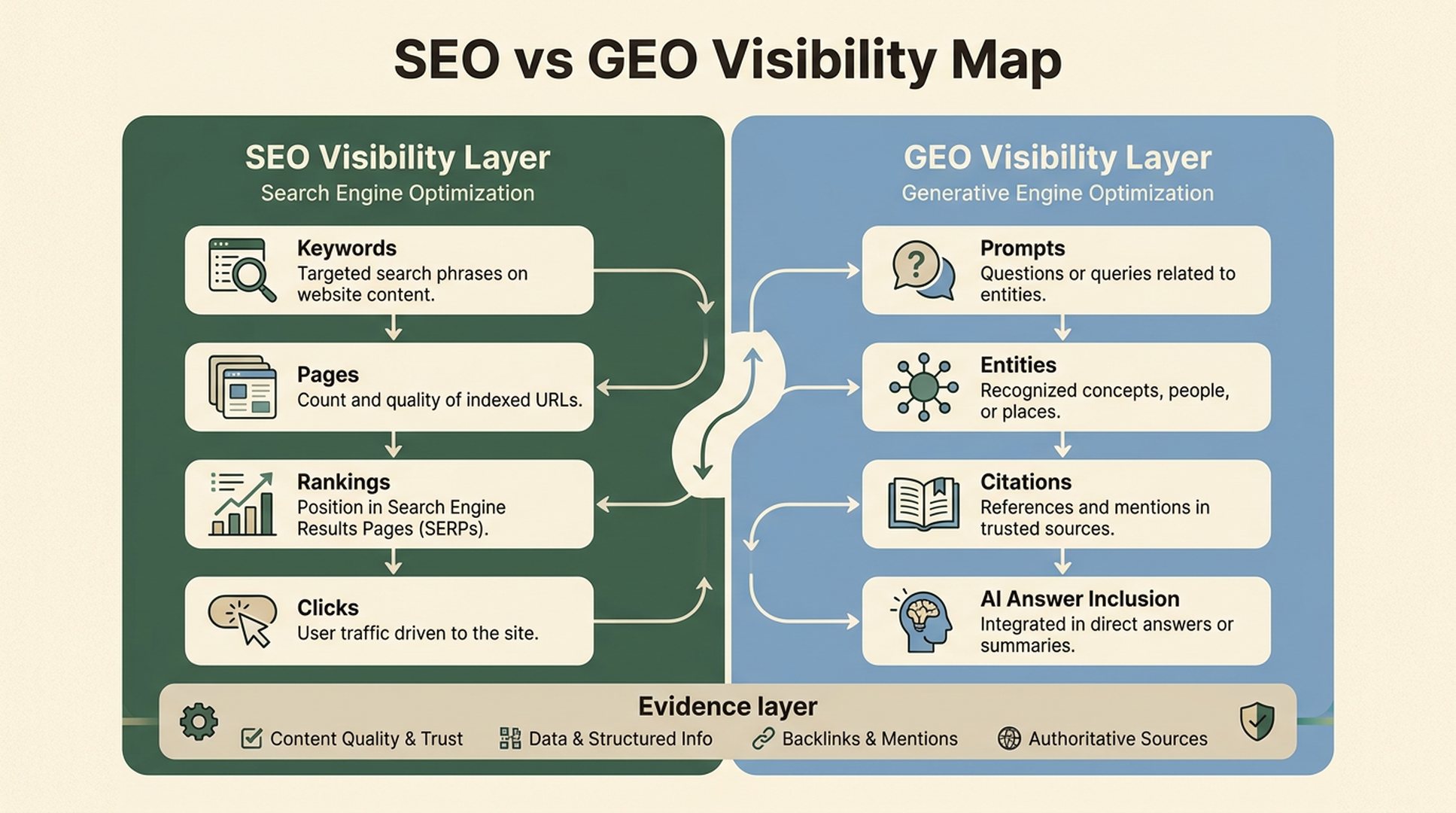
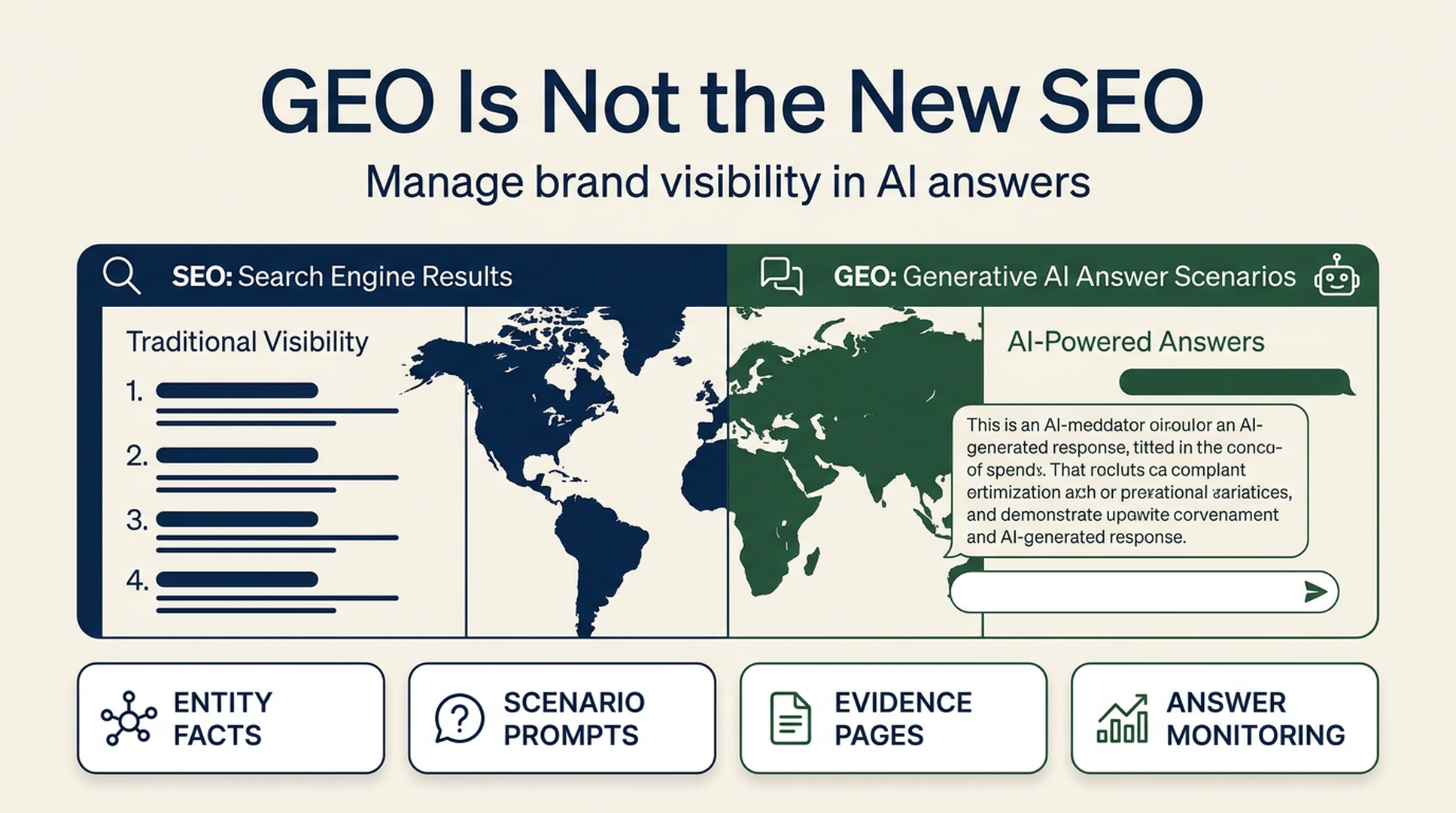
GEO and SEO should share evidence, but they optimize for different moments: search results versus AI-generated answers.
Why SEO alone is no longer enough
Traditional SEO is built around pages, queries, links, technical accessibility, and intent matching. That model is still useful. People still search Google. AI answer products still use web pages, structured data, reviews, and public mentions as raw material.
The problem is that AI search does not behave like a blue-link results page.
When someone asks an AI assistant, "What are the best accounting tools for a freelance consultant in the US?" the system may blend product pages, comparison articles, review snippets, pricing pages, help docs, Reddit threads, YouTube transcripts, and its own learned associations. It is not simply looking for the page that repeats "accounting software for freelancers" the most effectively.
It is trying to construct an answer.
That answer needs entities, use cases, constraints, evidence, and confidence. If your brand information is thin, scattered, outdated, or hard to verify, the model may skip you. Worse, it may include you but describe you badly.
This is the uncomfortable part: ranking and being understood are related, but they are not the same thing.
From keyword competition to scenario ownership
A useful way to separate SEO from GEO is to look at the unit of competition.
Question | SEO view | GEO view |
|---|---|---|
What are we optimizing for? | Keywords, pages, rankings, click-through | User scenarios, answer inclusion, accurate brand framing |
What is the main asset? | Search-optimized web pages | Verifiable evidence that answer engines can use |
What does success look like? | Ranking, impressions, organic clicks | Mentions, citations, accurate summaries, qualified referral traffic |
What can go wrong? | Lower rankings or fewer clicks | Omission, wrong positioning, outdated claims, negative answer framing |
What needs to be monitored? | SERPs, indexation, technical health | AI answers, citations, entity consistency, scenario coverage |
SEO usually starts with the keyword. GEO usually starts with the situation.
For example, a cybersecurity company may rank for "endpoint security software." That is useful. But in AI answers, the brand may win or lose on much more specific prompts:
- "Best endpoint protection for a 300-person healthcare company"
- "EDR tools that integrate well with Microsoft Defender"
- "Lightweight security software for a remote engineering team"
- "Alternatives to CrowdStrike for mid-market companies"
Those prompts are not just keywords. They are decision scenes. They include company size, category expectations, risk profile, existing stack, budget pressure, and comparison logic.
GEO work maps those scenes, then makes sure the brand has public, crawlable, believable evidence for each one.
The three jobs of GEO visibility management
Most teams treat GEO as a content problem: publish more pages, add FAQ blocks, mention AI search, hope for the best.
That is too narrow. GEO is closer to visibility management. It has three jobs.
First, it protects the brand entity. AI systems need to know who you are, what you do, who you serve, what your product is called, where official information lives, and which claims are current. If your site says one thing, old partner pages say another, and review sites describe you with outdated categories, the answer engine gets mixed signals.
Second, it watches the questions people ask. Classic brand monitoring often tracks mentions and sentiment. GEO monitoring should also track prompts. There is a big difference between "Is Brand X safe?" and "Does Brand X work with Salesforce?" One is a trust concern. The other is a buying signal. The response content should be different.
Third, it builds scenario evidence. A brand cannot be recommended in a scenario it has never explained. If you want to appear for "AI search visibility tools for agencies," you need public evidence that explains your agency use case, workflow, constraints, integrations, reporting model, and outcomes. A homepage claim is rarely enough.
This is why GEO feels less like a campaign and more like an operating loop.
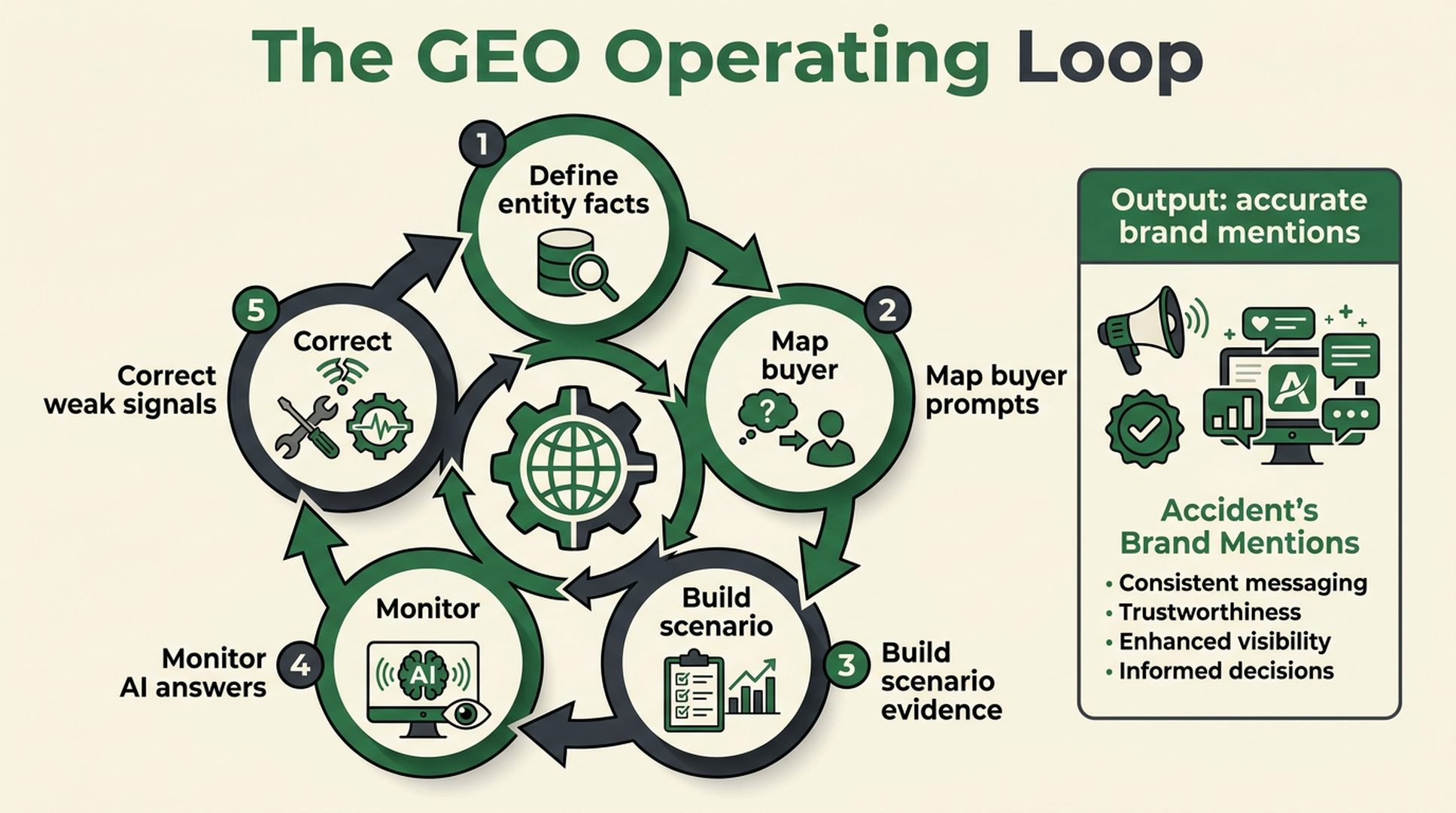
The GEO loop: define entity facts, map buyer questions, create scenario evidence, monitor AI answers, and correct weak or inaccurate signals.
What "answer-ready" brand evidence looks like
AI systems do not need your marketing team to write more dramatic claims. They need better evidence.
Good evidence is specific, consistent, and easy to quote. It usually includes:
Evidence type | Why it helps AI answers | Example |
|---|---|---|
Clear category language | Helps the system classify the brand | "Auspia is an AI search visibility and GEO workflow platform" |
Use-case pages | Connects the brand to real scenarios | "For SaaS teams measuring mentions across ChatGPT, Perplexity, and Google AI answers" |
Comparison pages | Helps answer alternative and shortlist questions | "Auspia vs manual AI visibility tracking" |
Customer proof | Adds credibility without relying only on self-description | Case studies, quotes, implementation notes |
Structured FAQs | Gives concise answers for extraction | Pricing, setup time, data sources, limits |
Updated docs | Reduces outdated summaries | Product capabilities, integrations, supported markets |
Third-party mentions | Builds corroboration | Reviews, partner pages, podcasts, articles, directories |
Notice what is missing: keyword stuffing.
The best GEO content often reads more plainly than old-school SEO content. It states who the product is for, when it is a fit, when it is not a fit, and what evidence supports the claim.
Why GEO and SEO should work together
It is tempting to turn GEO into a replacement story: old search is dying, AI search is the future, rebuild everything. That makes for a neat headline, but it is bad operating advice.
SEO is still part of the evidence supply chain. Your website needs to be crawlable. Your category pages need to explain the product. Your comparison pages need to rank or at least be discoverable. Your technical SEO needs to keep important pages accessible. Your brand needs clean schema, internal links, and canonical pages.
GEO adds another layer on top:
- Which prompts should include us?
- What sources do AI systems cite when they mention our category?
- Are we described with the right category and use case?
- Are old claims or weak third-party pages shaping the answer?
- Which missing content would make us easier to cite?
A good workflow is simple.
- Use SEO research to find durable demand: categories, alternatives, comparisons, pain points, and informational queries.
- Convert those topics into AI-answer scenarios: buyer role, company type, constraints, decision criteria, and follow-up questions.
- Build answer-ready pages and supporting assets for the scenarios that matter.
- Monitor AI answers regularly, not once a quarter.
- Fix the evidence layer when answers are wrong, thin, or missing your brand.
If you want a quick starting point, run an AI visibility check before you rewrite the whole site. Auspia's AI Search Visibility Checker can help teams see how their brand appears across answer-style prompts.
A practical GEO + SEO playbook for brand teams
Here is a simple version a team can run in one week.
Day 1: define the brand entity
Write a one-page source of truth:
- Official brand name, product names, and category
- Primary use cases
- Target customers
- Markets served
- Features that are current
- Claims you can prove
- Claims you should avoid
- Official URLs that should be treated as source pages
Then compare that against your homepage, About page, product pages, docs, review profiles, and social bios. Inconsistent naming is a small issue for humans and a large issue for machines.
Day 2: build the prompt map
Create 30 to 50 prompts that reflect real buying and research behavior. Use groups such as:
- Category discovery: "What are the best tools for..."
- Comparison: "Brand A vs Brand B for..."
- Alternatives: "Alternatives to..."
- Fit questions: "Is Brand X good for..."
- Risk questions: "Is Brand X safe/reliable/compliant..."
- Implementation: "How long does it take to set up..."
Do not make every prompt flattering. Include the awkward ones. AI visibility work that only tests happy-path prompts gives a false sense of security.
Day 3: inspect current AI answers
Run the prompt set across the AI systems your buyers are likely to use. Capture:
- Whether your brand appears
- How it is described
- Which competitors appear
- Which sources are cited or implied
- Whether the answer is accurate
- What content appears to be missing
For a broader site-level baseline, pair this with an Auspia GEO check so you are not relying only on manual screenshots.
Day 4: find evidence gaps
Turn the answer gaps into content gaps. Typical gaps include:
- No page for a specific use case
- No comparison content
- No clear answer to pricing or setup questions
- No recent third-party corroboration
- Old docs outranking current product pages
- Review profiles using outdated category labels
- Case studies that tell a story but do not state the use case clearly
This step matters because many AI answer problems are not model problems. They are evidence problems.
Day 5: publish and correct
Prioritize pages that can serve both SEO and GEO:
- A category page that explains the market in plain language
- A comparison page for a real competitor or workflow alternative
- A use-case page tied to a buyer scenario
- A concise FAQ page that answers extraction-friendly questions
- A proof page with customer examples or implementation detail
Then update third-party profiles where possible. If a review site, partner listing, marketplace page, or public documentation page is outdated, fix it. AI systems often trust corroborated information more than a single brand-owned claim.
Common mistakes
The first mistake is treating GEO as a few FAQ blocks. FAQs can help, but only if the rest of the evidence layer supports them.
The second mistake is chasing mentions without checking accuracy. A wrong mention can be worse than no mention, especially in categories where trust, safety, compliance, or pricing matter.
The third mistake is copying SEO habits into AI search. Long pages full of repeated phrase variants are not automatically useful to answer engines. Clearer pages often work better.
The fourth mistake is ignoring unbranded prompts. Many buyers ask AI systems for recommendations before they know which brands exist. If your GEO program only tests your own brand name, you are measuring reputation, not discovery.
The fifth mistake is relying only on your website. Brand visibility in AI answers is shaped by the web around you: reviews, communities, directories, analyst content, videos, podcasts, and public documentation.
Auspia's take
The cleanest way to think about GEO is this: SEO helps your pages get found. GEO helps your brand get understood.
You need both.
If your SEO foundation is weak, AI systems have fewer reliable sources to work with. If your GEO loop is weak, your strong SEO content may still fail to appear in the moments when buyers ask AI for a recommendation, comparison, or shortlist.
The best teams will not argue over which acronym wins. They will build a shared visibility system: crawlable pages, clear entity facts, scenario evidence, third-party corroboration, and recurring AI-answer monitoring.
That is the new brand visibility job. Less guessing. More evidence.
FAQ
Is GEO replacing SEO?
No. GEO changes the visibility target, but SEO still supplies much of the evidence that AI answer systems use. Brands should keep technical SEO, content quality, internal links, and authority-building while adding AI-answer monitoring and scenario evidence.
What is the biggest difference between GEO and SEO?
SEO focuses on ranking pages for search queries. GEO focuses on whether AI systems include, cite, and describe your brand correctly when they generate answers. The work overlaps, but the measurement and content strategy are different.
How do I know if my brand needs GEO work?
Start by testing the prompts your buyers would ask before purchase: alternatives, comparisons, use cases, risks, setup questions, and category recommendations. If your brand is missing, miscategorized, or described with outdated information, you need GEO work.
What content should I create first for GEO?
Create content that makes your brand easy to classify and cite: category pages, use-case pages, comparison pages, concise FAQs, proof pages, and updated documentation. Start with scenarios that match high-intent buyer questions.
Can small brands win in AI answers?
Yes, but not by pretending to be bigger than they are. Small brands can win narrow scenarios if they provide clear evidence, specific use cases, credible third-party mentions, and content that answers real buyer constraints better than larger competitors.