The first screen must earn the next scroll
Search visitors and AI retrieval systems both benefit when a page says its answer plainly, then proves it. This is not a trick: it is an editing discipline.
Definition of done: An approved answer-first page diff: direct answer, decision criteria, evidence, limits, and next step.
Allow 45 to 60 minutes. Bring the approved draft and Claim Review from Lesson 10, plus the Fact Pack. This is an editing pass. Do not add schema, FAQ blocks, or keyword repetition before you can explain the answer to a human.
Inspect the page in five blocks
Read [page draft or URL] and [Fact Pack]. Do not edit or publish. Return an
Answer Clarity Diff with: 1) the visitor question, 2) a 2-sentence direct
answer supported by confirmed facts, 3) missing decision criteria, 4) proof
blocks to add, 5) limitations to state, 6) a next action, and 7) proposed
section-level changes. Mark unsupported text NEEDS OWNER FACT.
Use this shape only when it fits: answer -> who this is for -> how to decide -> proof -> limits -> next step. A product page may need compatibility and returns; a local page may need service area, availability, and booking process.
Start with the reader's exact question
Write the question at the top of answer-clarity-review.md. For the running example it is: "What records should a freelance designer gather before a self- assessment deadline, and when might monthly bookkeeping help fit?"
Now read the first 150 words of the draft without looking at the rest. A good opening can be summarized as:
If you are a sole-trader designer preparing for self-assessment, gather the
records in this checklist before deciding whether monthly bookkeeping support
fits. The service can help organize ongoing records; it does not file personal
tax returns. The sections below show what to prepare and what happens next.
That is clearer than an opening such as Tax season is stressful for creatives and staying organized matters. The latter has no answer, no fit condition, no limit, and no reason to keep reading.
Quality check: A visitor can repeat the answer after one screen. If your opening needs three definitions before it answers, move the answer up and put background later.
Rewrite the first 120 words before rewriting everything
The fastest improvement is often in the opening. Ask Codex for a small diff first:
Using the page and Fact Pack, rewrite only the title, first 120 words, and
first heading. The opening must answer the visitor question, identify who the
answer fits, name one condition or limitation, and lead into evidence below.
Return the current text and proposed text side by side. Do not add facts that
are missing from the Fact Pack.
Choose the version that sounds clearest to the customer, not the one that sounds most "SEO optimized."
Compare the before and after line by line
Ask Codex to return a narrow review table, not a wholesale rewrite:
Page part | Current effect | Proposed effect | Fact Pack support | Owner decision? |
|---|---|---|---|---|
Title | Names bookkeeping broadly | Names the pre-deadline decision | Traffic Mission | No |
Opening | Creates anxiety but no answer | Gives checklist scope and tax-return limit | Service scope and terms | No |
First heading | Generic introduction | "Records to gather before you ask for help" | Onboarding checklist | No |
CTA | "Get in touch" | "Check whether monthly bookkeeping fits" | Need confirmed call process | Maybe |
If the proposed opening introduces a new promise, price, time, location, or outcome, send it back to the Claim Review. Clarity cannot be purchased with invented specifics.
Add decision blocks where a reader hesitates
Visitor hesitation | Useful page block | Example |
|---|---|---|
Is this for me? | Fit / not-fit table | Suitable for stores with a product feed; not marketplace-only sellers |
How do I choose? | Criteria or comparison table | Choose A when setup speed matters; choose B when custom workflow matters |
Can I trust this? | Evidence/source/process block | Steps follow the documented onboarding flow linked here |
What could go wrong? | Limit or policy note | Same-day service depends on service area and availability |
What happens now? | Next-step block | Check compatibility, book an assessment, or read setup guidance |
Do not add a decorative FAQ with questions nobody asks. A block earns its place only when it resolves a decision.
Make each block earn its space
Walk down the page and label each section as one of four jobs:
- Answer: states the conclusion or next decision.
- Evidence: proves a claim with a process, source, example, or explicit
boundary.
- Decision help: compares choices, describes fit, or gives steps.
- Next action: directs the reader to the useful next page or conversion.
If a section does none of these, remove it or move it to another page. For example, a long history of self-assessment may be accurate but does not help a reader prepare records or assess service fit. A short definition may stay only if the next decision depends on it.
Use this Codex prompt to prepare a reviewable change list:
Read [draft] and fact-pack.md. Label every section ANSWER, EVIDENCE, DECISION
HELP, NEXT ACTION, or REMOVE/MOVE. For REMOVE/MOVE, explain where it belongs
or why it is unnecessary. Then propose only the section-level changes needed
to make the main question clear. Cite Fact Pack rows for every new claim. Do
not edit files, add schema, publish, or create FAQ questions.
Check whether the page answers too many things
List every customer decision this page attempts to answer. Mark the primary
decision, supporting decisions, and decisions that should move to a separate
page. Explain any section that weakens the main answer.
If the page tries to define the topic, compare every option, teach setup, explain pricing, and solve troubleshooting, split it. Thorough is good; a junk drawer is not.
Reject extraction bait
Do not add fake FAQs, repeated keywords, or unsupported "best" claims merely to look answer-ready. The page passes when a real visitor can quote the answer and find the proof on the same page.
Test the page with three reader paths
Read the revised page as three people:
Reader | What they need to find | Pass condition |
|---|---|---|
Ready buyer | Does this service or product fit me? | Fit and limit are visible before the CTA |
Cautious researcher | Why should I trust this answer? | Evidence or source is near the claim it supports |
Wrong-fit visitor | What should I do instead? | The limit or alternative is clear and respectful |
If the page only works for the ready buyer, it is likely hiding information that leads to bad conversions. An explicit not-fit note often makes the page more useful and more credible.
Save the before-and-after note
Before publishing an approved change, save page URL/draft, original question, opening changed from/to, proof added, limit added, next action, and what you will check later. That note becomes evidence for the weekly growth loop.
Hand off a diff, not an intention
If the page lives in a CMS, hand the editor an exact change sheet. If it lives in a repository, use this prompt after you approve the sheet:
Use the approved Answer Clarity Diff and implementation sheet. Before editing,
list the exact files and sections you would change. Apply only those changes,
then show a diff and report any unsupported claim or missing destination link.
Do not publish, deploy, change a redirect, alter analytics, or make unrelated
formatting changes.
Review the diff against the Fact Pack. Then the next lesson connects this page to the rest of the topic, rather than leaving a clear answer stranded on its own.
Do not confuse answer clarity with short copy
A short answer can be clear and still incomplete. The goal is not to reduce a page to two sentences. The goal is to put the conclusion where a reader needs it, then let the page prove, qualify, and extend it. A complex comparison may need a detailed table. A safety-sensitive local service page may need careful limits and escalation guidance. Keep the detail when it resolves a decision; remove it when it only delays the answer.
If the answer changes after you add a limitation, that is a signal the page promise was too broad. Update the title and opening to match the honest scope instead of hiding the limitation lower on the page.
A final five-minute reader test
Give the page to someone who did not write it, or simulate that reader by opening the page in a fresh browser window. Without scrolling far, ask: what is the answer, who is it for, what is the important limit, and what should I do next? If those four answers are not visible, the page is not clear yet. Make one focused revision and record it in the before-and-after note rather than starting another broad rewrite.
The same test helps with AI-answer readiness without pretending that a model will quote you. A source page that states its answer, evidence, scope, and next step plainly is easier for any retrieval system to interpret than a page that hides its conclusion behind promotional copy. That is the durable benefit of this editing pass.
Completion check
- [ ] The opening answers the named visitor question in plain language.
- [ ] Each section has an answer, evidence, decision-help, or next-action job.
- [ ] New claims are traceable to the Fact Pack or marked for owner review.
- [ ] I saved an approved change sheet and before-and-after note.
Course map
Next: Make Codex Connect Your Pages So Every New Article Has a Job.
Author: Nora Whitfield, AEO Specialist for 800+ Answer Patterns at Auspia. Nora writes about useful answer structure and verifiable page claims.
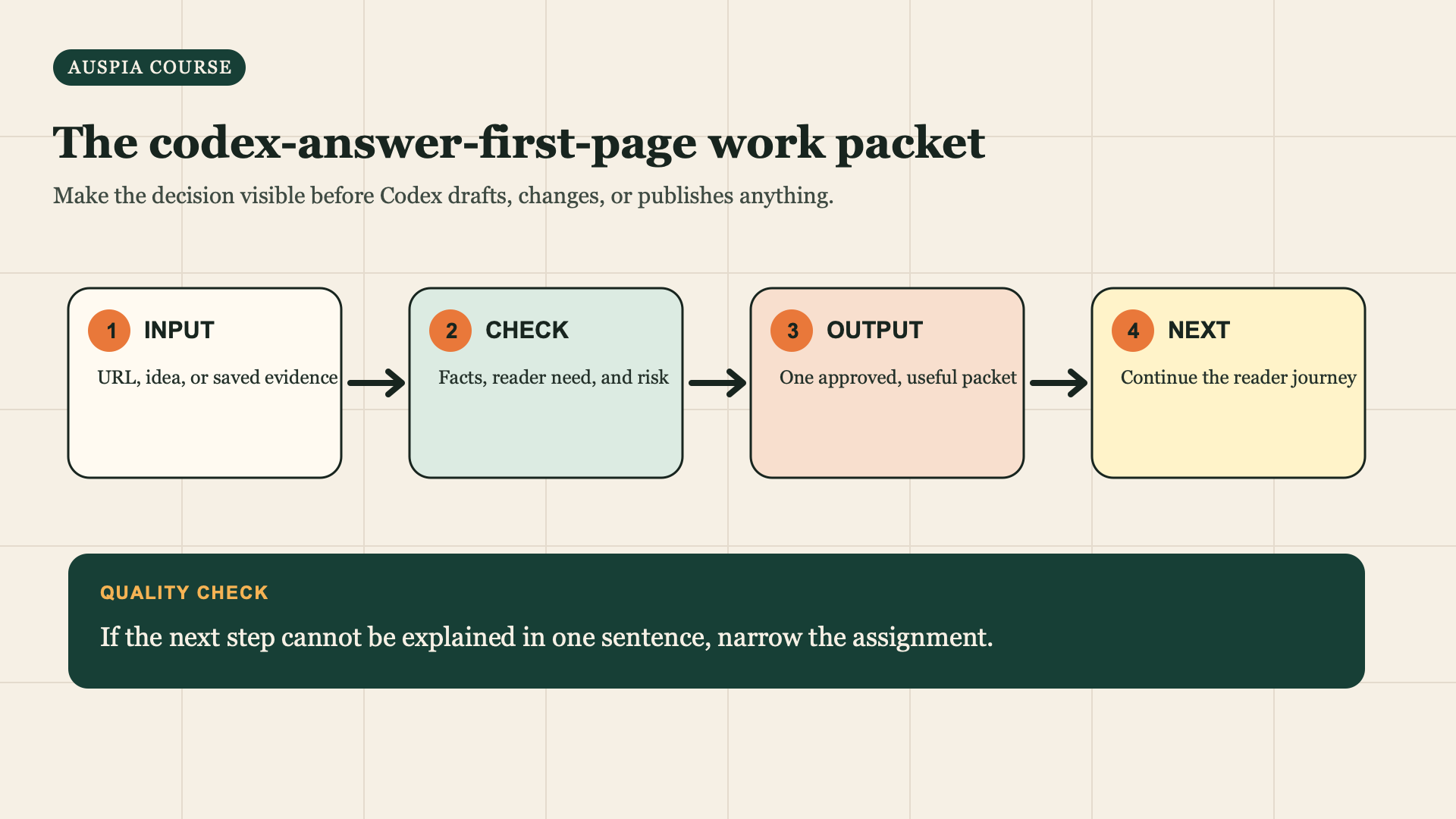
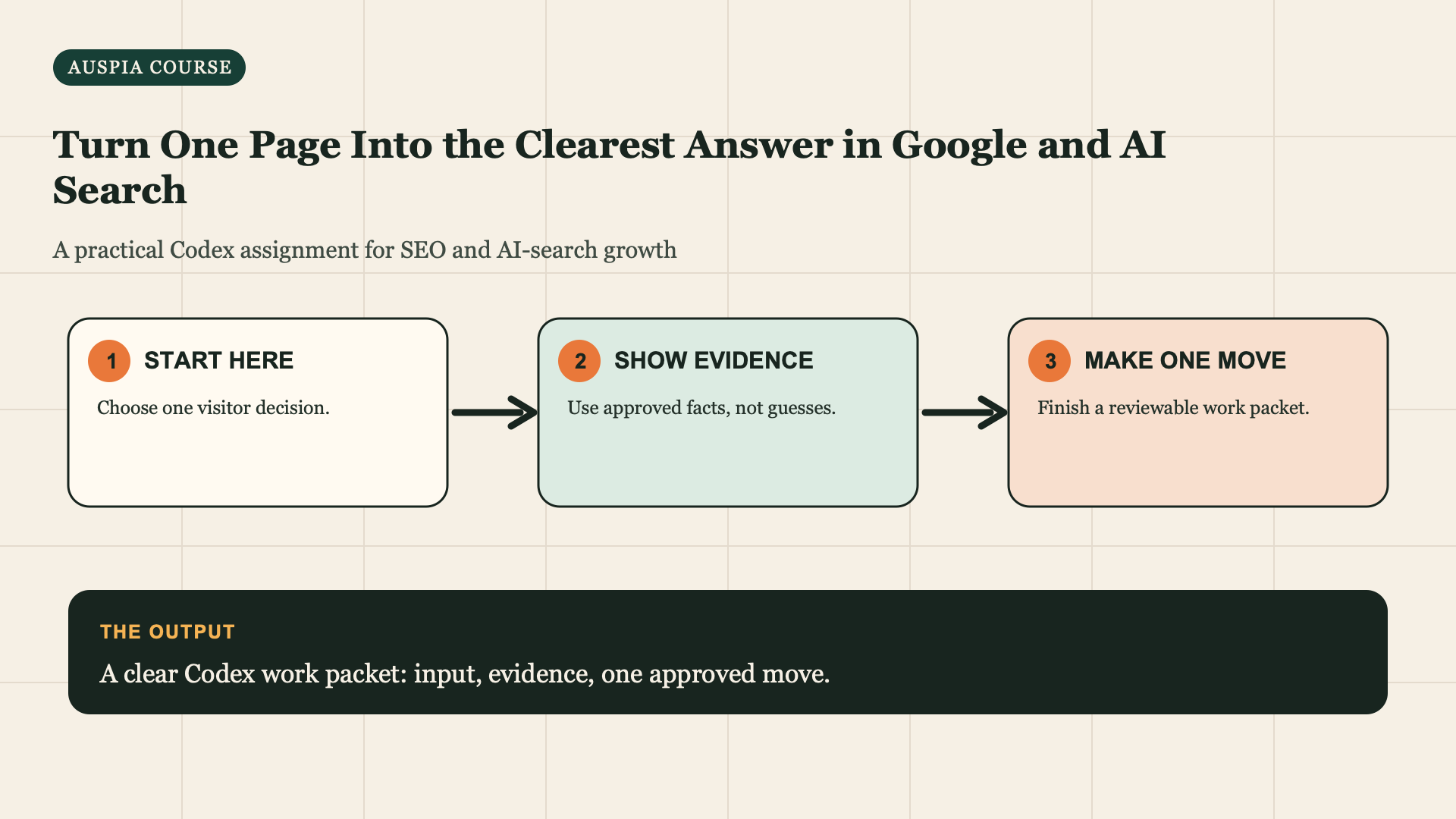
Use this sequence for the assignment: start with a real input, check the evidence, prepare one reviewable output, then choose the reader next step.