Quick answer
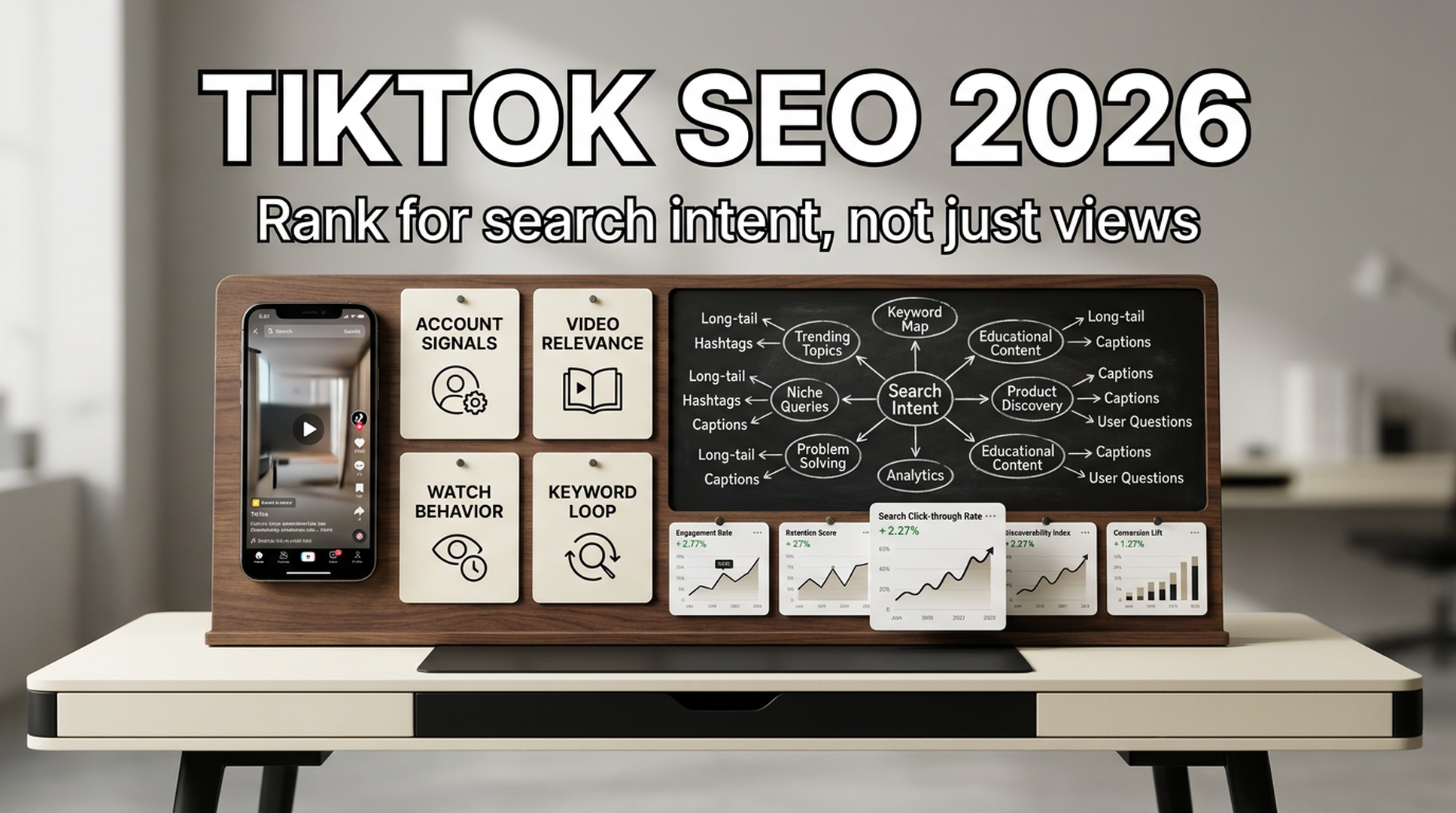
TikTok SEO in 2026 is the work of making short-form content easy for TikTok's search system to understand, rank, and keep testing after the first burst of recommendations is over. The practical formula is simple: build account trust, make each video clearly relevant to one search intent, and improve the viewer signals that prove the result deserves to stay near the top.
For teams that already publish on TikTok, this matters because search traffic behaves differently from feed traffic. Feed traffic is often spiky. Search traffic can keep sending viewers to an old video when the keyword, cover, caption, spoken hook, and engagement pattern still match what people are actively looking for.
This guide adapts the operating rhythm of platform SEO to TikTok for a global audience. No tricks. No keyword stuffing. Just a repeatable way to turn TikTok content into searchable assets.
Why TikTok SEO deserves attention in 2026
People no longer treat search as something that only happens on Google. They search inside TikTok when they want a quick recipe, a product demo, a travel plan, a local recommendation, a tutorial, or a creator's real opinion before they buy.
That shift changes the job of a content team. A TikTok video is no longer only a post in a feed. It can also be a search result.
The difference is important:
Traffic source | What usually triggers it | How long it tends to last | What you optimize |
|---|---|---|---|
For You feed | Interest prediction and early engagement | Often short and volatile | Hook, retention, shareability |
Paid ads | Budget and targeting | As long as budget runs | Creative, audience, offer |
TikTok search | A user typing a need into the search bar | Can compound over time | Keywords, relevance, authority, satisfaction |
A small account can still win search visibility when the query is specific and the content answers it better than broader competitors. That is why TikTok SEO is useful for B2C brands, creators, local services, ecommerce teams, SaaS marketers, educators, and agencies that need more than one viral hit.
The TikTok SEO model: trust, relevance, response
No outside team knows TikTok's ranking system perfectly. But for day-to-day execution, it helps to use a working model:
TikTok SEO performance = account trust + video relevance + viewer response.
A practical split looks like this:
Ranking area | Approximate role | What it includes |
|---|---|---|
Account trust | 30% | Profile clarity, niche consistency, posting cadence, originality, creator credibility |
Video relevance | 40% | Title, caption, spoken words, subtitles, cover text, hashtags, topic match |
Viewer response | 30% | Watch time, replays, saves, comments, shares, follows, click behavior |
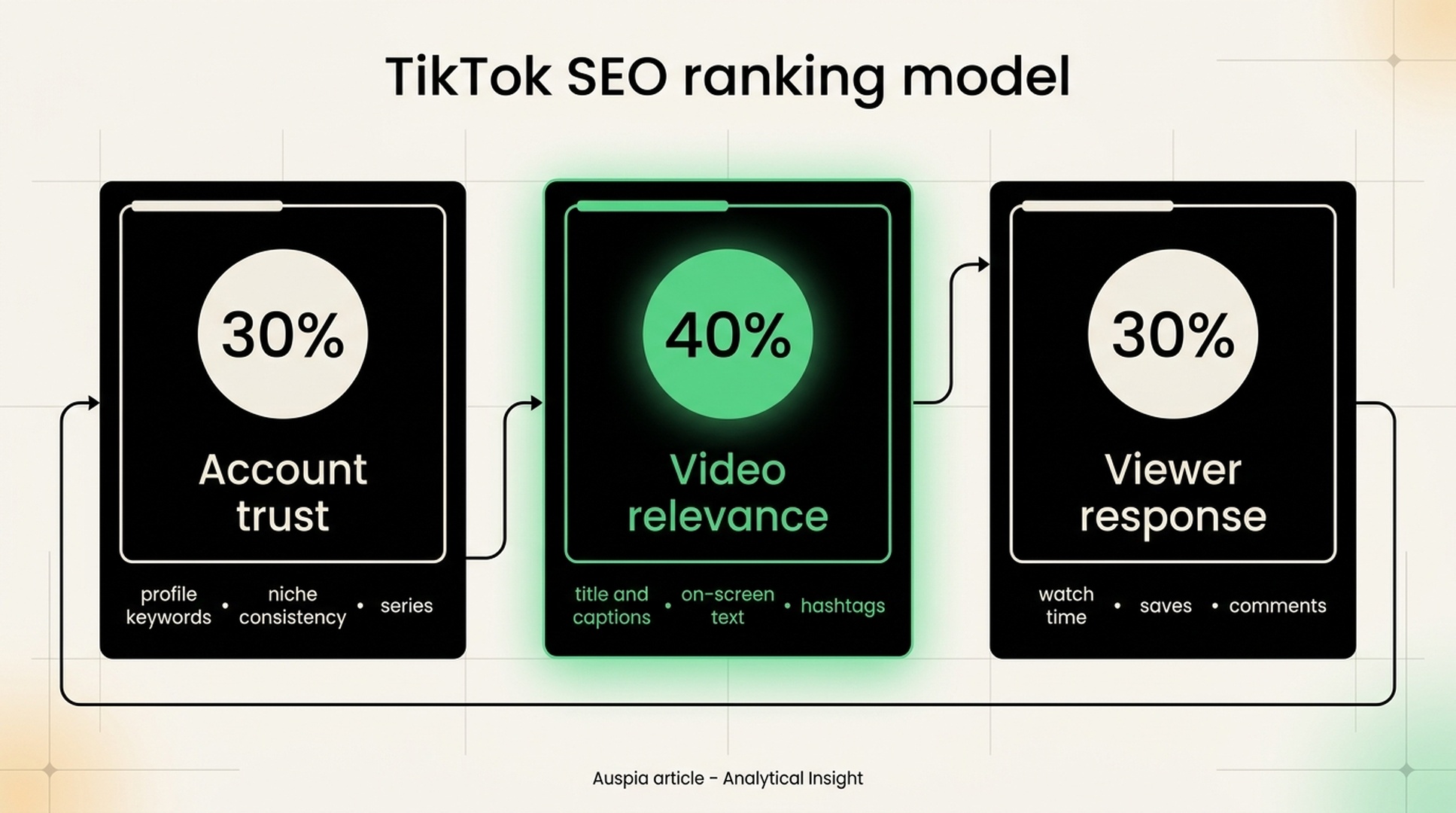
Caption: A working TikTok SEO model for 2026. Treat the percentages as an execution framework, not as official platform weights.
The mistake most teams make is optimizing only one part of the model. They add keywords to a caption but ignore the account profile. Or they produce a useful video but use a vague cover. Or they get clicks but lose viewers in the first five seconds.
TikTok search is less forgiving than that. The platform needs to understand the video, and users need to confirm that the result was worth showing.
Step 1: make the account easy to classify
Before optimizing individual videos, clean up the account. TikTok needs a fast read on what the account is about, and users need the same thing.
Start with the profile name. It should include either a niche term, a role, or a memorable brand signal. A vague name like "Daily Tips" is weak. A clearer version is "Solo Travel Tips by Mara" or "Auspia AI Search Lab."
Then tighten the bio. A good bio answers three questions:
Bio question | Example answer |
|---|---|
Who is this for? | "For SaaS marketers and content teams" |
What do you teach or show? | "SEO, GEO, AI search visibility, and content systems" |
Why should users trust you? | "Weekly audits, examples, and tool workflows" |
For business accounts, add proof where it is available: website, category, visible product demos, testimonials, certifications, partner mentions, or clear creator credentials. For creator accounts, the equivalent is consistency. If one week is skincare, the next week is crypto, and the next week is office humor, TikTok has a harder time deciding which searches you deserve to rank for.
A simple account checklist:
- Use a profile name that contains a niche or role, not only a personal nickname.
- Write a bio that says who the account helps and what it publishes.
- Keep 80% of posts inside one content territory.
- Organize recurring topics into playlists or series when available.
- Avoid low-effort reposting, scraped clips, and obvious AI filler.
This is basic work, but it matters. Search systems reward clarity.
Step 2: choose one search intent per video
A TikTok video can cover several ideas, but it should target one primary search intent. The tighter the intent, the easier it is to make the video rankable.
Bad target: "AI tools."
Better targets:
- "AI tools for real estate agents"
- "how to write a TikTok caption with ChatGPT"
- "best travel backpack for two weeks in Europe"
- "easy meal prep for college students"
- "how to check if Google can crawl my site"
The best TikTok SEO keywords usually have four traits:
Trait | What it means | Example |
|---|---|---|
Specific | The user has a clear need | "standing desk setup for small apartment" |
Visual | The answer benefits from video | "how to style wide leg jeans" |
Actionable | The viewer can apply the answer | "how to clean white sneakers" |
Commercial or decision-heavy | The user may buy, compare, book, or subscribe | "best CRM for freelancers" |
Use TikTok's own search suggestions, comment questions, competitor videos, Google autocomplete, Reddit threads, YouTube search, and customer support logs to build the list. If you are working on website traffic as well, compare the list with your SEO keyword set so TikTok, Google, and AI search content support each other instead of living in separate folders.
Step 3: place keywords where TikTok can read them
Keyword placement should feel natural to a viewer. The goal is not to repeat the same phrase until the caption looks broken. The goal is to make the topic unmistakable across the surfaces TikTok can parse.
Use seven placement points:
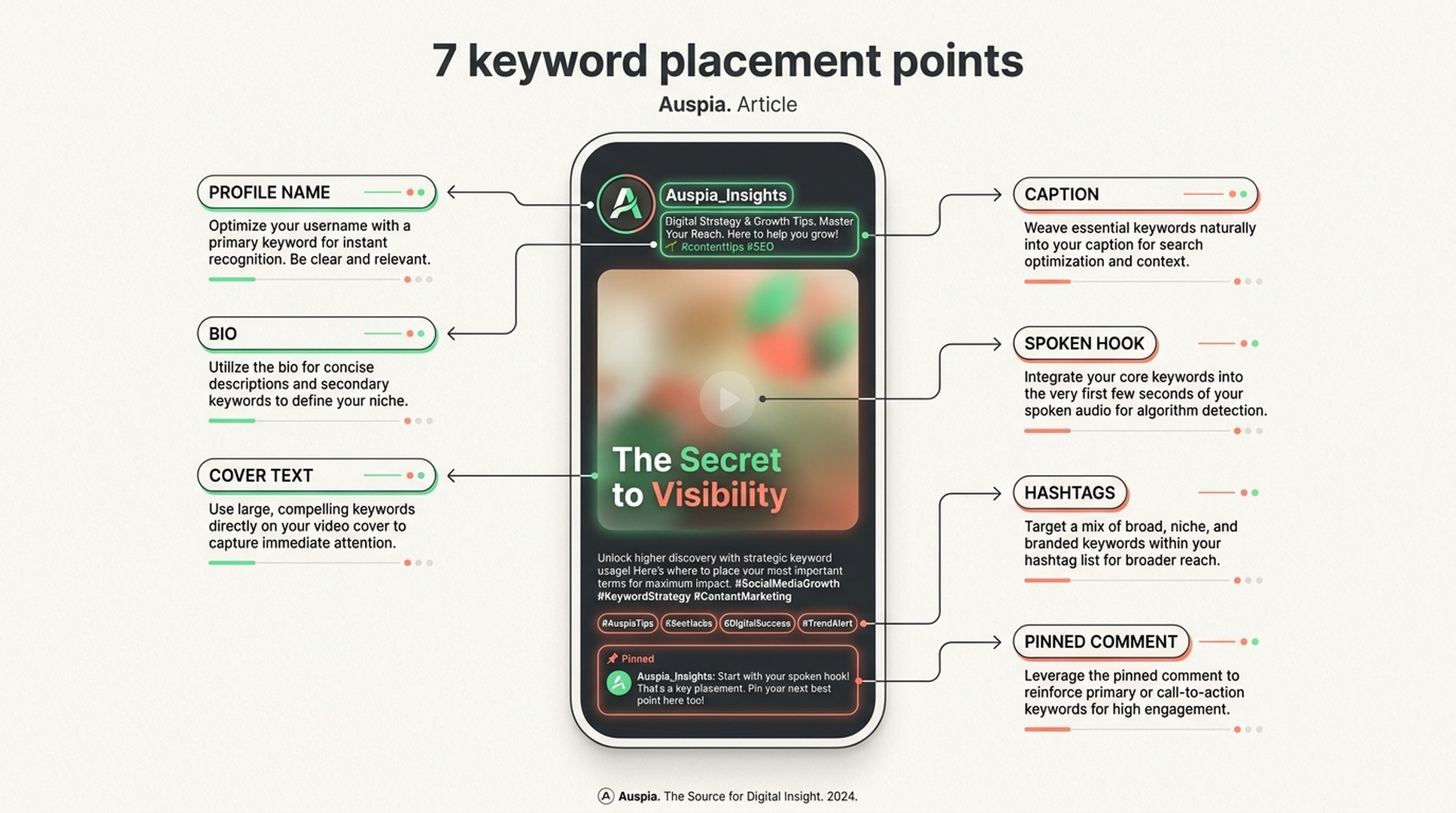
Caption: Put the primary keyword in the places that help both TikTok and humans understand the video.
Placement point | How to use it | Example for "TikTok SEO checklist" |
|---|---|---|
Profile name | Add the niche if it fits the account | "Auspia SEO Lab" |
Bio | Add broader topic language | "SEO and AI search workflows for growth teams" |
Cover text | Put the user-facing promise on screen | "TikTok SEO Checklist" |
Caption | Use the exact phrase once, then write naturally | "Use this TikTok SEO checklist before you publish..." |
Spoken hook | Say the phrase in the first few seconds | "Here is the TikTok SEO checklist I use..." |
Hashtags | Mix exact, niche, and category tags | #tiktokseo #contentmarketing #seotips |
Pinned comment | Reinforce the phrase through a real question or next step | "Want the TikTok SEO checklist template? Comment checklist." |
The spoken hook is easy to miss. TikTok can use speech and captions to understand a video, so saying the target phrase early is often more useful than hiding it in a long caption.
Step 4: build the video for search satisfaction
Ranking for a search term is not only about being found. The video has to satisfy the searcher quickly.
A reliable structure:
- Name the problem in the first three seconds.
- Confirm the audience.
- Give the answer in steps or examples.
- Show the result, comparison, or proof.
- End with a useful next action.
For example, a video targeting "TikTok SEO checklist" could use this script:
"Before you post a TikTok you want to rank in search, check these seven spots: profile, bio, cover, caption, spoken hook, hashtags, and pinned comment. The biggest miss is the spoken hook. If the keyword is only in the caption, TikTok gets a weaker signal and viewers may not understand the topic fast enough. Save this and use it before your next upload."
That is not fancy. It is clear. Clear usually wins search.
For tutorials, do not hold the answer hostage for too long. Search users are impatient. If the video takes 20 seconds to get to the point, a lot of viewers will bounce and the ranking signal gets weaker.
Step 5: improve viewer response without gaming the system
Viewer response tells TikTok whether the search result worked. The useful metrics vary by topic, but these are the ones to watch:
Signal | What it can indicate | How to improve it |
|---|---|---|
Click-through | The title and cover match the query | Make the cover specific and outcome-led |
Watch time | The answer holds attention | Cut filler, show examples, use tight pacing |
Replays | The video is useful or dense | Add checklists, steps, or visual comparisons |
Saves | The content has future value | Give templates, lists, recipes, setups, workflows |
Comments | The topic opens a follow-up need | Ask a narrow question, not a generic one |
Follows | The account owns the topic | Keep the niche consistent across videos |
Avoid fake engagement loops. They may create a temporary bump, but they train the team to chase the wrong behavior. A better approach is to design content that people would naturally save or send to someone else.
One practical trick: build content in pairs. Publish a short answer first, then a deeper follow-up when comments reveal the next search intent. This turns the comment section into keyword research.
Step 6: use playlists and series to extend ranking life
TikTok search benefits from topical depth. If one video answers "how to choose running shoes," the next five might answer:
- "running shoes for flat feet"
- "running shoes for knee pain"
- "daily trainer vs race shoe"
- "how running shoes should fit"
- "when to replace running shoes"
That cluster teaches both users and the platform that the account owns a topic. It also gives viewers a reason to watch more than one video.
For brands, this is where TikTok SEO starts to overlap with GEO. Search engines, AI answer systems, and social platforms all need repeated evidence that a brand is connected to a topic. A strong TikTok series can support brand discovery, branded search, and later citation readiness if the same ideas are also published on your site.
Step 7: run a weekly keyword loop
TikTok SEO improves when the team reviews data every week. The loop does not need to be complicated.
Use this workflow:
Step | What to do | Output |
|---|---|---|
1 | Export or record top search terms from TikTok analytics where available | Keyword list |
2 | Check which videos gained search traffic after the first 72 hours | Evergreen winners |
3 | Read comments on winning videos | Follow-up questions |
4 | Search the terms manually inside TikTok | Competing formats and covers |
5 | Create 5 to 10 new long-tail video briefs | Next production batch |
6 | Update pinned comments or playlists where useful | Better internal navigation |
Auspia's view: do not separate social SEO from website SEO. Use TikTok to discover language, objections, and product questions. Then turn the strongest patterns into website pages, FAQs, comparison articles, and AI-search-ready content. The Auspia tools can help audit whether the website side of that system is crawlable and structured enough for search engines and AI answer systems.
Common TikTok SEO mistakes
Most TikTok SEO problems are not caused by a lack of hacks. They come from sloppy basics.
Mistake | Why it hurts | Better approach |
|---|---|---|
Targeting huge generic keywords | Competition is high and intent is vague | Start with long-tail queries |
Stuffing captions with keywords | It looks spammy and weakens viewer trust | Use exact phrases once or twice naturally |
Ignoring the cover | Search users decide quickly | Put the answer or outcome on the cover |
Changing the topic every week | The account never builds topical trust | Keep a clear niche for most posts |
Overusing AI scripts | Videos sound interchangeable | Add examples, product shots, opinions, and real constraints |
Skipping comments | You miss the next keyword set | Mine comments for follow-up videos |
Measuring only views | Views can hide poor search fit | Track saves, search traffic, and long-tail performance |
The most dangerous mistake is publishing generic AI-written scripts at scale. TikTok is full of them now. They often sound smooth, but they lack a real point of view, real examples, and the little details that make a viewer believe a human tested the advice.
A simple TikTok SEO checklist for 2026
Use this before publishing any video that should rank in search:
- The video targets one primary search intent.
- The target keyword appears in the cover text.
- The keyword is spoken in the first few seconds.
- The caption uses the keyword naturally and explains the value.
- Hashtags include one exact or near-exact topic tag, plus broader category tags.
- The first 5 seconds answer "who is this for?" and "why should I watch?"
- The video gives the answer before asking for likes or follows.
- The pinned comment reinforces a useful next step.
- The video belongs to a visible series, playlist, or content cluster.
- The team reviews search performance within the next weekly content loop.
FAQ
Is TikTok SEO still worth doing in 2026?
Yes, especially for topics where users search for tutorials, product recommendations, local options, visual examples, and creator opinions. It should not replace website SEO, but it can become a strong discovery layer.
How many keywords should one TikTok video target?
One primary keyword and two or three close variants are enough. If a video tries to target too many different searches, the topic becomes unclear.
Do hashtags matter for TikTok SEO?
They help with classification, but they are not enough by themselves. The caption, cover text, spoken words, subtitles, account niche, and viewer response all matter.
Can a new TikTok account rank in search?
Yes, if it targets specific long-tail queries and answers them better than larger accounts. New accounts usually struggle with broad keywords, so start narrow.
Should brands use AI to write TikTok SEO scripts?
AI can help with outlines, keyword grouping, and variations, but the final script needs real examples, product knowledge, and a human voice. Generic scripts are easy to ignore.
Final take
TikTok SEO in 2026 is not about forcing old Google tactics onto short video. It is about matching search intent inside a video-first platform.
Make the account easy to classify. Pick one query per video. Put the keyword where TikTok and viewers can read it. Build videos that answer the query fast. Review the search data every week.
That is the work. It is not glamorous, but it compounds.