The short answer
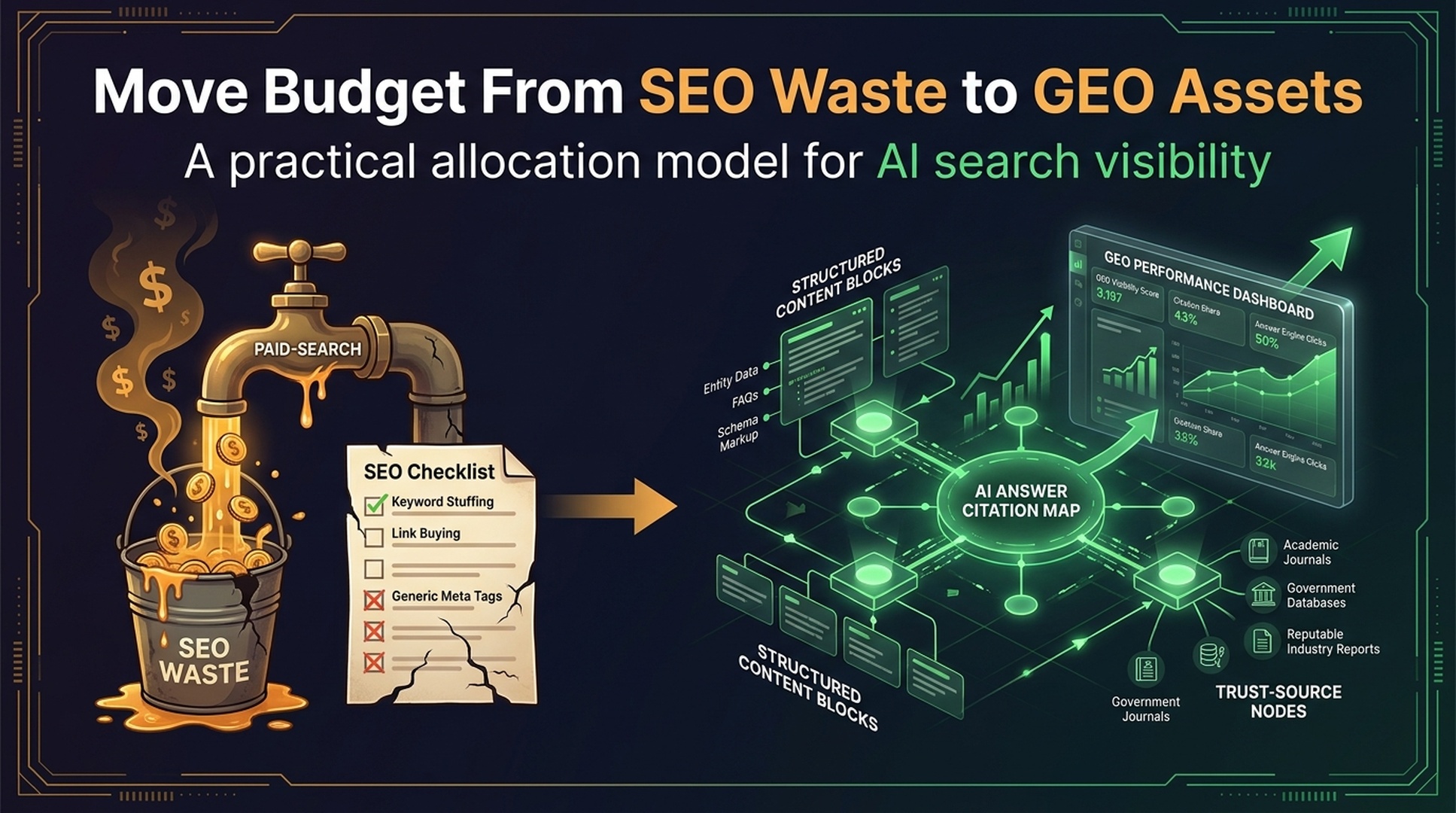
If your SEO budget is still buying thin content, routine backlinks, and technical tweaks that no longer change revenue, move part of it into GEO. Do it gradually, measure it honestly, and spend the money on assets that AI answer systems can understand, verify, and cite.
GEO is not a replacement for SEO or paid search. Paid search still protects near-term demand. SEO still keeps your site crawlable, useful, and discoverable. GEO adds a third job: making your brand easier for AI search engines, answer engines, and agentic research tools to select when users ask decision-heavy questions.
The budget mistake is treating GEO as a side experiment funded by leftovers. The better move is to identify the parts of SEO and SEM where marginal returns are already falling, then reallocate that money into structured content, evidence, semantic coverage, and measurement.
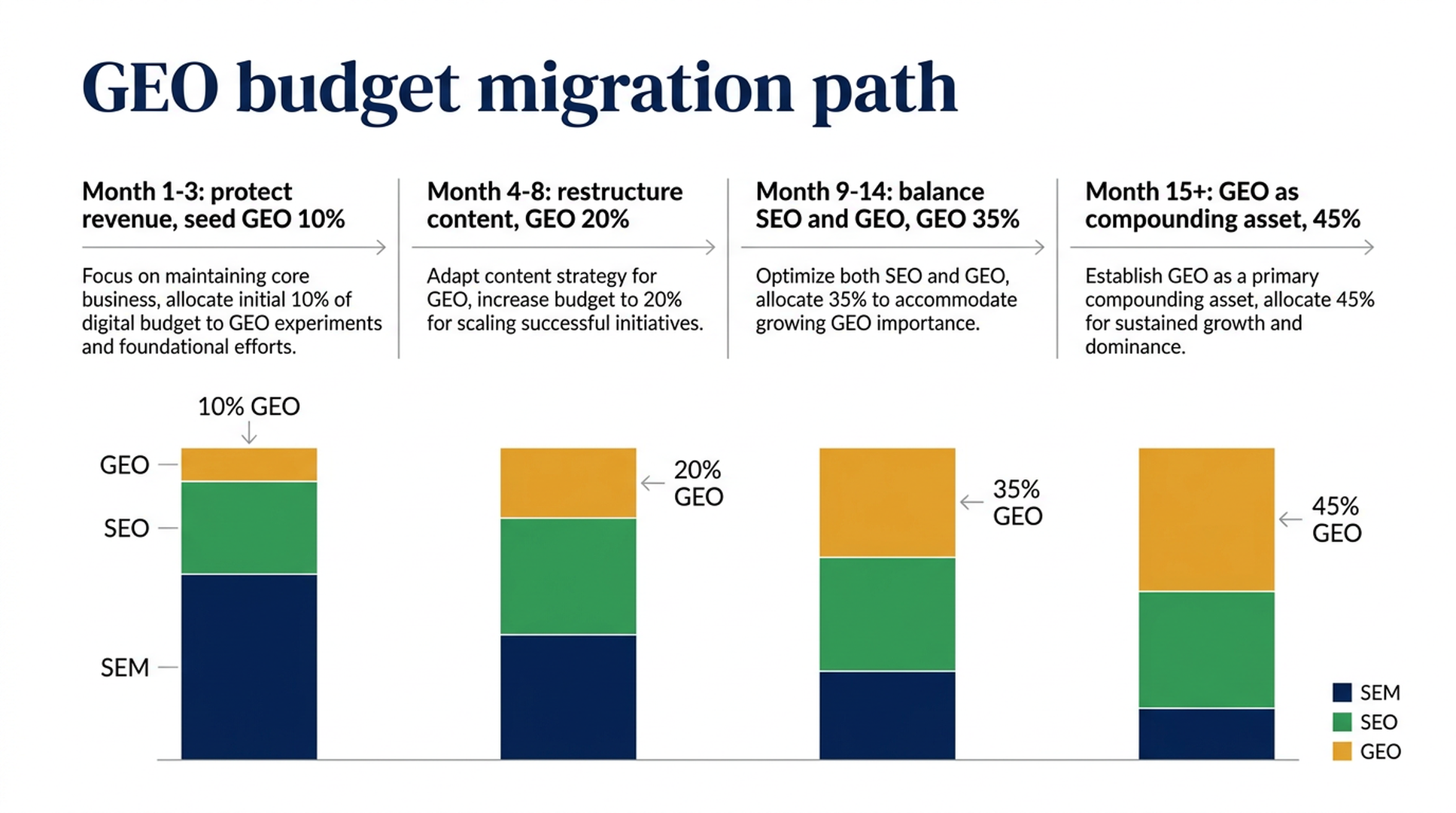
Caption: A practical migration path lets teams protect current pipeline while building AI-search visibility as a compounding asset.
Why the budget has to move
Most marketing budgets were built for an older search journey.
A buyer searched a short keyword, clicked several blue links, compared vendors manually, and filled out a form after enough retargeting. In that world, ranking pages and buying clicks were the obvious places to spend money.
The journey is changing. A buyer now asks a longer, more qualified question inside ChatGPT, Perplexity, Gemini, Copilot, Google AI Mode, or an industry assistant. The answer may summarize options, compare vendors, list trade-offs, and cite only a handful of sources. By the time that buyer reaches your site, much of the consideration work has already happened.
That changes the economics.
A traditional SEO visit often starts with exploration. A GEO-influenced visit often starts with a question that already contains the user's constraints: budget, industry, company size, geography, risk tolerance, integration needs, or decision timeline. That does not guarantee conversion, but it usually means stronger intent than a broad top-of-funnel keyword.
The question for CMOs is not "Should we stop SEO?" The question is sharper: "Which SEO and paid-search expenses are still creating durable demand, and which ones are only keeping an old reporting dashboard alive?"
GEO is an asset budget, not a traffic rental budget
Paid search behaves like a faucet. Turn it on and traffic arrives. Turn it off and the flow stops.
Strong GEO work behaves more like infrastructure. A well-structured product page, a clear comparison guide, a cited research asset, a clean FAQ, and third-party evidence can keep helping AI systems understand your brand long after the original production cost is paid.
That does not make GEO free. It takes planning, publishing, technical cleanup, content operations, external validation, and monitoring. But the spend creates assets instead of only renting attention.
A useful way to separate the budget is this:
Budget line | What it buys | When to keep it | When to reduce it |
|---|---|---|---|
SEM | Immediate capture of existing demand | High-intent keywords, launches, defensive brand terms | Broad terms with rising CPC and weak pipeline quality |
SEO | Crawlable, useful, searchable pages | Pages that rank, convert, and support authority | Low-quality content volume, cosmetic audits, weak link campaigns |
GEO | AI-readable evidence and answer eligibility | Decision-stage topics, comparison queries, category education | When there is no measurement plan or no real content depth |
This is why the first reallocation should not come from your best-performing SEO pages. It should come from the work nobody can defend without saying, "We have always done it this way."
A four-stage migration model
The safest GEO budget plan is staged. Most companies should not move half their search budget in one quarter. They should shift enough to learn, then use visibility and pipeline data to decide the next step.
Stage 1: months 1 to 3, protect revenue and seed GEO
Keep most paid search and proven SEO spend in place. Use roughly 10% of the search growth budget for GEO foundations.
This first phase is not about dramatic traffic gains. It is about making the brand legible to AI systems.
Useful work includes:
- auditing which pages answer real decision questions and which ones only target keywords;
- adding direct answers, clean definitions, comparison tables, and FAQ sections to priority pages;
- fixing inconsistent product names, category descriptions, author bios, and organization data;
- identifying third-party sources that already mention the brand, product category, or competitors;
- setting up AI-search visibility tracking for core prompts.
The goal is simple: stop publishing content that humans may tolerate but AI systems cannot confidently use.
Stage 2: months 4 to 8, move from tests to structured coverage
Once the foundations are in place, shift GEO toward 20% of the search growth budget. SEM can usually come down if broad campaigns are inefficient. SEO should focus less on volume and more on pages that can become answer sources.
This is where teams rebuild the content map around questions, not keywords alone.
For example, a cybersecurity company should not only chase "endpoint security software." It should build pages that answer questions like:
- "What endpoint security features matter for a 500-person finance company?"
- "How do EDR, MDR, and XDR differ for a lean IT team?"
- "Which security tools are easiest to deploy without a large SOC?"
These are the kinds of questions AI answer systems like to synthesize. If your site has the clearest, most verifiable answer, you have a chance to appear in the answer path.
Stage 3: months 9 to 14, balance SEO and GEO
At this point, many teams can move toward a roughly even split between SEO and GEO, while SEM becomes more selective.
Paid search should stay focused on high-intent terms and campaigns with clear pipeline proof. SEO should keep the technical base healthy. GEO should receive enough budget to produce and maintain assets across the buyer journey.
The work now becomes more editorial and evidence-driven:
- build comparison pages that fairly explain alternatives;
- publish original data, benchmarks, calculators, and checklists;
- improve author and company credibility signals;
- earn mentions from relevant industry sites, directories, analysts, podcasts, and partner pages;
- refresh pages when AI systems consistently cite outdated or weaker sources.
If the team is only rewriting blog posts, it is not doing mature GEO. Mature GEO connects the site, the wider web, and the answer systems that sit between the buyer and the brand.
Stage 4: month 15 and beyond, treat GEO as a compounding channel
After a year of disciplined work, some companies can make GEO the largest part of their organic search investment. That may mean 40% to 45% of the search growth budget, depending on the market.
This makes sense when three things are true:
- AI-search visibility is moving in the right direction for priority prompts;
- GEO-influenced traffic or assisted pipeline is visible in reporting;
- the company has a repeatable workflow for content, evidence, and measurement.
Without those conditions, a large GEO budget can become a new version of old SEO waste. The label changes, but the habit stays the same.
The allocation inside the GEO budget
Moving money into GEO is only useful if the money is spent well. A healthy annual GEO budget often breaks down into four buckets.
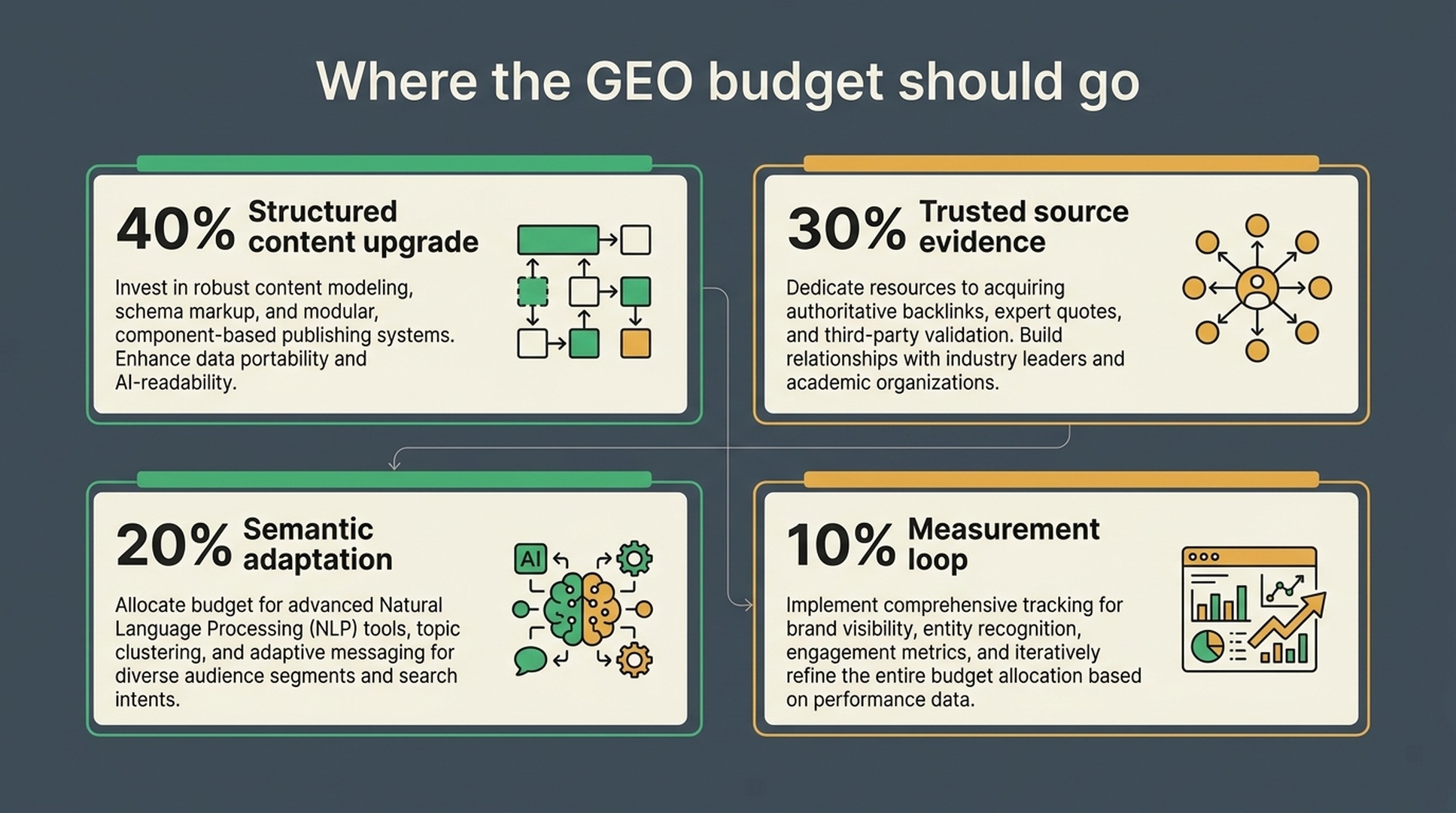
Caption: GEO budget should fund the whole answer-readiness loop, not just more blog posts.
40% for structured content upgrades
This is the boring work that usually matters most.
AI systems need clean page structure, explicit claims, stable entities, extractable tables, concise summaries, and enough context to understand when your answer applies. A beautiful landing page with vague copy is hard to cite. A clear page with definitions, use cases, constraints, pricing logic, comparisons, and FAQs is much easier to use.
Spend this money on upgrading pages that already matter:
- product pages;
- solution pages;
- comparison pages;
- category education pages;
- case studies;
- glossary and FAQ hubs.
The output should not be "more content." The output should be content that answers, proves, and routes the user to the next step.
30% for trusted source evidence
AI answer systems do not only look at what you say about yourself. They look for corroboration.
That makes third-party evidence a major GEO lever. Useful evidence can come from analyst mentions, customer reviews, partner pages, industry directories, reputable publications, research citations, community discussions, and public case studies.
The point is not to buy random media placements. Low-quality distribution creates noise. The point is to build a web of credible sources that confirms who the company is, what it does, who it serves, and why it deserves to appear in a recommendation set.
A simple test: if a human buyer would not trust the source, do not expect AI systems to treat it as a strong signal forever.
20% for semantic adaptation
Different AI systems do not answer in exactly the same way. Some lean on web citations. Some summarize known entities. Some prefer concise definitions. Some handle long documents well. Some are stronger at comparison and shopping-style prompts.
Semantic adaptation means translating your core message into the formats those systems can use:
- short answer blocks for direct questions;
- comparison tables for alternative evaluation;
- entity-rich descriptions for brand and product understanding;
- use-case pages for industry-specific prompts;
- concise FAQ answers for answer-engine extraction;
- supporting evidence for claims that would otherwise sound promotional.
This is where GEO starts to feel different from classic SEO. You are not only matching search volume. You are helping machines assemble a reliable answer.
10% for measurement and iteration
Do not let GEO become a black box.
Track a small set of prompts every week or month. Include brand prompts, category prompts, competitor prompts, problem prompts, and buying-intent prompts. Record whether your brand appears, which sources are cited, what language the answer uses, and which competitors show up repeatedly.
Useful metrics include:
- AI answer visibility for priority prompts;
- citation frequency and citation quality;
- share of answer against named competitors;
- landing pages reached from AI tools where referrer data is available;
- assisted conversions from AI-search and organic journeys;
- source gaps, such as missing review sites or weak comparison pages.
The first dashboard can be simple. What matters is making the work observable enough to improve.
How different companies should move
A startup should be more aggressive than an enterprise.
If a young brand has little SEO authority, competing head-on with incumbents for mature keywords may be expensive and slow. GEO gives the startup a chance to define the category around new questions, especially if the product solves a problem buyers are still learning to describe. A startup may put most of its non-paid content effort into GEO-style pages while keeping enough SEO hygiene to avoid technical mistakes.
A mid-market company should usually reallocate from underperforming SEO work first. If the company already has ranking pages, product-market fit, and a sales motion, the fastest wins often come from converting existing pages into better answer sources. Cut weak link campaigns, thin keyword pages, and content written only to fill a calendar. Fund structured upgrades and credible evidence instead.
A large enterprise should start with a controlled pilot. Pick 50 to 100 high-value pages across one product line or region. Rebuild them for AI answer readiness, improve third-party evidence, and measure a fixed prompt set for two quarters. If the pilot shows movement, expand the model. Enterprises do not need to be slow, but they do need proof that survives procurement and budget reviews.
Common mistakes when shifting budget
The first mistake is calling every content refresh "GEO." A page does not become GEO-ready because someone added an FAQ at the bottom. It needs clear entity signals, useful structure, evidence, and a reason to be trusted.
The second mistake is copying SEO reporting into GEO. Ranking position is not enough. You need to know whether AI systems mention you, cite you, describe you correctly, and include you in decision comparisons.
The third mistake is starving measurement. Teams love production budgets and dislike monitoring budgets. That is how they end up publishing for six months without knowing whether anything changed.
The fourth mistake is overcorrecting. SEM still matters. SEO still matters. GEO works best when it is connected to both, not when it becomes a silo with a new acronym and the same old content habits.
A practical first-month checklist
Use this checklist before moving a serious amount of budget:
- Pick 20 buyer questions that matter commercially.
- Test those questions in several AI answer systems and record current visibility.
- Identify which sources the answers cite today.
- Map the pages on your site that should answer those questions.
- Upgrade five priority pages with summaries, tables, FAQs, clear claims, and proof.
- Audit whether your brand, product, and category names are consistent across the web.
- Build one small measurement dashboard and review it every two weeks.
- Decide which low-return SEO or SEM line item will fund the next GEO sprint.
This keeps the shift grounded. You are not betting the budget on a trend. You are buying evidence.
Auspia perspective
The companies that win in AI search will not be the ones that publish the most. They will be the ones that make their expertise easiest to verify.
That requires clean content, credible sources, technical readiness, and repeated measurement. It is hard to do manually because the work crosses SEO, content, analytics, and brand trust.
Auspia.ai helps automate that system. It can analyze where your site is weak for SEO, GEO, and AEO, identify the pages and prompts that deserve attention, generate structured improvements, and monitor AI-search visibility without requiring your team to master every detail of search engineering. If you want SEO and GEO execution to run more intelligently with less manual guesswork, Auspia.ai is built for that.
FAQ
How much SEO budget should move to GEO first?
Start with 10% if the company is new to GEO. Move more only after you have a prompt set, priority pages, baseline visibility data, and a clear owner for the workflow.
Should GEO replace SEO?
No. SEO keeps your site discoverable, crawlable, and useful. GEO builds on that foundation so AI answer systems can understand and cite your content. Weak SEO usually makes GEO harder.
What is the best place to spend a small GEO budget?
Upgrade decision-stage pages first. Product, solution, comparison, and FAQ pages usually matter more than another batch of generic blog posts.
How do you measure GEO ROI?
Track AI answer visibility, citations, share of answer, AI-referred traffic where available, assisted conversions, and changes in how AI systems describe your brand. Tie those signals to pipeline cautiously, since attribution is still imperfect.
When should paid search budget be reduced?
Reduce paid search only where CPC is rising, conversion quality is weak, or campaigns are mostly buying low-intent traffic. Keep paid search for terms that reliably protect revenue.