The short answer
Structured content design makes your page easier for AI systems to break into useful answer units. A clear checklist tells the model what to do. A table tells it how options compare. A FAQ block tells it which question a paragraph answers.
That does not guarantee a citation. Nothing does. But it removes a common reason pages get ignored: the answer is present, yet buried inside a long paragraph that is hard to isolate, verify, or reuse.
For teams working on GEO in 2026, the job is no longer just "write a good article." The better job description is: build a page that a human can trust and an AI retrieval system can quote without guessing.
Why AI extraction changed the content brief
Traditional SEO taught teams to organize content for rankings and clicks. Headings, internal links, search intent, depth, and trust still matter. But AI search adds another reader before the human reader: the answer system.
That system does not experience your page like a person scrolling through a blog post. It tends to process content in chunks: headings, paragraphs, lists, tables, schema-like facts, citations, and repeated answer patterns across the web. If a chunk is self-contained and clear, it has a better chance of being retrieved, summarized, and used.
A messy paragraph can still rank. A structured answer can be reused.
That is the practical difference.
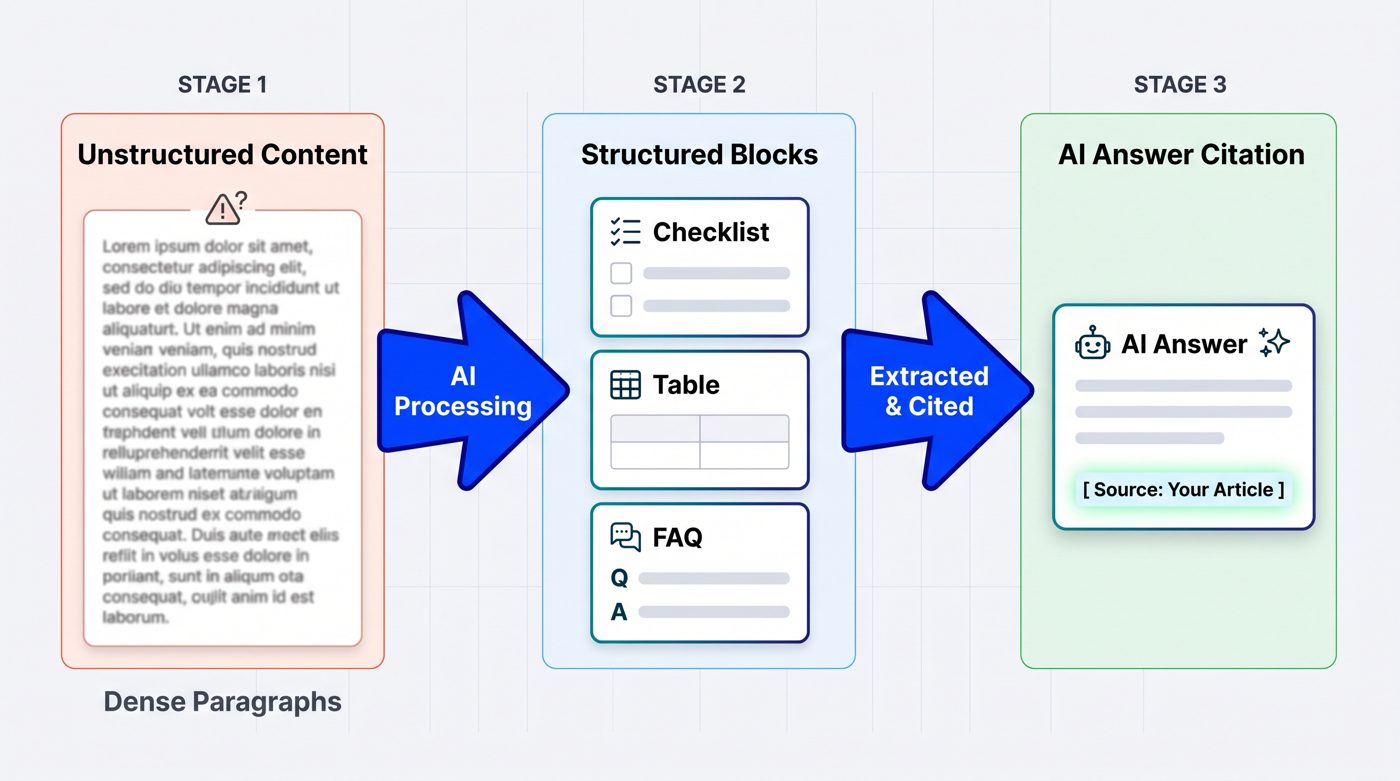
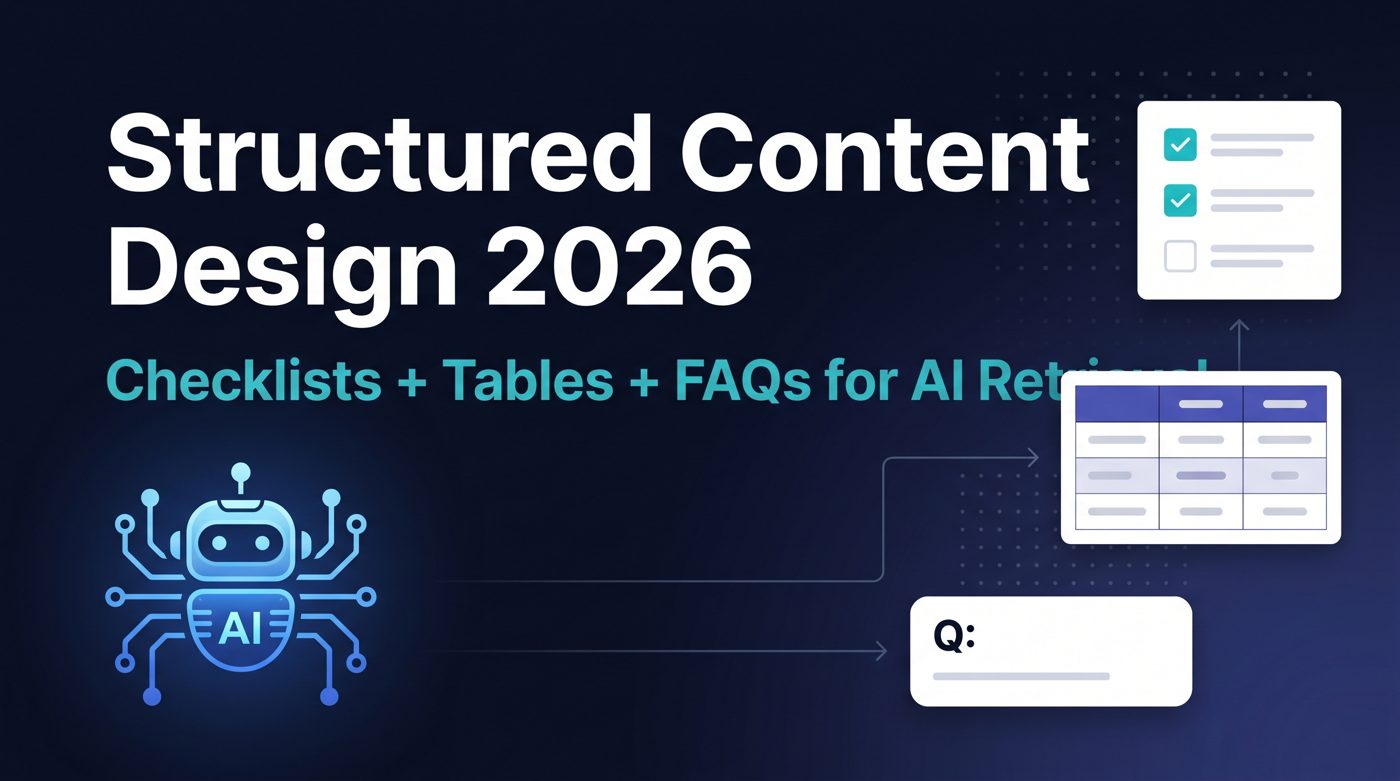
Caption: Structured content turns long paragraphs into answer-ready blocks that AI systems can parse, compare, and cite.
What structured content actually means
Structured content is not decoration. It is content with visible logic.
A page is structured when each important section has a job:
- A definition answers "what is this?"
- A checklist answers "what should I do?"
- A table answers "how do these options differ?"
- A FAQ answers "what exact question is being answered?"
- A process answers "what happens first, next, and last?"
- A source note answers "where did this fact come from?"
In GEO work, these sections act like extraction handles. They give AI systems cleaner boundaries around facts, decisions, and recommendations.
The 2026 extraction model: facts, logic, format
A useful way to plan AI-readable content is to separate three layers.
Layer | What it means | What AI can extract | Weak version | Better version |
|---|---|---|---|---|
Facts | Definitions, numbers, entities, claims, dates, sources | Concrete statements | "Many teams struggle with GEO" | "A GEO content audit should check brand facts, source quality, structured answer blocks, and citation gaps" |
Logic | Cause, comparison, sequence, prioritization | Reasoning path | "Structured content is better" | "Tables help comparison prompts because they place options and criteria in the same block" |
Format | Lists, tables, FAQs, steps, schema, captions | Reusable answer units | One long essay section | A definition, a checklist, a comparison table, and a FAQ block |
Most content teams already have facts. Many have decent logic. The missing layer is usually format.
That is why the same idea can perform very differently after being rewritten into a checklist, table, or FAQ.
Checklists: best for action extraction
Use a checklist when the reader wants to know what to do next. AI answer systems also like checklists because each item is a compact instruction.
A weak paragraph says:
You should make sure your page is credible, clear, and useful for AI tools. It should include sources, examples, structure, and clear answers to common questions.
A stronger checklist says:
- State the answer in the first 80-120 words.
- Add one source-backed fact or first-party observation for each major claim.
- Turn comparison sections into tables instead of prose-only paragraphs.
- Add a FAQ block for questions sales, support, or search users already ask.
- Use stable entity names: product name, company name, category, audience, and use case.
- Add alt text and captions to diagrams that explain the same concept as the image.
The second version is easier to quote because each line is a complete action. It also reduces ambiguity. The model does not have to infer the operating steps from a vague paragraph.
Checklist template for GEO content
Use this before publishing a page you want AI systems to understand.
Check | Pass condition |
|---|---|
Direct answer | The page answers the main question near the top |
Entity clarity | Brand, product, category, audience, and use case are named consistently |
Evidence | Important claims include a source, example, dataset, or clear reasoning |
Extraction blocks | The page includes at least one checklist, table, FAQ, or step-by-step process |
Comparison support | "Best," "vs," and "alternative" sections use tables where possible |
FAQ quality | Questions are real user questions, not filler |
Tool path | The reader has a next step, audit, template, or diagnostic workflow |
Tables: best for comparison and decision prompts
Tables are underrated because they look basic. For AI extraction, basic is often good.
When a user asks "GEO vs SEO," "Which tool should I use," or "What is the difference between these approaches," a table places the options and criteria in a single block. That helps both humans and machines compare without stitching together scattered sentences.
Content goal | Best format | Why it helps AI extraction | Example |
|---|---|---|---|
Explain a concept | Definition block + short example | Gives the model a clean summary and context | "GEO is the practice of making brand information easier for AI answer systems to retrieve and cite" |
Compare options | Table | Keeps criteria aligned across choices | SEO vs GEO vs AEO |
Teach a workflow | Numbered checklist | Preserves order and action | Audit page, add answer blocks, test prompts, update weak sections |
Handle objections | FAQ | Maps exact questions to direct answers | "Do FAQs still matter for GEO?" |
Prove a claim | Source note + data table | Separates evidence from opinion | Prompt visibility before/after an audit |
A good table does not need many columns. In fact, fewer columns usually work better. Use criteria that appear in real prompts: cost, speed, reliability, audience fit, use case, limitations, evidence needed, and next action.
FAQs: best for question-answer matching
FAQ blocks are not magic. Bad FAQs are easy to spot: generic questions, repeated answers, and thin paragraphs added for SEO surface area.
Good FAQs work because they create clean question-answer pairs.
For AI systems, that pairing matters. If a user asks a similar question, the FAQ block already tells the system: this exact text is an answer to this exact intent.
A useful FAQ pattern
Write FAQ answers with four parts:
- Direct answer in the first sentence.
- One constraint or exception.
- One practical example.
- One next step.
Example:
Do FAQs help GEO in 2026?
Yes, if the questions reflect real buyer, user, or support intent. A FAQ block helps AI systems map a question to a concise answer. It will not help much if the questions are invented only to stuff keywords. Start with questions from sales calls, customer support, search queries, and prompt tests.
That answer is short, but it has enough shape to be reused: answer, limitation, example, action.
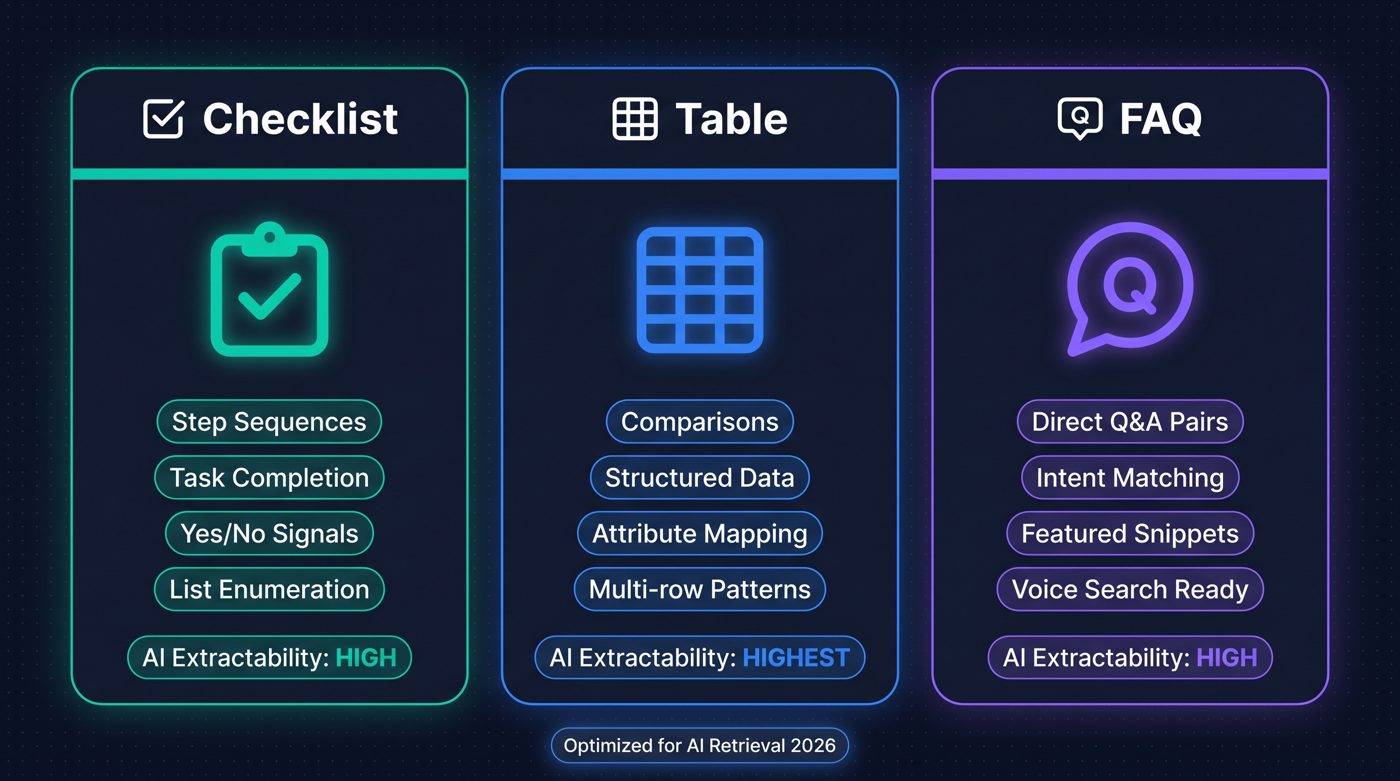
Caption: Checklists, tables, and FAQs each create a different kind of extraction handle for AI search systems.
How to turn a normal article into AI-readable blocks
Start with the article you already have. Do not rewrite everything at once.
Step 1: find the buried answers
Scan the draft and mark sentences that answer a clear user question. Most long articles contain 8-15 useful answers hidden inside paragraphs.
Look for sentences that define, compare, explain a cause, give a warning, or recommend an action.
Step 2: assign the right format
Use this quick decision rule:
If the answer is about... | Use... |
|---|---|
A definition | Short answer block |
A sequence | Numbered steps |
A decision | Comparison table |
A repeated concern | FAQ |
A quality standard | Checklist |
A relationship between concepts | Diagram or matrix |
Step 3: make each block self-contained
A block should still make sense if it is pulled out of the page. That means it needs nouns, not vague references.
Weak: "This is why it works."
Better: "FAQ blocks work for GEO because they pair a real user question with a direct answer that AI systems can match to similar prompts."
Step 4: add evidence where the claim needs trust
Not every sentence needs a source. But claims about performance, rankings, market behavior, and platform behavior need support.
Evidence can be:
- First-party prompt testing
- Customer support logs
- Search console patterns
- Public documentation
- A named report or dataset
- A clearly labeled internal benchmark
- A real example with limits stated
Do not fake authority. AI systems are getting better at detecting empty source language, and human readers already notice it.
Step 5: test the page with prompts
After publishing, ask questions that your buyer would ask in ChatGPT, Perplexity, Gemini, Google AI Overviews, or other answer surfaces you track.
You are looking for three signals:
- Does the answer mention your brand or page?
- Does the answer reuse your framing, checklist, table, or FAQ language?
- Does the answer cite your page, or cite competitors with more structured evidence?
If the model cites a competitor, inspect the cited page. Often the lesson is not that their writing is better. It is that their answer block is easier to extract.
A before-and-after example
Here is a common B2B software paragraph:
Our platform helps marketing teams improve AI search visibility by creating better content, identifying opportunities, and optimizing pages for generative engines.
It is readable, but it is too smooth. There is no strong extraction unit.
A structured version could look like this:
GEO task | What the content team should produce | Why it helps AI answers |
|---|---|---|
Brand entity clarity | A stable description of the company, category, audience, and use cases | Reduces confusion when AI systems summarize the brand |
Citation readiness | Source-backed answer blocks, examples, and comparison tables | Gives AI systems quotable evidence |
Prompt coverage | A list of buyer questions and evaluation prompts | Shows which answer surfaces matter |
Content repair | Updated FAQs, checklists, and tables on high-intent pages | Makes existing pages easier to retrieve and cite |
The second version gives the model a better map. It can extract tasks, assets, and reasons without rewriting the whole paragraph from scratch.
Common mistakes
The first mistake is treating structure as styling. A bullet list full of vague claims is still vague. A table with weak criteria is still weak. Format helps only when the information inside it is specific.
The second mistake is overbuilding. Some teams turn every page into a wall of tables. That is exhausting for readers and not automatically better for AI. Use structure where it clarifies a decision, process, or question.
The third mistake is writing FAQs after the article is done. FAQ planning should happen earlier. If five FAQ questions are central to the topic, they probably deserve sections in the article too.
The fourth mistake is skipping measurement. GEO content should be tested against prompts, not judged only by how nice the page looks in a CMS preview.
Auspia perspective: design for citation, not just comprehension
The old content workflow asks: "Is this article good enough to publish?"
The GEO workflow asks a sharper question: "Which exact blocks on this page could an AI answer system reuse?"
That question changes the work. You stop thinking only in pages and start thinking in answer assets: a definition block, a comparison table, a checklist, a FAQ pair, a workflow diagram, a source-backed claim.
If you want a quick diagnostic, run the page through Auspia's GEO Score Checker. It is designed to help teams spot whether a page is structured, clear, and ready for AI search visibility work.
FAQ
What is structured content design for GEO?
Structured content design for GEO is the practice of organizing a page into answer-ready blocks such as definitions, checklists, tables, steps, and FAQs. The goal is to make important information easier for AI systems to parse, verify, summarize, and cite.
Do checklists really help AI systems cite content?
Checklists can help when each item is specific and self-contained. They turn broad advice into discrete actions, which makes the content easier to extract. They do not guarantee citations, but they reduce ambiguity.
Are tables better than paragraphs for AI search?
Tables are better when the user intent involves comparison, criteria, or selection. Paragraphs are still useful for context and explanation. The strongest pages usually use both: prose for reasoning, tables for decisions.
How many FAQs should a GEO page include?
Use as many as the topic genuinely needs. For most pages, 4-8 strong questions are better than 20 thin ones. Prioritize questions from sales calls, support tickets, search queries, and prompt tests.
Should every blog post use structured content?
Every serious SEO or GEO page should have clear structure, but not every section needs a table or checklist. Use structured blocks where they make the answer easier to understand, compare, verify, or act on.
Author: Priya Nair, LLM Content Optimization Researcher, 700+ Prompts Studied at Auspia. Priya writes about LLM-ready content, answer synthesis, and practical structures that make pages easier for AI systems to understand.