Executive summary
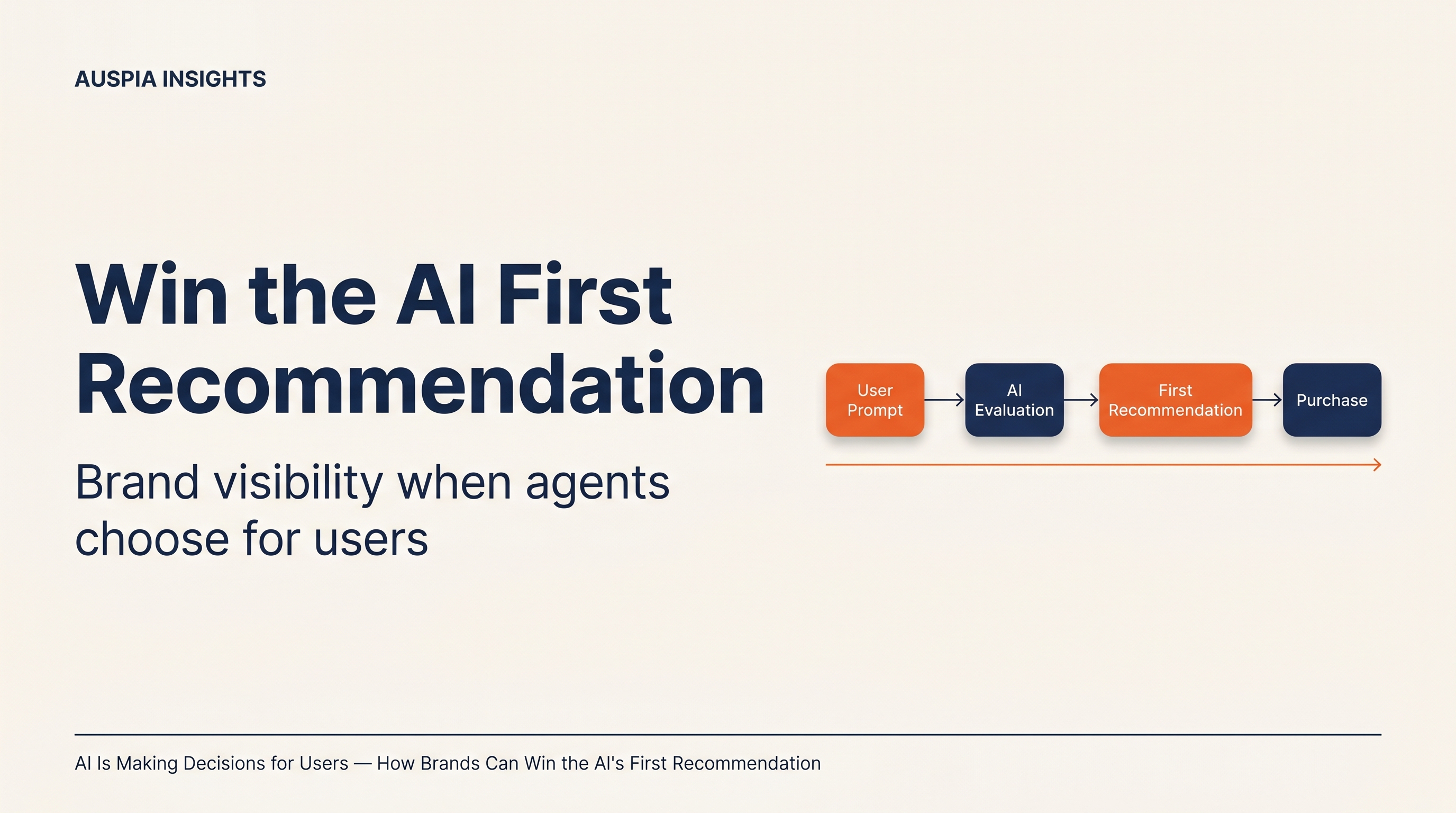
AI is becoming a decision layer between brands and buyers. People still search, compare, and read reviews, but more of that work is being compressed into one prompt: "Which product should I choose?" or "Find the best option for my situation." In that world, the brand that wins is not always the brand with the highest blue-link ranking. It is the brand an AI system can understand, trust, compare, and recommend without hesitation.
The practical answer is simple, though the work is not: brands need to become the safest first recommendation for AI. That means clear entity data, answer-ready pages, credible third-party proof, structured product or service information, and ongoing measurement across ChatGPT, Gemini, Perplexity, Google AI Overviews, and the next wave of shopping agents.
Auspia's view: SEO still matters, but it is no longer enough on its own. The new growth stack is SEO for discovery, AEO for direct answers, GEO for citations and recommendations, and brand-entity work for trust.
Why AI is becoming the new decision gate
A recent Mininglamp industry observation described a clear behavioral shift: consumers are moving from "search and filter" to "ask and decide." The examples are easy to recognize. A shopper does not want ten pages about wireless headphones. She wants a short list for commuting, calls, and a budget. A new parent does not want to read twenty formula pages. He wants to know which stage fits a six-month-old child and what risks to check.
This is why the AI layer matters. AI answers are not only summarizing content. In many categories, they are narrowing the choice set before the user ever reaches a brand website.
The shift is also visible in commerce. Amazon has tested AI shopping features such as Rufus and Buy for Me. McKinsey has described agentic commerce as a model where agents coordinate purchases across brands and services. Academic work on AI shopping agents has raised a related point: different agents can make different choices from the same market, and small changes in product presentation can affect what gets selected.
For marketers, the uncomfortable lesson is this: if the AI cannot see a brand clearly, the user may never consider it.
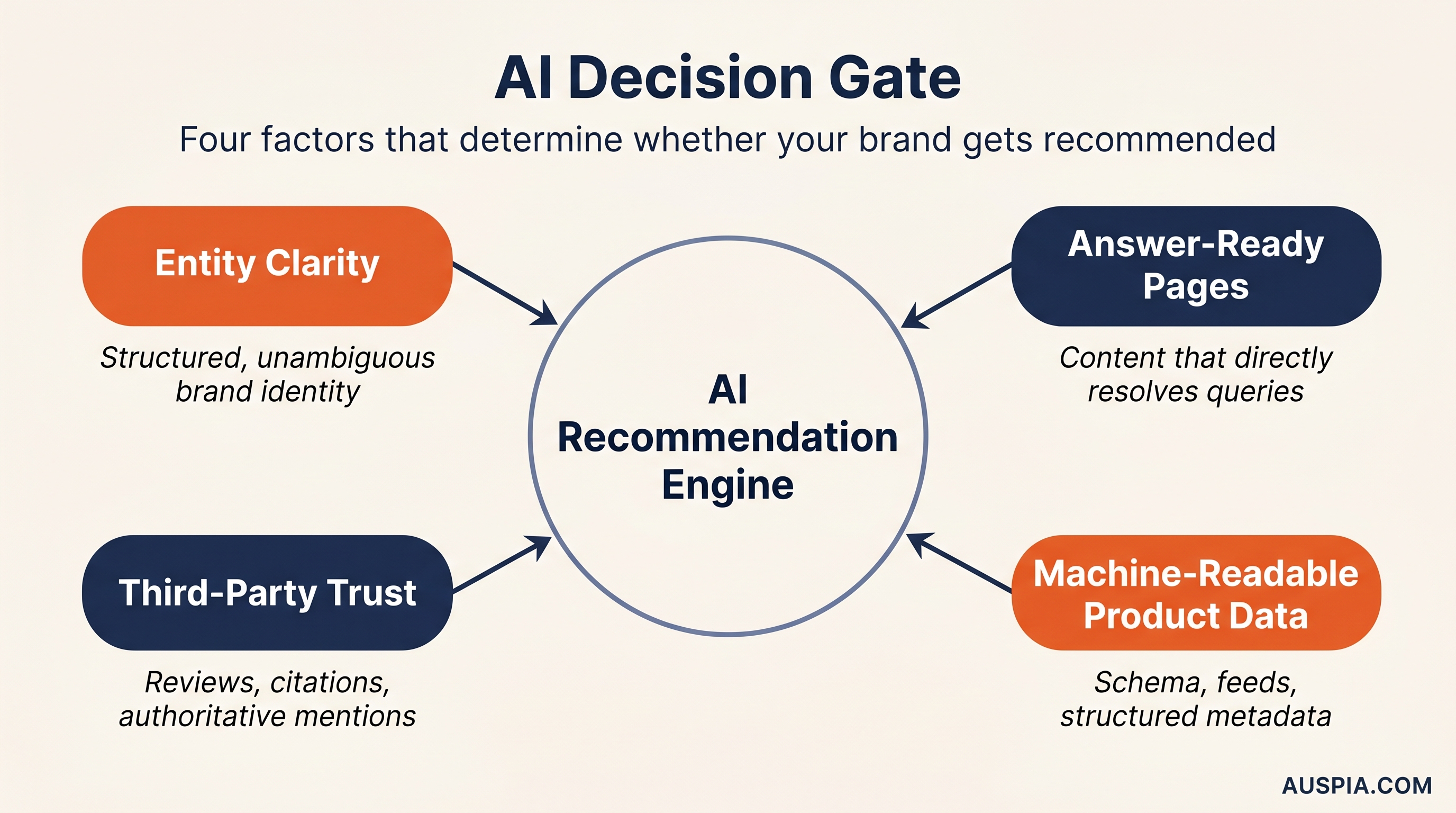
Caption: AI recommendation systems tend to reward brands that are easy to parse, easy to verify, and easy to compare.
The first recommendation is a trust problem, not a keyword problem
Traditional SEO asks, "Can we rank for this query?" AI recommendation work asks a harder question: "Would an AI system be comfortable naming us first?"
That is a different standard. A ranking page can win attention with a strong title, a good backlink profile, or a sharp comparison. An AI recommendation has to defend a choice. It needs enough confidence to say, in effect, "For this user, this brand is a reasonable answer."
That confidence usually comes from four signals.
- Entity clarity: AI needs a stable understanding of who the brand is. Brands should keep names, categories, descriptions, locations, ownership facts, and product scope consistent.
- Answer quality: AI needs extractable answers to buyer questions. Brands should provide short explanations, comparison points, FAQs, use-case pages, and clear claims.
- External proof: AI needs evidence beyond the brand's own website. Brands should build reviews, analyst mentions, partner pages, trusted directories, case studies, and press coverage.
- Actionability: AI needs data it can use to complete a task. Brands should expose pricing, availability, specs, policies, schema, feeds, APIs, and clean product pages.
Most brands over-invest in the second line and under-invest in the other three. They publish more content, but the brand entity stays messy. They write comparison articles, but the product data is hard to parse. They chase AI citations, but the outside proof is thin.
What "first recommendation" actually means
The goal is not to trick an AI into repeating a brand name. That is short-term thinking, and it usually produces weak content.
A more useful goal is recommendation readiness. A brand is recommendation-ready when an AI system can answer these questions without doing guesswork:
- What category is this brand in?
- Who is it best for?
- What problem does it solve better than alternatives?
- What evidence supports that claim?
- What are the limits, risks, price ranges, or tradeoffs?
- Where can the user verify the information or take action?
This matters because AI answers often collapse the funnel. In a normal search journey, a user might see ten results, open five tabs, compare three vendors, and then make a decision. In an AI journey, the model may show a short answer with two or three names. If your brand is absent from that first answer, you are not just losing a click. You may be losing the entire comparison set.
The four-layer playbook for winning AI recommendations
1. Build a brand entity AI can recognize
Start with the boring work. It is usually the work that pays.
Your brand name, short description, category, country, service area, product names, leadership facts, contact details, and social profiles should be consistent across your website and major external profiles. This includes LinkedIn, Google Business Profile, Crunchbase or comparable directories, software review platforms, marketplaces, partner pages, and industry listings.
For AI systems, inconsistency is friction. If one source calls you an "AI SEO platform," another calls you a "content automation agency," and another says you are a "marketing analytics tool," the model may still mention you, but it will struggle to place you cleanly.
A good entity paragraph should be plain:
Auspia is an AI search optimization platform for SEO, GEO, and AEO teams. It helps brands audit AI visibility, improve answer-ready content, and track how they appear in AI search results.
That kind of sentence is not fancy. It is useful. AI systems like useful.
2. Turn buyer questions into answer-ready pages
AI-first content is not shorter content. It is clearer content.
Map the prompts your buyers are likely to ask:
- "What is the best tool for checking AI search visibility?"
- "How do I know if my brand appears in ChatGPT answers?"
- "Which platform is better for GEO audits?"
- "What should a B2B SaaS company do before investing in AI search optimization?"
- "What are the risks of letting AI agents choose vendors?"
Then build pages that answer those questions directly. Use a short answer near the top. Add a comparison table. State who the product is for and who it is not for. Include evidence, screenshots, constraints, and next steps.
This is where AEO and GEO overlap. AEO makes content easy to extract as an answer. GEO makes the brand more likely to be cited or recommended inside generated answers.
3. Earn proof outside your own domain
A brand's own website is necessary, but it is not enough. AI systems often cross-check claims against external sources. That can include reviews, media coverage, community threads, data partners, academic references, marketplace listings, and high-authority directories.
For B2B brands, this proof may come from G2, Capterra, partner pages, integration directories, customer case studies, and analyst-style roundups. For ecommerce brands, it may come from verified reviews, retailer pages, product tests, creator comparisons, Reddit discussions, and structured marketplace data.
The goal is not random PR. The goal is corroboration. If your website says you are the best choice for mid-market GEO reporting, external sources should make that claim plausible.
4. Make product and service data machine-readable
Agentic commerce raises the bar. A human can tolerate a messy page. An agent may not.
If an AI agent is comparing options, it needs clean data: price, availability, plan differences, return policy, compatibility, shipping constraints, security information, supported integrations, service regions, and product specifications. In ecommerce, this means product feeds, structured data, clean category pages, and accurate stock information. In SaaS, it means plan pages, integration docs, API docs, security pages, and comparison pages that do not hide the facts.
Technical SEO still matters here. Clean crawl paths, schema, internal links, sitemaps, indexable content, and fast pages all help AI systems access the evidence. The difference is that the output may not be a click. It may be a recommendation.
A practical workflow for brands
Use this sequence if you are starting from zero.
Step 1: Run a prompt baseline
Pick 30 to 100 prompts that reflect real buyer decisions. Include category queries, comparison queries, risk queries, use-case queries, and budget queries.
Examples:
- "Best AI search visibility checker for a small marketing team"
- "Auspia vs alternatives for GEO tracking"
- "How should a SaaS company measure AI citations?"
- "Which tool helps create llms.txt files?"
- "What are the risks of AI search optimization?"
Run them across several AI surfaces. Record whether your brand appears, where it appears, what competitors appear, whether citations are used, and whether the answer is accurate.
Auspia's AI Search Visibility Checker is built for this kind of visibility audit.
Step 2: Fix factual drift
Collect the wrong or vague statements AI systems make about your brand. Then trace why they happen. Usually the cause is one of these:
- Old pages still indexed
- Conflicting descriptions across profiles
- Thin about or product pages
- Missing schema
- No external proof for a core claim
- Competitors with clearer comparison content
Do not start by publishing ten new articles. Start by making the facts consistent.
Step 3: Build the answer set
Create or improve pages for the questions that matter most. Each page should have:
- A direct answer in the first 100 words
- Clear definitions for important terms
- Comparison tables where buyers compare options
- Specific use cases and non-use cases
- Evidence, screenshots, and examples
- FAQ blocks that answer real follow-up questions
This is not about stuffing keywords into headings. It is about making the page easy for a model to quote accurately.
Step 4: Add third-party corroboration
For every claim you want AI to believe, ask: "Where else can this be verified?"
If the claim is "trusted by ecommerce teams," you need customer evidence, reviews, partner listings, or public case studies. If the claim is "works with Shopify," you need integration documentation or marketplace proof. If the claim is "strong in enterprise security," you need security pages, compliance documentation, and references that support the statement.
Step 5: Re-test monthly
AI visibility is not static. Models change, indexes update, citations shift, and competitors publish new pages. Track a fixed prompt set every month. Watch for three things:
- Share of answer: how often your brand appears
- Recommendation rank: whether you are first, second, or only mentioned later
- Answer accuracy: whether the model describes you correctly
If you only track traffic, you will miss the early signs. AI recommendation loss often appears before analytics show a traffic drop.
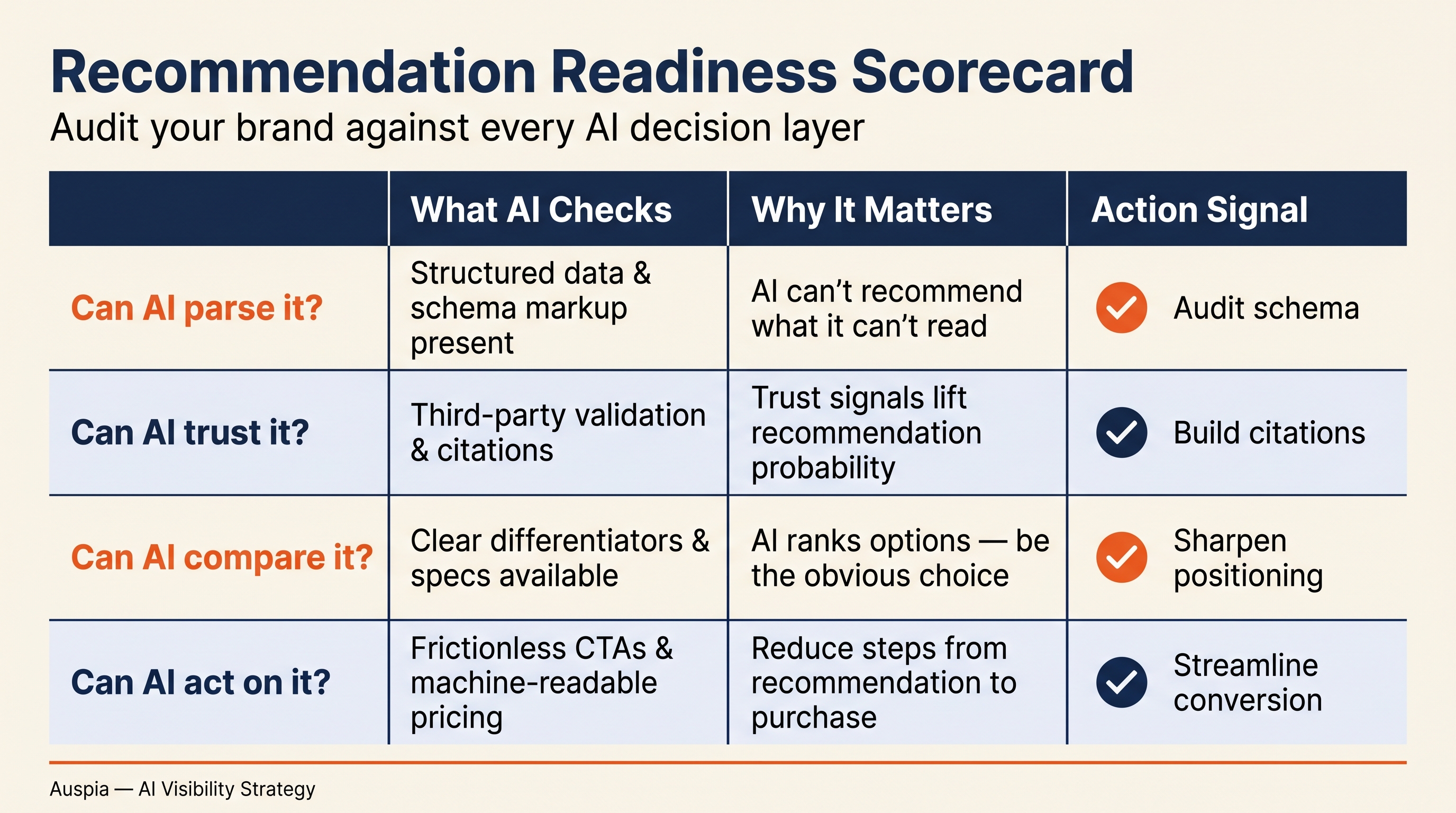
Caption: A simple readiness scorecard helps teams move from vague AI visibility work to measurable fixes.
Common mistakes that keep brands out of AI answers
The most common mistake is treating GEO as a content volume game. Publishing more pages does not help if the brand entity is unclear or the claims are unsupported.
The second mistake is writing for the old funnel only. Many pages still assume the user will click, browse, and self-educate. AI users often ask for a filtered answer. Your content needs to help the AI make that filter.
The third mistake is hiding the useful facts. Pricing, limitations, product fit, integrations, policies, and comparison criteria are often buried because teams want to force a demo. That may work for human lead capture. It is terrible for machine evaluation.
The fourth mistake is measuring only citations. Citations matter, but a recommendation without a citation can still shape demand. Track mentions, rank position inside the answer, sentiment, factual accuracy, and the sources the AI seems to rely on.
What teams should do this week
If you only have one week, do not boil the ocean. Do this:
- Write a clean brand entity paragraph and make it consistent across your site and key profiles.
- Choose 50 buyer prompts and record your current AI visibility baseline.
- Update your five most important product or service pages with direct answers, comparison tables, and clearer evidence.
- Add schema and check whether AI crawlers can access your important pages.
- Identify five external proof gaps: reviews, partner pages, directories, case studies, or expert mentions.
That is enough to start. The point is not to become perfect in a week. The point is to stop being ambiguous.
Final takeaway
The next search battleground is not only the results page. It is the decision layer. When users delegate research, comparison, and sometimes purchasing to AI, brands have to earn machine trust before they earn human attention.
The brands that win will be the ones AI can explain clearly: who they are, who they serve, why they are credible, and when they are the right choice. That is not a hack. It is the new discipline of being understandable enough to recommend.
Author: Adrian Cole, Analyst of 1,000+ AI Search Results at Auspia. Adrian writes about how brands appear in ChatGPT, Perplexity, Gemini, Google AI Overviews, and other answer surfaces.