GEO needs SEO first in 2026
If your pages cannot be crawled, indexed, understood, and trusted by Google, they are unlikely to become reliable sources for AI answers. GEO is worth doing in 2026, but it is not a shortcut around SEO. It is a layer on top of technical access, structured content, entity clarity, authority signals, and conversion pages.
The practical order is simple:
- Fix the pages that should already rank and convert.
- Turn your best commercial and educational content into clear answer assets.
- Add schema, evidence, authorship, and source references so machines can understand what each page is claiming.
- Monitor AI mentions, branded search, and assisted conversions instead of treating AI visibility as the final goal.
A brand mention inside an AI answer is useful. A qualified visitor who later searches your brand, lands on a strong page, and converts is more useful.
Why this matters now
Since Google expanded AI Overviews and continued testing AI-first search experiences, more teams have started asking a fair question: "How do we get cited by AI?" The wrong answer is to ignore everything that made a site discoverable in the first place.
AI answer systems still need sources. They need pages that are accessible, specific, fresh enough, and safe to quote. In practice, the sites that do well in AI answers often already have the boring parts in place: indexable pages, clear headings, structured data, links from relevant sources, and content that answers a real question without hiding the answer under sales copy.
That does not mean organic ranking and AI citations are identical. They are not. But they overlap enough that skipping SEO is usually an expensive detour.
SEO is the foundation, GEO is the citation layer
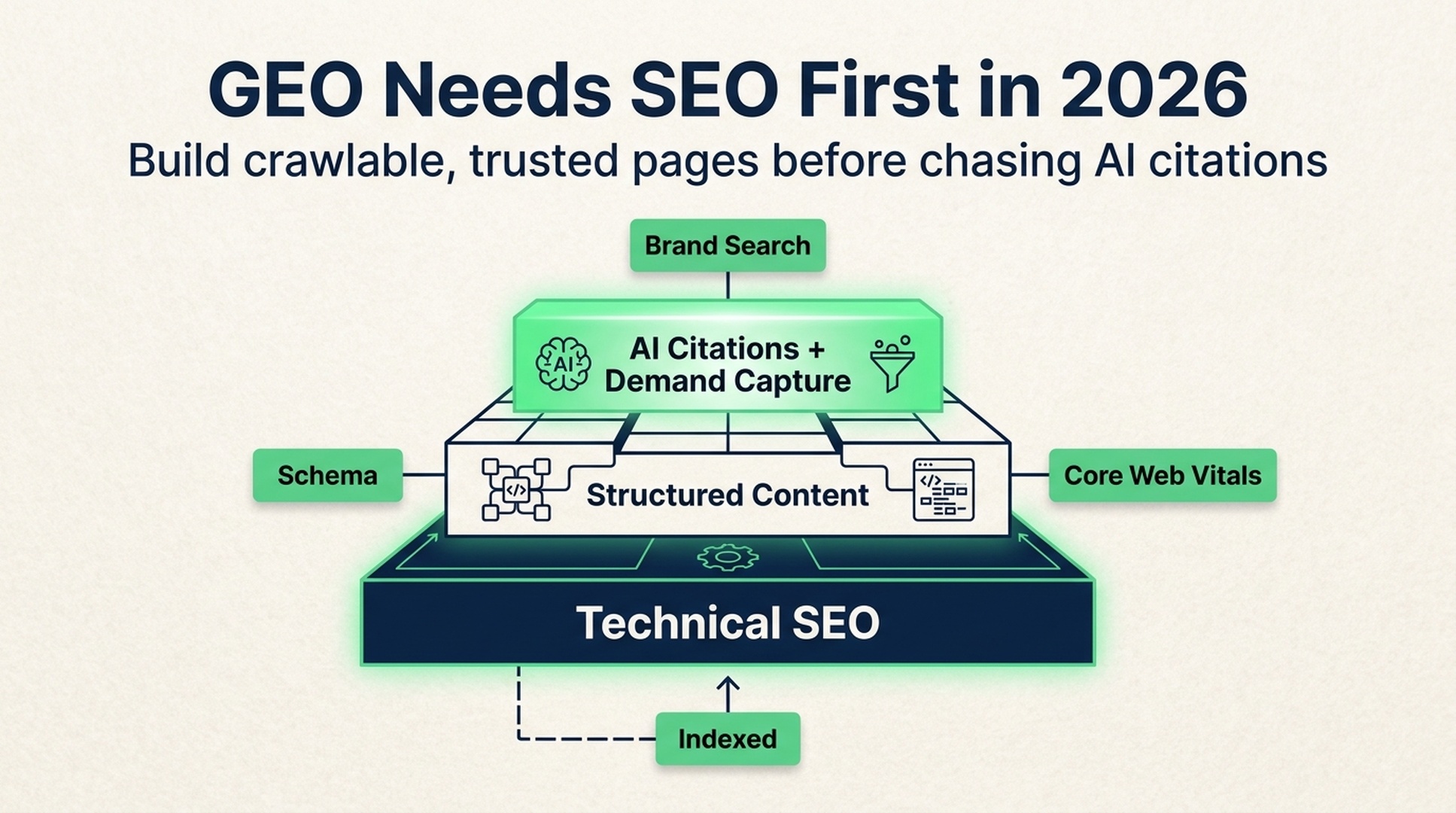
Think of SEO and GEO as two layers of the same traffic system.
- Layer: Technical SEO; Main job: Make key pages crawlable, fast, mobile-friendly, and indexable; What it gives AI systems: A reliable page that can be discovered and parsed
- Layer: Content SEO; Main job: Match search intent with useful pages; What it gives AI systems: Clear topics, entities, answers, and supporting context
- Layer: Authority and trust; Main job: Prove that the brand and page are credible; What it gives AI systems: Safer sources to reference in answers
- Layer: GEO; Main job: Package content so AI systems can extract and cite it; What it gives AI systems: Concise answers, evidence blocks, definitions, comparisons, and next-step context
- Layer: Conversion SEO; Main job: Capture demand after the mention; What it gives AI systems: Product pages, brand SERPs, comparison pages, demos, trials, and contact paths
The mistake is treating GEO as if it sits outside this system. It does not. GEO depends on the same raw material, then asks for better structure.
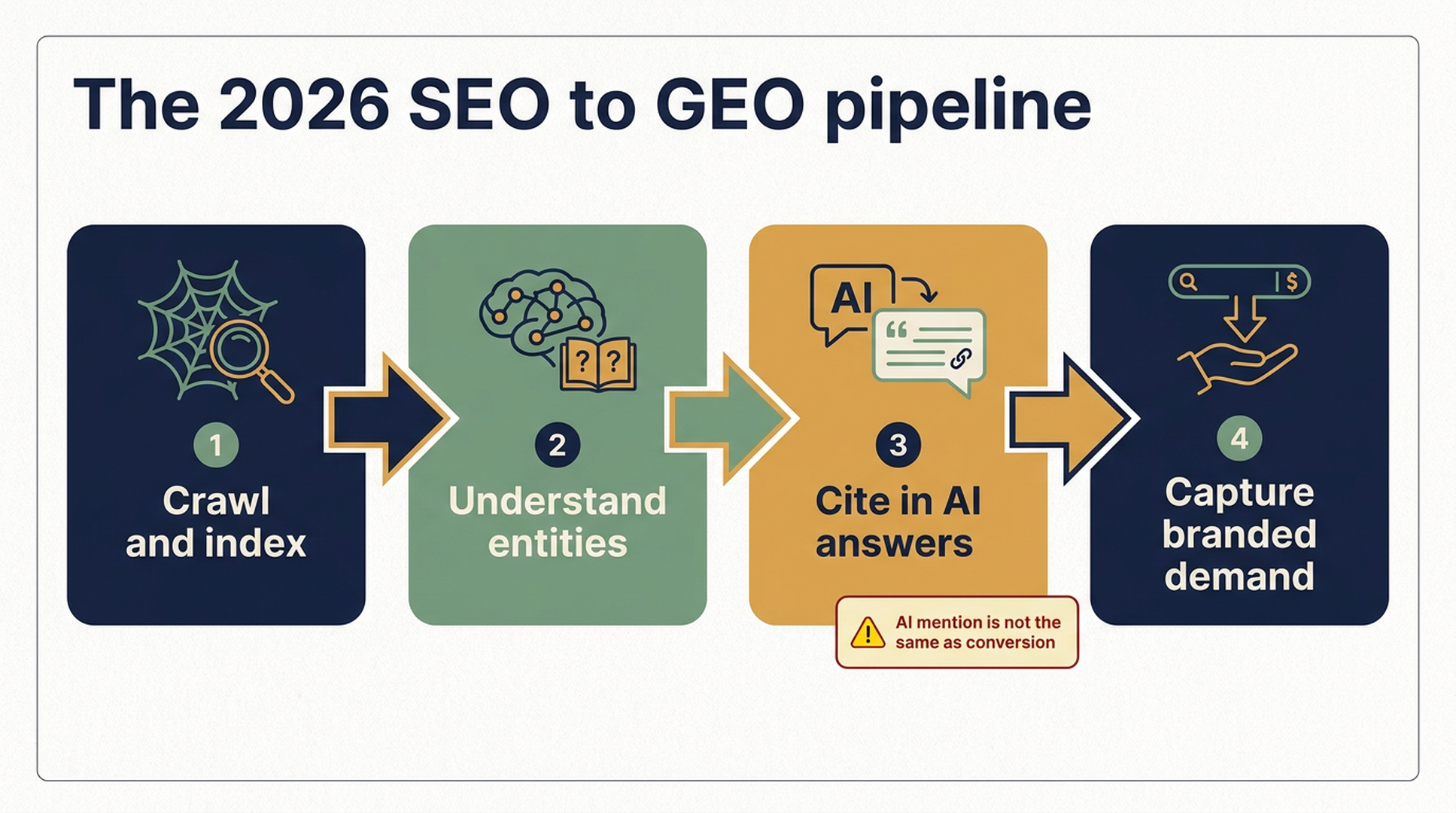
Caption: GEO starts with crawlable pages and ends only when branded demand can be captured.
The invisible SEO work that decides AI visibility
Most teams describe SEO as keywords, articles, and backlinks. Those matter, but the work that supports AI citation is often less visible.
1. Crawl and index access
If Google cannot access the page, the rest of the strategy is theory.
Check these first:
- Check: robots.txt; Common failure: Important folders blocked by accident; Tool: Google Search Console, robots.txt checker
- Check: Index coverage; Common failure: Commercial or resource pages not indexed; Tool: Google Search Console
- Check: JavaScript rendering; Common failure: Main content loads only after scripts that crawlers struggle with; Tool: URL Inspection and rendered HTML checks
- Check: Canonicals; Common failure: Useful pages canonicalized to the wrong URL; Tool: Site crawl tools
- Check: Internal links; Common failure: Important pages orphaned or buried too deep; Tool: Screaming Frog, Sitebulb, internal crawl reports
For 2026, also update older checklists that still use FID as the main interaction metric. Google replaced FID with INP for Core Web Vitals in 2024. The current practical targets are usually LCP under 2.5 seconds, INP under 200 milliseconds, and CLS under 0.1.
2. Structured data and entity clarity
Schema does not magically create rankings. It does help search systems understand what a page is about.
For AI visibility, structured data is most useful when it supports a real page structure:
- Page type: Product page; Useful schema: Product, Offer, Review, AggregateRating; What it clarifies: What the product is, who it is for, price or availability signals, proof
- Page type: Article or guide; Useful schema: Article, BlogPosting, FAQPage where appropriate; What it clarifies: Author, date, topic, answer blocks
- Page type: Software or tool page; Useful schema: SoftwareApplication, Product; What it clarifies: Features, category, use cases, pricing model
- Page type: Local or service page; Useful schema: LocalBusiness, Service, Organization; What it clarifies: Location, service area, identity, contact routes
- Page type: Comparison page; Useful schema: ItemList, Product, Review where relevant; What it clarifies: Which options are being compared and on what criteria
The page still needs real substance. A thin page with schema is still a thin page.
3. Answer structure
AI systems prefer content that can be lifted cleanly into an answer. That usually means the page has:
- a direct answer near the top;
- short definitions that stand on their own;
- comparison tables where the differences matter;
- concrete criteria, numbers, constraints, and examples;
- citations or evidence for claims that could affect decisions;
- internal links to deeper pages when the user needs to act.
Weak version:
Our analytics platform is powerful, flexible, and trusted by modern teams.
Better version:
For a B2B SaaS team with a 90-day sales cycle, product analytics should connect activation events, account-level usage, and CRM stages. Without that connection, the growth team can see feature usage but cannot tell which events predict pipeline.
The second answer has entities, use case, constraint, and decision value. It is easier for both humans and machines to understand.
4. Trust signals
AI search is more careful with claims that can affect money, health, legal choices, or business operations. Even in lower-risk industries, the same principle applies: the system needs reasons to trust you.
Useful trust signals include:
- named authors or reviewers with relevant experience;
- recent update dates where freshness matters;
- original data, test notes, or methodology;
- third-party mentions and reviews;
- external links from credible, relevant sites;
- clear company identity and contact information;
- consistency between product pages, documentation, reviews, and social proof.
Trust is not created by adding the word "expert" to a page. It is created by making the evidence visible.
The trap: AI mentions without business impact
A newer problem is showing up in 2026 planning meetings: the brand appears in AI answers, but the pipeline barely moves.
That can happen for three reasons.
- What happened: The AI answer satisfied the whole query; Why traffic did not follow: The user had no reason to click; Fix: Add deeper assets: calculators, templates, demos, benchmarks, comparison pages
- What happened: The page answered an informational query only; Why traffic did not follow: The user learned something but was not ready to buy; Fix: Connect answer pages to commercial intent pages
- What happened: The user searched the brand later but found weak results; Why traffic did not follow: Competitors, marketplaces, or old profiles captured the demand; Fix: Strengthen branded SEO, review pages, and comparison SERPs
This is where pure GEO reporting can mislead teams. AI visibility can create awareness, but awareness needs a place to land.
A complete path might look like this:
- A buyer asks an AI system, "Which customer support tools work well for a 50-person SaaS company?"
- The AI answer mentions your brand because your comparison and use-case pages are clear.
- The buyer remembers the name but does not click immediately.
- Later, they search "your brand pricing" or "your brand vs Intercom."
- Your branded SEO pages rank well, answer the next question, and move the buyer toward a demo.
GEO planted the seed. SEO captured the demand.
A 2026 readiness checklist before you spend on GEO
Before launching a GEO campaign, audit the foundation. This is not glamorous, but it prevents wasted work.
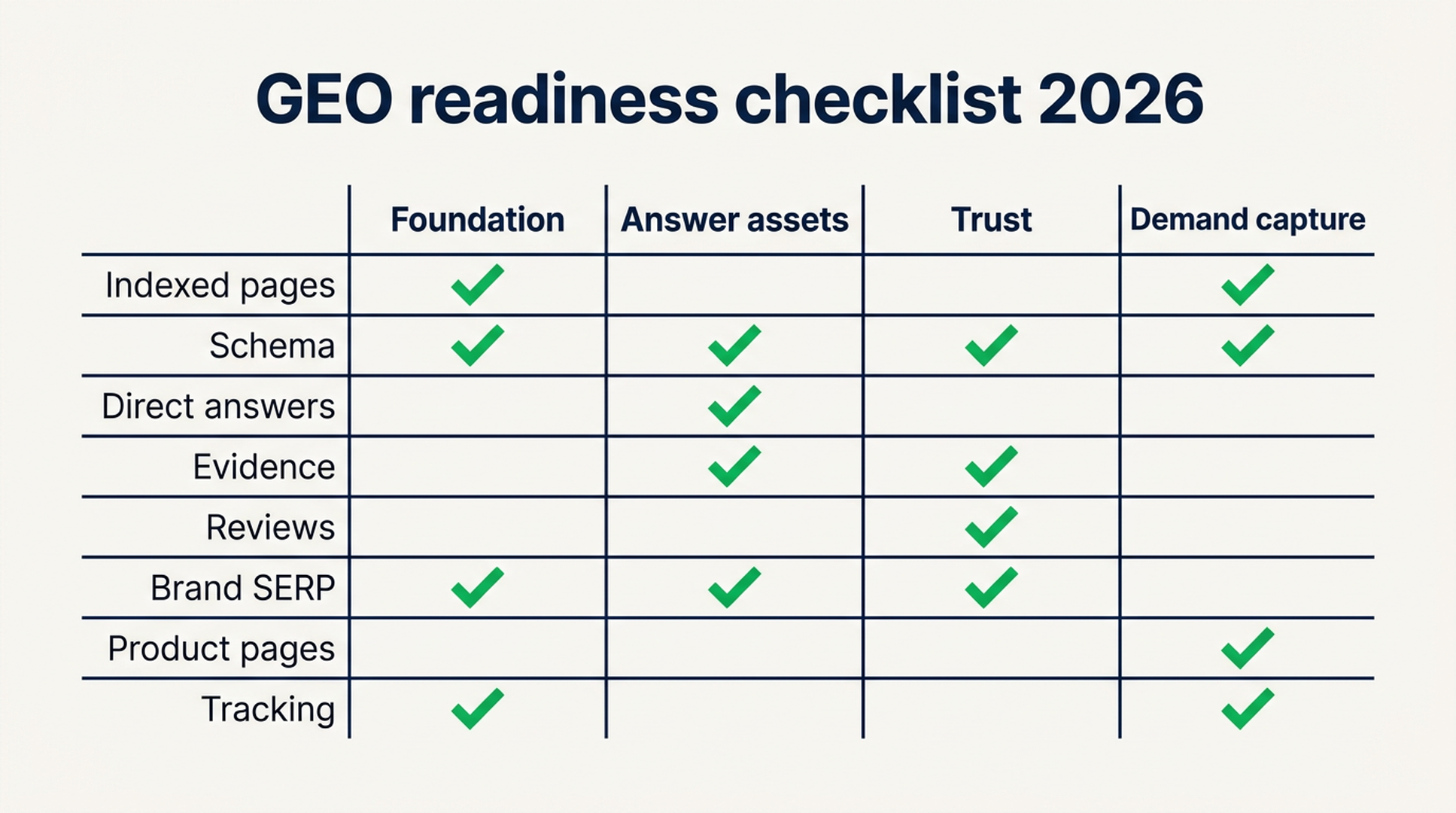
Caption: Use the checklist before treating AI citations as a standalone growth channel.
- Area: Indexing; Minimum standard: Key commercial and resource pages are indexed; How to check: Google Search Console coverage and URL Inspection
- Area: Crawl rules; Minimum standard: robots.txt and meta robots do not block important pages; How to check: Crawl test and robots.txt audit
- Area: Performance; Minimum standard: LCP < 2.5s, INP < 200ms, CLS < 0.1 on key templates; How to check: PageSpeed Insights and CrUX where available
- Area: Schema; Minimum standard: Product, Organization, Article, FAQ, or Software schema added where relevant; How to check: Rich Results Test and schema validator
- Area: Answer assets; Minimum standard: Priority questions have pages with direct answers and evidence; How to check: Manual content review
- Area: Internal links; Minimum standard: Answer pages link to product, comparison, demo, or tool pages; How to check: Crawl report and content audit
- Area: Branded SERP; Minimum standard: Brand, pricing, reviews, alternatives, and comparison queries are covered; How to check: Google Search Console and manual SERP checks
- Area: AI tracking; Minimum standard: AI mentions, citation accuracy, and branded search lift are monitored; How to check: Prompt library, manual checks, AI visibility tools
If several of these are red, start there. A GEO agency, tool, or prompt workflow cannot compensate for pages that search systems cannot access or trust.
How to build SEO and GEO together
The working model is not "SEO first for a year, then GEO." Most teams should build them together, with the SEO foundation leading the sequence.
Step 1: Map the questions that matter
Start with 20 to 50 questions that real buyers ask before purchase.
Useful sources:
- Google Search Console queries;
- sales calls and demo notes;
- support tickets and live chat logs;
- Reddit, Quora, community forums, and G2-style review pages;
- competitor FAQs and comparison pages;
- People Also Ask and related searches.
Group the questions by intent:
- Intent: Definition; Example: "What is AI search visibility?"; Best page type: Glossary or explainer
- Intent: Evaluation; Example: "Best tools for tracking AI citations"; Best page type: Comparison or buyer guide
- Intent: Selection; Example: "How to choose between A and B"; Best page type: Use-case comparison
- Intent: Validation; Example: "Is this brand reliable?"; Best page type: Case study, review, proof page
- Intent: Action; Example: "How do I check llms.txt?"; Best page type: Tool page or template
Step 2: Create answer pages, not just blog posts
A blog post can rank. A strong answer asset can rank, get cited, and support sales.
For each priority question, include:
- the direct answer in the first 100 words;
- a short definition if the topic is new;
- a table or checklist that summarizes the decision;
- evidence, examples, or source links;
- schema where appropriate;
- a clear next step: tool, template, demo, comparison, or product page.
Auspia users can start by auditing key pages with the Website SEO Score Checker, then checking whether the same pages are visible in AI-style answers with the AI Search Visibility Checker.
Step 3: Separate answer content from conversion content
This is the part many teams miss.
- Content type: Answer content; Main purpose: Get understood and cited; Example CTA: "See the benchmark table" or "Use the checklist"
- Content type: Comparison content; Main purpose: Help the buyer choose; Example CTA: "Compare plans" or "View alternatives"
- Content type: Product content; Main purpose: Convert active demand; Example CTA: "Start trial" or "Book a demo"
- Content type: Proof content; Main purpose: Reduce risk; Example CTA: "Read the case study" or "See methodology"
Do not force every answer page to sell immediately. But do give the reader a reason to continue.
Step 4: Monitor the right metrics
Traditional SEO metrics still matter: impressions, clicks, rankings, indexed pages, Core Web Vitals, and conversions. Add AI-era metrics on top.
- Metric: AI mention rate; What it tells you: How often your brand appears for priority questions
- Metric: Citation quality; What it tells you: Whether the AI answer links to the right page and describes you accurately
- Metric: First-mentioned rate; What it tells you: Whether you appear before competitors in AI answers
- Metric: Question coverage; What it tells you: How many priority questions have a suitable answer asset
- Metric: Branded search lift; What it tells you: Whether AI exposure creates later brand demand
- Metric: Assisted conversions; What it tells you: Whether cited pages help users move toward demo, signup, or purchase
If AI mentions rise but branded search and assisted conversions do not, the issue may not be GEO. It may be weak demand capture.
Auspia take
GEO is not fake. It is also not magic.
The strongest 2026 strategy treats GEO as a visibility layer inside a larger search system. You still need pages that Google can crawl. You still need content that answers real questions. You still need authority signals. And when an AI answer mentions your brand, you still need SEO pages ready for the next search.
The brands that win are unlikely to be the ones chasing every new acronym. They will be the ones that make their expertise easy to find, easy to verify, and easy to act on.
FAQ
Is GEO replacing SEO in 2026?
No. GEO adds a new optimization layer for AI answers, but it depends on many SEO basics: crawlability, indexation, page quality, structured data, entity clarity, and trust signals.
Can a new website get AI citations without ranking well?
It can happen, especially for niche questions or original data, but it is not a dependable strategy. A new site should build technical SEO, answer assets, and authority signals before expecting consistent AI mentions.
What should I fix first before starting GEO?
Start with indexation, crawl rules, page performance, structured data, and content clarity on your most important commercial and informational pages. Then create answer assets for buyer questions.
How do I measure whether GEO is helping revenue?
Track AI mentions, citation accuracy, branded search growth, assisted conversions, and performance of branded or comparison pages. Do not judge GEO only by whether an AI answer mentions your brand.
Which pages are most useful for GEO?
Useful pages include comparison guides, FAQ-style answer pages, product pages with clear schema, original data pages, case studies, and tool pages that solve a concrete problem.