Executive Summary
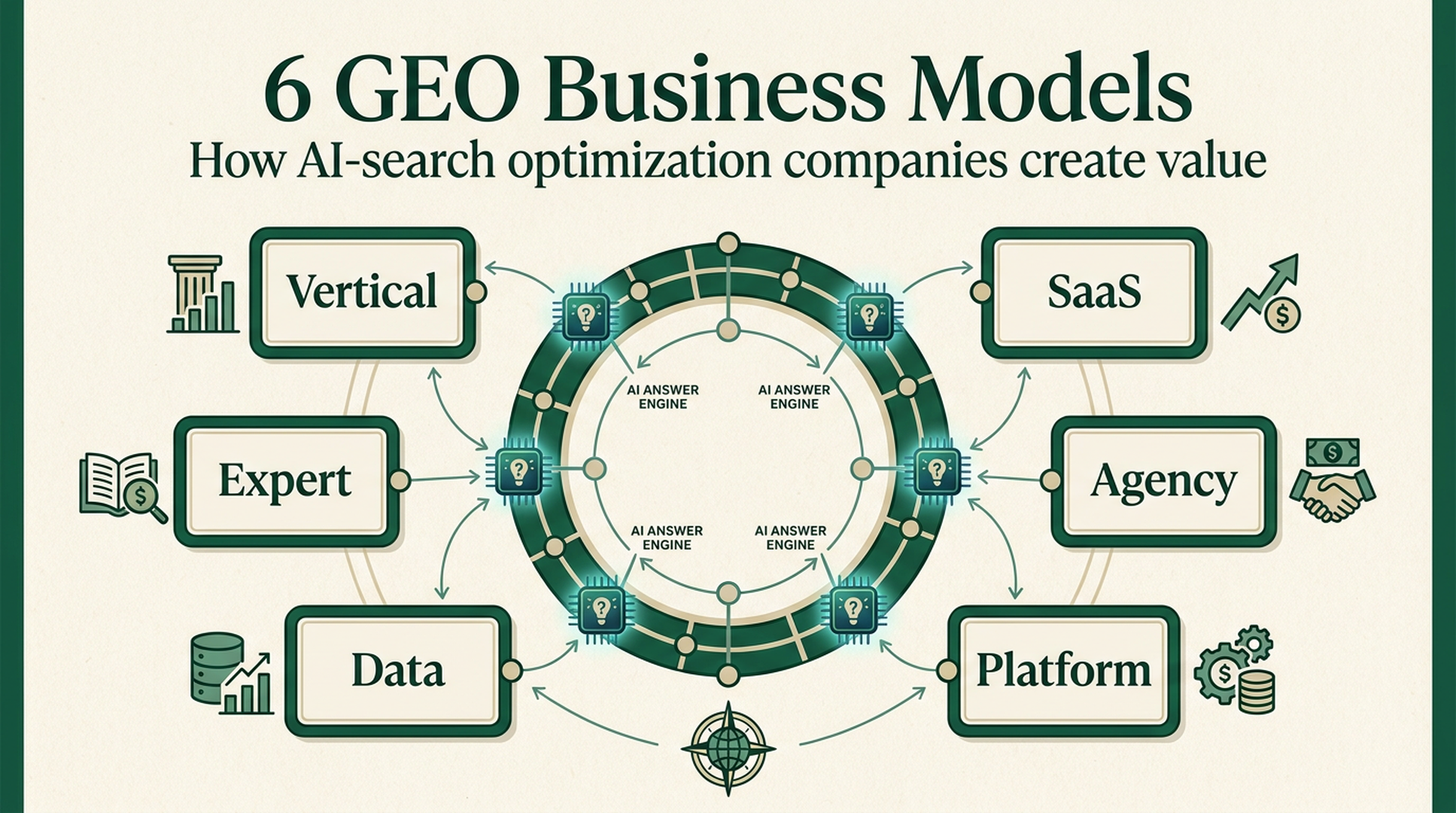
GEO is no longer a single service category. It is becoming a market with at least six repeatable business models: visibility SaaS, agency delivery, platform add-ons, data-led intelligence, expert-led advisory, and vertical specialization.
The important question is not "Should we enter GEO?" The better question is: which part of the value chain can we win?
- If you have engineering strength, build measurement and workflow software.
- If you already sell marketing services, package GEO as a repeatable delivery system.
- If you own a customer base, add GEO as an upgrade module.
- If you own search, review, or industry data, turn it into decision intelligence.
- If you have trust and distribution, build an advisory or education-led business.
- If you are a small team, pick one vertical and become the GEO authority there.
For growth teams, this matters because the vendors you choose will shape your AI-search visibility strategy. A SaaS tool, a channel-heavy agency, a CRM platform, and a vertical specialist all sell "GEO," but they solve different problems and carry different risks.
This article breaks down the six models so operators can choose partners, build capabilities, and avoid buying the wrong version of GEO.
Why GEO Is Splitting Into Different Business Models
Generative Engine Optimization is young, but the market is already fragmenting.
Some teams define GEO as visibility tracking across ChatGPT, Perplexity, Google AI Overviews, Gemini, and other answer engines. Others treat it as content production, citation building, entity optimization, PR, digital shelf monitoring, or sales enablement.
That confusion creates opportunity. Early markets usually reward whoever can simplify the chaos for a specific buyer.
A buyer does not wake up wanting "GEO." They want one of these outcomes:
Buyer Need | What They Actually Want | Best-Fit GEO Model |
|---|---|---|
"Are AI systems mentioning us?" | Measurement, benchmarks, alerts | Visibility SaaS |
"Can someone execute this for us?" | Content, entity, citation, reporting | Agency delivery |
"Can this plug into our existing stack?" | Workflow inside CRM, ecommerce, CMS, or marketing suites | Platform add-on |
"Which prompts and topics are worth fighting for?" | Demand intelligence and prioritization | Data-led intelligence |
"Who can I trust in a confusing market?" | Judgment, training, roadmap, advisory | Expert-led advisory |
"Who understands my category?" | Industry-specific playbooks and proof | Vertical specialist |
The mistake many teams make is treating these as the same business. They are not.
A software company optimizes for product retention. A channel agency optimizes for sales capacity. A platform company optimizes for expansion revenue. A vertical specialist optimizes for industry trust.
If you understand the model, you can understand the incentives.
Model 1: GEO as Visibility SaaS
This is the most obvious starting point. Build a product that monitors how brands, products, executives, and competitors appear in AI-generated answers.
A typical GEO visibility SaaS helps teams answer questions like:
- How often does our brand appear in AI answers?
- Which competitors are recommended more often?
- Which sources are being cited?
- Which prompts create positive, negative, or missing visibility?
- Which pages should we create or update next?
- Did our visibility change after a campaign, PR mention, or content update?
The revenue logic is straightforward:
- Monthly or annual subscriptions.
- Usage-based fees for prompt tracking, API calls, seats, or markets.
- Enterprise services for setup, reporting, and custom integrations.
This model fits teams with strong engineering, product design, data infrastructure, and capital discipline. It can become valuable because software compounds. Once the system can monitor prompts, sources, competitors, and visibility trends at scale, every new customer improves the dataset and product feedback loop.
But SaaS is not an easy path. The market still has open questions:
- Which AI platforms matter most for each industry?
- How stable are AI answers over time?
- How should teams measure influence when answers are personalized?
- What actions actually move visibility?
- How do buyers separate useful metrics from vanity dashboards?
The biggest risk is building a dashboard that reports problems but does not help users act. GEO SaaS needs to move from "look at your score" to "here is the next workflow that increases your odds of being cited."
Auspia's view: visibility measurement is necessary, but it is not the full strategy. A strong tool should connect monitoring with entity cleanup, source strategy, content briefs, technical checks, and answer-readiness improvements. That is why teams should pair GEO dashboards with practical checks such as an AI Search Visibility Checker or a broader GEO readiness workflow.
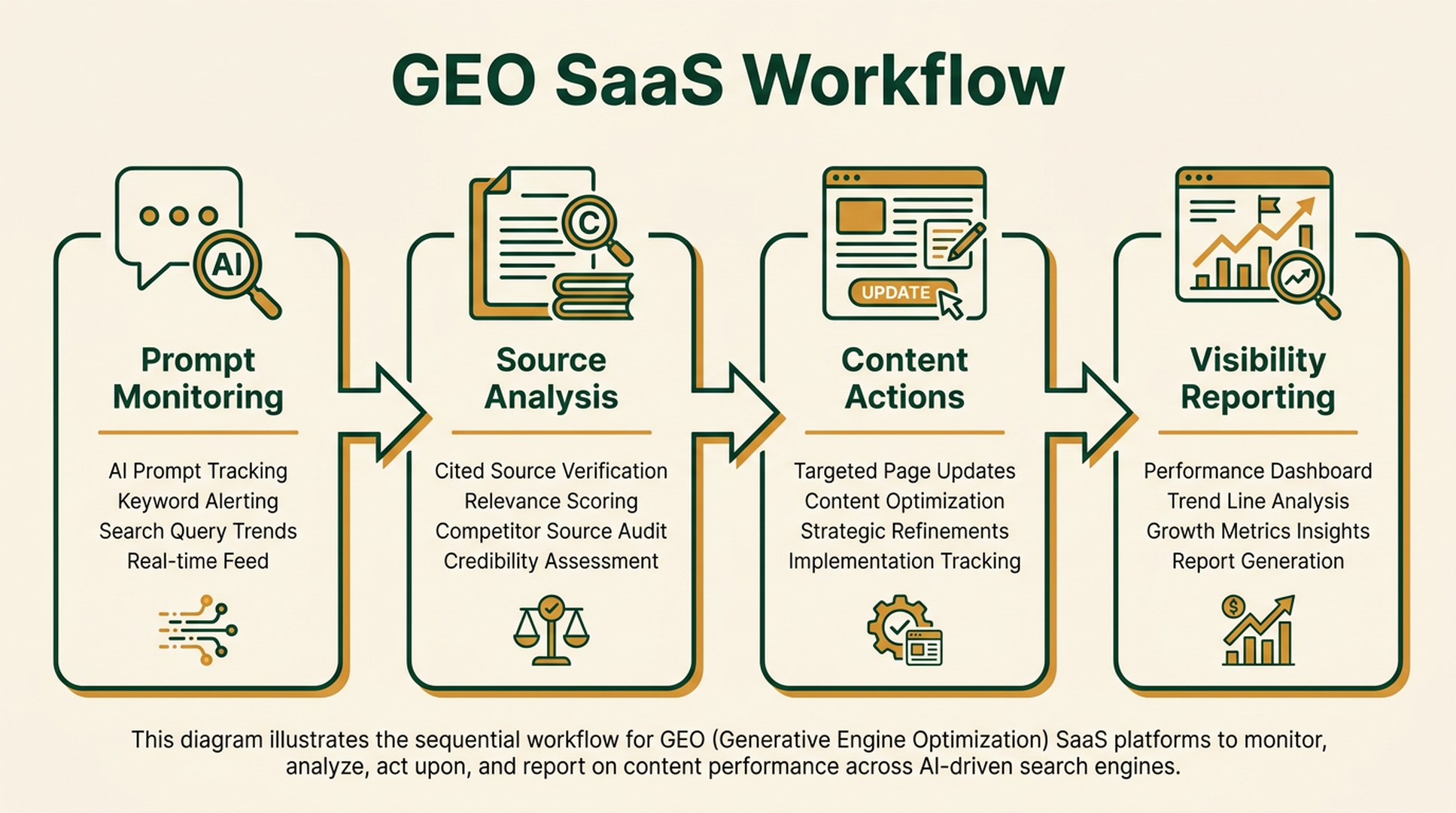
GEO SaaS creates value when it connects measurement with action, not when it only shows a score.
Model 2: GEO as an Agency Delivery System
The second model turns GEO into a service package.
This is where many agencies, consultants, and marketing operators enter the market. They do not need to invent the category. They need to standardize the delivery.
A mature GEO agency model usually includes:
- A diagnostic audit.
- Prompt and competitor mapping.
- Entity and source gap analysis.
- Content refreshes and new answer-targeted pages.
- Third-party profile, review, PR, or citation work.
- Monthly reporting tied to visibility and pipeline signals.
The profit comes from retainers, setup fees, project packages, and sometimes performance-linked upsells.
The fastest-growing agency operators usually do one thing well: they make the service teachable. They turn messy expert work into SOPs, templates, checklists, QA rules, and dashboards. That makes hiring, training, and account delivery easier.
This model can scale through channels. A central team builds the methodology, tooling, scripts, and delivery standards. Local partners, niche consultants, or sales teams bring clients. The headquarters earns through enablement fees, revenue share, white-label delivery, or licensing.
The upside is speed. When buyers are anxious about AI search and do not know what to do, a packaged service is easier to buy than a complex platform.
The risk is quality. If a GEO agency over-standardizes, it may sell the same checklist to every client. That creates weak content, fake citations, and reports that look impressive but do not change AI-answer inclusion.
A good GEO agency should be able to show:
- What prompts matter for the client's real buyers.
- Which sources currently shape AI answers.
- Which entity gaps prevent confident recommendations.
- Which actions were taken and why.
- What changed over time.
- What remains outside the agency's control.
If the agency cannot explain the logic, it is probably selling trend anxiety instead of durable growth work.
Model 3: GEO as a Platform Add-On
The third model belongs to companies that already own customer relationships.
Think of CRM platforms, ecommerce software, CMS providers, review platforms, local-business marketing suites, analytics tools, and enterprise SEO platforms. For them, GEO is not always a new company. It can be a new module.
This model works because the platform already has assets that a new GEO startup must fight to acquire:
- Existing customers.
- Sales teams.
- Support and onboarding processes.
- Billing relationships.
- Industry data.
- Integrations with websites, products, campaigns, reviews, or CRM records.
A platform can add GEO in several ways:
- AI visibility reporting inside an existing dashboard.
- Content recommendations inside a CMS workflow.
- Review, FAQ, or product-data optimization inside ecommerce tools.
- Source and citation monitoring for local or marketplace listings.
- Sales enablement showing how AI answers influence buyer research.
The economics are attractive. If even a small percentage of existing customers upgrade, the platform can create meaningful expansion revenue with lower acquisition cost than a standalone vendor.
The stronger version of this model connects AI visibility to business outcomes:
AI answer presence -> source click -> lead capture -> CRM record -> sales conversation -> revenue.
That full loop is hard for a small GEO-only vendor to own. It is easier for a platform that already sits in the workflow.
The weakness is speed. Larger platforms move slowly. They may launch a module because the market expects it, not because they have a deep point of view. Product teams may also treat GEO as a feature rather than a strategic layer.
For buyers, the evaluation question is simple: does the platform's GEO module produce better decisions, or does it merely add another report to an existing dashboard?
Model 4: GEO as Data-Led Intelligence
Some companies should not start with content or software UI. They should start with data.
This model fits teams that already understand search demand, ecommerce categories, reviews, social listening, marketplace rankings, media monitoring, SERP features, or competitive intelligence.
Their edge is not that they can write another article. Their edge is that they can answer questions such as:
- Which AI prompts map to high-intent buyer journeys?
- Which sources are repeatedly cited in our category?
- Which competitors appear because of reviews, PR, documentation, or community discussions?
- Which questions have commercial value?
- Which topics are not worth pursuing yet?
- Where should the brand invest first?
This is a different mindset from generic content production. It begins with demand structure.
A data-led GEO company can monetize through:
- Subscription intelligence dashboards.
- Category reports and benchmarking.
- Enterprise advisory.
- Data APIs.
- Prioritization frameworks for agencies or internal teams.
The strongest version of this model becomes a map of the market. It tells teams where AI-search opportunity exists before they spend time creating content or building citations.
This matters because not every prompt is worth fighting for. Some prompts have low purchase intent. Some are dominated by sources a brand cannot realistically influence. Some are informational and useful for awareness, but weak for conversion. Some are valuable because they appear at the exact moment a buyer is comparing solutions.
Auspia's view: GEO strategy should start with a map, not a content calendar. Before publishing ten new pages, teams should understand which questions, entities, sources, and buyer stages matter. That is why the best GEO programs combine AI-answer monitoring with classic SEO, entity research, and conversion analysis.
Model 5: GEO as Expert-Led Advisory
Early markets create trust gaps. Buyers hear the buzzword, see conflicting advice, and worry about wasting budget.
That environment rewards credible experts.
An expert-led GEO business usually grows from public thinking: essays, teardown videos, webinars, LinkedIn posts, newsletters, templates, audits, workshops, and private communities. The product is not only information. The product is judgment.
There are two versions of this model.
The first is content-led authority. The expert publishes clear analysis, explains what is real, warns against shallow tactics, and builds trust over time. Revenue comes from consulting, workshops, retainers, training cohorts, and strategic advisory.
The second is paid-distribution authority. The expert uses ads, webinars, live events, or high-volume social distribution to turn market anxiety into faster demand. Revenue often comes from courses, group programs, implementation packages, and premium advisory.
Both can work. They have different constraints.
Content-led authority compounds slowly but creates strong pricing power. Paid-distribution authority can scale quickly but depends on conversion skill, cash flow, and strong fulfillment.
The income stack usually has four layers:
Revenue Layer | What It Sells | Strength | Limitation |
|---|---|---|---|
Advisory | Judgment and diagnosis | High margin | Hard to scale |
Cohorts or workshops | Repeatable method | Scalable expertise | Requires curriculum quality |
Done-for-you services | Implementation | High ticket | Operationally heavy |
Templates or courses | Entry-level trust | Broad reach | Lower pricing power |
The risk is over-personalization. If the business depends entirely on one person, it can become fragile. The long-term challenge is to convert expert judgment into reusable frameworks, tools, community, research, or team capability.
Model 6: GEO as Vertical Specialization
The final model may be the best entry point for small teams.
Instead of saying "we do GEO," say:
- We do GEO for B2B SaaS.
- We do GEO for law firms.
- We do GEO for dental groups.
- We do GEO for cybersecurity vendors.
- We do GEO for hotels and travel brands.
- We do GEO for ecommerce categories with complex product comparison.
Vertical specialization works because GEO is not only a technical problem. It is a buyer-context problem.
A legal buyer, a hotel guest, a software procurement team, and a patient searching for a clinic do not ask the same questions. They trust different sources. They compare different proof. They move through different decision paths.
When a GEO team focuses on one vertical, it gains four advantages:
- Deeper question maps.
- Denser case studies.
- Lower delivery cost through repeatable playbooks.
- Stronger trust because prospects see category fluency.
A vertical specialist can also build proprietary assets: industry prompt libraries, citation maps, review-pattern benchmarks, FAQ databases, competitor matrices, and content templates. Over time, those assets become harder to copy than a generic GEO checklist.
This model is especially strong for small teams because it avoids horizontal competition. You do not need to beat every GEO vendor. You need to become the obvious choice for one category.
How to Choose the Right GEO Model
If you are building a GEO business, start with your unfair advantage.
Your Advantage | Strongest Model | Avoid This Trap |
|---|---|---|
Engineering and data infrastructure | Visibility SaaS | Building scores without workflows |
Agency sales and delivery | Agency delivery system | Selling generic packages with weak proof |
Existing customer base | Platform add-on | Treating GEO as a cosmetic feature |
Proprietary data | Data-led intelligence | Producing reports without action paths |
Personal trust and audience | Expert-led advisory | Staying too dependent on one personality |
Deep industry knowledge | Vertical specialization | Expanding horizontally too early |
If you are buying GEO support, use the same table in reverse. Ask the vendor what model they are actually built for.
A SaaS vendor should show measurement reliability and action workflows. An agency should show delivery quality and category logic. A platform should show integration with business outcomes. A data company should show prioritization power. An expert should show judgment and repeatable methods. A vertical specialist should show deep proof inside your industry.
What Most Teams Miss
Most teams enter GEO by asking, "How do we rank in AI answers?"
That is too narrow.
The better questions are:
- Which AI answer moments influence our buyers?
- Which sources train or shape those answers?
- Which entities does the model understand confidently?
- Which pages, profiles, reviews, datasets, or mentions support our authority?
- Which vendor model matches our real constraint?
- What can we measure monthly without pretending to control the whole AI system?
GEO is not magic. It is a new interface on top of old trust signals: content quality, entity clarity, topical authority, third-party validation, technical accessibility, and audience demand.
The companies that survive will not be the loudest ones. They will be the ones that connect AI visibility to a repeatable business model.
Auspia Takeaway
GEO is becoming a full market, not a single tactic.
The six mature paths are already visible:
- Visibility SaaS.
- Agency delivery systems.
- Platform add-ons.
- Data-led intelligence.
- Expert-led advisory.
- Vertical specialization.
Each path can work, but each requires a different capability stack.
For growth teams, the practical move is to stop buying "GEO" as a buzzword. Define the business problem first: measurement, execution, integration, prioritization, trust, or vertical expertise.
Then choose the model that matches the problem.
If you want to start with a lightweight internal audit, test your brand with Auspia's GEO and AI search tools. Look for three things first: whether AI systems mention you, which sources they trust, and which buyer questions you are still missing.
FAQ
What is the most profitable GEO business model?
There is no universal winner. SaaS can create enterprise value, agencies can produce fast cash flow, platforms can monetize existing customers, and vertical specialists can build high-trust recurring revenue. The best model depends on the team's existing advantage.
Is GEO SaaS enough by itself?
Usually not. Measurement is valuable, but teams also need workflows for content, entity optimization, citation strategy, technical accessibility, and reporting. A dashboard without action paths becomes a vanity tool.
Should small agencies offer GEO services?
Yes, but they should avoid generic packages. A small agency has a better chance if it chooses a vertical, builds a repeatable prompt and source map, and creates proof inside one category before expanding.
How should a company choose a GEO vendor?
Ask what business model the vendor is built around. SaaS vendors should prove measurement and workflows. Agencies should prove delivery quality. Platforms should prove integration. Data vendors should prove prioritization. Vertical specialists should prove category depth.
How is GEO different from SEO?
SEO focuses on visibility in search results, while GEO focuses on being understood, cited, and recommended by AI answer systems. The two overlap because AI systems still rely on accessible content, credible sources, structured entities, and authority signals.