Executive summary
GEO is usually described as a new marketing opportunity: optimize for AI search, get mentioned by ChatGPT, appear in Perplexity answers, and capture demand before competitors do. That framing is useful, but incomplete.
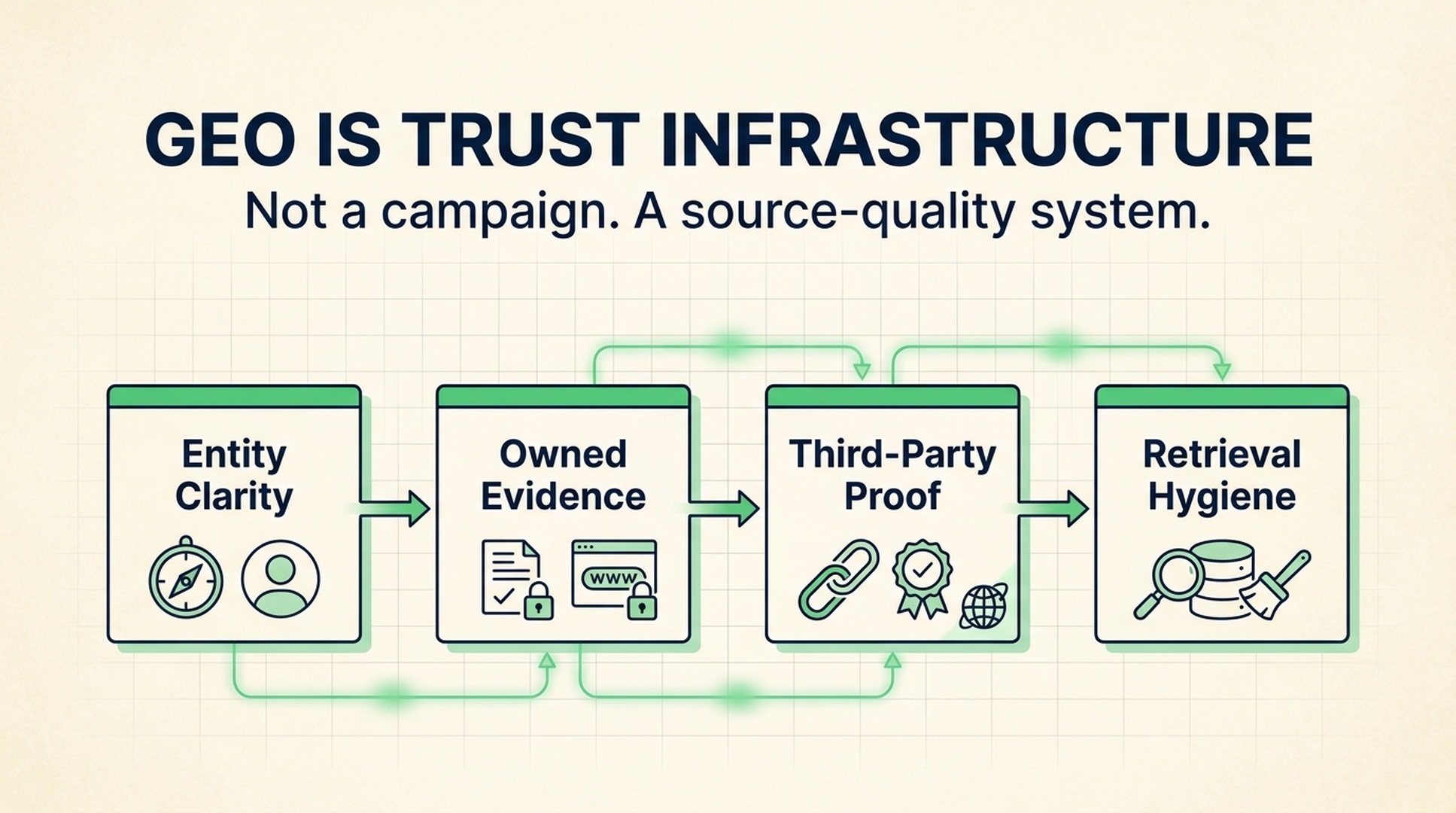
The better way to understand GEO is this: GEO is trust infrastructure for the AI search era.
Traditional marketing tries to create reach. GEO tries to make a brand, product, or page reliable enough for AI systems to use as a source. That means the work is less about short-term content volume and more about verifiable information, consistent entity signals, useful documentation, third-party evidence, and pages that answer real questions clearly.
For growth teams, the practical takeaway is simple: do not run GEO as a three-month content sprint. Build it like an operating system for trust.
The misconception: GEO is treated like another acquisition channel
The most common mistake is to place GEO in the same mental bucket as paid search, affiliate campaigns, influencer marketing, or traditional SEO content calendars.
That creates a familiar operating model:
Campaign mindset | Trust infrastructure mindset |
|---|---|
Pick keywords | Map user decisions and source gaps |
Publish more content | Publish verifiable answers and evidence |
Track mentions only | Track source quality, consistency, and citations |
Optimize one page | Align product, support, documentation, PR, and reviews |
Expect fast lift | Compound trust over months |
The campaign mindset is tempting because it gives teams a clear checklist. Choose prompts. Write articles. Add schema. Submit pages. Check whether AI tools mention the brand.
But AI answer engines do not work like ad inventory. They are not simply looking for the loudest brand. They are trying to assemble a credible answer from sources they can retrieve, compare, and trust.
That difference changes the job.
Marketing creates reach. Trust infrastructure creates retrievable proof.
Marketing is built around attention. It asks: how do we reach more of the right people at the right moment?
The metrics follow that logic: impressions, clicks, conversion rate, CAC, ROI, pipeline, and revenue attribution. When the spend stops, a large part of the reach often stops too.
Trust infrastructure works differently. It asks: when a user, journalist, buyer, analyst, or AI system checks this company, what proof exists?
That proof includes:
- Accurate product pages with clear use cases, limitations, pricing logic, and update history.
- Help docs that explain real workflows instead of hiding complexity.
- Case studies that separate verified results from illustrative examples.
- Review profiles and third-party listings with consistent brand and product information.
- Expert pages, comparison pages, and glossary pages that answer questions without exaggeration.
- Crawlable technical files such as
robots.txt,sitemap.xml, and, where appropriate,llms.txt.
Marketing can produce a spike. Trust infrastructure creates a source base that keeps working after the campaign ends.
That is why GEO should not be owned by content alone. Content is the interface. Evidence is the asset.
What AI answer systems are really evaluating
When someone asks an AI system for a recommendation, explanation, comparison, or buying shortlist, the model is not looking for a slogan. It is trying to generate the most useful answer it can from the information available to it.
Different AI search products use different retrieval, ranking, and citation systems. But in practice, the same questions keep showing up:
- Is this source specific enough to answer the query?
- Is the information consistent across the company website, documentation, review sites, and public profiles?
- Is the claim supported by examples, data, dates, authorship, or external references?
- Does the page answer the user’s real decision question, or only repeat promotional language?
- Can the system safely cite this source without misleading the user?
This is where many brands fail. They have marketing pages, but not source pages. They have positioning, but not proof. They have blog posts, but not answerable evidence.
A page that says “the leading AI platform for modern teams” is hard for an AI answer system to use. A page that explains who the product is for, what problem it solves, how it differs from alternatives, what integrations it supports, and what results customers have verified is much more usable.
GEO is the discipline of making that second type of source normal across the business.
SEO competes for links. GEO competes for source inclusion.
SEO and GEO overlap, but they are not the same job.
SEO is still essential. Search engines need to crawl, index, understand, and rank your pages. Technical SEO, internal linking, page speed, structured data, and content relevance still matter.
But GEO changes the unit of competition.
In classic SEO, the visible prize is often a ranked link. If your page appears high in the search results and earns a click, the page can convert the user directly.
In GEO, the visible prize is often source inclusion. Your information may become part of an AI-generated answer, a cited source, a buying summary, or a comparison. Sometimes the brand is visible. Sometimes the answer absorbs the information before the user ever clicks.
That can feel uncomfortable for marketers who are used to controlling the landing page journey. But it matches how people now make decisions. A buyer may ask an AI assistant to shortlist tools, summarize tradeoffs, compare pricing, check common complaints, or explain implementation risk before visiting a website.
If your source base is thin, inconsistent, or overly promotional, you may be filtered out before the click exists.
That is why GEO is not just “SEO for AI.” It is a source-quality layer on top of SEO.
The new moat: information quality across the whole brand
The long-term advantage in GEO is not a prompt hack. It is the quality of your public information system.
Ask a few uncomfortable questions:
- Does your homepage say one thing while your docs say another?
- Are product features described differently across comparison pages, sales decks, app marketplaces, and help articles?
- Do your case studies include dates, methodology, and constraints, or only polished outcomes?
- Do third-party profiles use outdated descriptions, old screenshots, or inconsistent category labels?
- Can a crawler understand who the company serves, what the product does, and why it is credible?
- Are important decision questions answered on crawlable pages, or trapped in demos, PDFs, sales calls, and private decks?
These are not cosmetic issues. They are retrieval issues.
AI systems cannot cite evidence they cannot access. They struggle with brands that describe themselves differently everywhere. They are less likely to rely on pages that make broad claims without details.
A strong GEO program turns scattered brand information into a coherent source graph.
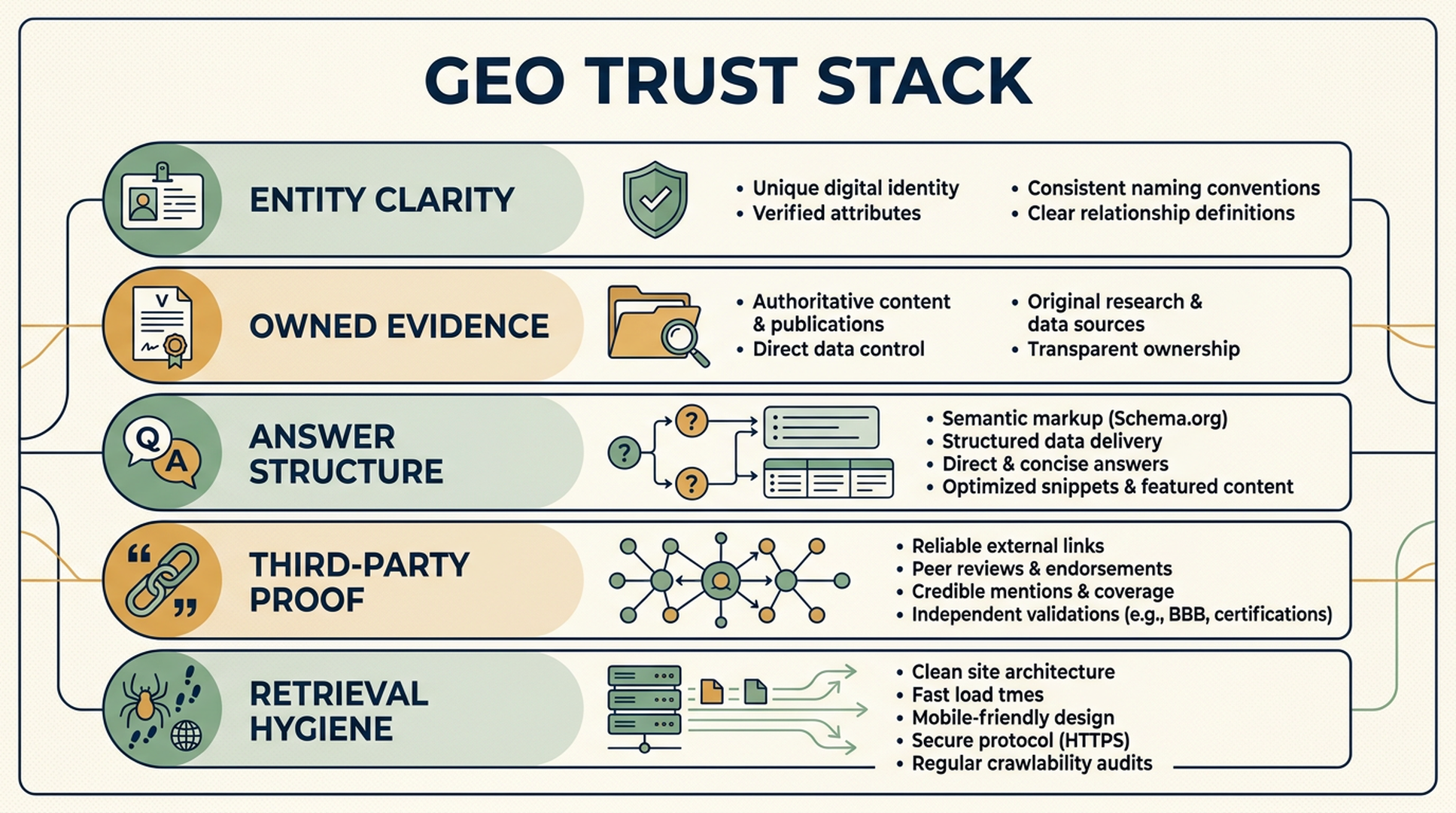
A practical GEO trust stack
Use this five-layer stack to audit whether your brand is becoming AI-citable or simply publishing more content.
Layer | What to check | Example action |
|---|---|---|
Entity clarity | Can AI systems identify the brand, product, category, audience, and locations? | Standardize names, descriptions, organization schema, social profiles, and directory listings. |
Owned evidence | Do your pages explain claims with details users can verify? | Add use cases, limitations, screenshots, changelogs, pricing context, and methodology notes. |
Answer structure | Can pages answer specific questions directly? | Use concise definitions, comparison tables, FAQs, and decision checklists. |
Third-party proof | Do independent sources confirm or contextualize your claims? | Maintain review profiles, partnerships, citations, press mentions, and customer stories. |
Retrieval hygiene | Can AI crawlers and search engines access the right pages? | Review |
If you want a fast starting point, run a crawlability and AI access check with an AI search visibility checker, then review the pages that matter most for buyer decisions.
What most teams miss
Most teams do not fail at GEO because they lack content ideas. They fail because they only optimize the surface.
They rewrite blog posts, but leave product pages vague. They add FAQ schema, but the answers are generic. They chase mentions in AI tools, but do not fix outdated third-party profiles. They publish comparison pages, but avoid the real tradeoffs buyers care about. They ask “how do we get AI to recommend us?” before asking “are we recommendable?”
That last question matters.
If the product is unclear, the documentation is weak, the review footprint is thin, and public claims are inconsistent, GEO will expose those weaknesses. AI search compresses the research process. It reduces the advantage of vague branding and increases the value of clear evidence.
This is good news for serious companies. If you have a real product, real expertise, and real customer value, GEO gives you a reason to make those assets visible and structured.
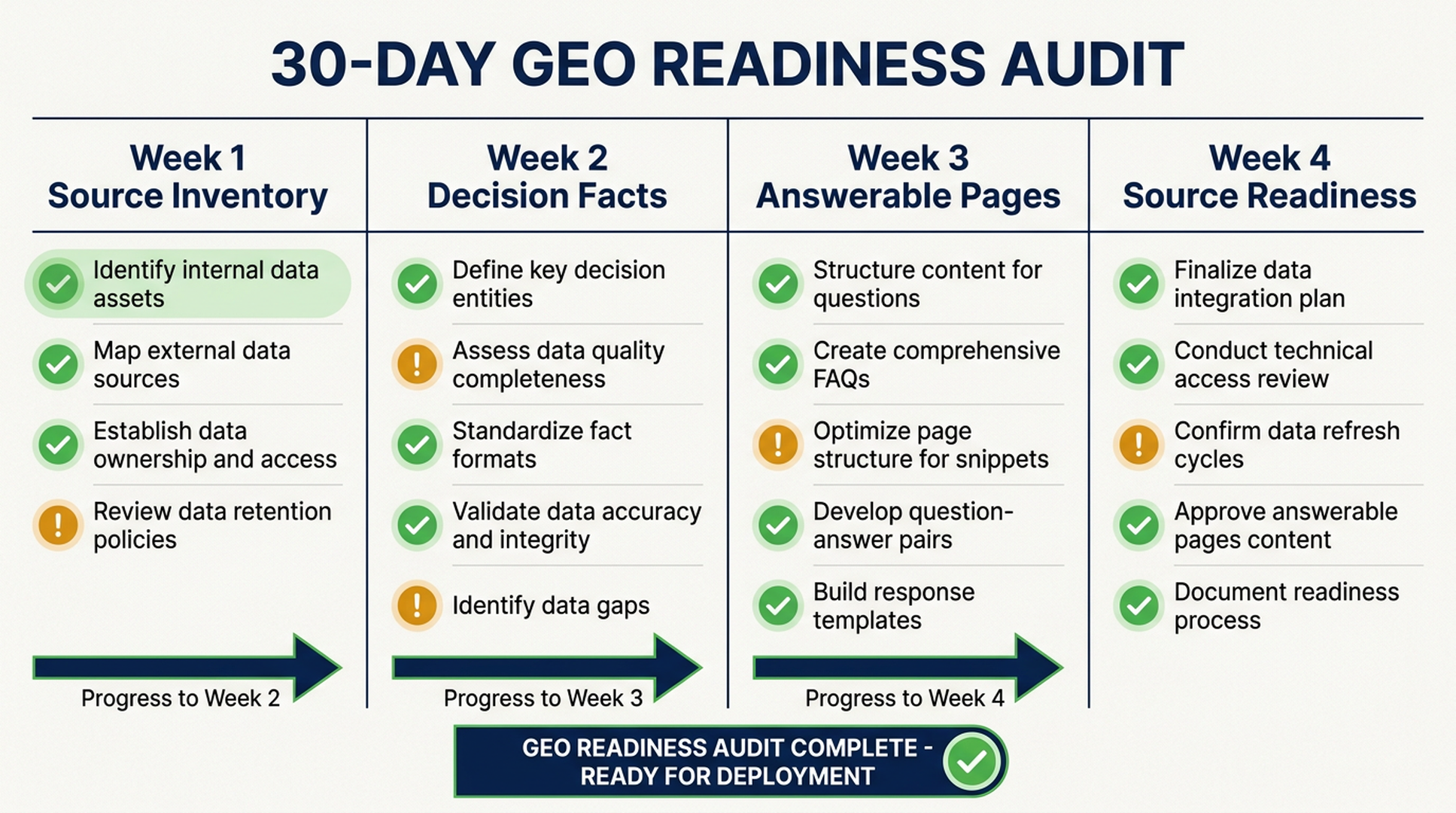
How to apply this in 30 days
You do not need to rebuild the entire website before starting. Begin with the pages and facts that AI systems are most likely to use in answers.
Week 1: Build the source inventory
List the public sources that describe your brand:
- Homepage and product pages.
- Pricing, documentation, changelog, help center, and integration pages.
- Case studies, blog explainers, comparison pages, and glossary pages.
- Review sites, app marketplaces, GitHub, LinkedIn, Crunchbase, partner pages, and press mentions.
- Technical access files including
robots.txt, sitemap, andllms.txtif you use one.
Then mark which sources are accurate, outdated, missing, duplicated, or contradictory.
Week 2: Fix the decision facts
Prioritize facts that influence buying decisions:
- What the product does.
- Who it is for.
- Which use cases it supports.
- What integrations, regions, languages, or platforms it covers.
- What limitations or requirements users should know.
- What proof exists for outcomes.
Make these facts consistent across owned and third-party sources.
Week 3: Create answerable pages
Turn vague pages into answer-ready pages. Good formats include:
- “What is X?” explainers.
- “X vs Y” comparison pages.
- Use-case pages for specific buyer jobs.
- Implementation checklists.
- Evidence-backed case studies.
- FAQ sections based on real sales, support, and search questions.
Each page should answer the core question near the top, then support it with details.
Week 4: Measure source readiness
Track more than brand mentions. A useful GEO dashboard should include:
- Which pages are crawlable and indexed.
- Which pages appear as citations in AI search products.
- Which facts are repeated correctly or incorrectly by AI systems.
- Which third-party sources influence answers.
- Which answer gaps still send users to competitors.
Use the results to update pages, not just report visibility.
Auspia takeaway
The brands that win in AI search will not be the ones that treat GEO as a trick. They will be the ones that make their business easier to verify.
That means the work is cross-functional. Marketing can lead the narrative, but product must clarify features, support must surface real user questions, sales must document objections, leadership must approve honest positioning, and technical teams must keep the site accessible.
Auspia’s view is that GEO belongs in the same operating system as SEO, content strategy, and brand trust. It should be measured, but not reduced to a short-term campaign metric.
If you want to begin, start with one buyer question your site does not answer well. Create the best source page on that question. Add evidence. Make it crawlable. Connect it internally. Then repeat.
That is how GEO compounds.
FAQ
Is GEO just another name for SEO?
No. SEO helps pages get crawled, indexed, ranked, and clicked in search engines. GEO focuses on whether AI answer systems can understand, trust, and use your information inside generated answers. The two overlap, but GEO requires stronger evidence, consistency, and source readiness.
Can GEO produce short-term traffic?
Sometimes, especially when AI search products cite your pages or when GEO work improves traditional SEO pages. But the safer expectation is compounding trust over time, not instant traffic spikes.
Who should own GEO inside a company?
Marketing or growth can coordinate the program, but GEO needs input from product, support, sales, PR, legal, and engineering. The work touches claims, documentation, customer proof, crawler access, and third-party source consistency.
What is the first GEO audit a team should run?
Start by checking whether AI systems can answer basic questions about your brand accurately: what you do, who you serve, what use cases you support, how you compare, and what proof exists. Then verify whether the cited or likely source pages are accurate, crawlable, and consistent.
Do we need an llms.txt file for GEO?
Not every site needs one immediately, but it can help clarify important resources for AI-oriented crawlers and agents. It should not replace strong pages, sitemaps, internal links, and crawlable documentation. Treat it as a routing aid, not a magic ranking factor.