How GEO Actually Works: The Mechanics Behind AI Citations
GEO (Generative Engine Optimization) is often described vaguely — "optimize for AI." But what does that actually mean at a technical level?
Here's the precise definition: GEO is the practice of making your content the source material that AI models (ChatGPT, Perplexity, Gemini, Claude) draw from when generating answers. It's not about ranking higher. It's about becoming part of the AI's answer.
The difference from SEO is fundamental:
- SEO competes for ranking position
- GEO competes to be the source AI cites
Let's break down exactly how this works — the underlying mechanics, the ranking factors, and the technical work involved.
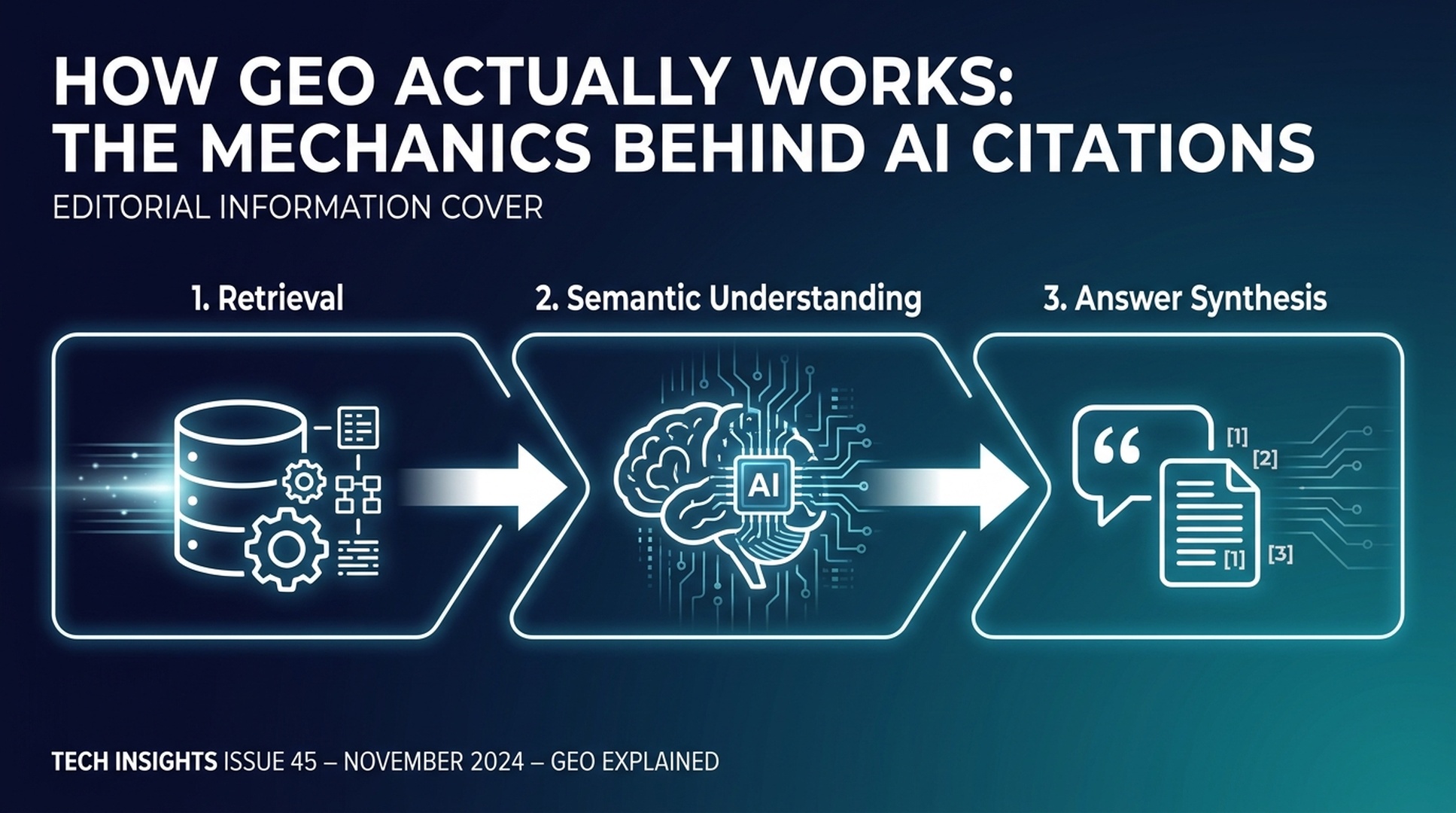
The Three-Layer Model: How AI Selects and Cites Content
GEO operates on three distinct layers. Understanding them explains why traditional SEO tactics don't automatically transfer.
Layer 1: Information Retrieval
Large language models don't rely solely on training data. They pull real-time information through RAG (Retrieval-Augmented Generation):
- Retrieval: The AI searches indexed or external web content (similar to how search engines index pages)
- Augmentation: It selects content fragments that are both credible and highly relevant
- Generation: It synthesizes multiple fragments into a coherent answer
The key insight: AI doesn't just pick "the #1 result." It pulls fragments from multiple sources and assembles them into an answer. Your content doesn't need to be the only source — it needs to be one of the sources worth pulling from.
This layer is still somewhat similar to traditional SEO. But the next two layers are where GEO diverges completely.
Layer 2: Semantic Understanding
When AI evaluates which content to use, it's not matching keywords. It's assessing four dimensions:
Semantic Relevance — Does the content directly answer the question? Does it cover user intent rather than just matching terms?
Authority — Is the source credible? Is the website, author, or brand recognized? Is it referenced by other authoritative sources?
Structural Clarity — Can a machine easily understand and extract from this content? Are there clear conclusions, steps, or definitions?
Citability — Is the content suitable for being extracted as a standalone fragment and used directly in an answer?
Layer 3: Answer Synthesis
Finally, AI makes a decision:
- Whether to cite your content at all
- Which specific fragment to use
- Whether to attribute a source or paraphrase without citation
- Whether to "absorb and rewrite" your information
GEO's core challenge lives here: make AI choose to use you rather than skip past your content.
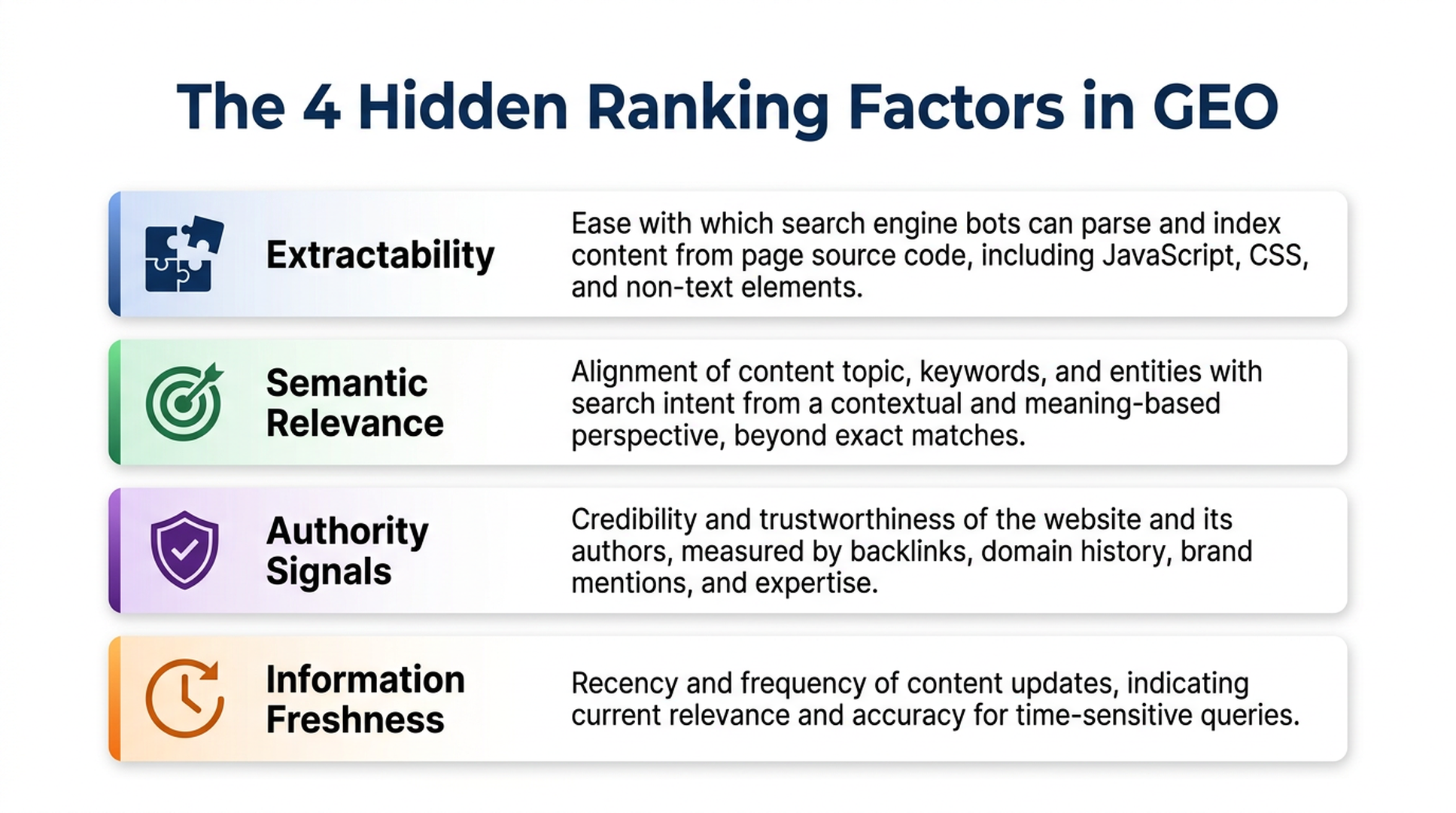
The Four Hidden Ranking Factors in GEO
Traditional SEO ranking is straightforward: keyword match + backlink authority + page authority.
GEO has a different formula — an implicit ranking system based on four factors:
Factor 1: Extractability (Most Critical)
AI strongly prefers content that's easy to pull fragments from:
- Clear structure with headings and sections
- Paragraphs that can stand alone as complete information units
- Explicit conclusions, not buried takeaways
❌ Bad: A long marketing paragraph with no clear conclusion
✅ Good: Definition → Principle → Steps → Comparison — each as a distinct, extractable section
The test: can AI copy or paraphrase a single paragraph and have it make sense on its own?
Factor 2: Semantic Relevance
AI evaluates whether content directly answers the question being asked.
When a user asks "what's the difference between GEO and SEO," AI prefers content that:
- Has a comparison structure built in
- States clear conclusions
- Provides context and examples
Content that talks around the topic without directly addressing it gets passed over.
Factor 3: Authority Signals (E-E-A-T, Amplified)
Similar to SEO's E-E-A-T concept, but with stronger emphasis on verifiability:
- Brand authority (company, experts, recognized names)
- Content expertise (depth, accuracy, specificity)
- Data and case study support
- Cross-source citation (being referenced by other credible sources)
A positive feedback loop exists here: being cited by AI reinforces your authority signal for future citations.
Factor 4: Information Freshness
AI systems prefer:
- Recent data and trends
- Up-to-date statistics
- Sites that update content regularly
This is especially critical in fast-moving fields like technology, AI, and business.
The Seven Technical Workstreams of GEO
GEO isn't mystical. It's a systematic discipline combining content engineering, data engineering, and semantic engineering. Here's what the actual work looks like.
1. Content Structure Engineering
Goal: Make content that AI can read and extract from easily.
Typical optimizations:
- Hierarchical heading structure (H1-H2-H3)
- Modular content blocks (definition / principle / steps / comparison)
- FAQ sections that make questions and answers explicit
- Short paragraphs with conclusions placed first (inverted pyramid)
This is fundamentally about improving extractability.
2. Entity Optimization
AI understands the world through entities, not keywords. Entities include:
- Brand names
- Product names
- Technology names
- People and organizations
The work involves:
- Defining entities clearly (what is this brand? what does it do?)
- Building entity relationships (how does this product relate to this technology?)
- Ensuring entities appear consistently across multiple contexts
This helps AI build a coherent understanding of what your brand represents.
3. Semantic Coverage
GEO isn't about writing one article around one keyword. It's about covering an entire question space.
For any given topic, GEO-style content should address:
- What is it (definition)
- Why does it matter (context and motivation)
- How does it work (mechanism and process)
- How does it compare (alternatives and tradeoffs)
- What are common questions (FAQ)
The goal is building knowledge graph coverage, not optimizing a single page.
4. Structured Data Implementation
Technical optimizations include:
- Schema.org structured data markup
- FAQ schema for question-answer pairs
- Article schema for content metadata
These help AI quickly understand page structure and content type, reducing the processing effort needed to extract value.
5. Citable Content Design
AI preferentially cites content that includes:
- Data with sources
- Research findings
- Clear argumentation with evidence
This means deliberately designing:
- Sentences that work as standalone citations
- Verifiable conclusions with supporting evidence
- Industry reports, experimental data, and comparative testing
6. Multi-Channel Content Distribution
GEO doesn't happen only on your website. AI training and retrieval sources are diverse:
- Industry publications
- Professional communities (Reddit, Stack Overflow, niche forums)
- White papers and research reports
- Social media and professional networks
The goal is expanding the probability that AI encounters your brand across multiple independent sources — which reinforces authority signals.
7. User Intent Modeling
GEO requires analyzing:
- Question types (informational / decisional / comparative)
- Query patterns (especially long-tail questions)
- User journey stages
Then reverse-engineering content design:
You're not writing articles. You're writing answers to questions AI will be asked.
GEO vs. SEO: The Fundamental Difference
Dimension | SEO | GEO |
|---|---|---|
Core objective | Rank higher | Get cited by AI |
What you optimize for | Search engine algorithms | AI model comprehension and citation |
Content focus | Keywords | Semantic meaning + answers |
Exposure format | Link clicks | Direct answers in AI responses |
Traffic path | User clicks through | AI cites / brand exposure |
One Sentence to Rule Them All
SEO fights for webpage rankings.
GEO fights for voice in AI-generated answers.
Or more directly:
SEO makes users see you. GEO makes AI speak for you.
GEO is a systematic strategy for making your content easier for AI to discover, understand, and trust — so you hold a favorable position in the new era of AI-driven search.
FAQ
What is the core principle behind GEO? GEO works on three layers: information retrieval (AI pulls content from multiple sources), semantic understanding (AI evaluates relevance, authority, structure, and citability), and answer synthesis (AI decides whether and how to use your content). The goal is to make your content the preferred source material at each layer.
What are the four ranking factors in GEO? Extractability (can AI pull a standalone fragment?), semantic relevance (does it directly answer the question?), authority signals (is it credible and verifiable?), and information freshness (is it current?).
How is GEO technically different from SEO? GEO involves seven workstreams: content structure engineering, entity optimization, semantic coverage, structured data, citable content design, multi-channel distribution, and user intent modeling. Unlike SEO's focus on keywords and backlinks, GEO focuses on making content machine-readable, semantically complete, and independently citable.
Does GEO replace SEO? No. GEO builds on top of SEO foundations. High-quality, well-structured content serves both traditional search engines and AI systems. But GEO adds layers that SEO doesn't cover — entity clarity, semantic completeness, extractability, and cross-platform authority signals.
How do I start implementing GEO? Open Perplexity or ChatGPT, search for your brand and core topic terms, and check if you appear in the answers. If not, start with your highest-traffic content: add clear structure, explicit conclusions, FAQ sections, data citations, and ensure your entities are clearly defined. Then expand coverage across multiple platforms.