Short answer
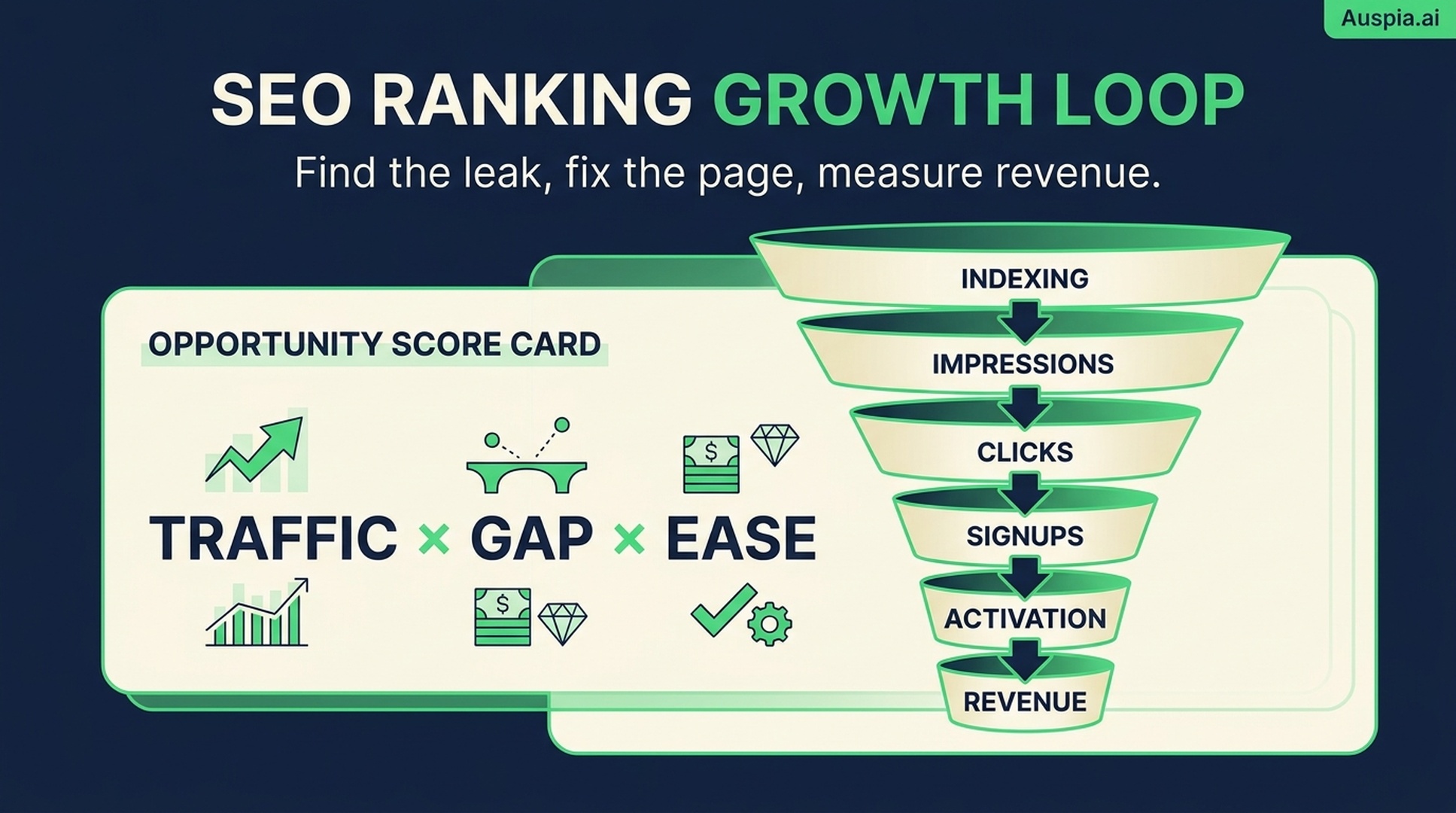
SEO ranking growth is not about finding one magic ranking factor. It is a repair loop. You find where the page is leaking value, fix the highest-value bottleneck, then measure whether the repair moved clicks, signups, activation, or revenue.
That sounds simple, but the manual version gets messy fast. You have to combine Google Search Console, analytics, keyword data, crawl checks, content audits, internal links, conversion data, and follow-up reviews. Most teams do not need to learn the full big-company SEO playbook before they can improve rankings. They can use Auspia to diagnose the site, identify the weak links, and turn the next SEO, GEO, or AEO action into a working task list.
This article explains the ranking optimization loop in plain English, then shows where Auspia can automate the parts that usually slow teams down.
Ranking is a competition, not a checklist
A page can be indexed and still fail. It can rank and still get no clicks. It can get clicks and still fail to produce signups, trials, downloads, demos, or revenue.
That is the part many SEO checklists miss.
Search performance is a chain:
Stage | What can go wrong | What to check first |
|---|---|---|
Crawling | Search engines cannot reach the page | Robots rules, redirects, server errors, JavaScript rendering |
Indexing | The page exists but does not enter the index | Canonical tags, noindex, duplication, sitemap coverage |
Impressions | The page is indexed but rarely shown | Keyword fit, page type, content depth, internal links |
Clicks | The page is shown but ignored | Title, meta description, SERP intent, brand trust |
Conversion | Visitors arrive but do not act | First screen, offer clarity, CTA, proof, form friction |
Activation | Leads or users do not become valuable | Product fit, onboarding path, expectation mismatch |
For a mature site, the first question should not be "what content should we write next?" It should be "where are we losing the most value right now?"
That one question changes the whole job. Instead of producing more pages by habit, you repair the pages that already have demand, signals, or business potential.
Start with a URL-level funnel
A useful SEO audit connects search data to business data. Page by page.
At minimum, you want to see:
- Is the URL indexed?
- Does it receive impressions?
- Does it receive clicks?
- Does organic traffic stay, scroll, or bounce quickly?
- Does the page generate signups, downloads, leads, trials, or purchases?
- Do those users activate or produce downstream value?
This matters because two pages with the same traffic can have very different problems.
One page may get 50,000 impressions and a weak click-through rate. That is a SERP packaging problem. Another page may get 10,000 clicks and almost no signups. That is a page promise or conversion problem. A third page may rank well but send users into a broken onboarding flow. That is not really an SEO win.
For each important URL, assign the page to one of four buckets:
Bucket | Signal | Likely repair |
|---|---|---|
Not visible | No indexing or no impressions | Technical indexing, internal links, page consolidation |
Seen but not clicked | High impressions, low CTR | Title, meta, angle, rich result eligibility, brand clarity |
Clicked but not converting | Organic visits, weak action rate | First screen, offer, proof, CTA, form, pricing clarity |
Converting but low quality | Signups or downloads, weak activation | Intent match, onboarding, device or version fit, expectation setting |
Once you know the bucket, the fix becomes less random.
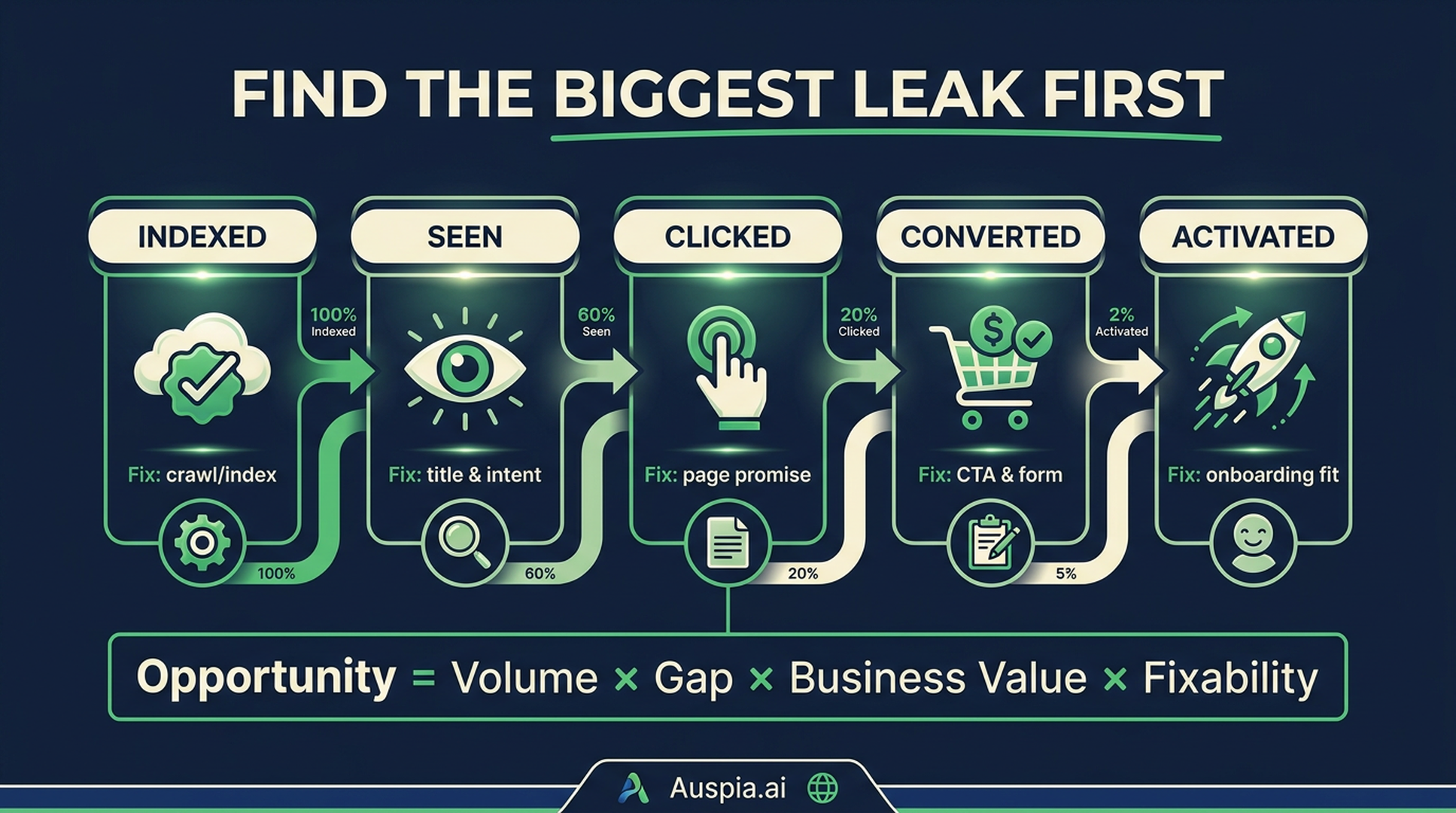
Caption: Good SEO work starts by finding the biggest leak in the URL funnel, not by adding more pages blindly.
Score the opportunity before doing the work
Not every page deserves the same effort. Some pages have huge upside. Some are noisy distractions.
A simple opportunity score helps:
Opportunity = traffic potential x current gap x business value x fixability
Here is how to use it.
Factor | Practical question | Example score logic |
|---|---|---|
Traffic potential | Could this URL or topic bring meaningful qualified demand? | Search volume, impressions, competitor traffic, topic demand |
Current gap | How much value is currently leaking? | Low CTR, low conversion rate, weak ranking, missing index |
Business value | Would better performance matter commercially? | Trial value, lead quality, product relevance, revenue path |
Fixability | Can the team realistically improve it soon? | Clear technical issue, easy title test, simple CTA repair, content gap |
A page with 100,000 impressions, 0.4 percent CTR, clear commercial intent, and a weak title may be worth fixing this week. A brand-new article targeting a vague high-volume keyword may not be.
This is where Auspia can save time. Instead of manually stitching together signals from multiple tools, use Auspia to inspect the page, surface the likely bottleneck, and decide whether the next action should be a technical fix, a content rewrite, a tool page, an internal-link update, or an AI visibility improvement.
Fix keyword targeting by looking at intent, not volume
Keyword research is useful. Keyword obsession is not.
A large keyword with unclear intent can waste months. A smaller keyword with strong fit can bring fewer visitors but better users.
Before choosing or repairing a target keyword, check four things:
- Does the query show a clear task or buying need?
- Can this page format satisfy the query?
- Does your product or expertise naturally belong in the answer?
- Is there a visible weakness in the current results that you can beat?
For example, "AI SEO" is broad. The intent may be education, tools, agencies, strategy, or news. "AI search visibility checker" is much clearer. The user wants to check something. A tool page or diagnostic workflow is more likely to fit than a generic essay.
The manual way to solve this is to inspect the SERP, cluster related queries, check competitors, and decide whether the page should be a blog post, category page, comparison page, template, tool, or hub.
The faster way is to use Auspia's AI Search Visibility Checker and related SEO/GEO tools to understand the visibility gap, then build the asset that matches the user's actual task.
Plan pages before keywords start competing with each other
Large sites often create their own ranking problems. They publish many similar pages, target overlapping keywords, and then wonder why Google rotates the wrong URL.
This is usually a planning problem, not a writing problem.
Before creating a new page, ask:
- Do we already have a page that should own this intent?
- Is this keyword a standalone page, a sub-section, a tool page, a comparison page, or part of a cluster?
- Which page should be the hub?
- Which supporting pages should link to it?
- What anchor text would sound natural rather than forced?
A clean structure helps search engines and AI systems understand which page is authoritative for which task. It also keeps your team from spending weeks producing pages that compete against each other.
For AI search, this matters even more. Entity clarity, canonical page ownership, and consistent internal linking all make it easier for answer systems to identify the right source.
Improve content by adding a real advantage
AI has made average content cheap. That is not a reason to stop publishing. It is a reason to stop publishing pages that only rephrase public knowledge.
A page has a better chance when it adds at least one advantage:
- A tool the reader can use immediately
- A comparison table based on real testing
- Screenshots from the current product or workflow
- Original examples from customer, sales, support, or product data
- A clear framework that helps the reader make a decision
- A checklist that turns advice into action
If the current top results define a term, write the page that helps the reader complete the task. If competitors list features, show the workflow. If everyone writes a guide, create a checker or template.
That is the practical difference between content volume and content leverage.
Auspia is useful here because it can help turn an abstract SEO topic into a concrete asset. Sometimes the best answer is not another article. It is a diagnostic page, a scorecard, an LLMs.txt check, a robots.txt AI crawler check, or a short workflow that removes doubt for the reader.
Do the technical checks before blaming the content
A technically broken page can make good content look bad.
For priority URLs, check the basics before rewriting everything:
- Is the page crawlable?
- Is it indexable?
- Is the canonical tag correct?
- Is the page in the sitemap?
- Is the status code clean?
- Are redirects intentional?
- Does the rendered page expose the main content?
- Are hreflang tags correct for multilingual pages?
- Is structured data valid where it matters?
- Are Core Web Vitals within a reasonable range?
Google's Core Web Vitals thresholds are useful guardrails: Largest Contentful Paint should be at or under 2.5 seconds, Interaction to Next Paint should be under 200 milliseconds, and Cumulative Layout Shift should stay at or under 0.1 for a good experience.
Do not overcomplicate this. If a page cannot be crawled, indexed, rendered, or used comfortably, content polish will not save it.
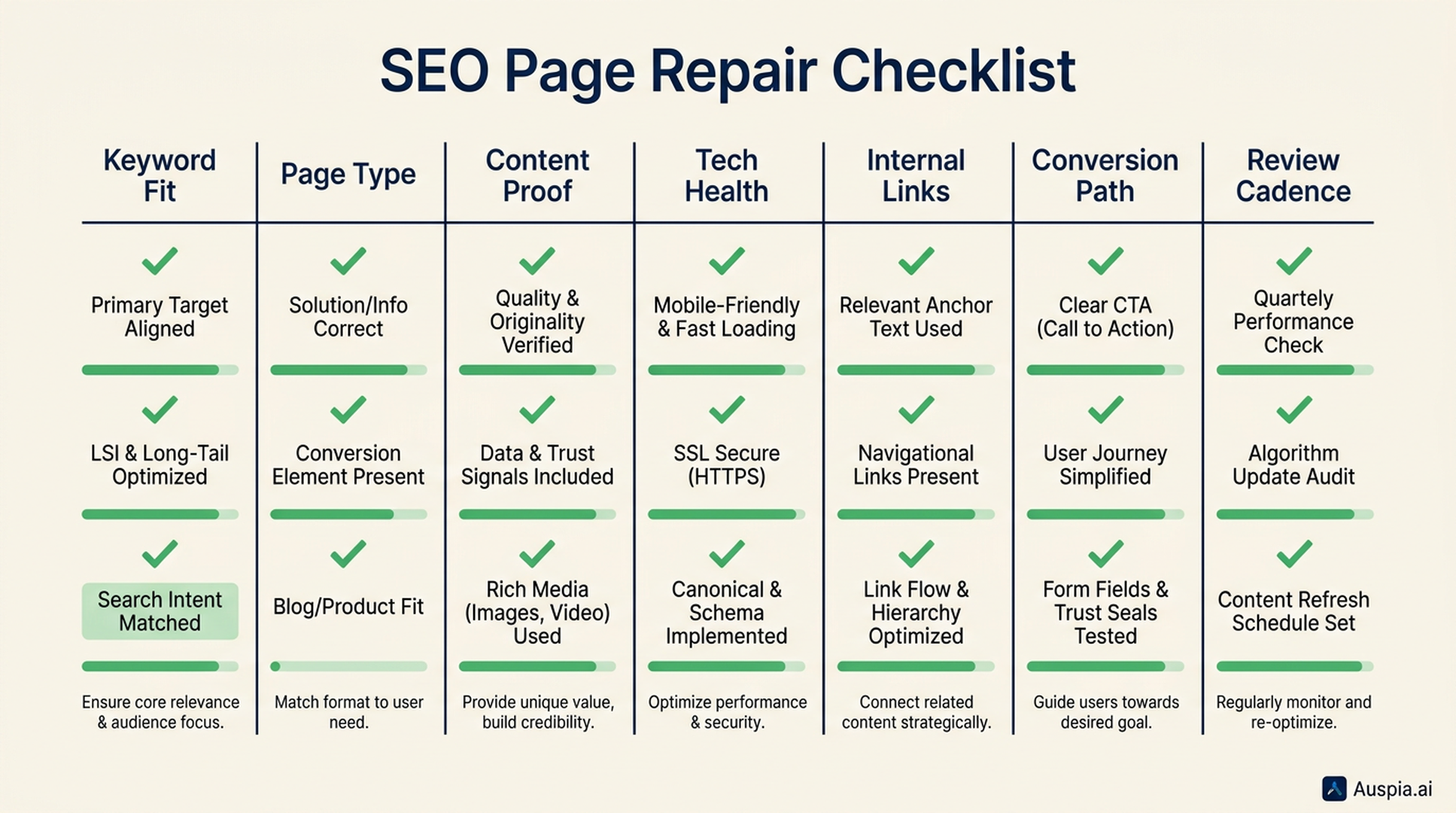
Caption: Priority pages need both search repairs and business repairs. Rankings alone are not the finish line.
Use internal links to show what matters
Internal links are not just navigation. They tell search engines which pages matter and how topics relate to each other.
For a new or repaired page, connect it to:
- The parent hub or category page
- Related supporting articles
- Relevant high-traffic pages
- Product or tool pages that match the intent
- Pages that already receive external links or strong engagement
Avoid exact-match anchor text everywhere. A natural link profile inside your own site should include variations that match how people actually read.
For example, a page about AI crawler readiness might naturally link to the Robots.txt AI Crawler Checker, but it should not repeat the same anchor in every article. Mix the phrasing when it helps the reader.
Treat backlinks as fuel, not medicine
Backlinks can help, but they are often used too early.
Before spending time or money on links, ask:
- Is the page indexed and technically healthy?
- Does it already match the search intent?
- Is the content clearly better or more useful than the pages above it?
- Does the page convert qualified traffic?
- Is there a real link gap against competing pages?
If the answer is no, backlinks may only send authority to a weak page. For most teams, links should go to strategic pages that have already proven demand and commercial value.
This is especially true for tool pages, comparison pages, and high-intent landing pages. If a page already earns impressions but gets stuck below stronger competitors, links may be part of the repair. If the page has no clear intent fit, fix the page first.
Optimize for conversion, not just visits
SEO that stops at traffic is unfinished.
For a SaaS page, ecommerce page, app download page, or service landing page, check the conversion path with the same seriousness you bring to keyword rankings.
Ask:
- Does the first screen say what the product does and who it is for?
- Is the main CTA visible without scrolling?
- Does the page reduce risk with proof, screenshots, reviews, or examples?
- Does the offer match the searcher's stage of awareness?
- Are forms, downloads, checkout, or demo flows tracked properly?
- Can you connect organic visits to activation or revenue later?
A page with fewer visits but higher activation may be more valuable than a broad informational page with impressive traffic and no business path.
That is why the best SEO teams work like growth teams. They care about ranking, but they also care about the user after the click.
Review pages on a schedule
SEO feedback arrives in waves. Some technical changes show up quickly. Content and authority changes can take longer.
Use a review cadence instead of checking randomly:
Timing | What to review |
|---|---|
1 to 3 days | Indexing, rendering, tracking, broken links, obvious errors |
14 days | Early impressions, crawl behavior, SERP appearance |
30 days | CTR, ranking direction, engagement, conversion path |
60 days | Content gaps, internal links, competitor movement |
90 days | Business value, refresh needs, expand/merge/retire decision |
The point is not to stare at rankings every morning. The point is to make each page part of a learning loop.
If a page gets no indexation, fix access. If it gets no impressions, revisit intent and internal links. If it gets impressions but no clicks, repair the SERP promise. If it gets visits but no conversions, repair the offer and page experience.
Where Auspia fits in the ranking loop
The full ranking loop is powerful, but it is a lot to run by hand. That is why many teams either avoid SEO altogether or reduce it to "publish more articles."
Auspia gives teams a simpler path:
- Audit the site for SEO, GEO, AEO, and AI visibility gaps
- Identify whether the problem is technical, content, intent, linking, or conversion-related
- Find pages that should be repaired before new pages are created
- Turn SEO topics into practical assets such as tools, checkers, templates, and guides
- Check whether AI crawlers and answer engines can understand key pages
- Build a review rhythm so content does not decay quietly
You can still learn the full SEO craft. It is worth learning if SEO is your job. But if your real job is running a product, agency, ecommerce store, or SaaS company, you probably need the output more than the theory.
Use Auspia to find the leak, decide the next repair, and keep the loop moving.
FAQ
How do I improve SEO rankings for an existing website?
Start by finding where value is leaking. Check whether priority URLs are indexed, receiving impressions, earning clicks, converting visitors, and producing qualified users. Fix the highest-value bottleneck before creating more pages.
What is an SEO opportunity score?
An SEO opportunity score is a way to prioritize work. A practical version is traffic potential multiplied by current performance gap, business value, and fixability. Pages with high upside and easy repairs should move first.
Should I focus on keywords or technical SEO first?
If a page has crawl, indexation, rendering, canonical, or speed problems, fix those first. If the page is technically healthy but not performing, then inspect keyword intent, page type, content quality, internal links, and conversion path.
Are backlinks still important for ranking?
Backlinks can help, especially for competitive queries, but they work best when the target page already matches intent, has useful content, converts well, and has a clear business reason to rank. Links should not be used to compensate for a weak page.
Can Auspia help with SEO ranking optimization?
Yes. Auspia helps teams diagnose SEO, GEO, AEO, and AI visibility issues, then turn the findings into practical page repairs, content assets, tool workflows, and review actions without requiring a full enterprise SEO process.