


Direct answer
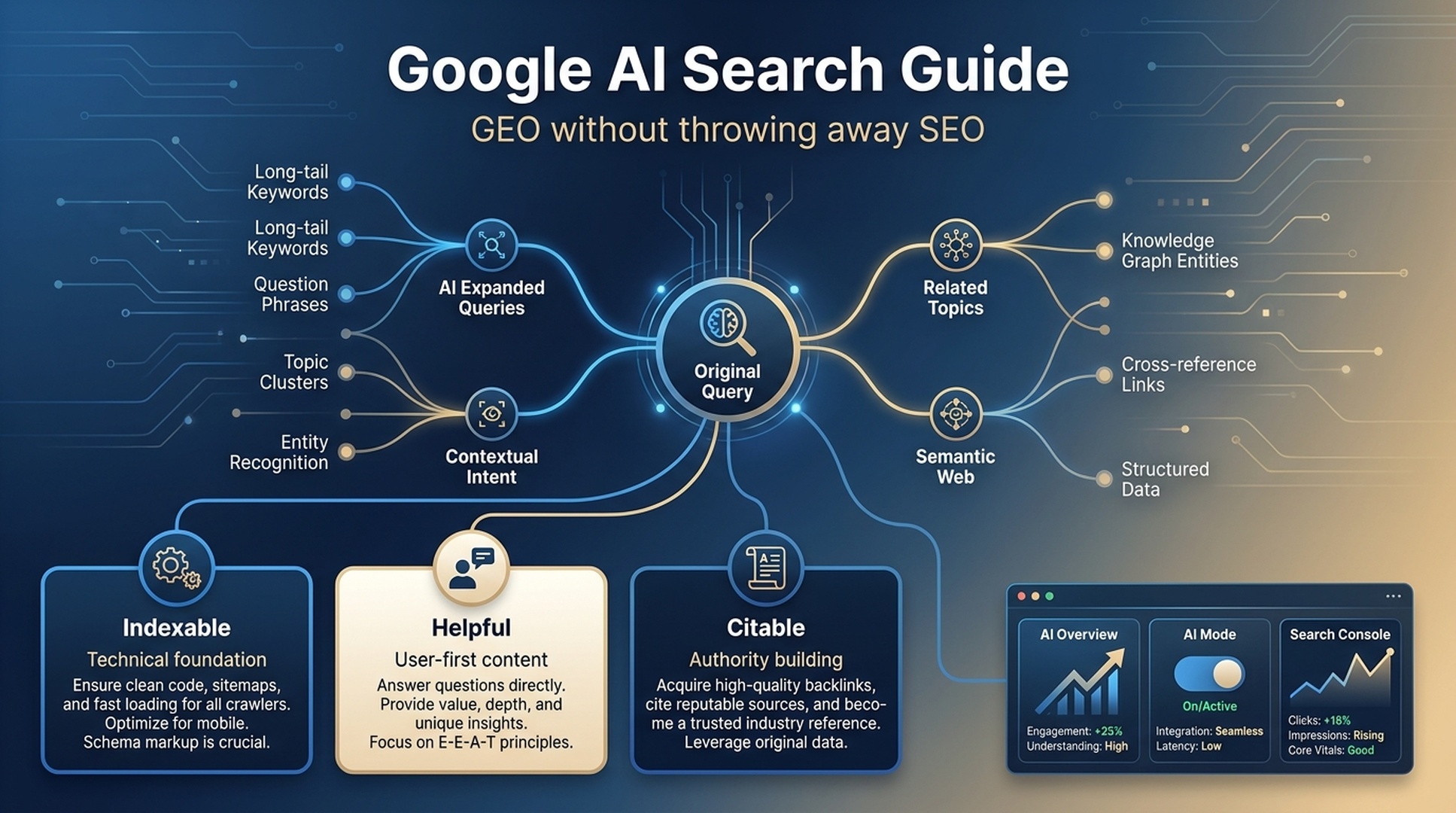
Google's AI search guidance does not say that SEO is dead. It says the opposite: pages need the same basic requirements as Google Search, then stronger evidence, clearer answers, and better crawlability if they want a chance to appear as supporting links in AI Overviews or AI Mode.
That is the practical definition of GEO for most growth teams. GEO is not a magic replacement for SEO. It is a way to make your existing search assets easier for AI answer systems to find, understand, trust, and cite.
If your traffic is flat but qualified inquiries are dropping, the problem may not be rankings alone. Buyers are asking AI systems to shortlist vendors, compare options, explain requirements, and summarize risks before they ever click a result. Your website has to serve that behavior.
What changed in Google's AI search guidance
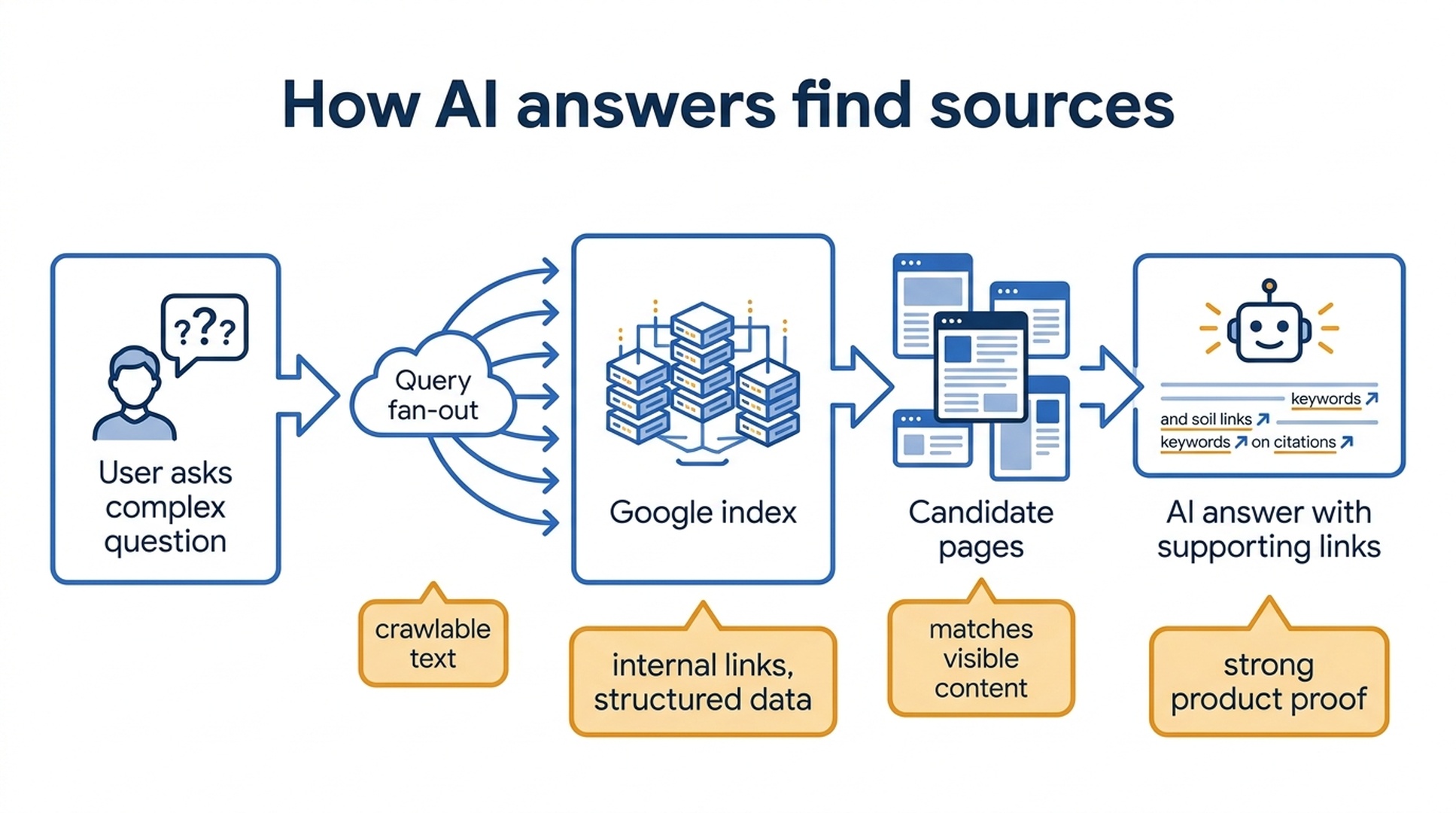
Google's Search Central documentation for AI features is refreshingly plain. AI Overviews and AI Mode still use Search systems, still show links, and still depend on pages that can be indexed. Google also explains that AI Mode and AI Overviews may use query fan-out, where the system issues multiple related searches across subtopics and data sources before building a response.
That one detail matters. A classic search result page often rewards the best page for one query. An AI answer may look for pages that help with several pieces of the same decision: definition, comparison, evidence, pricing, risk, implementation, local availability, and next steps.
A page that ranks for "enterprise knowledge base software" may not be enough if the buyer asks:
"What knowledge base tools should a 300-person SaaS company use if we need SOC 2 readiness, multilingual help docs, and AI search visibility?"
That question fans out into many smaller checks. The pages that survive are usually not thin landing pages. They are pages with crawlable text, specific claims, proof, current details, and enough structure for a model to quote safely.
What GEO means now
GEO, or generative engine optimization, is the practice of making your brand, pages, and proof assets usable by AI answer systems.
For an Auspia-style growth team, that means five things:
- Your important pages are indexable and eligible to appear in Google Search.
- Your content answers real buyer questions in text, not only in images, PDFs, or gated decks.
- Your structured data matches the visible page content.
- Your product, entity, author, and business details are consistent across the site and trusted third-party sources.
- Your pages contain evidence that an AI system can cite without guessing.
The last point is where many teams fall short. They publish broad claims like "trusted by leading teams" or "built for modern growth" and then wonder why AI answers cite a competitor with a boring comparison table, named customers, technical specs, and a public changelog.
AI systems prefer boring evidence over polished vagueness.
Is SEO obsolete?
No. SEO is still the floor.
Google's AI feature guidance says pages need to meet the same technical requirements as Search. To be eligible as a supporting link in AI Overviews or AI Mode, a page must be indexed and eligible to show in Search with a snippet. Google also says there are no additional technical requirements for AI features beyond that baseline.
So the question is not "SEO or GEO?" The question is: which parts of SEO are now non-negotiable, and what extra work makes the page worth citing?
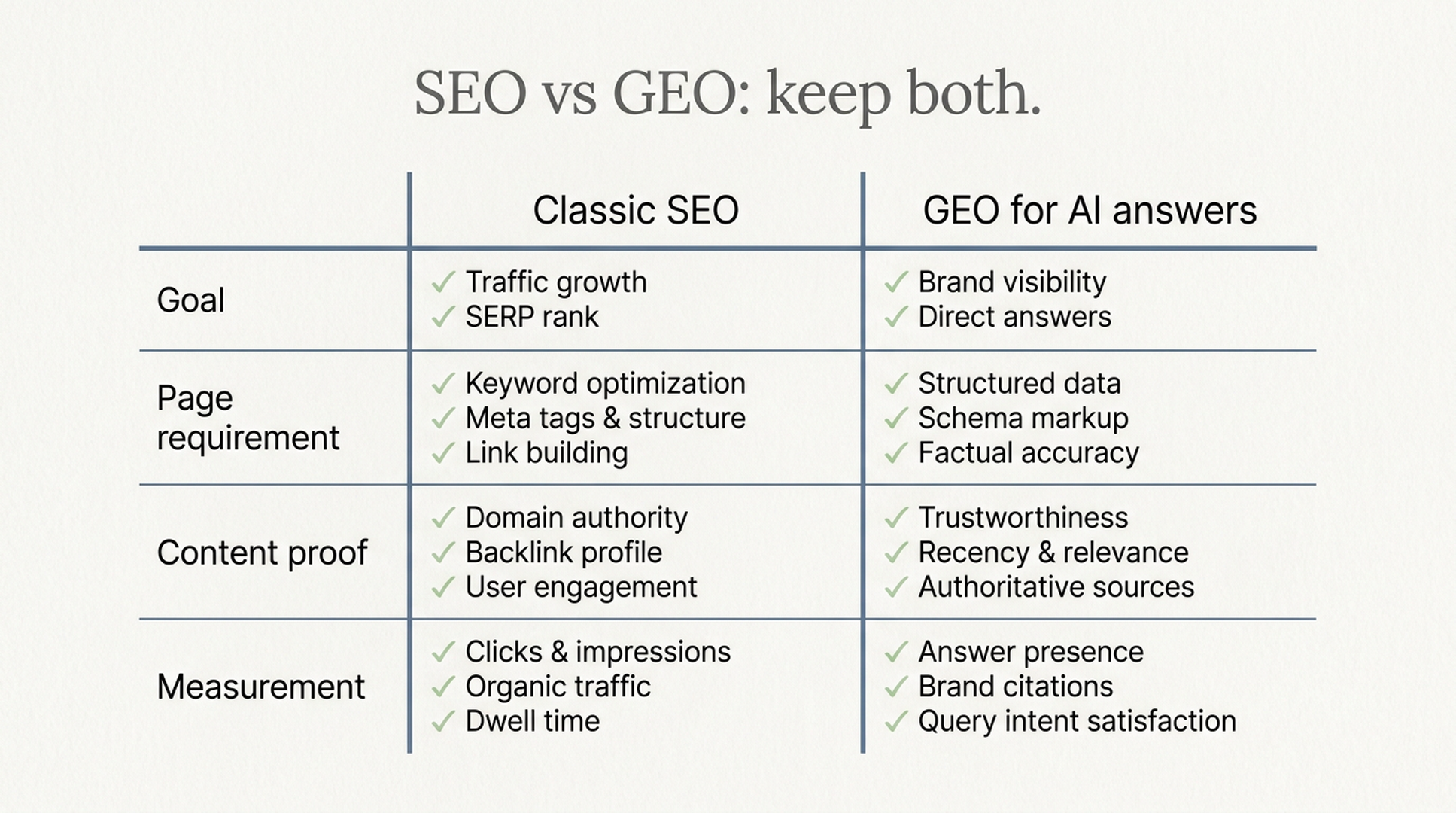
Area | Classic SEO | GEO for AI answers |
|---|---|---|
Main goal | Earn rankings and clicks | Earn visibility inside answer journeys |
Core asset | Search page or landing page | Citable answer page, guide, data page, comparison, FAQ, case proof |
Technical baseline | Crawlable, indexable, fast, mobile usable | Same baseline, plus important text visible to crawlers and not blocked by controls |
Content style | Match keyword intent | Cover the decision path behind the prompt |
Proof | Backlinks, authority, engagement | Named evidence, clear claims, current facts, schema that matches the page |
Measurement | Rankings, clicks, impressions, conversions | Search traffic plus AI answer presence, citation checks, assisted conversions |
SEO gets you into the library. GEO helps AI systems decide whether your page is a reliable paragraph to quote from that library.
Why this matters for B2B and SaaS teams
The source article focused on export manufacturers. The same pattern is already visible in global SaaS, agencies, marketplaces, industrial suppliers, healthcare technology, legal services, education, and local service brands.
A buyer rarely starts with "vendor pricing page" anymore. They ask messy questions:
- "Best CRM for a 40-person real estate brokerage using Google Workspace"
- "Which SOC 2 consultants are good for seed-stage SaaS?"
- "Alternatives to HubSpot for companies with a small sales ops team"
- "What should I check before hiring an AI automation agency?"
- "How do I compare commercial solar installers for a multi-site retail chain?"
Those prompts mix category research, vendor discovery, risk reduction, and purchase criteria. A website built only around short commercial keywords will miss many of those paths.
This is why some teams see the odd pattern of rankings holding steady while pipeline softens. The buyer still uses search, but a larger share of evaluation happens before the click.
The pages most likely to benefit from GEO
GEO is useful for almost every serious website, but it is not equally urgent everywhere. Prioritize it when the buying decision is complex and the buyer needs explanation before conversion.
Business type | Why GEO matters | Useful page types |
|---|---|---|
B2B SaaS | Buyers compare features, integrations, pricing, security, and implementation risk | Comparison pages, use-case guides, integration pages, security docs, migration guides |
Agencies and consultants | Trust depends on proof, process, and specialization | Methodology pages, case studies, audit templates, industry-specific service pages |
Industrial and manufacturing suppliers | Buyers need specs, certifications, capacity, compliance, and regional availability | Product spec hubs, certification pages, capability pages, FAQ pages |
Local multi-location services | AI answers often summarize who serves which area and for what use case | Location pages, service-area pages, review proof, structured business details |
Ecommerce brands with technical products | Buyers ask fit, compatibility, materials, durability, and comparison questions | Buying guides, product comparison tables, compatibility explainers |
If your category has long sales cycles, technical details, regulation, or many competing vendors, GEO deserves attention now.
A practical GEO checklist for Google AI search
Use this as a first pass before inventing a large GEO program.
1. Confirm the page can appear in Search
Check whether the page is indexed, eligible for snippets, internally linked, and not blocked by robots.txt, noindex, CDN rules, or preview controls that reduce snippet availability. Google specifically points site owners back to Search technical requirements and Search Console diagnostics.
For a quick crawl-and-indexing audit, run a page through Auspia's Website SEO Score Checker before rewriting anything.
2. Put important content in crawlable text
Do not hide core answers inside hero images, JavaScript-only widgets, PDFs, screenshots, carousels, or gated files. If the information helps a buyer decide, put it on the page in readable HTML.
That includes product limits, supported regions, pricing assumptions, implementation steps, certifications, comparison criteria, and known tradeoffs.
3. Build pages around prompts, not just keywords
Keywords still matter, but prompts reveal the real decision. Instead of only targeting "AI search visibility checker," also answer questions like:
- "How do I know whether ChatGPT or Gemini can find my brand?"
- "Why does my site rank but not appear in AI answers?"
- "What signals make a brand more citable in AI search?"
A good prompt-led page usually covers context, answer, evidence, objections, comparison, and next step.
4. Make claims easy to verify
Replace vague claims with named proof.
Weak: "Our platform improves content operations."
Better: "The platform audits indexability, robots.txt access, schema consistency, and AI search visibility for each URL, then groups issues by page type."
For service businesses, add methodology, sample deliverables, anonymized before-and-after examples, practitioner bios, review sources, and limitations. For software, add docs, changelogs, integrations, screenshots, and support boundaries.
5. Align schema with visible content
Structured data is not a place to say what the page does not say. Google calls out that structured data should match visible text. For GEO, this is even more important because mismatch makes your page harder to trust.
Use schema to clarify entities, products, FAQs, reviews, organization details, breadcrumbs, and article metadata where appropriate. Keep it honest.
6. Keep business and product facts current
AI answers punish stale information in quiet ways. You may not see an obvious ranking drop, but your page can become less useful for queries involving current pricing, active markets, integrations, availability, compliance, or supported use cases.
Update pages that describe:
- Pricing and plans
- Product capabilities
- Supported regions
- Certifications and compliance
- Integrations
- Case studies
- Executive or author information
- Merchant Center or Business Profile details where relevant
7. Track answer presence, not just traffic
Google reports AI feature appearances within Search Console performance data rather than as a neat standalone GEO dashboard. That means you still need your normal SEO reporting, plus a separate answer-visibility workflow.
At minimum, track a small library of buyer prompts monthly across Google AI Mode, AI Overviews when triggered, ChatGPT, Perplexity, Claude, and Gemini. Record whether your brand appears, whether your page is cited, which competitors appear, and what proof the answer uses.
Auspia's AI Search Visibility Checker is built for this kind of prompt-level visibility check.
What most teams get wrong
The biggest mistake is treating GEO as a list of hacks.
Adding an FAQ block will not rescue a weak page. Publishing an llms.txt file will not compensate for thin content. Stuffing "best" and "top" phrases into headings will not make a brand trustworthy. Schema will not fix claims that buyers cannot verify.
The second mistake is deleting SEO work to chase AI visibility. That is backwards. If the page is not crawlable, indexable, internally linked, and useful to humans, it has little chance of becoming a reliable AI source.
The third mistake is writing only for broad category prompts. Real buyers add constraints. They mention team size, geography, stack, budget, compliance, timeline, and risk. Your content should do the same.
Auspia's take
GEO is best understood as evidence design.
You are not trying to trick an AI answer engine. You are making the true parts of your business easier to retrieve, compare, summarize, and cite. That requires old SEO discipline and better editorial judgment.
Start with ten pages, not a 200-page content sprint. Pick the pages that already influence pipeline: your highest-intent landing pages, two comparison pages, two use-case pages, one proof-heavy case study, one technical trust page, and a practical FAQ or buying guide. Audit each page against the checklist above. Then test the buyer prompts that should lead to those pages.
If the AI answer ignores you, ask why. Usually the reason is visible: the competitor has clearer proof, a better comparison, stronger third-party mentions, fresher product details, or a page that answers the actual prompt instead of repeating a keyword.
That is fixable. But it is not fixed by renaming SEO as GEO.
FAQ
What is GEO?
GEO, or generative engine optimization, is the work of making a brand and its content easier for AI answer systems to find, understand, trust, and cite. It includes technical SEO, content structure, entity consistency, proof assets, and prompt-level visibility tracking.
Did Google officially say to do GEO?
Google's documentation does not frame this as a separate replacement for SEO. Its AI feature guidance tells site owners to follow foundational Search requirements, create helpful and reliable content, make important content crawlable, keep structured data aligned with visible text, and use Search Console to diagnose issues.
Is SEO still worth doing if AI answers reduce clicks?
Yes. SEO remains the eligibility layer for Google AI features and the main way many buyers discover pages. GEO should extend SEO by improving answer-readiness, citation quality, and decision-stage coverage.
Which pages should I optimize first for AI search?
Start with pages that already influence revenue: comparison pages, product or service pages, use-case pages, case studies, technical trust pages, and buying guides. Then expand into long-tail prompt pages based on real buyer questions.
How do I measure GEO performance?
Use normal SEO metrics such as impressions, clicks, indexed pages, and conversions, then add answer-level checks. Track whether your brand or pages appear in AI answers for a fixed prompt library, which competitors are cited, and whether assisted conversions change after page improvements.


