The short version
Most SEO teams do not lose because they missed a secret tactic. They lose because the basic work is half-done: pages target the wrong intent, old content keeps aging, schema is missing, internal links are random, and trust signals are buried.
For 2026, the highest-ROI SEO work is still practical, but the bar is higher. Search results now include AI summaries, answer engines, richer shopping modules, local packs, and more zero-click behavior. A page needs to rank, explain itself clearly, prove why it should be trusted, and make its facts easy for both search engines and AI systems to reuse.
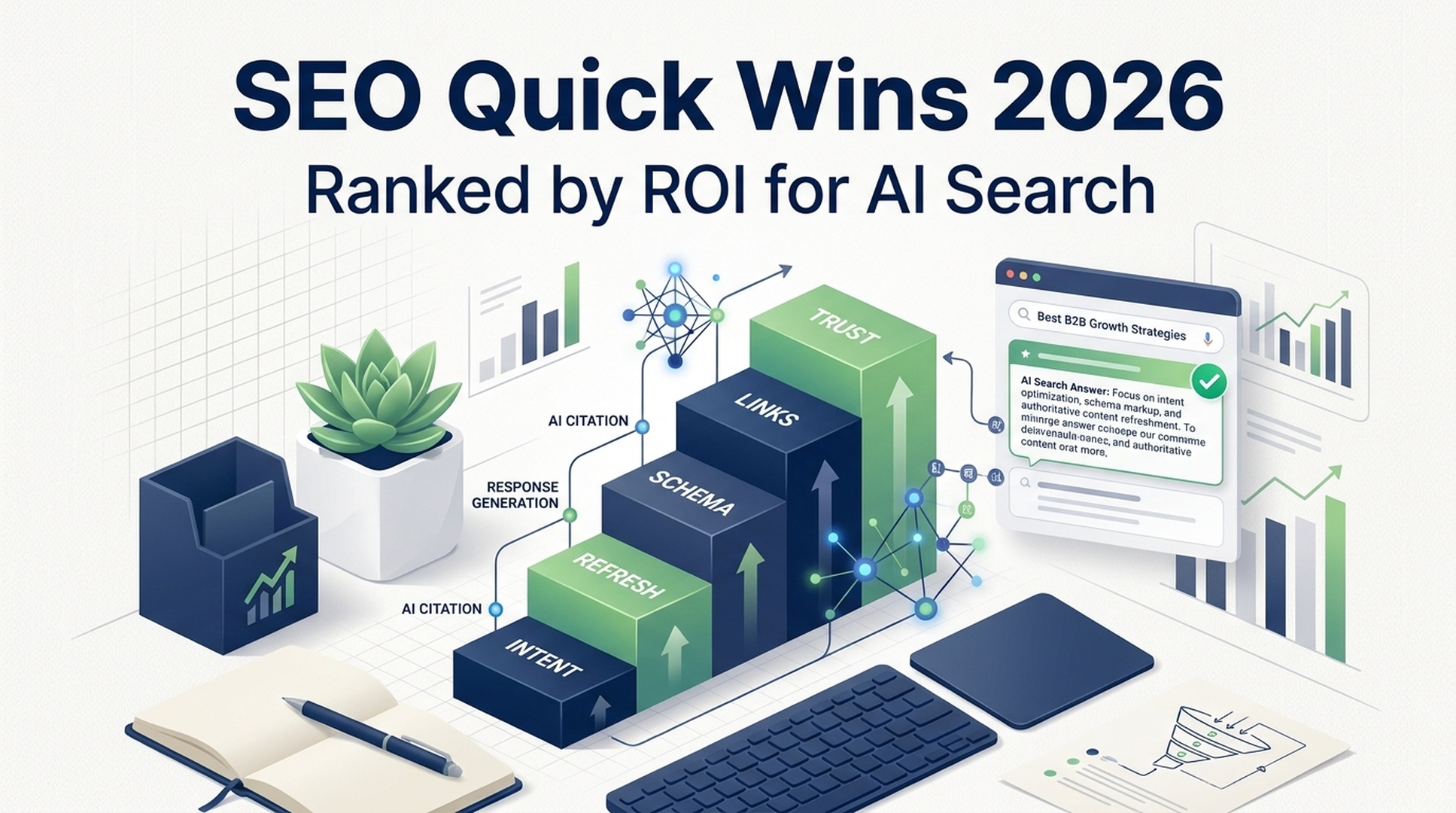
If you only have one month, do these five things first:
Priority | SEO quick win | Why it pays back |
|---|---|---|
1 | Match search intent on your top pages | Fixes the most common ranking mismatch |
2 | Refresh pages that already get impressions | Faster than publishing from zero |
3 | Add schema where it matches the page | Helps machines classify the content |
4 | Improve internal links | Moves authority and context through the site |
5 | Strengthen E-E-A-T signals | Helps users and AI systems decide whether to trust you |
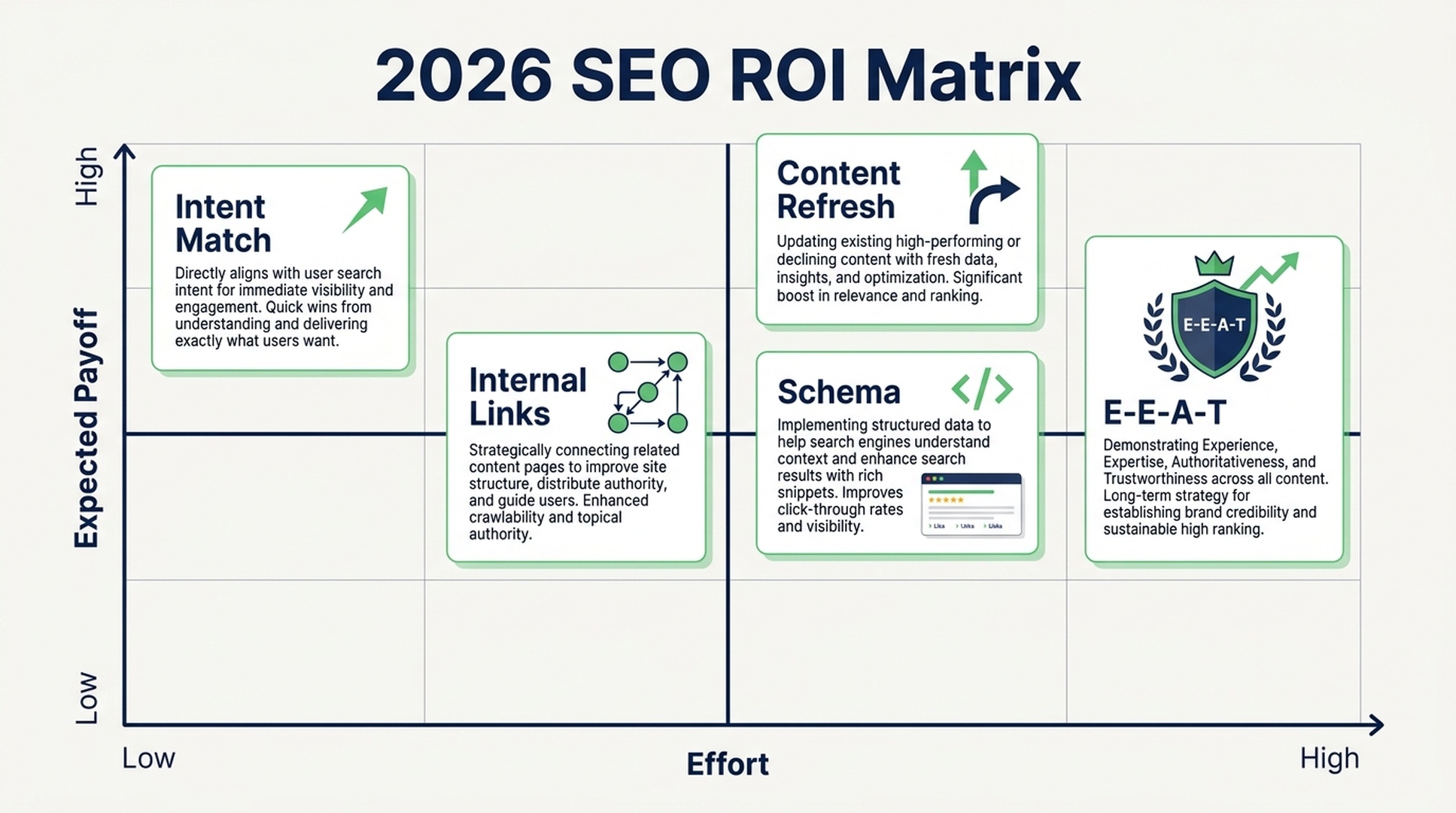
Caption: A practical way to choose what gets done first: fix the highest-impact basics before adding new channels or content formats.
Why SEO quick wins need a 2026 update
The old checklist is not wrong. Long-tail keywords still matter. Title tags still matter. Page speed still matters. What changed is the job those basics have to do.
In 2026, SEO work has to support three kinds of discovery at once:
Discovery surface | What it needs from your page |
|---|---|
Traditional Google results | Relevance, authority, crawlability, strong snippets |
AI answers and answer engines | Direct explanations, clean entity signals, sourced facts |
Human decision paths | Trust, proof, examples, next steps, clear conversion routes |
That means a page cannot be written only for a keyword. It has to answer the query, fit the search result format, show evidence, and connect to the rest of the site.
Auspia's view is simple: treat SEO, GEO, and AEO as one operating system. SEO gets the page discovered. AEO makes the answer extractable. GEO improves the odds that AI systems understand and cite the brand. If you want to check that broader readiness, the AI Search Visibility Checker is a useful place to start.
High-ROI fixes to do first
1. Match the search intent before rewriting anything
Search intent is the reason behind the query. Before you rewrite copy, add keywords, or build links, check whether the page type matches what searchers actually want.
Look at the current top results for the target query. Are they tutorials, tools, product pages, comparison pages, category pages, templates, or short definitions? If your page uses the wrong format, small copy edits will not save it.
Use this quick audit:
Question | What to check |
|---|---|
What format dominates the SERP? | Guide, list, tool, product page, directory, comparison |
What level of knowledge is assumed? | Beginner, operator, buyer, developer, executive |
What action does the searcher want next? | Learn, compare, buy, troubleshoot, calculate, download |
What proof do top pages include? | Screenshots, pricing, author bio, examples, reviews, data |
If the query is "SEO checklist for SaaS," a generic definition page is probably the wrong asset. If the query is "website SEO score checker," a long essay without an interactive tool is also the wrong asset. Match the job first.
2. Refresh old pages that already have impressions
New content takes time to earn trust. Existing pages already have crawl history, backlinks, internal links, and search data. That makes content refreshes one of the fastest SEO moves available.
Start with pages that meet one of these conditions:
- They rank on page two or low page one.
- They get impressions but weak click-through rate.
- They used to bring traffic but declined over the last six to twelve months.
- They target a topic where the SERP has changed.
- They have outdated dates, screenshots, examples, or product references.
Do not just change the publish date. Refresh the substance:
Refresh task | What to update |
|---|---|
Search intent | Re-check the current SERP and adjust the page format |
Facts | Replace old stats, obsolete platform details, and dead examples |
Coverage | Add missing sections that competitors answer better |
Visuals | Update screenshots, diagrams, tables, and comparison blocks |
Snippet quality | Rewrite title, meta description, intro, and answer block |
Conversion path | Add the most relevant tool, audit, demo, or next article |
For many teams, a monthly refresh sprint beats a monthly new-content sprint.
3. Add schema, but only where it describes the real page
Schema markup does not magically create rankings. It helps search engines and other machines understand what a page is. That still matters in 2026 because classification is part of visibility.
Use schema when it matches the content:
Page type | Useful schema |
|---|---|
Blog article | Article, BreadcrumbList, Organization |
Tutorial | HowTo, FAQPage if there is a real FAQ |
Product or software page | Product, SoftwareApplication, Review if supported by real reviews |
Local business page | LocalBusiness, PostalAddress, OpeningHoursSpecification |
Comparison or glossary page | Article, FAQPage, BreadcrumbList |
The mistake is adding every schema type to every page. That creates noise. A short, accurate schema set is better than a bloated one that claims the page is something it is not.
4. Rebuild internal links around intent, not habit
Internal links are one of the easiest SEO improvements because you control them. They help users move to the next useful page, and they help search engines understand which pages matter.
The common mistake is linking only from new articles to old articles. The better move is to link from authoritative pages into pages that need more context or equity.
Use this pattern:
Source page | Link to | Anchor style |
|---|---|---|
High-traffic guide | Related tool or conversion page | Descriptive, action-oriented |
Category hub | Supporting cluster pages | Exact topic, not "read more" |
Product page | Educational guide | Problem or use-case anchor |
Old ranking article | Newly refreshed page | Natural topic phrase |
A good internal link tells the reader what they will get before they click. "Check SEO score" is better than "click here." "AI search visibility audit" is better than "learn more."
5. Make E-E-A-T visible, not implied
Experience, expertise, authoritativeness, and trust are often treated as abstract quality ideas. For a real website, they are practical page elements.
Add the signals users can see:
- A named author or reviewer for important pages.
- A short author bio that explains why this person can write on the topic.
- Clear publish and last-updated dates.
- Links to original sources, documentation, or data when claims depend on them.
- Screenshots, examples, customer evidence, methodology notes, or first-hand observations.
- Clear company information, contact options, and editorial standards.
This matters for AI search too. AI systems are more likely to reuse content that is specific, attributed, and easy to verify. Generic paragraphs without sources are cheap now. Specific proof is not.
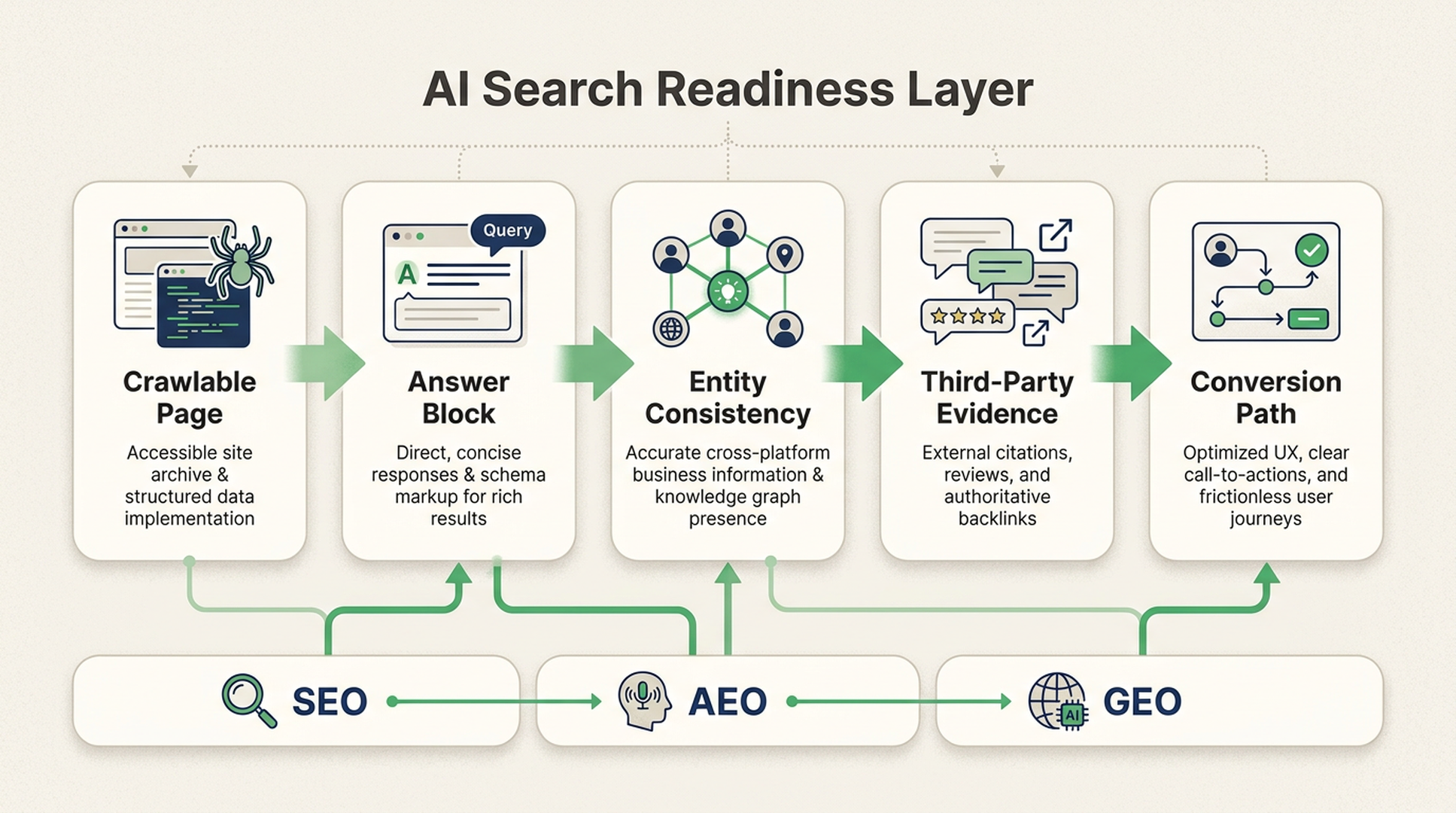
Caption: SEO quick wins become more durable when each page is also prepared for AI answers and brand/entity recognition.
Medium-ROI basics that still compound
Once the top five are moving, the rest of the checklist still matters. Do not ignore it. Just do not let it distract from the work with higher leverage.
Target long-tail keywords with real buying or problem intent
Long-tail keywords usually have lower volume, but they are easier to satisfy and often closer to action. The best long-tail pages are narrow enough to be useful and connected enough to support a larger topic cluster.
Good examples:
Weak target | Better target |
|---|---|
SEO tools | SEO audit tool for small business websites |
AI search | how to check if ChatGPT can find my brand |
content marketing | B2B SaaS content refresh checklist |
local SEO | local SEO checklist for multi-location clinics |
Put the keyword where it helps the user
Titles, H1s, URLs, first paragraphs, subheads, and alt text still matter. The goal is not repetition. The goal is clarity.
A page about an AI crawler checker should say that plainly. A product page should not hide its actual use case behind brand language. If readers need five seconds to figure out what the page is about, search engines probably need help too.
Add information competitors cannot easily copy
AI has made generic content cheaper. That means original information has become more valuable.
Useful forms include:
- A small benchmark from your own data.
- A teardown of real SERPs or AI answers.
- A comparison table based on hands-on testing.
- Screenshots from your workflow.
- A template that reflects how your team actually works.
- Clear examples from a specific industry, not imaginary "Company X" stories.
This is also where GEO work starts. AI systems need distinct facts to cite. If your page says the same thing as 50 other pages, there is no strong reason to choose yours.
Write alt text for accessibility and context
Alt text should describe the image. It should not be a place to dump keywords.
Bad alt text: "SEO SEO checklist best SEO tips 2026."
Better alt text: "A table ranking five SEO quick wins by effort and expected payoff in 2026."
That helps accessibility, image search, and agentic browsing tools that need to understand what is on the page.
Keep local profiles accurate if local intent matters
For local businesses, Google Business Profile and other local listings can be higher ROI than another blog post. Keep names, addresses, phone numbers, categories, photos, services, opening hours, and reviews current.
For global SaaS or B2B companies, the equivalent is entity consistency: your company description, product names, leadership names, category, and positioning should match across your site, LinkedIn, review platforms, software directories, and press pages.
Scenario-specific moves
Some SEO quick wins only matter in certain contexts. Use them when the page or business model needs them.
Tactic | Use it when | Watch out for |
|---|---|---|
Featured snippet targeting | The SERP still shows paragraph, list, or table snippets | AI answers may reduce clicks, so connect the answer to a next step |
Image compression | Pages are image-heavy or Core Web Vitals are weak | Do not ruin screenshots that carry important detail |
Voice-style questions | The audience searches in conversational phrases | Avoid fake FAQ bloat |
Topic clusters | You need topical authority around a strategic category | Validate real intent before generating dozens of pages |
Competitor keyword gaps | Competitors rank for relevant terms you missed | Do not copy keywords that do not fit your product or buyer |
The 2026 AI-search layer
The classic SEO checklist is not enough on its own anymore. Add these five checks to every important page.
Add a short answer block near the top
For pages that answer a clear question, add a 40- to 60-word answer near the top. It should be direct enough for AI answers and featured snippets, but not so shallow that users bounce.
Example:
SEO quick wins in 2026 are low-friction improvements that help pages rank, get cited, and convert sooner. The highest-ROI actions are search intent alignment, content refreshes, schema markup, internal linking, E-E-A-T improvements, and AI-search readiness checks.
Make entity information consistent
Your brand, product, category, and core claims should look the same across the web. If your homepage calls the product an "AI search visibility platform," but your LinkedIn page says "marketing automation software" and your directories say "SEO agency," machines and buyers both get mixed signals.
Audit these places:
- Homepage and about page.
- Product pages.
- LinkedIn company page.
- Review profiles and software directories.
- Author bios and guest posts.
- Press pages and partner listings.
Build third-party evidence
AI systems do not only look at your site. Buyers do not either. Reviews, comparison pages, community discussions, partner pages, customer stories, and credible mentions all help define whether the brand is real and trusted.
This does not mean spamming forums. It means being present where the buying conversation already happens.
Check agent readiness
If AI agents and browser automation tools cannot read your site, complete forms, or understand page structure, you have a new kind of conversion leak.
Check for:
- Semantic HTML.
- Visible labels on forms.
- Crawlable content rather than critical text hidden behind client-only rendering.
- Descriptive buttons and links.
- Accessible tables and images.
- Clear pricing, product, contact, and policy pages.
A technical SEO audit and an agent-readiness audit now overlap more than many teams expect.
Review AI crawler access
Robots.txt choices are now strategic. Some teams want broad AI crawler access. Others need tighter control. Either way, the decision should be intentional.
Review whether important crawlers can access the pages you want discovered, and whether private, duplicate, or low-value areas are blocked. Then document the policy so SEO, legal, and engineering are not making separate decisions.
The Robots.txt AI Crawler Checker can help teams spot obvious access issues before they turn into visibility problems.
A one-month execution plan
If your team has one month, do not try to do all 15 things at once. Run a focused sprint.
Week | Work | Output |
|---|---|---|
Week 1 | Intent audit for top 20 pages | Keep, rewrite, merge, or retarget decision for each page |
Week 2 | Refresh top 10 aging pages | Updated content, dates, visuals, answer blocks, titles |
Week 3 | Schema and internal links | Clean schema set and new links from authoritative pages |
Week 4 | Trust and AI-readiness pass | Author bios, sources, entity consistency, crawler checks |
At the end, measure impressions, clicks, rankings, assisted conversions, AI-answer mentions where you can track them, and crawl/indexing changes. Do not judge the work only by next-day rankings.
Quick checklist
Use this before publishing or refreshing an important page:
- The page format matches the current SERP intent.
- The first section gives a direct answer.
- The title, H1, URL, and opening paragraph are clear.
- The page includes current examples, screenshots, or evidence.
- Schema matches the real page type.
- Internal links point to and from the right pages.
- Author, date, sources, and company signals are visible.
- Images have descriptive alt text.
- The page is readable by crawlers and agents.
- The next action is obvious to the reader.
Auspia takeaway
The safest SEO strategy for 2026 is not to chase every new trick. It is to execute the durable work with more discipline: match intent, refresh what already has traction, structure pages for machines, show proof for humans, and make your brand easier for AI systems to understand.
Most sites do not need more ideas first. They need a shorter list and better follow-through.
FAQ
What are SEO quick wins in 2026?
SEO quick wins are changes that can improve search visibility without rebuilding the whole site. In 2026, the strongest quick wins are intent alignment, refreshing existing pages, adding accurate schema, improving internal links, strengthening trust signals, and making pages easier for AI systems to extract.
Are traditional SEO tips still useful with AI search?
Yes, but they need to be executed differently. Keywords, links, schema, page speed, and content quality still matter. The difference is that pages also need direct answers, consistent entity signals, visible evidence, and clean structure for AI answer systems.
Should I publish new content or refresh old content first?
Refresh old content first if you already have pages with impressions, backlinks, or declining traffic. New content is still useful, but refreshed pages often show faster movement because they already have search history and internal authority.
How many internal links should a page have?
There is no fixed number. A practical range for many articles is three to seven useful internal links, but relevance matters more than count. Each link should help the reader take the next logical step.
Does schema help rankings directly?
Schema is not a ranking shortcut. It helps search engines understand the page type, entities, and structure. That can improve eligibility for rich results and reduce ambiguity, especially on articles, tutorials, products, local pages, and FAQ sections.