The short answer
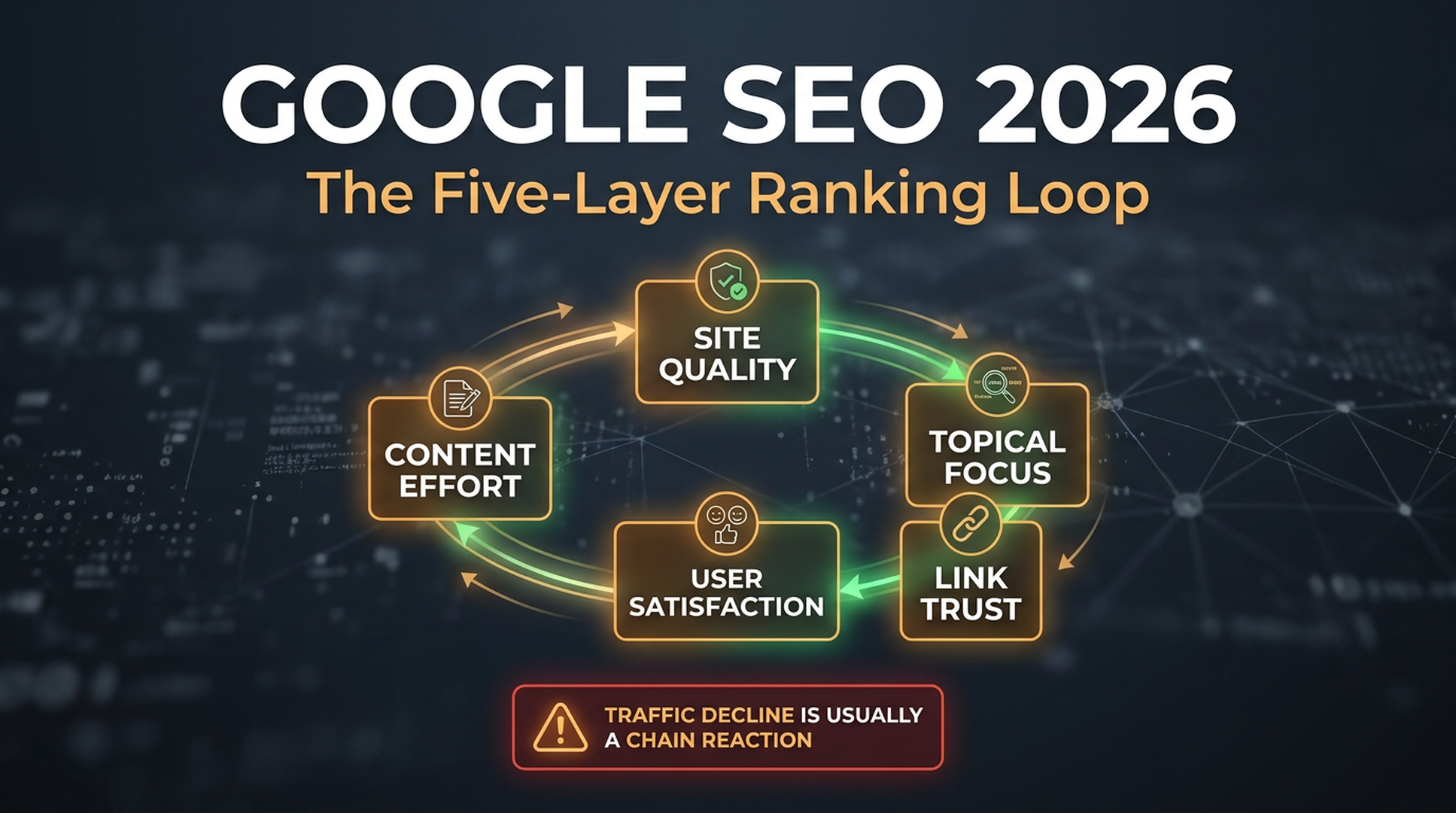
If your SEO has been getting harder every year, the problem is probably not one bad title tag, one weak backlink, or one missed schema field. In 2026, Google SEO behaves more like a connected scoring loop.
A weak content page can create poor user behavior. Poor behavior can drag down site-level quality. A lower site quality profile can reduce how much your links help. Once that happens, even decent pages stop getting tested as often. The site feels stuck.
That is the pattern behind many slow SEO declines: not a single penalty, but a chain reaction.
This article breaks the system into five practical layers:
- Site-level quality
- Topical focus
- Link trust
- User satisfaction
- Content effort
The model is inspired by public discussion around the 2024 Google Search documentation leak, Google's own helpful content guidance, and what SEO teams can still observe in Search Console in 2026. It is not a claim that we know Google's exact weights. Nobody outside Google does. But it is a useful operating model for diagnosing why a site keeps losing visibility after every core update.
Why this matters more in 2026
The old SEO playbook assumed that each URL could fight for itself. Find a keyword, publish a page, point a few links at it, refresh the year in the title, repeat.
That is a dangerous habit now.
Google's public guidance keeps pushing the same direction: create helpful, reliable, people-first content, not pages made mainly to attract search traffic. Google also has dedicated guidance for AI features in Search, which means publishers now have to think about classic rankings and AI answer eligibility at the same time.
The 2024 Search documentation leak added another layer to the conversation. The leaked Content Warehouse API documentation was reported to include more than 14,000 attributes across Google's search systems. Google confirmed the documents were authentic, while warning that they were incomplete, outdated, and easy to misread without context. That caveat matters. A field name is not a ranking formula.
Still, the leak gave SEO teams a useful reminder: Google stores and processes signals at many levels, not just the individual page. Analysts discussed attributes related to click behavior, site authority, topical coherence, links, content freshness, and quality systems. Whether a specific attribute is active today is less important than the broader lesson: modern search quality is multi-layered.
For teams working on SEO, GEO, and AI search visibility, that means one thing: fixes need to be systemic.
Layer 1: site-level quality decides how much room you get
The first layer is the one many teams ignore because it feels unfair. A strong page on a weak site has less room to grow.
Site-level quality is not a magic number you can look up in a third-party tool. Think of it as Google's accumulated memory of your domain: indexed quality, spam risk, usefulness, user satisfaction, link profile, page patterns, and topical consistency.
This explains why two pages with similar keyword targeting can behave so differently. One gets crawled, tested, and moved upward. The other gets indexed, then sits on page four forever.
In practical terms, a site-level quality problem often looks like this:
Symptom | What it usually means | First repair move |
|---|---|---|
Many indexed pages with zero impressions | Google does not see enough demand or value in the long tail | Prune, merge, or rewrite dead pages |
Core pages rank briefly, then fade | The page may not satisfy users after the first test | Rework the intent match and first-screen answer |
New content takes longer to move | The domain may not be earning enough trust signals | Improve internal links and update proven assets |
Links stop moving rankings | Link equity may be diluted by low-quality sections | Clean index bloat before buying more links |
The uncomfortable part: publishing more can make the problem worse. If 300 thin posts are dragging down the average quality of the site, adding 30 more lightly edited AI posts will not rescue it.
A better first move is a site quality audit:
- Export the last 12 to 16 months from Google Search Console.
- Mark pages with no clicks, no meaningful impressions, no backlinks, and no business purpose.
- Merge overlapping pages into stronger hubs.
- 301 redirect pages with useful equity.
- Noindex or delete pages that exist only because someone once chased a keyword.
Do not start with content production. Start by removing the drag.
Layer 2: topical focus tells Google what you deserve to rank for
A site can publish a lot and still fail because its topic boundary is blurry.
This is common on SaaS, agency, ecommerce, and B2B manufacturing sites. A team starts with a real niche, then slowly drifts. An invoice automation company publishes about "digital transformation." A cybersecurity startup writes about remote work culture. A CNC machining supplier starts chasing AI trend keywords.
The traffic looks tempting. The topical damage is not obvious until later.
Modern search systems use entity understanding, embeddings, internal links, anchor text, and site-level patterns to infer what a site is actually about. If the site keeps wandering, the main topic becomes harder to trust.
A clean topical strategy has three parts:
Part | Good version | Weak version |
|---|---|---|
Core entity | "Accounts payable automation for mid-market finance teams" | "Business productivity" |
Supporting clusters | invoice capture, approval routing, ERP sync, audit trails | leadership, AI trends, remote culture |
Commercial bridge | solution pages, comparison pages, templates, calculators | isolated blog posts with no product path |
For 2026 SEO, the question is not "Can we rank for this keyword?" The better question is: "Would ranking for this keyword make our site easier or harder to understand?"
Auspia's rule of thumb: finish one topic cluster before opening the next. A cluster is finished when it has a clear hub, supporting pages, internal links, updated examples, and a conversion path.
If you want a quick way to check this, run your priority pages through an AI search visibility review, then compare how consistently your brand is associated with the same entities. Auspia's AI Search Visibility Checker is useful for spotting that gap before it becomes a traffic problem.
Layer 3: link trust is about distance, context, and fit
Backlinks still matter, but the cheap version of link building has become a trap.
A useful link is not just a hyperlink from any indexed page. It carries context. It sits near relevant language. It comes from a site that is trusted in or near your category. It points to a page that deserves the citation.
A weak link is often technically visible but practically useless. You can buy 200 of them and still see nothing move.
The better 2026 priority order looks like this:
- Industry publications and analyst resources
- Customer stories and partner pages
- Expert roundups where your team contributes real data
- Trade associations, conference pages, and ecosystem directories
- High-quality niche blogs with real readership
Notice what is missing: generic guest post farms, foreign-language link networks, expired-domain blog rolls, and sitewide footer links.
Internal links deserve more respect too. They are the link system you control. If your best educational article never points to the related product page, you are leaving relevance on the table. If every internal anchor says "learn more," you are wasting context.
A simple internal link repair:
- Pick five commercial pages that matter.
- Find the ten strongest informational pages related to each one.
- Add one natural contextual link from each article to the relevant commercial page.
- Vary the anchor text based on the sentence, not a spreadsheet.
- Add a short surrounding phrase that clarifies why the linked page helps.
This is boring work. That is why it works. Most competitors skip it.
Layer 4: user satisfaction decides whether the page earns more tests
A page can be optimized and still lose because users do not like it.
The most obvious failure is the quick return to search results. Someone clicks your result, sees a vague opening, cannot find the answer, and goes back. Even if you avoid using the term "bounce rate," the behavior is bad. The page did not do its job.
In 2026, many SEO pages still fail in the first screen. They open with a definition nobody asked for, a brand paragraph nobody cares about, or three sentences of throat-clearing before the answer appears.
Fix the first screen first.
For informational pages, the first screen should usually include:
- A direct answer in plain language
- A short table, checklist, or decision rule
- The audience or use case the page is written for
- A clear next step for readers who want to act
For commercial pages, the first screen should usually include:
- What the product or service does
- Who it is for
- Proof that reduces risk
- A comparison, demo path, or qualification step
Here is a useful diagnostic: if a user took a screenshot of your first screen and sent it to a colleague, would the colleague understand why the page exists?
If not, the page is probably asking Google for more trust than users are willing to give.
Layer 5: content effort is easier to detect than teams think
The fastest way to create a weak SEO site in 2026 is to publish AI drafts at scale without adding anything humans would notice.
The issue is not that AI was used. The issue is that the page has no original effort: no examples, no constraints, no data, no screenshots, no comparisons, no practitioner judgment, no real editorial point of view.
Google's helpful content guidance asks site owners to consider whether content is made primarily for people or mainly to attract search engine visits. That is still the cleanest editorial test.
You can usually spot low-effort content in 30 seconds:
Low-effort signal | Better replacement |
|---|---|
Generic intro that could fit any industry | Start with the specific problem and who has it |
Repeated definitions | Add a decision rule or failure pattern |
No examples | Use a real product, workflow, or market scenario |
No visual explanation | Add a diagram, table, annotated screenshot, or checklist |
Fake freshness | Update data, screenshots, examples, and recommendations |
One warning about "2026" titles: adding the year is useful only if the article is actually current. If the body still reads like a 2023 post with a new title, readers can tell. Search systems can also detect stale sections through crawl history, page changes, and content comparison.
A proper refresh changes the page materially. Add new examples. Remove obsolete advice. Update screenshots. Rewrite the answer if the market changed.
How the five layers create a decline loop
Here is the chain reaction many teams miss:
Broken layer | What happens next |
|---|---|
Thin content | Users do not stay, save, compare, or convert |
Poor satisfaction | The page earns fewer successful tests |
Lower site confidence | New pages struggle before they even start |
Weak topic focus | Google cannot tell what the site should own |
Low-value links | Link equity fails to rescue the system |
This is why some sites do not recover after a core update even after "fixing" a few articles. The site is not suffering from one broken part. It is suffering from a loop.
The good news is that loops can work in the other direction too.
A focused cluster improves topical clarity. Better internal links move users and relevance toward key pages. Better first screens improve satisfaction. Stronger pages earn better links. Over time, the site becomes easier to trust.
No single fix is dramatic. The combined effect is.
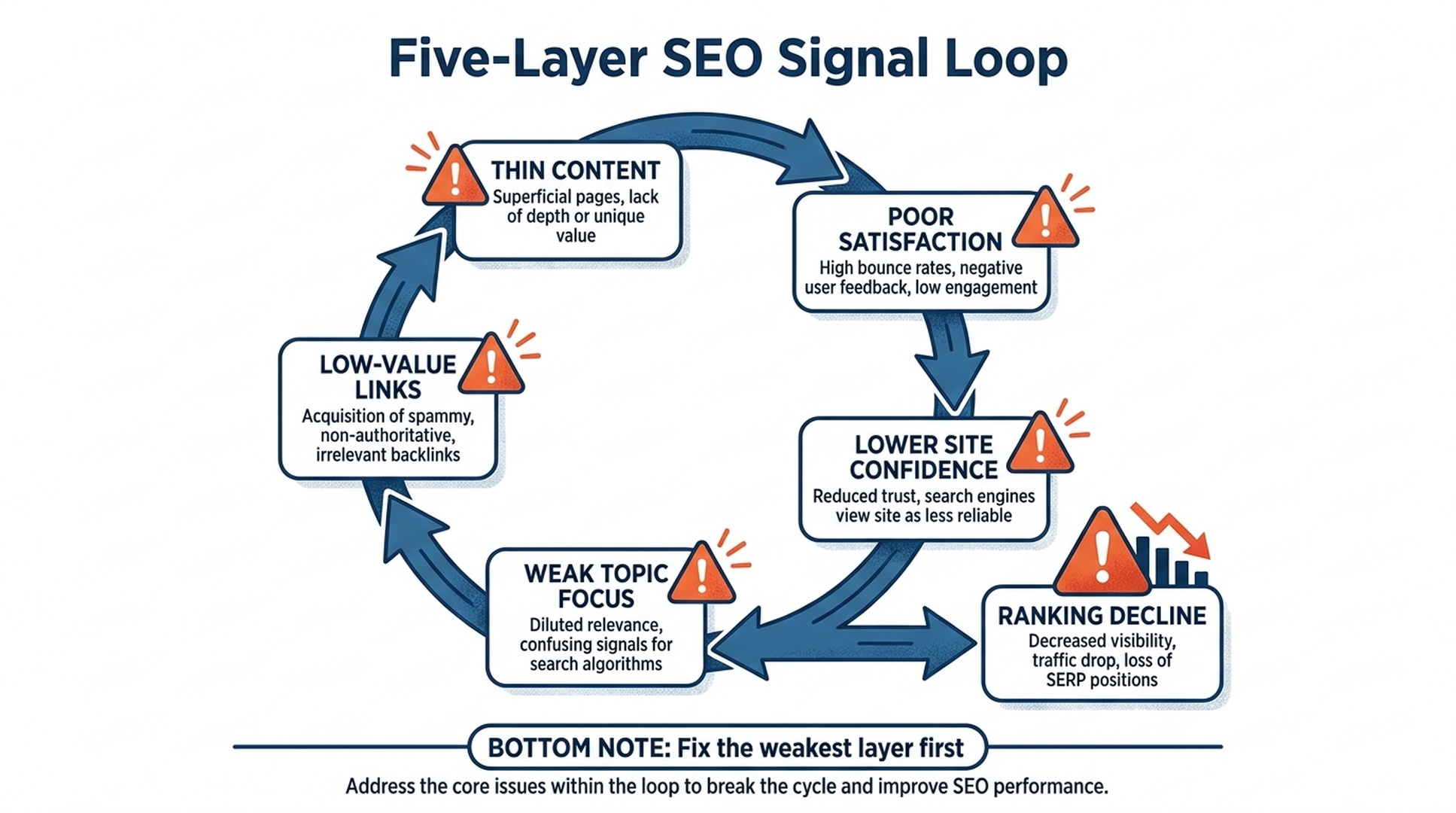
Caption: The five-layer SEO loop is useful because it shows why a small content problem can turn into a site-wide ranking problem.
A 2026 recovery checklist for SEO teams
Use this sequence if organic traffic is sliding or stuck.
Week | Action | Output |
|---|---|---|
1 | Run an index and performance audit | Keep, merge, rewrite, noindex, delete list |
2 | Define topic boundaries | Core entity, clusters, pages to stop writing |
3 | Repair internal links | Commercial pages connected to strongest articles |
4 | Rebuild first screens | Direct answers, tables, proof, next steps |
5 | Upgrade content effort | Examples, data, visuals, screenshots, expert notes |
6 | Pursue trusted links | Partner, customer, industry, and association targets |
Do not do this once. Repeat it quarterly. SEO decay is real, especially on sites with large content libraries.
Auspia's practical advice is to track three dashboards at the same time:
- Search Console performance by URL group
- Content quality status by cluster
- AI search visibility by brand and topic prompts
Classic rankings and AI answers now feed the same business question: does the market recognize your site as a useful source for this topic?
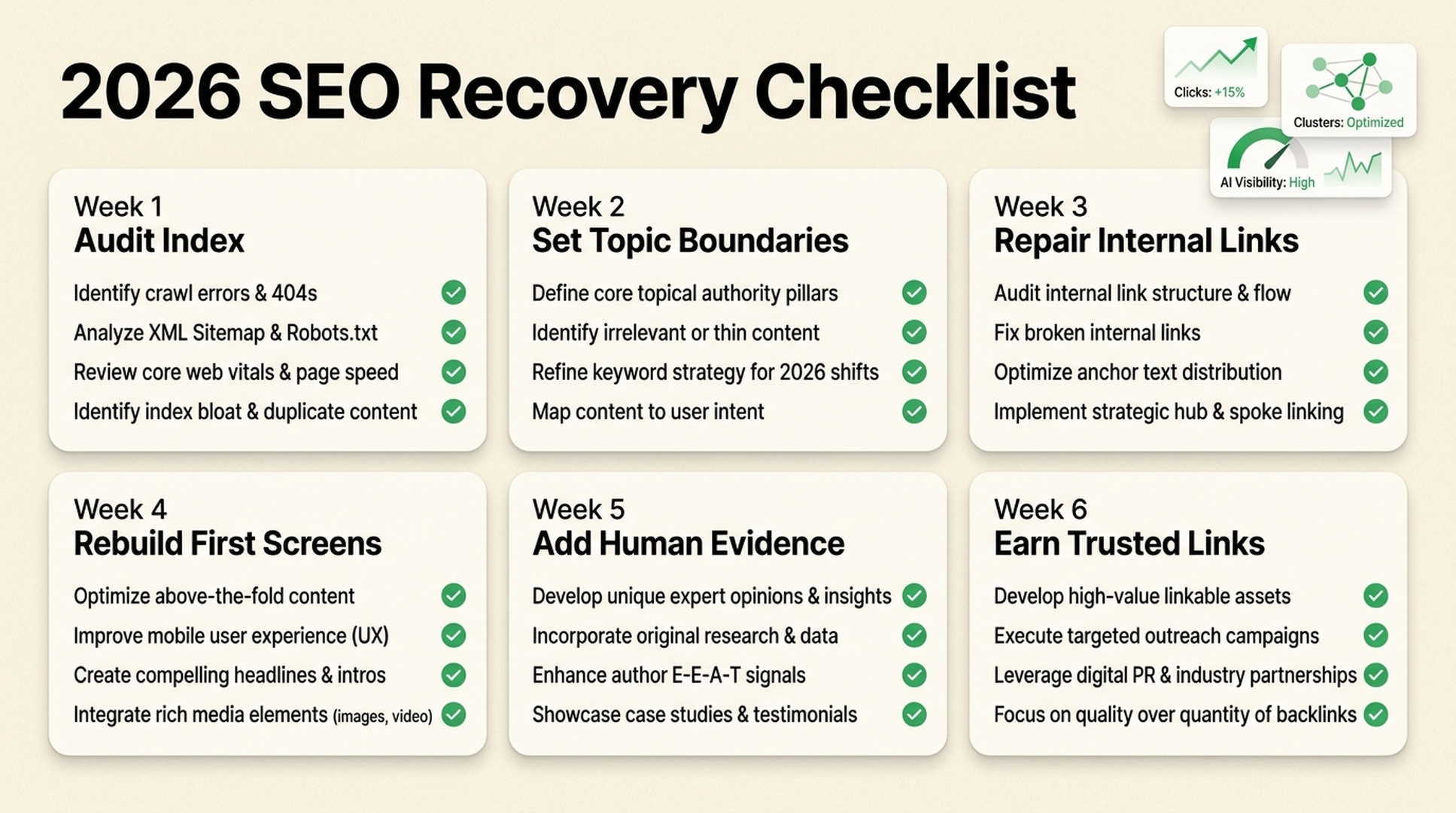
Caption: A practical six-week recovery sequence for teams that need to repair the system before publishing more content.
What most teams should stop doing
A few habits are especially expensive now:
- Publishing pages because a keyword tool shows volume, even when the topic does not fit the site.
- Refreshing posts by changing only the year, title, and first paragraph.
- Buying links before cleaning index bloat.
- Writing informational posts with no internal path to a product, tool, template, or demo.
- Treating AI content as a final draft instead of a rough research assistant.
- Measuring SEO only by total sessions instead of cluster health and qualified outcomes.
The pattern is simple: stop trying to make weak pages look optimized. Make useful pages hard to ignore.
Auspia takeaway
The most useful SEO mindset for 2026 is not "ranking factors." It is system repair.
If a site has low-quality indexed pages, blurry topical focus, weak internal links, shallow content, and poor first-screen satisfaction, no single tactic will save it. The work is slower and less glamorous: cut the dead pages, tighten the topic, improve the pages users actually land on, and earn links that make sense in the real world.
That same work also helps AI search. Answer engines need clear entities, trusted sources, concise explanations, and pages worth citing. A messy SEO site is usually a messy GEO site too.
Start with the loop. Find the weakest layer. Fix that before you publish another batch of content.
FAQ
Is the 2024 Google Search documentation leak still useful in 2026?
Yes, but only as context. The leak does not reveal exact ranking weights, and Google warned against treating it as a complete current ranking guide. Its value is that it reminds SEO teams to think in systems: site-level signals, user behavior, links, topical coherence, and content quality can interact.
Does Google use a site authority score?
Google has publicly pushed back on simple third-party ideas of domain authority. The leaked documentation reportedly included a siteAuthority attribute, but that does not tell us how or whether it is used today. For practical SEO, the safer point is this: site-level trust and quality patterns clearly matter.
Should we delete old blog posts with no traffic?
Not automatically. First check whether the page has backlinks, conversions, internal link value, or a strategic reason to exist. If it has none, merge it, rewrite it, noindex it, or delete it. The goal is not fewer pages. The goal is fewer useless pages.
Is AI-generated content bad for SEO?
AI use is not the problem by itself. Low-effort content is the problem. If AI helps with research, outlines, or editing, then humans add examples, data, screenshots, judgment, and fact-checking, the result can still be useful. Publishing unedited AI text at scale is where sites get into trouble.
How often should we refresh SEO content in 2026?
Refresh important pages at least twice a year, and sooner when products, search intent, regulations, pricing, screenshots, or SERP formats change. A real refresh should add useful new information, not just a new date.
Sources and further reading
- Google Search Central: Creating helpful, reliable, people-first content
- Google Search Central: AI features and your website
- Search Engine Land: Unpacking Google's massive search documentation leak
- The Verge: Google confirms the leaked Search documents are real