Executive summary
In 2026, Google SEO work should start with opportunity diagnosis, not with publishing more pages. A team that knows which keywords are close to page one, which pages waste crawl and authority, and which commercial terms are under-served can move faster than a team that simply writes every week.
The practical workflow is simple: audit the current site, estimate lost traffic, sort keywords by speed and upside, repair page structure, refresh content by intent, then prioritize terms with real business value. This article turns that process into a checklist for global B2B, ecommerce, SaaS, and service websites.
If you want a quick read on one sentence: stop treating SEO as a content calendar problem. Treat it as an opportunity allocation problem.
Why this matters in 2026
Organic search is more crowded now. AI summaries, shopping modules, forums, video results, comparison pages, and brand-heavy SERPs all compete for the same click. At the same time, many websites still make the same old mistake: they put all their effort into new articles while ignoring the keywords and pages already sitting near a breakthrough.
That is expensive. A keyword ranking in position 11 or 14 may need a better title, clearer intent match, stronger internal links, or a refreshed section. A new article may need months to earn the same chance.
The 2026 SEO team needs a sharper habit: diagnose before executing. That means looking at search visibility, click loss, page quality, internal authority, and conversion intent before deciding what to write or fix next.
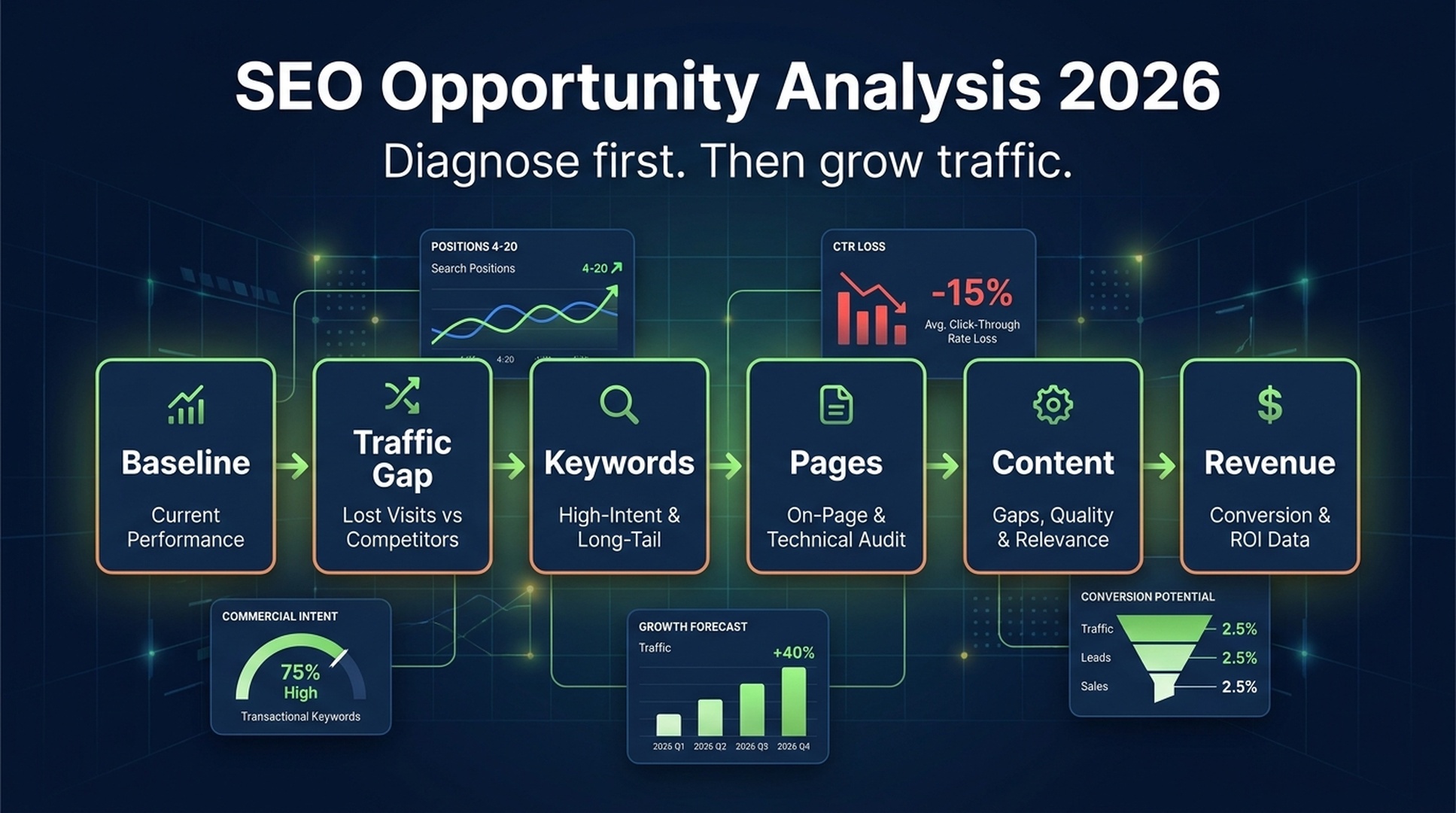
The six-step SEO opportunity workflow
Step | Main question | What to look for | Typical action |
|---|---|---|---|
1. Site baseline | What do we already have? | Indexed pages, ranking keywords, page-one terms, traffic leaders | Build the starting report |
2. Traffic gap | Where are clicks being lost? | Positions 4-20, declining CTR, search volume still present | Set realistic uplift targets |
3. Keyword layers | Which terms deserve attention first? | Quick wins, low-competition demand, non-brand growth terms | Create the optimization queue |
4. Page structure | Is authority going to the right pages? | Thin pages, cannibalization, weak product pages | Merge, redirect, strengthen, relink |
5. Content operations | Does each page match intent? | Outdated posts, weak examples, missing comparisons, thin FAQs | Refresh or consolidate content |
6. Commercial focus | Which terms can turn into revenue? | High-CPC terms, demo intent, pricing intent, product-fit terms | Build conversion paths |
This is not a one-time audit. It works best as a monthly operating loop.
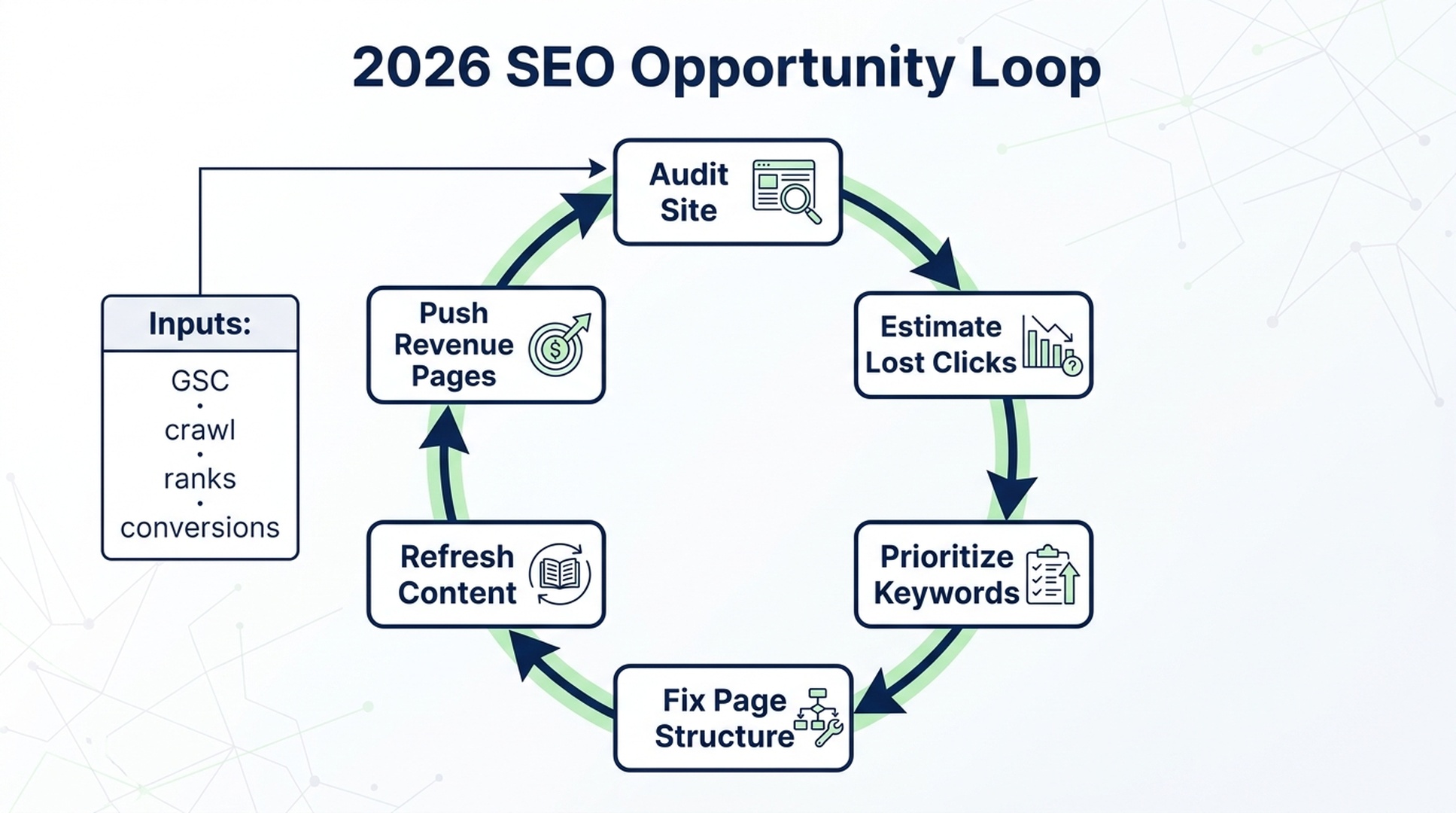
Caption: The 2026 SEO opportunity loop works best as a monthly cycle, not a one-off audit.
Step 1: start with the site baseline
Before changing anything, answer four questions:
- How many valid pages are indexed and worth keeping?
- How many keywords rank in the top 100, top 20, and top 10?
- Which pages bring most non-brand traffic?
- Which important pages bring almost no search traffic?
This baseline separates reality from team folklore. A founder may believe the product pages are the main SEO asset, while the data shows that three old glossary posts carry most organic traffic. A content manager may think the blog is underperforming, while the real issue is that product category pages have no internal links and no clear search intent.
Use Google Search Console, analytics, a rank-tracking tool, and a crawl. If you want a faster first pass, run a site check through Auspia's Website SEO Score Checker and combine it with Search Console exports.
Step 2: measure the traffic gap
A traffic gap is the difference between your current organic clicks and the clicks you could reasonably earn if existing keywords moved into stronger positions.
Do not model fantasy outcomes. Assume only realistic improvements:
- Position 11 to 7 after a focused page refresh
- Position 8 to 4 after improving intent match and internal links
- Position 4 to 2 after adding stronger proof, comparisons, or structured answers
- Position 20 to 10 only when the page already matches intent and has enough authority
This step helps the team avoid vague goals like "increase SEO traffic." A better goal is: "Move 40 non-brand keywords from positions 8-20 into the top 7 within 90 days, with priority on terms tied to product pages and buying intent."
That target is easier to execute, easier to assign, and easier to review.
Step 3: split keywords into quick wins and blue-ocean opportunities
A good keyword list is not just a dump of search volume. It needs layers.
Quick-win keywords already have traction. They often sit on page two or the lower half of page one. These are the first place to look because Google has already decided the page is relevant. The question is usually quality, specificity, or authority.
Blue-ocean opportunities are different. They have useful demand, lower competition, and enough commercial relevance to justify new content or new landing pages. In 2026, these often appear in long-tail comparison searches, problem-specific queries, "alternative to" searches, and practical how-to searches with a clear buyer behind them.
Separate brand and non-brand terms as well. Brand terms show demand capture. Non-brand terms show market reach. A healthy SEO program needs both, but they should not be judged by the same rules.
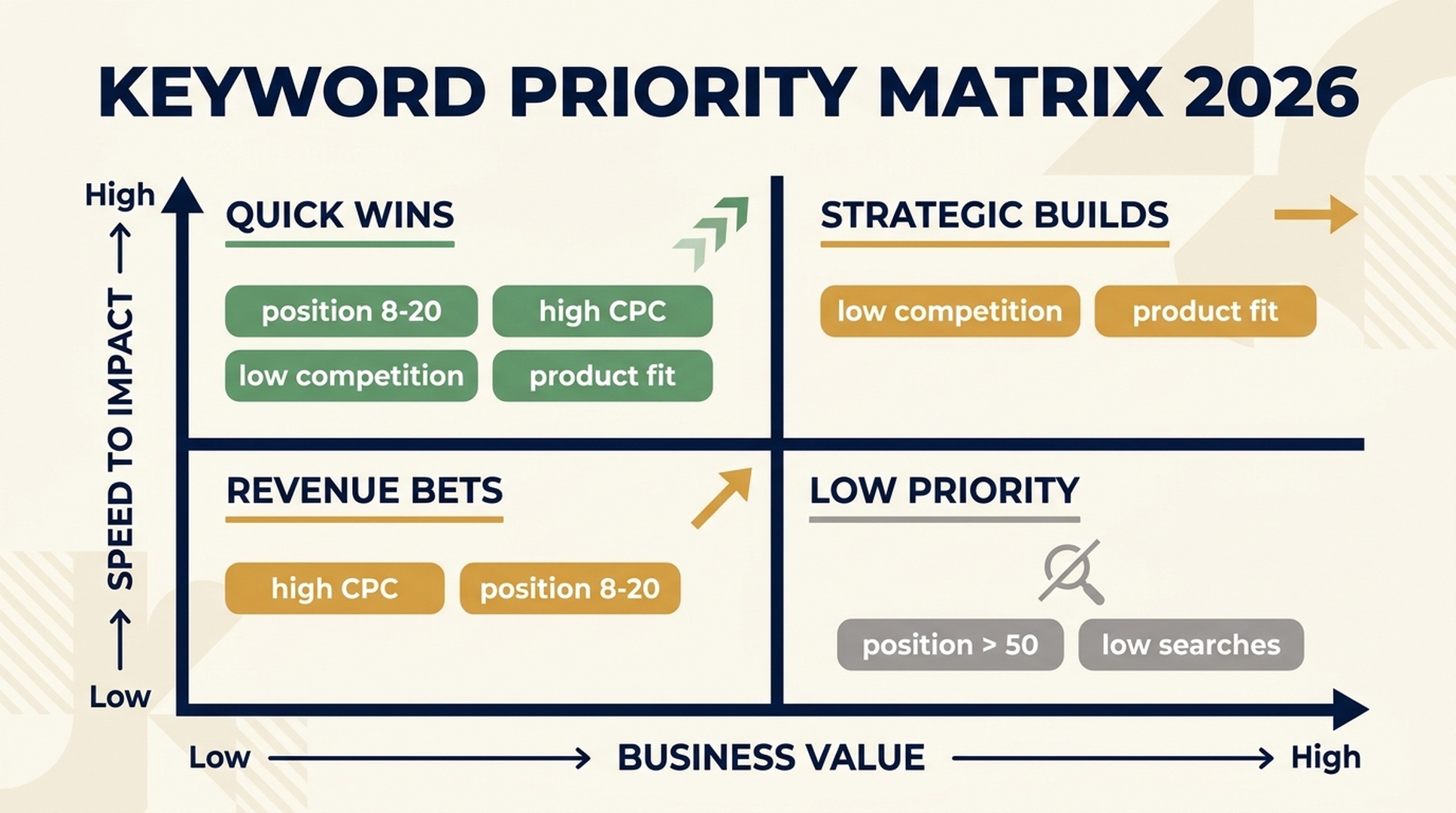
Caption: Prioritize keywords by speed to impact and business value before assigning writing or optimization work.
Step 4: diagnose the page structure
Many sites leak SEO value through poor page structure.
Common patterns include:
- Blog articles rank, but product or service pages do not.
- Several pages compete for the same query and none performs well.
- Old thin posts remain indexed even though they bring no traffic and no business value.
- Important conversion pages are buried five clicks deep.
- Internal links point to informational pages but ignore pages that can convert.
The fix is not always to write more. Sometimes the right move is to merge three weak pages into one stronger guide, redirect an outdated post, add internal links from high-traffic pages to commercial pages, or rewrite a product page so it answers the actual search intent.
A useful rule: every indexed page should have a job. It should attract demand, support topical authority, answer a customer question, assist conversion, or help another important page rank. If it does none of those, it deserves scrutiny.
Step 5: run content operations by intent, not by volume
Publishing more content can help, but only when the content has a clear role.
Start by grouping existing pages by intent:
Intent type | Example query | Best page type | Content requirement |
|---|---|---|---|
Informational | "what is technical SEO" | Explainer or glossary | Simple definition, examples, FAQ |
Commercial research | "best SEO audit tools for SaaS" | Comparison page | Criteria, trade-offs, screenshots, pricing context |
Problem solving | "why are pages indexed but not ranking" | Diagnostic guide | Symptoms, causes, workflow, fixes |
Transactional | "enterprise SEO audit service" | Service page | Offer, proof, process, CTA |
AI search visibility | "how to get cited by AI search" | GEO/AEO playbook | Entity clarity, citations, answer-ready structure |
This prevents the usual content mistake: answering a buying query with a generic blog post or answering a beginner query with a sales page.
For teams working on both SEO and AI answer visibility, intent mapping also supports AI Search Visibility Checker workflows. Pages that give concise definitions, named entities, clear evidence, and extractable steps are easier for humans to trust and easier for answer systems to summarize.
Step 6: put commercial terms at the center
Traffic without conversion is not the goal. Some low-volume keywords matter because the searcher is close to action.
Look for terms that suggest buying intent:
- "pricing"
- "agency"
- "service"
- "software"
- "alternative"
- "comparison"
- "for ecommerce"
- "for SaaS"
- "near me" for local service categories
- "template" when the template connects to a paid workflow
High CPC can be a useful clue, but it is not enough. A keyword with high CPC still needs product fit. Ask whether the page can naturally offer a next step: audit, demo, checklist, tool, consultation, trial, or purchase.
The strongest SEO programs connect keyword priority to revenue paths. They do not stop at rankings.
A 2026 SEO opportunity checklist
Use this checklist during monthly planning:
- Export top queries and pages from Search Console.
- Mark non-brand keywords in positions 4-20.
- Identify pages losing impressions or clicks over the last 90 days.
- Find pages with traffic but weak conversion paths.
- Find commercial pages with weak internal links.
- Group keywords into quick wins, new opportunities, and low-priority noise.
- Refresh pages that are close to page one before commissioning new articles.
- Merge or redirect pages that split intent.
- Add structured sections that answer common questions directly.
- Review whether each priority page has a clear next action.
The review should end with a short queue, not a giant spreadsheet. Ten precise fixes beat 200 vague keyword ideas.
Common mistakes
The first mistake is treating content volume as strategy. If the site has weak structure, unclear intent, and no commercial paths, publishing more pages only creates more maintenance.
The second mistake is chasing high-volume keywords too early. These terms can be useful, but they are rarely the fastest path for a mid-sized site. Quick-win terms and specific commercial queries often create momentum sooner.
The third mistake is deleting low-traffic pages without checking their role. Some pages support internal links, topical coverage, or sales conversations. Decide based on job, not traffic alone.
The fourth mistake is ignoring AI search behavior. In 2026, pages need to work for classic rankings and answer extraction. That means clearer definitions, named entities, source-backed claims, concise summaries, and page sections that can stand alone.
Auspia take
The best SEO work in 2026 looks less like endless writing and more like portfolio management. Every page and keyword competes for limited time. The team that wins is usually the team that can say, "This is the next page to improve, this is why, and this is the expected business upside."
That is the habit Auspia recommends: diagnose the opportunity, rank the actions, then execute in short cycles. Use tools to remove repetitive data work, but keep judgment where it belongs: intent, page quality, offer fit, and conversion path.
FAQ
What is SEO opportunity analysis?
SEO opportunity analysis is the process of finding the keywords, pages, and technical fixes most likely to improve organic traffic and business outcomes. It usually combines rankings, Search Console data, crawl data, traffic, conversion intent, and content quality review.
Should I optimize old pages or publish new content first?
Optimize old pages first when they already rank in positions 4-20, match the right intent, and have business value. Publish new content when there is a clear keyword gap that existing pages cannot satisfy.
How often should a team run this workflow?
Most growing sites should run a lightweight version every month and a deeper review every quarter. Fast-moving ecommerce, SaaS, and media sites may need weekly monitoring for priority keyword groups.
What makes this different in 2026?
The main difference is click competition. Google results now include more AI summaries, rich results, forums, shopping units, video, and comparison surfaces. SEO teams need to prioritize opportunities with stronger intent and clearer conversion paths, not just search volume.
Can this workflow help with AI search visibility?
Yes, especially when pages are rewritten with concise answers, clear entities, supporting evidence, comparison tables, and direct FAQs. Those same improvements help both search users and AI answer systems understand the page.