Executive Summary
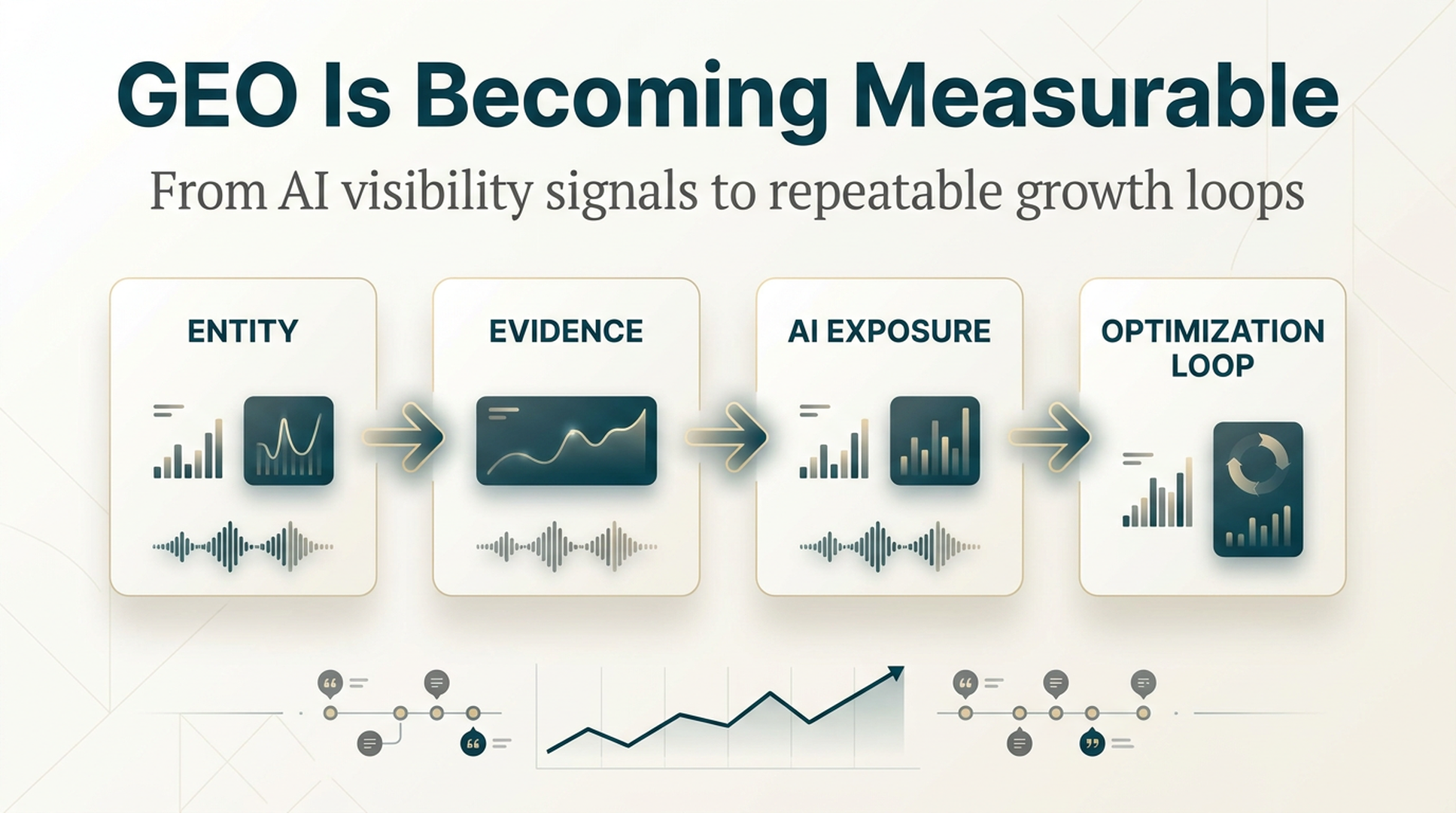
GEO is moving from a vague visibility idea into an operating loop. The shift is simple: brands now need to manage how they are understood as entities, how their content is used as evidence, and how their AI-search exposure is measured.
The practical takeaway: do not treat GEO as a replacement for SEO. Treat it as the next layer on top of crawlability, indexability, useful content, and clear product facts. Search engines and AI systems still need a clean site. They also need stronger evidence than a generic blog post.
This article breaks down what changed, why it matters, and how a growth team can build a repeatable GEO workflow without turning every week into a research project.
What Changed: GEO Is No Longer Just a Theory
For most of the past year, GEO work felt a little uncomfortable. Teams could see AI Overviews, ChatGPT answers, Perplexity citations, and Copilot results shaping discovery, but the measurement layer was thin. You could test prompts manually. You could track citations. You could compare answer coverage. But there was no stable reporting loop that felt like classic SEO reporting.
That is starting to change.
Several signals now point in the same direction:
- Google is giving creators and brands more structured identity surfaces through Search profiles and knowledge-style brand pages.
- Search Console is beginning to expose generative AI visibility signals, including appearances in AI experiences.
- Google's own AI optimization guidance keeps pointing back to the basics: crawlable pages, reliable content, useful structure, and first-hand value.
- Microsoft is rebuilding parts of web retrieval around AI grounding, not just traditional blue-link ranking.
None of this means SEO is dead. That line is lazy. The better read is that SEO has become the foundation layer, while GEO decides whether your site is useful enough for an AI system to quote, summarize, compare, or recommend.
The New GEO Stack
A useful GEO stack has four layers. If one layer is weak, the whole system gets noisy.
Layer | What It Means | What To Check |
|---|---|---|
Search foundation | Pages can be crawled, rendered, indexed, and understood | Robots rules, internal links, canonical tags, page speed, schema basics |
Brand entity | Search and AI systems can identify who you are | About pages, author profiles, social profiles, organization facts, third-party mentions |
Evidence content | Your pages contain quotable proof, not just generic summaries | Data, examples, comparisons, dates, screenshots, product specs, expert notes |
Measurement loop | You can see where AI systems mention, cite, or ignore you | AI visibility tests, GSC AI data when available, prompt sets, citation tracking |
The trap is skipping straight to the last layer. Manual prompt testing is useful, but it will not fix a site that has thin category pages, unclear authorship, blocked crawlers, or content that says the same thing as every competitor.
Why Search Profiles Matter For Brand Entities
Search profiles sound small at first. A profile that connects a website, creator identity, and social channels can feel like a brand card rather than an SEO feature.
But entity clarity matters more in AI search than many teams realize.
AI answer systems need to decide whether a brand, publisher, product, or author is real, relevant, and trustworthy enough to include in an answer. A clean identity footprint helps with that. It gives the system more consistent signals about the same entity across the open web.
For a company, this usually means:
- The website uses one clear organization name.
- Social profiles point back to the same domain.
- The About page explains what the company does without keyword stuffing.
- Leadership, product, location, and support information are not hidden.
- External mentions use consistent naming.
A profile page alone will not make a brand rank. But if Google and other systems are collecting entity surfaces more deliberately, then messy brand identity becomes a GEO risk.
Why GSC-Style AI Reporting Changes The Workflow
The most important thing about AI-search reporting is not the first version of the metrics. Early reports will be incomplete. They may lack prompt-level data. They may not show clicks. They may separate impressions in ways that feel awkward.
Still, even limited AI exposure data changes how teams work.
Before, GEO was mostly a research practice. After reporting arrives, GEO becomes an optimization loop:
- Find which pages appear in AI experiences.
- Compare those pages against pages that should appear but do not.
- Identify missing evidence, weak entity signals, outdated facts, or thin comparisons.
- Rewrite the page with stronger answer-ready sections.
- Monitor whether the page gains more AI exposure or citations.
That is the same discipline that made SEO work: not magic, not one-off hacks, just feedback loops.
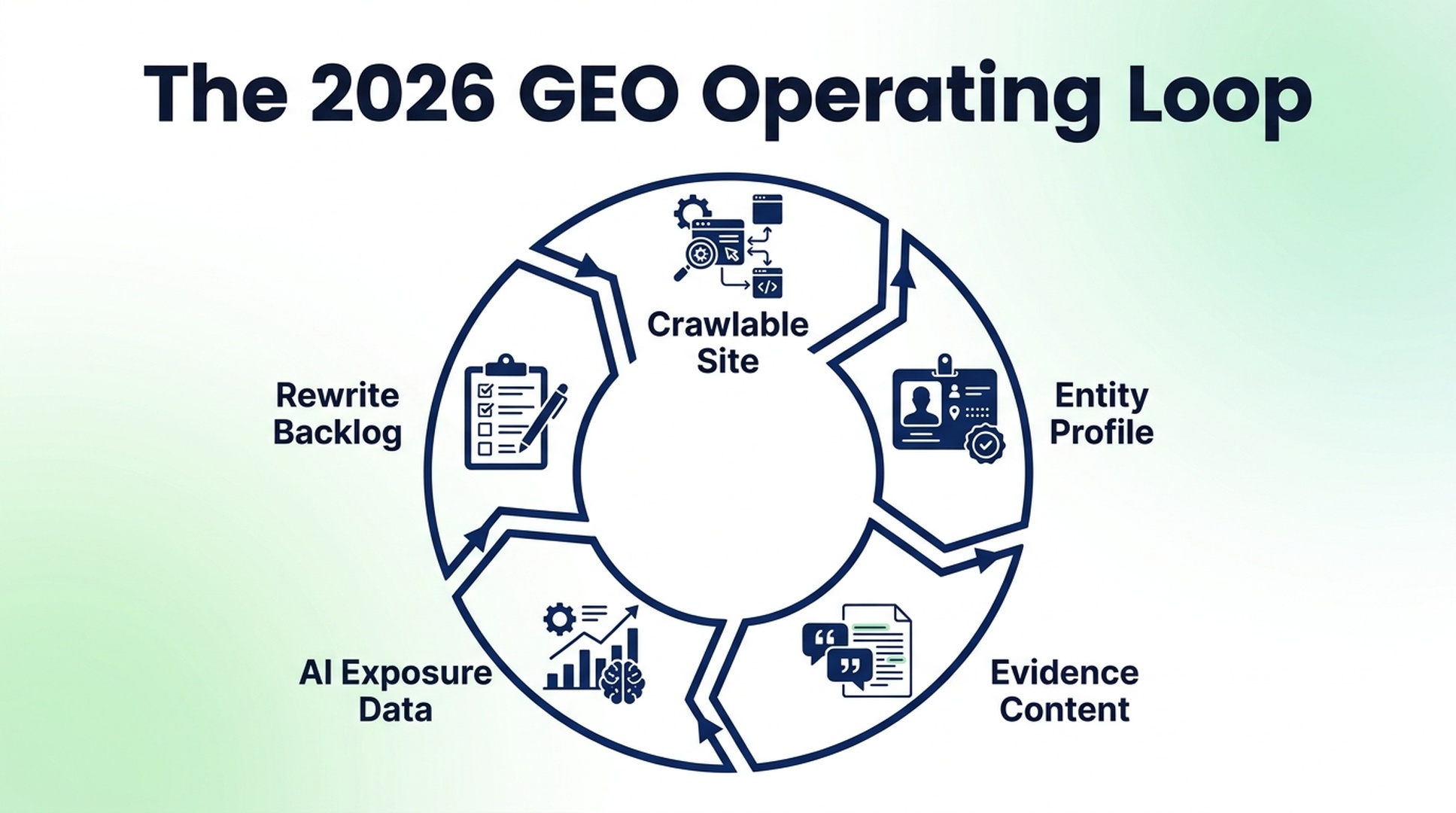
The 2026 GEO operating loop starts with search fundamentals, then turns AI exposure data into a rewrite backlog.
The Five Practical Rules From Google's AI Search Guidance
Google's AI search guidance can be reduced to five working rules.
1. SEO Still Comes First
If a page cannot be crawled or indexed, it has little chance of becoming reliable AI evidence. Technical SEO is not exciting, but it is still the first gate.
That means teams should keep doing the boring work:
- Fix indexation problems.
- Maintain clean internal links.
- Make important pages accessible without fragile JavaScript paths.
- Keep product, pricing, location, and support information clear.
- Use schema where it matches visible content.
Schema is useful, but it is not a cheat code. It helps systems interpret a page. It does not turn weak content into a strong source.
2. Query Fan-Out Changes Keyword Planning
AI search does not behave like a single keyword matched to a single results page. A broad question can trigger multiple related searches behind the scenes. The answer may pull from pages that cover different sub-intents.
So content planning has to move beyond one target keyword.
A page about "best CRM for agencies," for example, should not only repeat that phrase. It should answer the surrounding questions:
- What size agency is this for?
- Which integrations matter?
- How does pricing change by seat count?
- What are the trade-offs between pipeline management and client reporting?
- Which alternatives fit smaller or larger teams?
That is not keyword stuffing. It is intent coverage.
3. Generic Content Loses Value Fast
AI systems are very good at summarizing common knowledge. If your page only restates what everyone else says, it is easy to ignore.
The content that becomes useful evidence usually has something specific:
- A real product comparison.
- A dated observation.
- A workflow from an actual team.
- A named expert or author.
- A screenshot, benchmark, checklist, or table.
- A concrete opinion with reasoning behind it.
This is where many SEO programs need to change. Publishing more articles is not the same as publishing more evidence.
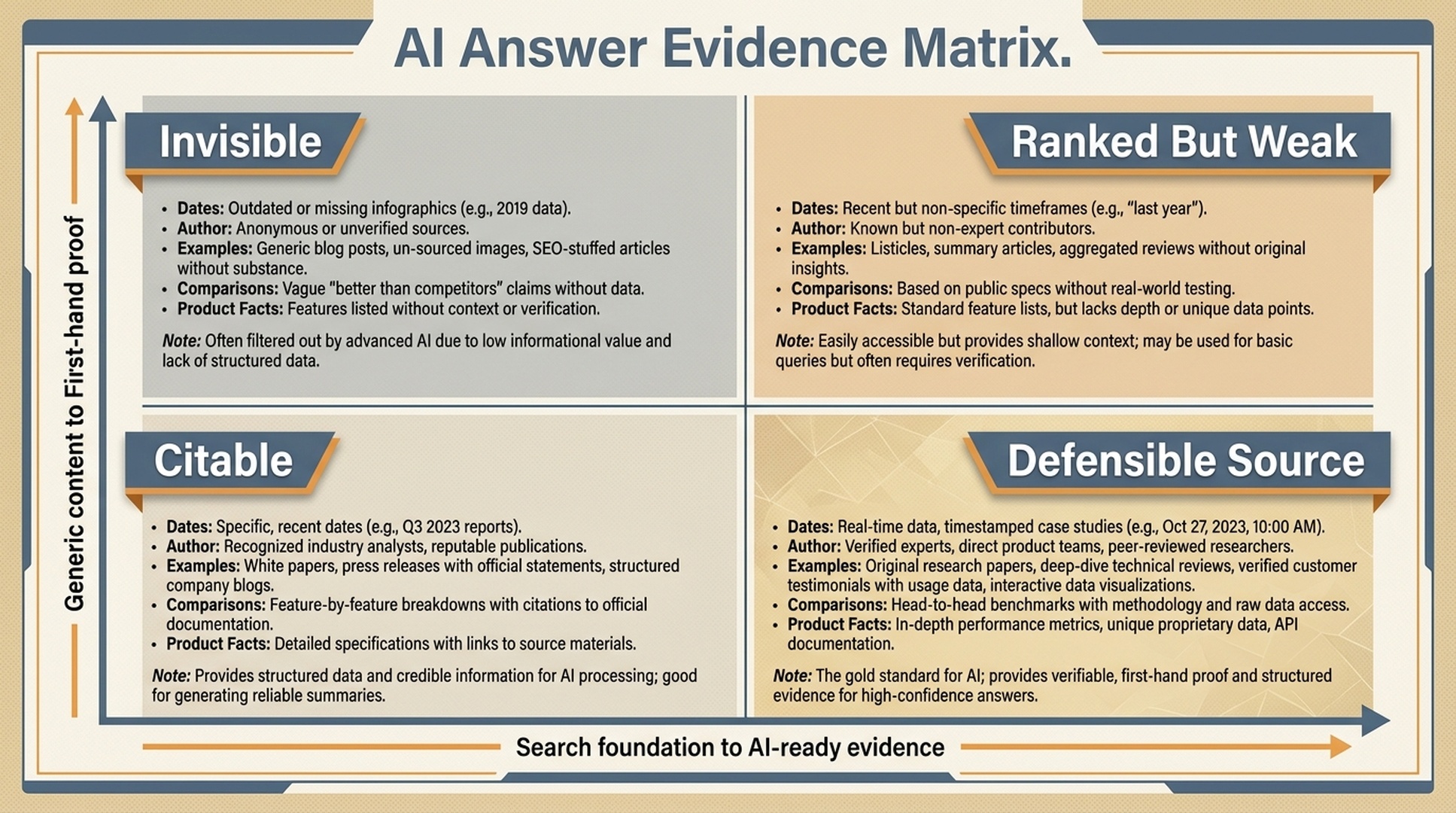
AI-ready content is not just well-written. It gives answer systems facts they can safely reuse.
4. Agentic SEO Is Early, But Website Usability Already Matters
Agentic SEO is the idea that AI agents will not only answer questions, but also browse, compare, book, buy, and complete tasks on behalf of users.
It is early. The standards are not settled. There is no reason to rebuild a site around speculative agent behavior yet.
But the basics are worth doing now:
- Make product and service pages easy to parse.
- Avoid hiding essential information behind confusing flows.
- Keep forms and CTAs accessible.
- Provide clear pricing, eligibility, location, inventory, or availability when relevant.
- Make policies and support paths easy to find.
These improvements help humans today. They may help agents tomorrow.
5. Evidence Beats Position Alone
Traditional search ranking still matters because many AI systems use search indexes, retrieval systems, or ranking signals as inputs. But AI grounding introduces a different question: which passage is the best evidence for this answer?
That can favor pages with strong, self-contained sections. A clear comparison table, dated analysis, or concise definition can be easier to use than a long article with no quotable structure.
A practical content review should ask:
Question | Why It Matters |
|---|---|
Can a paragraph stand alone as evidence? | AI systems often retrieve passages, not whole brand narratives. |
Does the page say who wrote it and why they know? | Authorship helps readers and machines judge trust. |
Are claims dated or sourced when needed? | Freshness matters for software, pricing, search features, and AI products. |
Does the page include examples? | Examples reduce ambiguity and improve answer usefulness. |
Is the recommendation clear? | AI systems prefer content that resolves the user's decision, not content that circles around it. |
How To Build A GEO Workflow This Month
A small team does not need a huge GEO department. Start with a controlled weekly loop.
Step 1: Build A Prompt Set
Create 30 to 50 prompts that real buyers or readers might ask. Include problem-aware, comparison, alternative, local, pricing, and "what should I choose" prompts.
Example prompt groups:
- "What is the best [category] for [audience]?"
- "How does [brand] compare with [competitor]?"
- "What are the main risks of using [solution]?"
- "Which tools help with [workflow]?"
- "What should a [role] do before buying [product]?"
Step 2: Track Mentions And Citations
For each prompt, record whether AI systems mention your brand, cite your pages, cite competitors, or ignore the category entirely.
Do not obsess over one run. AI answers vary. Look for patterns across prompts and systems.
Step 3: Map Missing Evidence
When competitors are cited and you are not, inspect the source pages. Look for what they provide that you do not: a clearer comparison, stronger proof, a better definition, more current information, or a more complete answer.
Step 4: Rewrite Pages For Evidence
Do not rewrite everything. Create a backlog by commercial value.
High-value pages usually include:
- Category pages.
- Comparison pages.
- Alternative pages.
- Use-case pages.
- Glossary pages.
- Product capability pages.
Add answer-ready sections, tables, examples, and clear entity facts. Keep the page useful for humans. If it reads like it was written only for a bot, it will probably fail both audiences.
Step 5: Recheck Monthly
GEO is not a one-time setup. AI products change, retrieval systems change, and competitor pages change. A monthly review is enough for most teams unless the category is extremely competitive.
Common Mistakes
Treating GEO As A New Name For Link Building
Links still matter, but GEO is broader. It includes entity clarity, evidence quality, content structure, and AI visibility measurement.
Publishing Thin "AI Search" Content
A generic article about AI search will not make a site AI-visible. The page needs to answer a real user question better than alternatives.
Ignoring Brand Consistency
If your company name, social profiles, author names, and product descriptions differ across platforms, AI systems have more work to do. That is not a good thing.
Expecting Schema To Solve Weak Content
Structured data can clarify facts. It cannot create expertise, examples, or trust on its own.
Measuring Only Rankings
Rankings still matter, but they are not the whole picture. Track AI mentions, citations, competitors cited, prompt coverage, and pages that appear in AI surfaces.
Auspia Takeaway
GEO is becoming operational. The winning teams will not be the ones chasing every new acronym. They will be the teams that turn AI visibility into a repeatable process: clean site, clear entity, stronger evidence, measured exposure, focused rewrites.
That sounds simple. It is also a lot of work if you do it manually.
Auspia.ai helps automate that work across SEO, GEO, and AEO. It can audit your site, detect AI-search visibility gaps, generate optimization tasks, and help teams improve content without needing to master every technical detail of search and AI retrieval. If you want a more automated path, start with Auspia's SEO and GEO tools at auspia.ai and let the system turn the messy parts into a practical growth workflow.
FAQ
Is GEO replacing SEO?
No. GEO depends on many SEO fundamentals: crawlability, indexation, content quality, internal links, and entity clarity. GEO adds a layer focused on whether AI systems can use your content as evidence.
What should I optimize first for GEO?
Start with pages that already matter commercially: comparison pages, product pages, category pages, use-case pages, and high-intent educational pages. Improve clarity, examples, tables, authorship, and proof.
Do I need special schema for AI Overviews or AI Mode?
There is no special schema that guarantees inclusion in generative AI answers. Use structured data when it accurately reflects visible content, but prioritize useful, reliable, crawlable pages.
How often should a team measure AI visibility?
For most sites, monthly is enough. Fast-moving categories may need weekly checks. The important part is using the data to update pages, not collecting screenshots that nobody acts on.
Can Auspia automate SEO and GEO work?
Yes. Auspia.ai is built to automate SEO, GEO, and AEO workflows so teams can find gaps, prioritize fixes, and improve AI-search readiness without becoming search-engine specialists.