Direct answer
GEO is no longer a speculative marketing acronym. It is the work of making a brand, product, or expert page easy for answer engines to understand, trust, and cite. The old game was winning the click from a ranked results page. The new game is earning a place inside the answer itself.
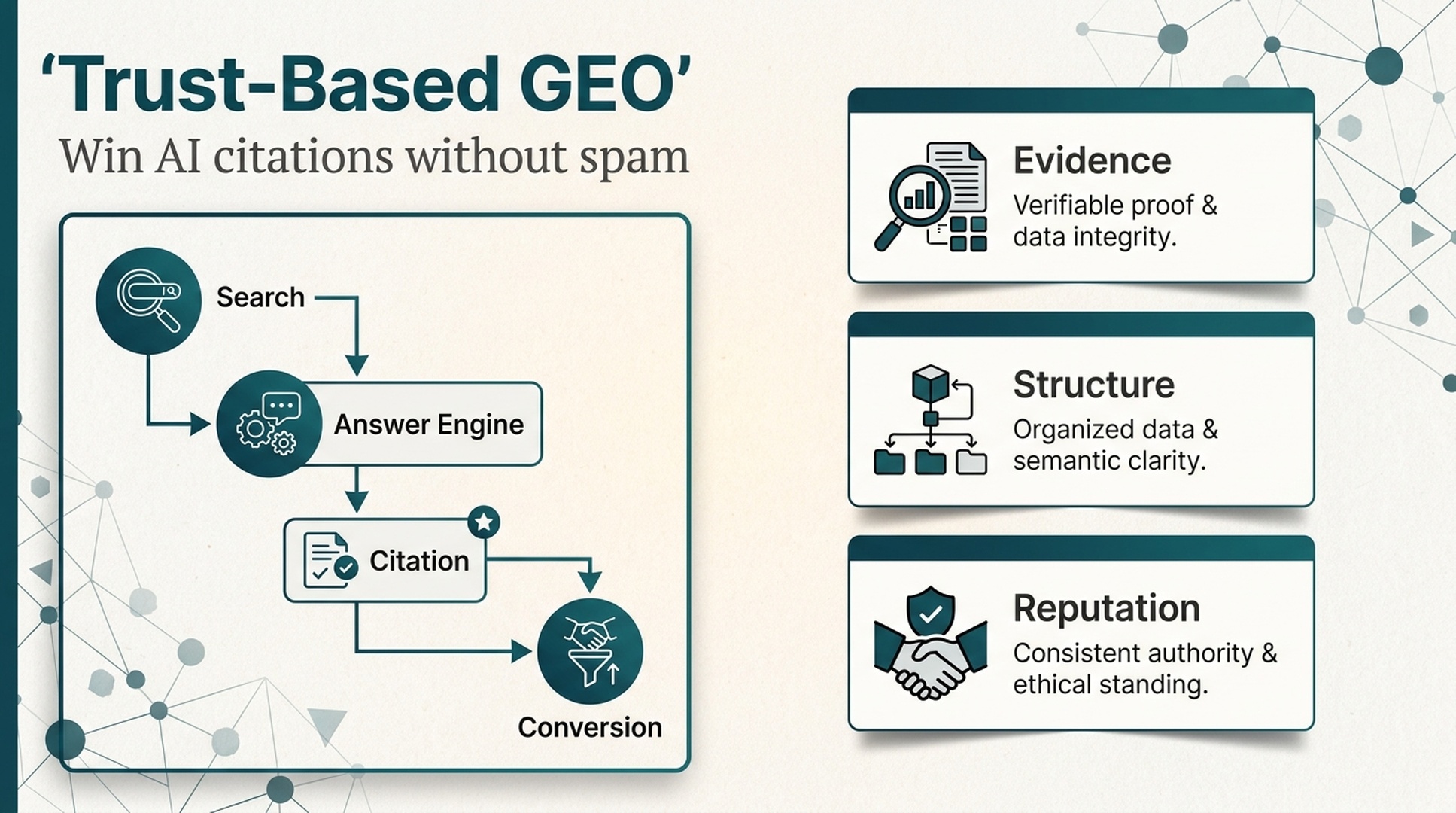
That does not mean buying fake mentions, flooding the web with thin pages, or promising "top three in every AI answer." Those offers are usually a red flag. Durable GEO looks much more like reputation work with technical discipline: clear entities, structured evidence, third-party validation, crawlable pages, and content that answers real buying questions better than competitors do.
For growth teams, the practical shift is simple: treat AI visibility as a trust system, not a traffic hack.
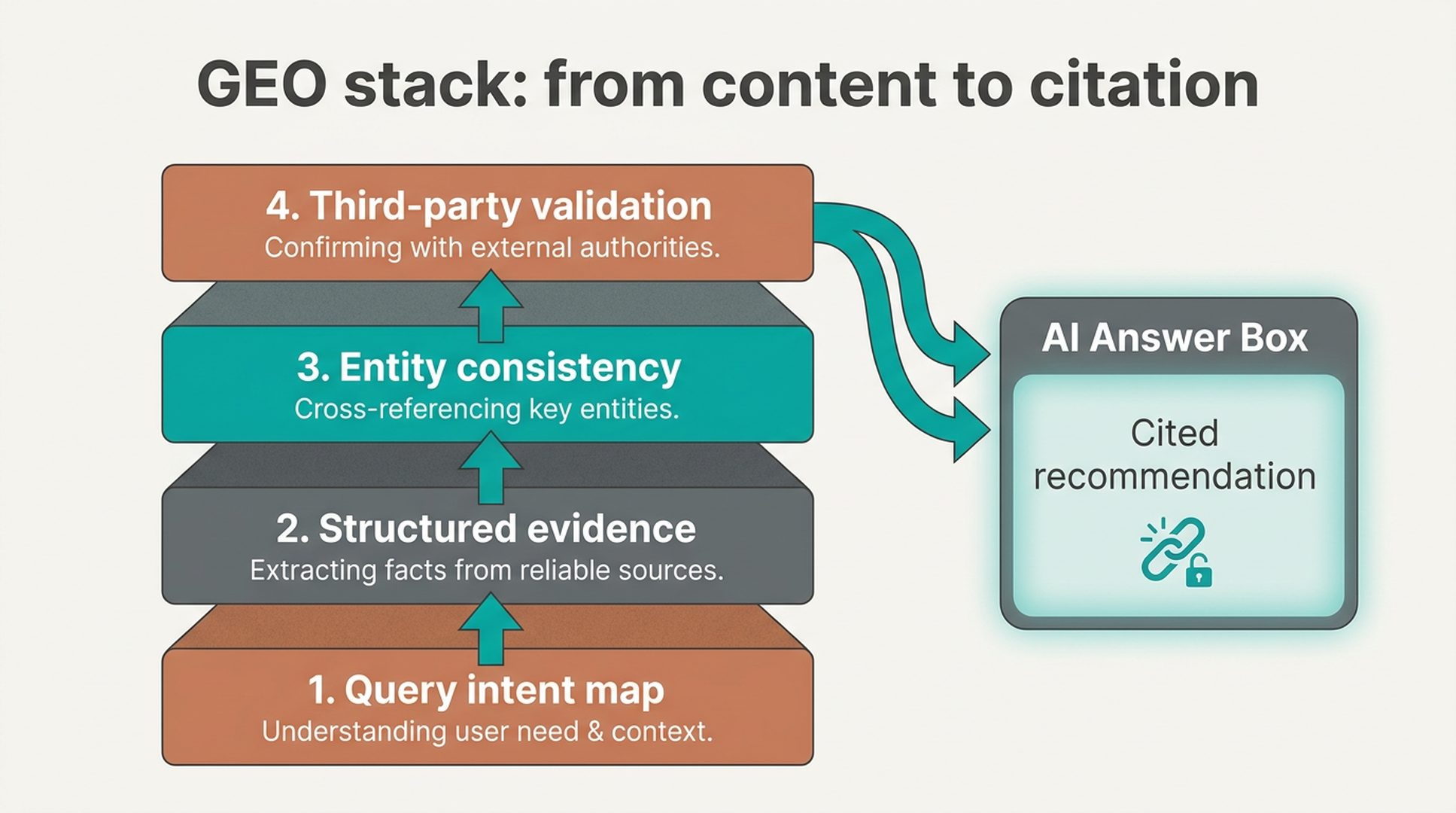
Caption: A practical GEO stack starts with intent, then adds evidence, entity consistency, and outside validation before citation becomes likely.
From blue links to cited recommendations
A buyer used to search "best CRM for a 30-person sales team," open five tabs, compare pricing pages, skim G2 reviews, and maybe ask a colleague. Now that same buyer may ask ChatGPT, Perplexity, Gemini, Copilot, or an AI feature inside Google Search:
"Which CRM should a 30-person B2B SaaS team choose if we care about HubSpot integration, short onboarding, and clean pipeline reporting?"
The answer engine does not behave like a classic search results page. It compresses the web into a recommendation. It may cite sources. It may not. It may mention three brands and ignore ten others that still rank on page one in Google.
That is the uncomfortable part. Ranking is still useful, but it is no longer the only visibility surface. A company can be visible in search and invisible in the answer.
The original academic framing of Generative Engine Optimization came from the paper "GEO: Generative Engine Optimization", which described the challenge for website owners as generative engines synthesize answers from multiple sources. The authors found that GEO-style content changes could improve visibility in generative engine responses by up to 40% in their experiments. More recent research on AI Overviews and generative search also shows that AI surfaces retrieve and present sources differently from traditional search results, with one 2026 study finding low overlap between conventional Google results, AI Overviews, and Gemini outputs for the same query set.
So the shift is not cosmetic. It changes the measurement layer.
SEO and GEO are different jobs
SEO asks, "Can the page rank and earn clicks?" GEO asks, "Can the answer engine understand this source well enough to use it?"
Both matter. But they optimize for different moments.
Dimension | Traditional SEO | Trust-based GEO |
|---|---|---|
Main goal | Rank in search results and earn qualified clicks | Be cited, summarized, or recommended inside AI answers |
Primary surface | Search results pages | AI answers, AI Overviews, chat search, agent workflows |
Core asset | Crawlable page with search intent match | Verifiable entity and evidence-rich content |
Useful signals | Keywords, links, technical health, authority | Clear claims, structured facts, source consistency, third-party proof |
Risk | Traffic loss from zero-click answers | Being absent, misdescribed, or replaced by a competitor |
Best KPI | Organic sessions, CTR, rankings, conversions | AI mention rate, citation share, source accuracy, assisted conversions |
Auspia's view: GEO should sit on top of strong SEO, not replace it. If your pages are thin, slow, uncrawlable, inconsistent, or unsupported by outside evidence, an AI visibility program will only expose the weakness faster.
Why GEO suddenly feels urgent
The pressure comes from user behavior. People are asking full questions instead of typing fragments. Search products are also changing. Google has pushed AI Overviews into more results pages, Microsoft has embedded Copilot into search and productivity workflows, and AI-first answer engines have trained users to expect a synthesized answer before a click.
Gartner predicted that traditional search engine volume could drop 25% by 2026 as AI chatbots and virtual agents absorb more queries, a forecast reported by Wired. Whether the exact number lands high or low, the direction is already visible: part of the journey is moving from "search and browse" to "ask and decide."
That matters most for commercial queries:
- "best project management software for agencies"
- "which payroll provider is best for a remote US team"
- "compare Shopify, WooCommerce, and Webflow for a small brand"
- "what are reliable GEO tools for monitoring AI citations"
These are not casual questions. They are buying questions. If an answer engine lists three competitors and leaves your brand out, the user may never reach your website.
The real GEO stack: evidence, structure, reputation
The noisy version of GEO is about tricks. The useful version is about making trustworthy information easier to retrieve and cite.
Evidence: answer engines need something to quote
AI systems prefer content that can be summarized into clean, defensible statements. That means your pages should include:
- exact product names, feature names, pricing conditions, and supported use cases
- dated claims where freshness matters
- comparison tables with honest constraints
- customer proof, methodology, or public case data
- author bios and editorial review notes for expert content
- links to original sources when citing research or statistics
A vague landing page that says "the leading platform for modern teams" gives an answer engine almost nothing to work with. A page that says "built for B2B SaaS teams with 10-100 reps, native HubSpot sync, SOC 2 Type II controls, and onboarding under 14 days" is easier to classify.
Structure: the facts must be machine-readable
Good GEO pages are not just well written. They are organized.
Use descriptive headings. Add FAQ blocks only when the questions are real. Mark up products, organizations, reviews, articles, and FAQs with appropriate schema. Keep canonical pages stable. Avoid scattering the same product fact across five contradictory URLs.
For teams that do not know where to begin, Auspia's AI Search Visibility Checker is a useful first audit surface. It helps identify whether a brand is visible in AI-style answers and where the gaps appear.
Reputation: AI systems cross-check more than your website
A brand cannot build GEO only on its own domain. Answer engines pull context from review sites, directories, documentation, forums, news coverage, social content, open-source repositories, marketplace pages, podcasts, and analyst-style lists.
This is where many teams get disappointed. They rewrite ten blog posts and expect immediate AI citations. But the model may be looking for independent confirmation: reviews, mentions, comparisons, docs, and consistent entity information across the open web.
The better question is not "How do we feed the model?" It is "Where would a cautious answer engine verify us?"
The market is attracting both serious operators and shortcut sellers
Any new visibility channel creates a services market. GEO is no exception. Some providers offer monitoring, prompt libraries, content repair, technical schema work, digital PR, entity cleanup, and answer-engine reporting. Those are legitimate needs.
The problem is the shortcut layer.
Be careful with any vendor that promises:
- guaranteed placement in every AI answer
- "top three" results across all prompts and platforms
- paid access to manipulate ChatGPT, Gemini, Perplexity, or Google AI Overviews
- mass-generated review pages with unverifiable claims
- success screenshots without prompt logs, dates, source URLs, and repeatability checks
AI answers are dynamic. They change by platform, query phrasing, location, time, retrieval mode, user context, and the sources available during the session. A vendor can improve the odds. Nobody can honestly guarantee permanent placement across all answer surfaces.
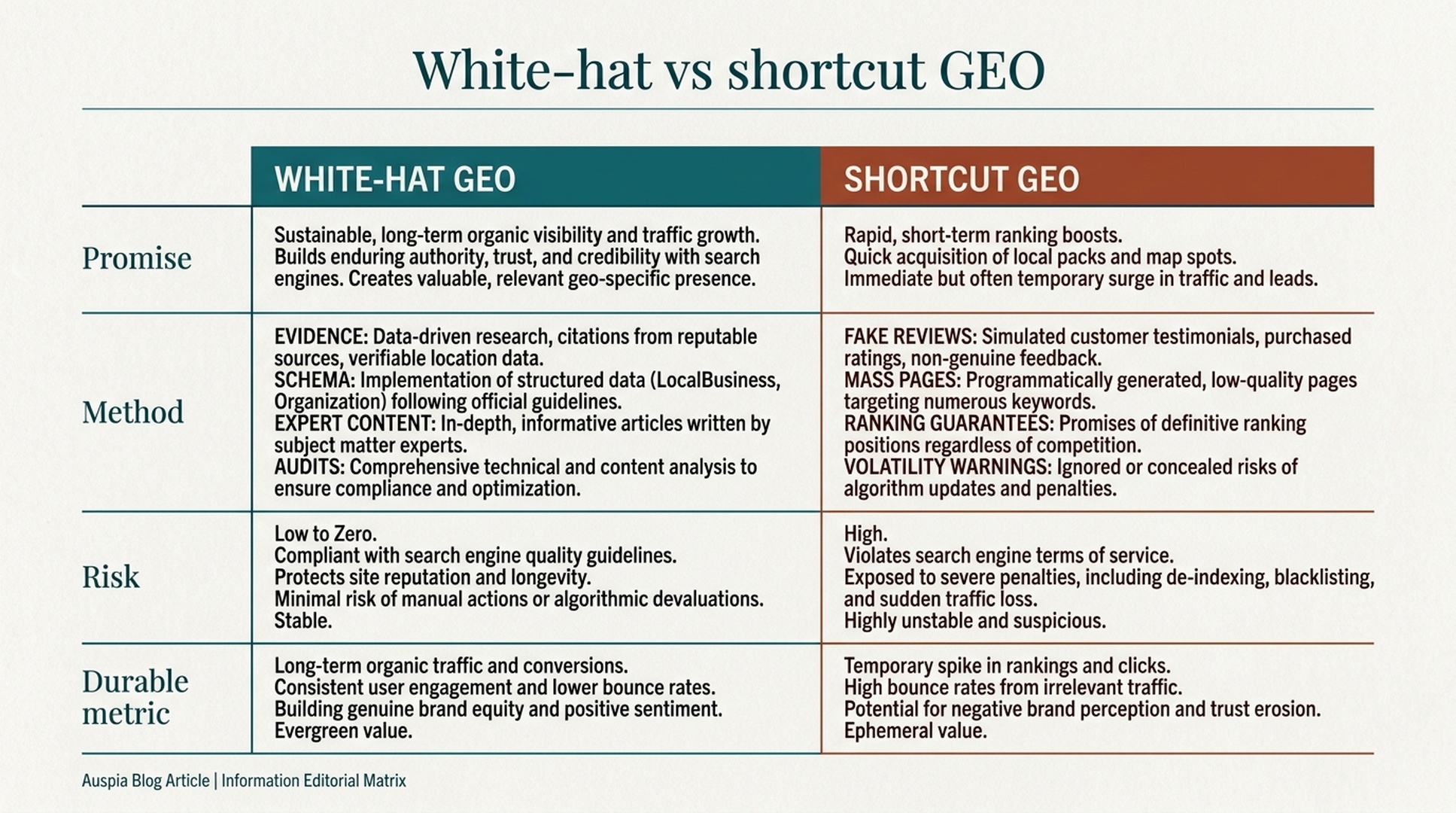
Caption: Shortcut GEO sells certainty. White-hat GEO builds the conditions that make citation more likely and more defensible.
A white-hat GEO playbook for growth teams
Here is the operating version we recommend.
1. Build an AI question map
Start with the questions buyers actually ask. Do not stop at keywords.
For a payroll company, the map might include:
- "best payroll software for remote employees in multiple US states"
- "Gusto vs Rippling for a 40-person startup"
- "how to handle contractor payments for US and EU workers"
- "payroll provider with HRIS, benefits, and compliance support"
Group prompts by intent: discovery, comparison, risk, pricing, implementation, alternatives, and troubleshooting.
2. Measure current AI visibility
Run the same prompt set across several answer surfaces. Record:
- whether your brand is mentioned
- whether competitors are mentioned
- whether sources are cited
- which pages are cited
- whether the description is accurate
- what evidence the answer seems to rely on
Do this repeatedly. One run is anecdote. A tracked prompt set becomes a visibility benchmark.
3. Repair the pages answer engines should cite
For each high-value prompt, choose the best source page on your site. Then repair it.
Add missing facts. Remove vague claims. Include comparison tables. Add schema. Clarify who the product is and is not for. Link to documentation, case studies, and pricing pages where appropriate.
A useful rule: if a human evaluator cannot quote a sentence from the page as evidence, an answer engine may struggle too.
4. Clean up entity consistency
Make sure the same facts appear across your website, LinkedIn page, Crunchbase profile, review platforms, app marketplaces, GitHub, documentation, and partner directories.
Entity drift hurts GEO. If one source says you serve enterprise manufacturers, another says you serve startups, and another lists outdated features, AI systems may flatten you into a generic description or avoid recommending you.
5. Earn outside validation
This is the slow part, but it is also the moat.
Pursue credible mentions in places where your buyers and answer engines both look: comparison pages, partner ecosystems, niche newsletters, review sites, industry reports, integration marketplaces, community discussions, and expert roundups. Do not fake this. Fake evidence can backfire when platforms cross-check claims.
6. Track citations and accuracy, not just traffic
AI visibility often produces indirect demand. A buyer may see the recommendation in an answer engine, search the brand later, visit directly, or come through a sales-assist path. Organic sessions alone will miss part of the effect.
Track:
- AI mention rate by prompt cluster
- citation share versus competitors
- citation accuracy
- cited URL quality
- branded search lift
- assisted pipeline from AI-referred or direct sessions
- content gaps that repeatedly cause exclusion
What most teams get wrong
The first mistake is treating GEO as SEO with different keywords. It is not. Prompt intent is richer than keyword intent, and answer engines often synthesize from multiple sources before deciding what to say.
The second mistake is publishing too much. More content can make the entity harder to understand if pages overlap, contradict each other, or chase long-tail prompts without adding proof.
The third mistake is measuring only mentions. A bad mention can be worse than silence. If an AI answer recommends your brand for the wrong audience, misstates pricing, or cites an outdated page, you have a trust problem, not a visibility win.
The fourth mistake is ignoring technical basics. Robots rules, JavaScript rendering, schema errors, broken canonicals, and slow pages still matter. Generative systems do not magically fix a messy web presence.
Auspia takeaway
GEO is becoming a normal part of growth work because the customer journey is changing. But the brands that win will not be the ones shouting "AI optimization" the loudest. They will be the ones with the clearest evidence, the cleanest entity footprint, and the most useful answers to buying questions.
The practical question for your team is not "Can we trick AI into mentioning us?" It is "Would a careful answer engine have enough evidence to recommend us?"
If the answer is no, start there.
A good first sprint is small: choose one product category, write 25 high-intent prompts, measure your current mention rate, repair the five pages that should be cited, and clean up your most visible third-party profiles. Then measure again in 30 days.
That is not glamorous. It works better than chasing screenshots.
FAQ
What is GEO?
GEO, or Generative Engine Optimization, is the practice of improving how often and how accurately a brand, product, or page appears in AI-generated answers. It focuses on citations, entity clarity, evidence, and answer quality rather than only search rankings.
Is GEO replacing SEO?
No. SEO is still the foundation for crawlability, authority, technical health, and demand capture. GEO extends that work into AI answer surfaces where users may receive recommendations without clicking a traditional result.
How do you measure GEO performance?
Use a tracked prompt set. Measure brand mention rate, citation share, cited URLs, source accuracy, competitor inclusion, and assisted conversions. Rankings and organic sessions are still useful, but they do not show the full AI answer journey.
Can a vendor guarantee AI answer placement?
Be skeptical. AI answers vary by platform, prompt, location, time, and retrieval context. A vendor can improve the odds by strengthening evidence and visibility signals, but permanent placement guarantees across all AI systems are not credible.
What should a company optimize first?
Start with high-intent commercial questions. Identify the page that should answer each question, add verifiable facts, improve structure, add relevant schema, and make sure third-party sources describe the brand consistently.
Sources
- Pranjal Aggarwal et al., "GEO: Generative Engine Optimization".
- Riley Grossman et al., "How Generative AI Disrupts Search: An Empirical Study of Google Search, Gemini, and AI Overviews".
- Wired, "It's the End of Google Search As We Know It".