Many companies start SEO with a reasonable but incomplete plan: publish more articles, wait a few months, and hope qualified leads begin to arrive.
The plan feels productive. A team can assign writers, set a weekly publishing target, and point to a growing blog archive. Then six months pass. Organic traffic barely moves. Leads are thin. Someone in the room says the quiet part out loud: maybe SEO does not work for us.
That is usually the wrong lesson.
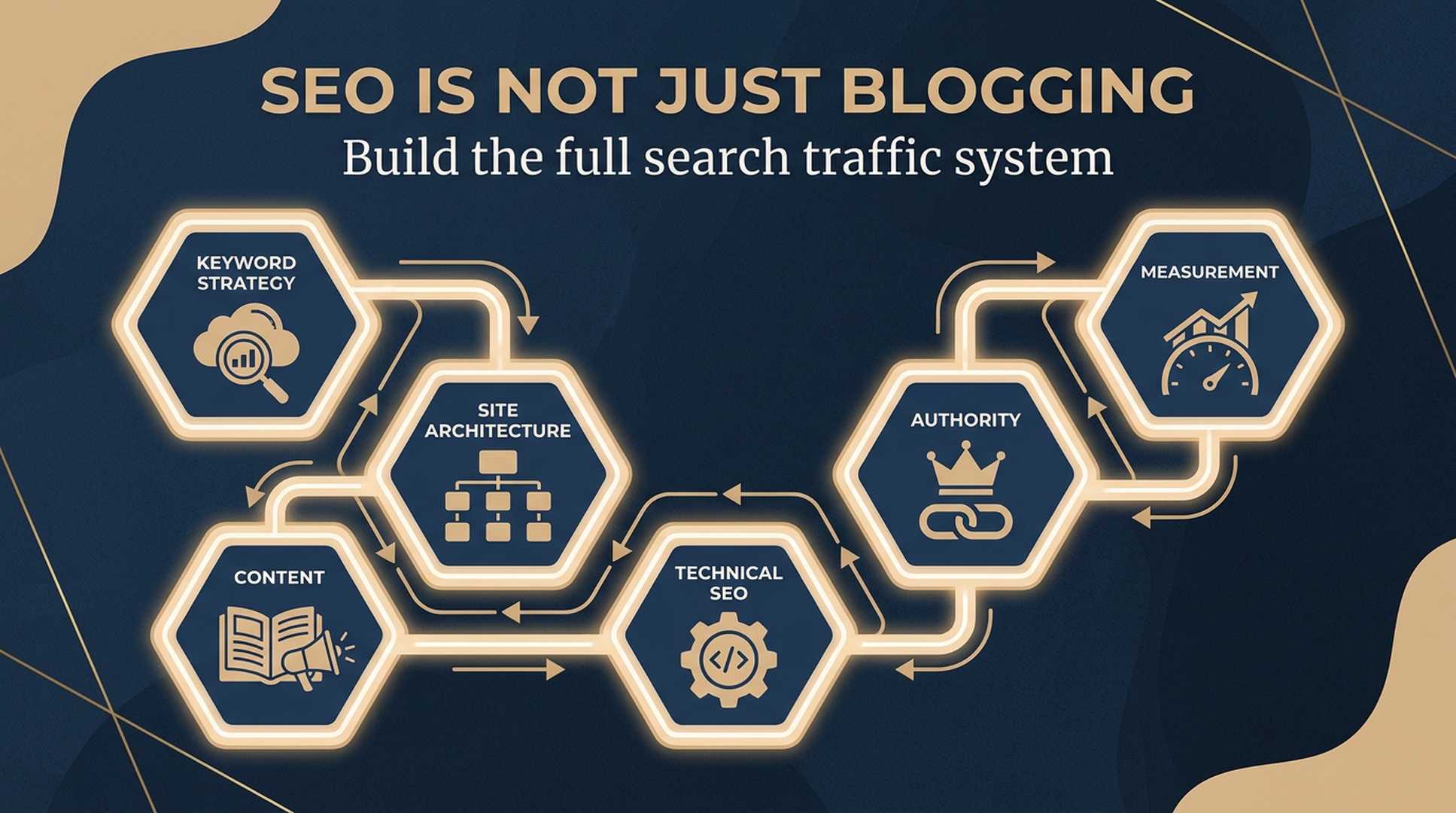
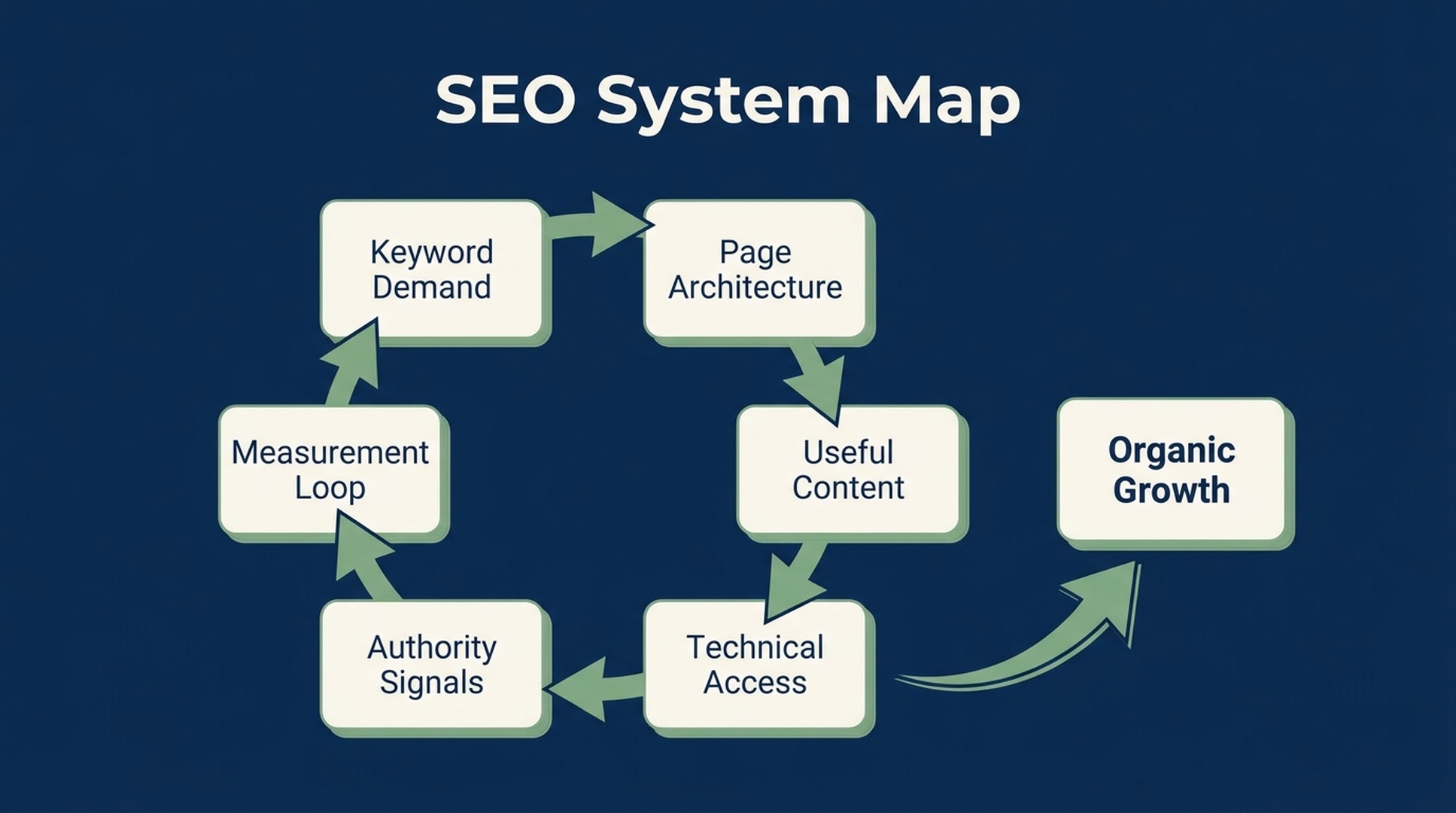
SEO often fails because the team treated writing as the whole job. Articles matter, but they are only one part of the system. Real SEO connects search demand, site structure, technical access, authority, and measurement into a repeatable traffic engine.
If your current plan is "publish two posts a week," you may not have an SEO strategy yet. You have a content calendar.
The short answer
SEO is not the act of writing blog posts. SEO is the work of helping search engines and users understand which problems your business solves, which pages answer those problems, and why your site deserves to rank.
A working SEO program usually includes six parts:
SEO layer | What it does | Common failure when missing |
|---|---|---|
Keyword strategy | Finds real search demand and intent | Teams write what they want to say, not what buyers search |
Site architecture | Gives each keyword group a page to land on | All traffic is forced into blog posts |
Content system | Answers search intent with useful pages | Posts are generic, thin, or disconnected |
Technical SEO | Lets crawlers access, render, and index pages | Good pages stay invisible or underperform |
Authority building | Gives Google reasons to trust the domain | Competitors outrank similar content |
Measurement loop | Shows what to improve next | Teams publish blindly and never compound gains |
The blog is one room in the house. It is not the foundation.
Why teams confuse SEO with content
Content is the most visible part of SEO. A new post has a title, a URL, a publish date, and a person responsible for it. That makes it easy to manage.
The less visible work is harder to explain in a weekly meeting. Keyword mapping, crawl diagnostics, internal links, template improvements, canonical rules, schema, and backlink quality do not look as obvious as a finished article. But they often decide whether the article has any chance.
This is where many B2B and SaaS teams get stuck. They build a blog that keeps growing while the rest of the site stays flat:
- Product pages target broad branded language instead of search terms.
- Comparison and alternative pages are missing.
- Use-case pages are too thin to rank.
- Blog posts answer informational queries but do not route readers to conversion pages.
- Technical issues slow crawling or split ranking signals across duplicate URLs.
The result is not "SEO failed." The result is "publishing happened without a search system around it."
Keyword research is the starting point, not a final step
Many teams decide on topics internally:
"What should we write this month?"
SEO starts with a different question:
"What are buyers, evaluators, and users already searching for?"
Those searches do not all deserve the same page type. A person searching "best CRM for agencies" is in a different state of mind from someone searching "what is customer lifecycle marketing." A person searching "Shopify SEO audit tool" needs something different from someone searching "how to write product descriptions for SEO."
A simple keyword map should separate at least four kinds of demand:
Intent type | Example query | Better page type |
|---|---|---|
Product or solution | "AI search visibility checker" | Tool page or solution page |
Comparison | "Semrush alternative for small teams" | Comparison page |
Problem and how-to | "how to improve AI search visibility" | Playbook or guide |
Definition | "what is GEO optimization" | Glossary or explainer |
This matters because the wrong page type can waste a good keyword. A blog post may rank for a definition query, but it is rarely the best landing page for a high-intent tool query. A product page can convert bottom-funnel demand, but it may be too sales-heavy for an early-stage educational query.
At Auspia, we usually look at keyword research as page design input, not just topic selection. The keyword tells you the format, the search intent, the internal links, the proof needed, and the next action the reader should take.
Site architecture decides where rankings can grow
A good-looking website can still have weak SEO architecture.
This is common. The homepage is polished. The navigation is clean. The brand language sounds strong. But when you inspect the site through a search lens, the structure is too shallow.
Typical problems include:
- Every non-homepage keyword is pushed into the blog.
- Product categories have no crawlable landing pages.
- Use-case pages exist but all use nearly identical copy.
- Important pages sit four or five clicks away from the homepage.
- URLs change without redirects.
- Internal links do not connect related pages.
A stronger structure gives each major demand cluster a natural home:
Homepage
├── Product or service pages
│   ├── Core solution
│   ├── Feature pages
│   └── Integrations or industries
├── Use-case pages
│   ├── By audience
│   ├── By workflow
│   └── By problem
├── Tools or calculators
│   ├── Audit tools
│   ├── Checkers
│   └── Generators
└── Learning center
    ├── Definitions
    ├── Playbooks
    ├── Comparisons
    └── Case studies
The principle is simple: each important keyword group needs a page that matches its intent.
If all of your organic traffic depends on articles, the site is fragile. If the architecture supports product, comparison, use-case, tool, and education pages, SEO has more places to compound.
For teams building AI search and organic visibility together, this structure also helps answer engines. Clear page types, clean internal links, and explicit entities make it easier for AI systems to understand what your company does and when to mention it. You can test this with an AI search visibility checker once the core pages are in place.
Technical SEO is boring until it blocks everything
Technical SEO rarely gets attention at the start. It should.
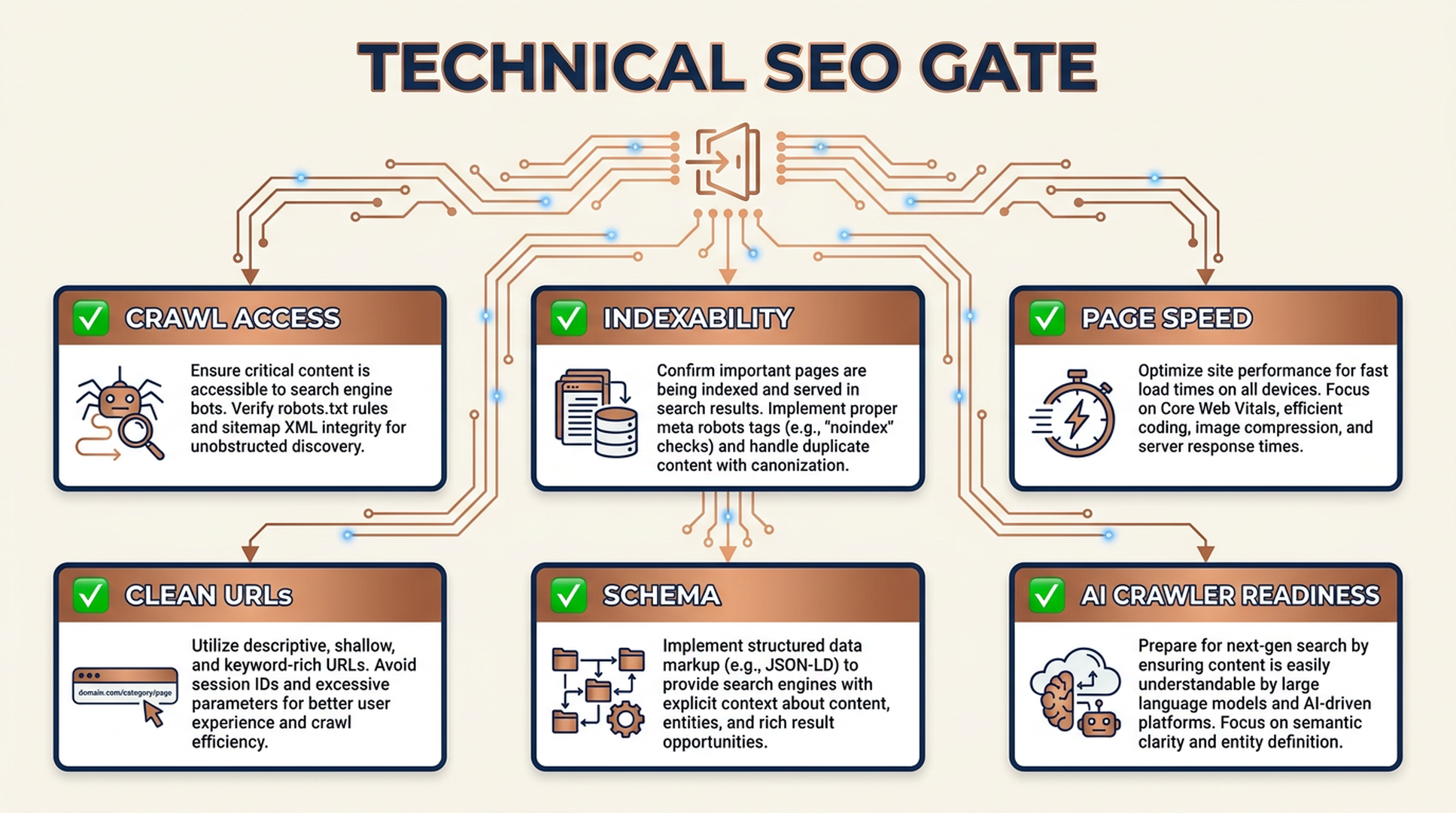
Search engines need to discover, crawl, render, index, and understand your pages before content quality can matter. If the technical layer is weak, publishing more content may only create more pages that underperform.
The basics are not glamorous, but they are non-negotiable:
- Fast pages on mobile and desktop.
- Clean, stable URLs.
- XML sitemap coverage for important pages.
- Robots.txt rules that do not block valuable sections.
- Canonical tags that point to the right version of each page.
- Structured data where it helps clarify products, articles, FAQs, tools, or organizations.
- Internal links that make important pages easy to find.
- No accidental noindex tags on pages meant to rank.
This is also where many AI-era SEO mistakes begin. Some teams want to be cited by AI answers but block useful crawlers, hide important content behind scripts, or publish pages with vague entity signals. Before chasing advanced GEO tactics, check whether search engines can access and interpret the basics. Auspia's SEO and GEO tools are useful for this kind of first-pass diagnosis.
Authority still matters
A technically healthy site with useful content can still lose to stronger competitors. Authority is one reason.
In practical terms, authority comes from the rest of the web showing that your site is worth trusting. That can include links and mentions from industry publications, partners, review sites, customer stories, data studies, open-source projects, podcasts, events, and useful tools that people reference naturally.
This does not mean buying random links. Low-quality link building can do more harm than good.
Better authority work is usually tied to real business assets:
Asset | Why it earns authority |
|---|---|
Original data report | Journalists, analysts, and bloggers can cite it |
Free tool | Users share it because it solves a narrow problem |
Partner integration page | Partners have a reason to link back |
Customer case study | Proof travels through both brands' audiences |
Technical guide | Practitioners reference it when solving a problem |
Authority is slow work, which is why many SEO programs need months rather than weeks. But without it, a site can keep publishing decent articles and still struggle to outrank domains that Google already trusts more.
Measurement turns SEO from output into a loop
A content calendar asks, "Did we publish?"
An SEO measurement loop asks better questions:
- Which pages are getting impressions but low click-through rates?
- Which pages rank on page two and need stronger internal links or better coverage?
- Which high-intent keywords still have no matching page?
- Which pages attract traffic but fail to move readers toward conversion?
- Which technical errors are affecting indexation?
- Which backlinks or mentions changed after a campaign?
This is where SEO becomes cumulative. You publish, measure, update, consolidate, add internal links, improve templates, and build authority around pages that are close to working.
A team that only publishes will keep starting from zero. A team that measures can turn near-misses into wins.
A practical SEO system for growth teams
If you are starting from a blog-only SEO plan, do not throw everything away. Rebuild the system around it.
Use this sequence:
- Audit existing pages and traffic. Identify pages with impressions, rankings, conversions, crawl issues, and duplicate intent.
- Build a keyword map. Group search demand by intent, funnel stage, difficulty, and page type.
- Fix the site structure. Create or improve landing pages for product, use-case, comparison, tool, and educational demand.
- Clean up technical blockers. Check indexability, speed, sitemap coverage, robots rules, schema, and internal links.
- Publish with purpose. Every new article should support a keyword cluster and link to the right business page.
- Build authority around assets, not just URLs. Prioritize data, tools, guides, partnerships, and case stories.
- Review monthly. Update pages based on rankings, clicks, conversions, and new search behavior.
This is less exciting than "publish 100 articles." It also works better.
Common mistakes
The most common SEO mistakes are not mysterious:
- Treating blog volume as the main KPI.
- Choosing topics because competitors wrote about them, without checking intent.
- Publishing articles that have no internal links to revenue pages.
- Ignoring product, use-case, and comparison pages.
- Building a site that looks good to humans but is hard for crawlers to understand.
- Expecting results in 30 days from a channel that often compounds over 6 to 12 months.
- Separating SEO, content, product marketing, and web development into silos.
If that list feels uncomfortably familiar, the fix is not simply "write better articles." The fix is to make SEO a cross-functional operating system.
Auspia takeaway
The truth about SEO is blunt: publishing is not strategy.
Articles can bring traffic, educate prospects, and support AI answer visibility. But they only do that well when they sit inside a larger system: researched keywords, mapped intent, strong landing pages, technical access, internal links, authority, and a measurement habit.
Before asking whether SEO works, ask whether your team has built the conditions for SEO to work.
If the answer is no, start smaller than a full content machine. Audit the site. Map the keywords. Fix the page types. Then publish with a clear job for every page.
That is how SEO stops being a pile of articles and becomes an acquisition channel.
FAQ
Is blogging still useful for SEO?
Yes, but blogging works best when each article supports a mapped keyword cluster, answers a real search intent, and links to relevant conversion pages. Random publishing rarely compounds.
How long does SEO take to show results?
For a new or weak domain, meaningful progress often takes 6 to 12 months. Existing sites with technical issues or under-optimized pages can sometimes see improvements faster after fixes, but competitive rankings still need time.
Should every keyword become a blog post?
No. Some keywords need product pages, comparison pages, tool pages, glossary pages, or use-case pages. The search intent should decide the page type.
What should a small team do first?
Start with an audit, then map keywords to existing and missing pages. Fix crawl/indexing problems and improve pages already getting impressions before launching a large publishing schedule.
How does this connect to AI search visibility?
AI answer systems rely on clear entities, accessible content, credible sources, and structured evidence. A strong SEO foundation makes it easier for both search engines and AI systems to understand and cite your site.