Short answer
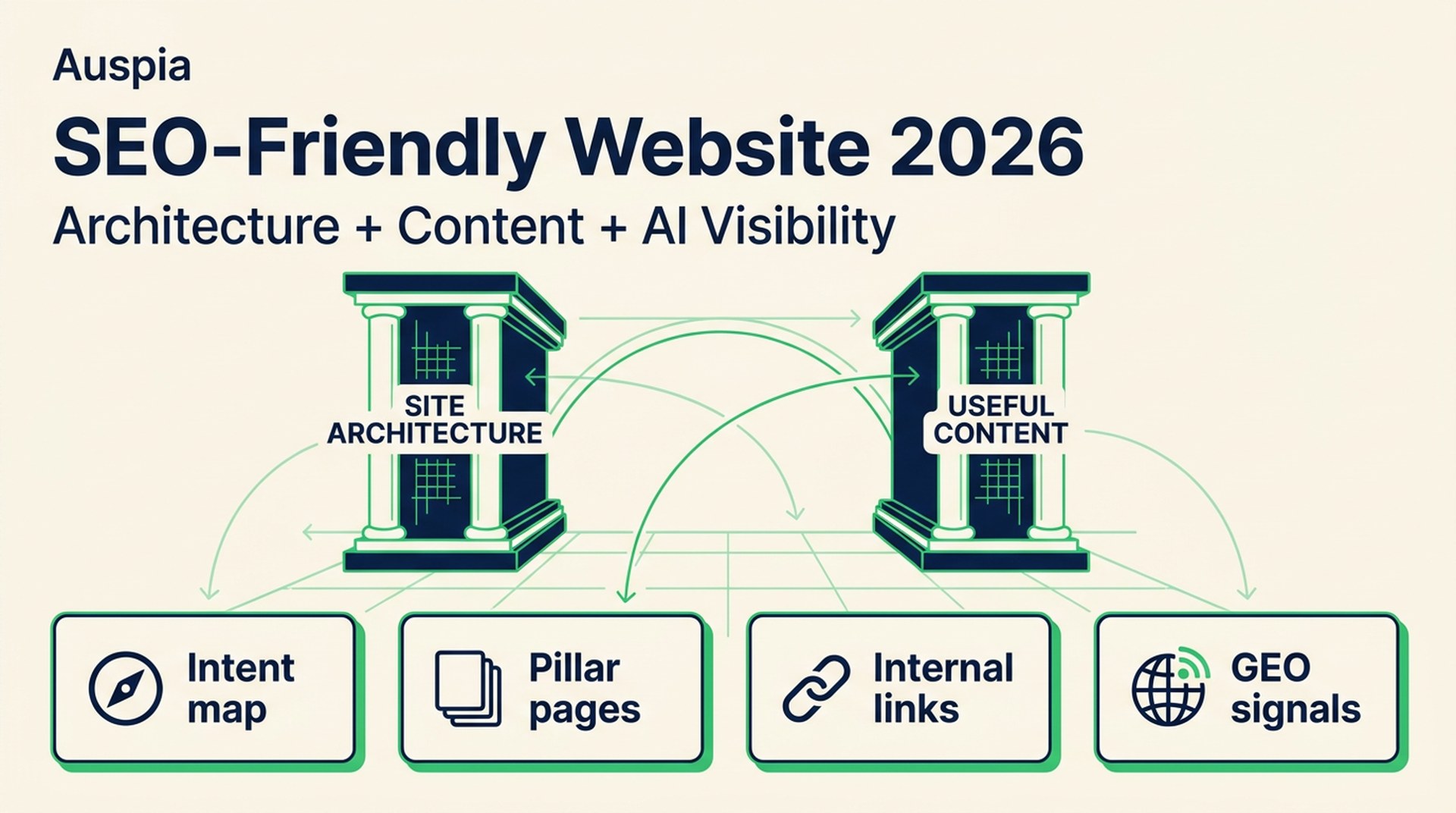
A website becomes SEO-friendly in 2026 when two things are designed before publishing: the architecture and the content system. Speed, backlinks, schema, plugins, and indexing tools all matter, but they work best when the site already has a clear structure and pages that satisfy search intent.
The newer layer is GEO. Search engines and AI answer systems both need to understand what your site is about, which pages carry authority, what each page answers, and why your claims can be trusted. A site that is easy for people to navigate is usually easier for Google and AI systems to interpret too.
If you are building a new independent site, do not start by creating random pages. Start with a map.
Why architecture comes before tactics
Many teams launch a website, publish a few pages, submit the sitemap, and wait for rankings. When nothing happens, they blame backlinks, hosting, or the SEO plugin.
Sometimes those are the problem. More often, the site has no real architecture.
Search engines need to understand which pages are important, how topics connect, and which page should rank for which intent. Users need the same thing. If a buyer lands on a page and cannot tell what you sell, who it is for, or where to go next, the crawler is not the only confused visitor.
In 2026, this matters even more because AI answer systems extract meaning from structure. They look for entity clarity, page purpose, supporting evidence, and consistent context across the site. A messy website makes that job harder.
The two ranking foundations: architecture and content
Technical SEO, page speed, schema, and links support rankings. They do not replace the two foundations.
Foundation | What it means | Why it matters |
|---|---|---|
Site architecture | The planned relationship between homepage, pillar pages, clusters, product pages, trust pages, and internal links | Helps search engines and users understand topical authority and page priority |
Content quality | Pages that answer a clear intent with useful detail, proof, examples, and readable structure | Gives Google and AI answer systems something worth ranking, quoting, or citing |
A weak site can get temporary visibility. New pages often appear, disappear, and move around as search systems test how users respond and how the page fits the index. That is normal. Stable rankings usually come when the site has enough structure, relevance, and trust to deserve a consistent position.
Build the site map before you build the site
An SEO-friendly site begins as a keyword and intent map, not a design mockup.
Plan these page types first:
- Homepage: the clearest statement of category, audience, offer, and trust.
- Pillar pages: broad topic pages that explain important themes and link to deeper pages.
- Cluster pages: focused pages for long-tail questions, use cases, comparisons, and problems.
- Product or service pages: commercial pages built for conversion and purchase intent.
- Trust pages: case studies, about page, methodology, benchmarks, reviews, and author expertise.
- FAQ and glossary pages: concise answers for repeated questions and AI extraction.
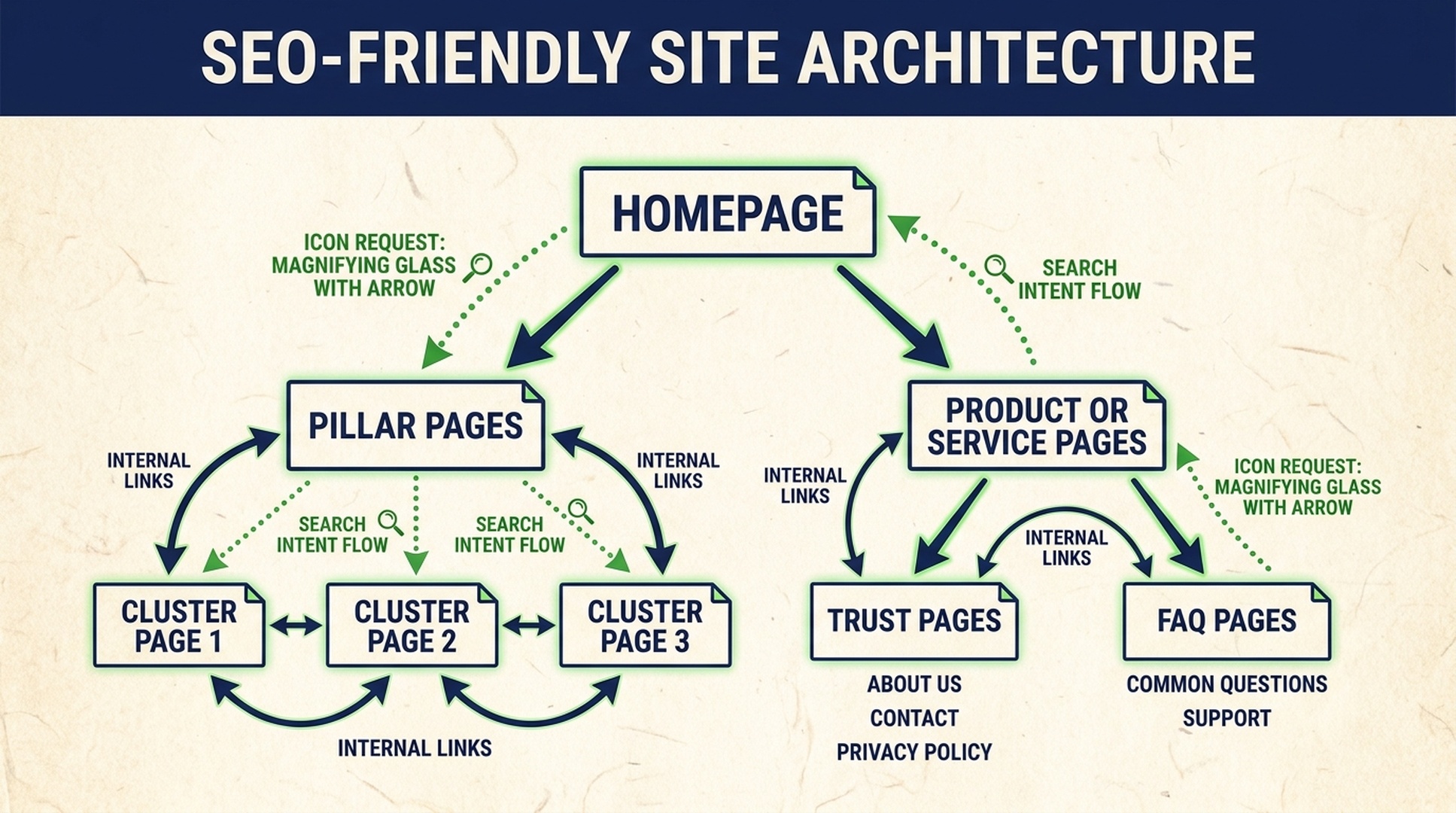
The goal is not to create more pages. The goal is to create the right pages and connect them well.
A simple rule: every important keyword group should have one primary page. If two pages target the same intent, they may compete with each other. If no page targets the intent, you are hoping Google guesses.
Use pillar pages as the ranking backbone
Pillar pages are often the difference between a random blog and a website with topical authority.
A pillar page should cover a major topic in enough depth to help both beginners and buyers. It should define the topic, explain why it matters, answer the common questions, and link to more specific pages. For a B2B SaaS company, that might be a page about "AI search visibility." For an ecommerce brand, it might be "sustainable running shoes" or "cold brew equipment."
A good pillar page includes:
- A direct explanation near the top.
- Subsections based on search intent, not internal company jargon.
- Links to cluster pages and commercial pages.
- Clear examples, tables, or decision frameworks.
- Entity context: product category, use case, audience, region if relevant, and related terms.
- Proof, such as data, screenshots, customer language, or expert notes.
This is where LSI terms and related phrases should appear naturally. Do not force synonyms into every paragraph. Use the language real customers use when they describe the problem.
For more detail on the SEO side of this system, see Auspia's SEO category.
Content should match intent, not just contain keywords
Google does not rank a page because a keyword appears ten times. It ranks pages that satisfy the likely intent behind the query.
That distinction matters. A query like "what is GEO" needs a clear explainer. A query like "GEO score checker" needs a tool or landing page. A query like "best AI visibility tools" needs comparison criteria. A query like "how to make Shopify pages index faster" needs a practical troubleshooting guide.
Use this checklist before writing:
Question | Why it matters |
|---|---|
What is the reader trying to do? | Prevents writing generic content around a keyword |
What page type fits this intent? | Keeps blog posts, landing pages, and product pages from doing the wrong job |
What answer should appear in the first 150 words? | Helps readers and crawlers confirm relevance quickly |
What proof can we show? | Separates useful content from AI filler |
What page should this link to next? | Builds internal authority and conversion paths |
In 2026, the safest content strategy is still the hardest one: write pages that help a specific person solve a specific problem.
Why generic AI content struggles
AI can help create content, but raw AI output is rarely enough to rank in competitive search results.
The problem is not that AI wrote the first draft. The problem is that many AI drafts are generic. They repeat known advice, pad sections, use broad claims, miss internal links, and avoid the messy details that make an article useful.
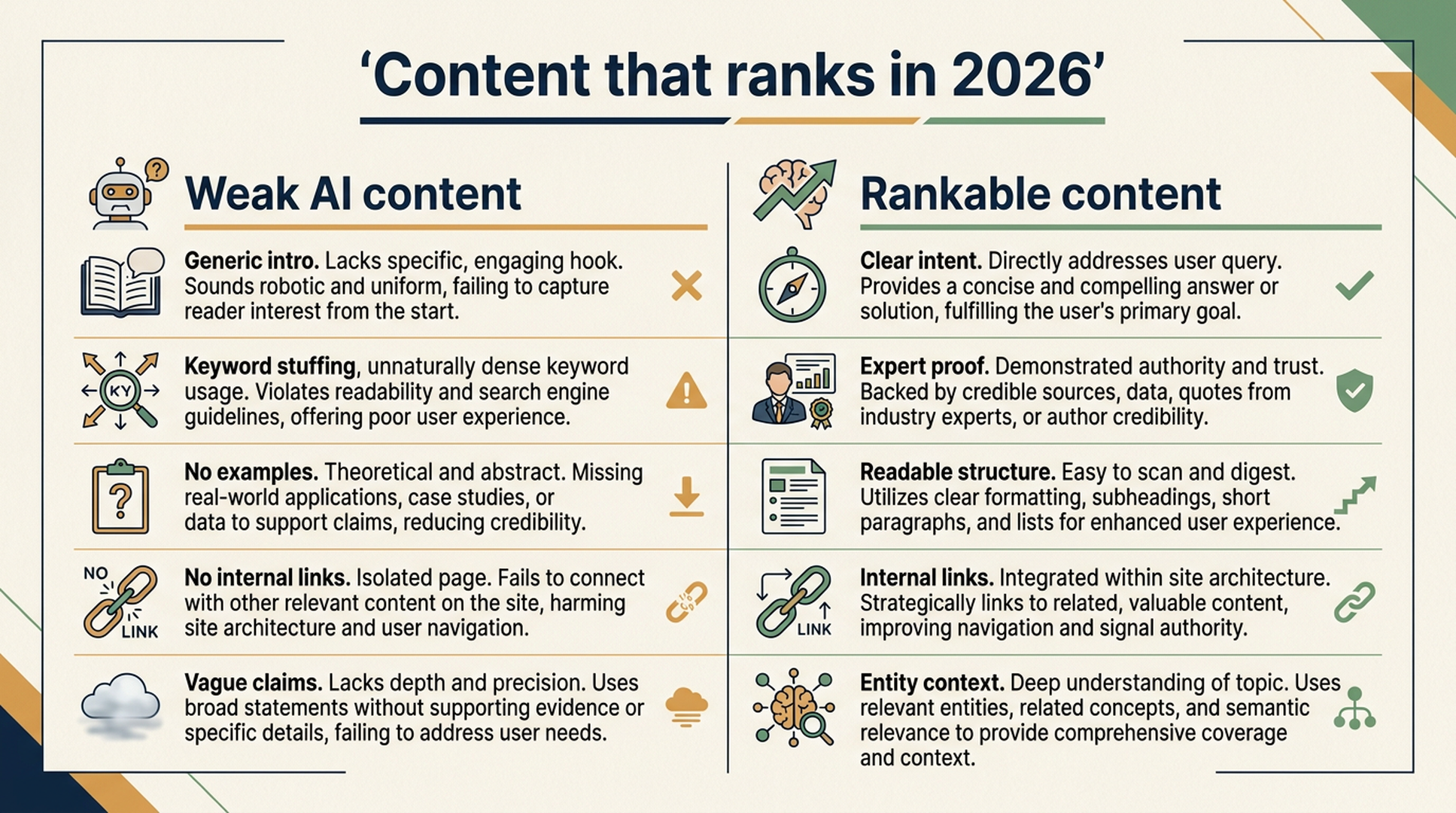
A page can use AI in the workflow and still be strong if it includes human knowledge, business context, and verification.
Use AI for:
- Clustering keywords by intent.
- Drafting outlines.
- Turning product knowledge into content briefs.
- Finding internal-link opportunities.
- Producing schema drafts.
- Checking whether a page answers the target query.
Do not let AI invent expertise. Feed it your product notes, customer questions, sales objections, support tickets, screenshots, and research. Then edit the output until it sounds like a person who actually understands the market.
Technical SEO still matters, but it is not the whole strategy
Once architecture and content are planned, technical SEO keeps the system healthy.
Prioritize these checks:
Technical area | What to do |
|---|---|
Crawlability | Make sure important pages are not blocked by robots.txt, noindex tags, or broken canonicals |
Indexing | Use Google Search Console to inspect important URLs and monitor coverage |
Page speed | Compress images, reduce unnecessary JavaScript, and test mobile performance |
Internal links | Link from pillar pages to clusters and from clusters back to the right pillar or product page |
Schema | Add Organization, Article, Product, FAQ, Breadcrumb, or Review markup where appropriate |
Mobile UX | Check real mobile templates, not just desktop previews |
Duplicate pages | Control tag pages, filters, variants, and thin archives |
Submitting pages manually can help a new site get discovered, but it is not a ranking strategy. A stronger goal is to publish consistently enough, and link clearly enough, that crawlers learn the site deserves regular visits.
Small vertical sites can still win
Large categories are hard. Narrow categories are often more realistic.
A small independent site can rank if it owns a specific niche better than broad competitors. Instead of building one generic site for "industrial equipment," a company might build focused sections or vertical sites around packaging machines, tea processing equipment, or toy safety testing. The narrower the intent, the easier it is to create pages that feel exact.
This does not mean every business should launch dozens of websites. Splitting authority across many domains can backfire. But it does mean your architecture should respect how customers search by product line, use case, geography, and problem.
The 2026 SEO-friendly website checklist
Use this before launching a new site or rebuilding an existing one.
Area | Check |
|---|---|
Strategy | Each page has a target intent and a reason to exist |
Architecture | Homepage, pillars, clusters, product pages, and trust pages are mapped |
Keywords | Primary and related terms are placed naturally in titles, headings, URLs, and copy |
Content | Pages include examples, proof, tables, screenshots, or clear frameworks |
Internal links | Important pages receive links from related pages |
GEO readiness | Brand, category, audience, use cases, and evidence are easy to extract |
Technical SEO | Indexing, speed, mobile layout, schema, and canonicals are checked |
Measurement | Search Console, analytics, rank tracking, and AI visibility checks are active |
For AI search specifically, you can use an AI Search Visibility Checker to see whether your brand appears for the prompts that matter.
Common mistakes
The first mistake is building the site before building the map. Design comes after strategy.
The second mistake is treating pillar pages like long blog posts. A pillar page should organize a topic and route readers to deeper pages.
The third mistake is publishing AI drafts without adding proof. Search results are crowded with content that sounds correct but says very little.
The fourth mistake is chasing fast indexing while ignoring long-term crawl trust. Getting indexed quickly is useful. Staying ranked is better.
The fifth mistake is forgetting conversion. SEO traffic has to lead somewhere: a tool, demo, product page, comparison page, or next useful guide.
FAQ
What makes a website SEO-friendly in 2026?
An SEO-friendly website has clear architecture, pages mapped to search intent, useful content, clean technical SEO, internal links, and entity signals that help both search engines and AI answer systems understand the site.
Are backlinks still important?
Yes, but they support a strong site rather than rescue a weak one. Links work best when the site already has useful pages, clear topical structure, and assets worth referencing.
Can a new website rank without authority?
It can rank for narrow, low-competition, long-tail queries if the page matches intent well. Stable rankings for competitive terms usually require more content depth, internal links, evidence, and external trust over time.
Should I use AI to write SEO pages?
Use AI as an assistant, not as the only writer. It can help with briefs, clustering, drafts, and checks. The final page needs real product knowledge, examples, proof, and human editing.
How many pillar pages does a new site need?
Start with a few major topics that match your business model. A small site may only need three to five strong pillar pages at first, each supported by focused cluster pages.
Auspia takeaway
The best SEO-friendly websites in 2026 are not built by accident. They are planned around architecture, intent, content quality, technical health, and AI visibility.
Auspia helps turn that system into an automated workflow. You can audit a site, map SEO/GEO opportunities, generate structured content plans, monitor AI search visibility, and keep optimization moving without becoming an SEO specialist first. If you want intelligent SEO and GEO execution instead of scattered manual work, start with Auspia.ai and its growth tools.