The short version
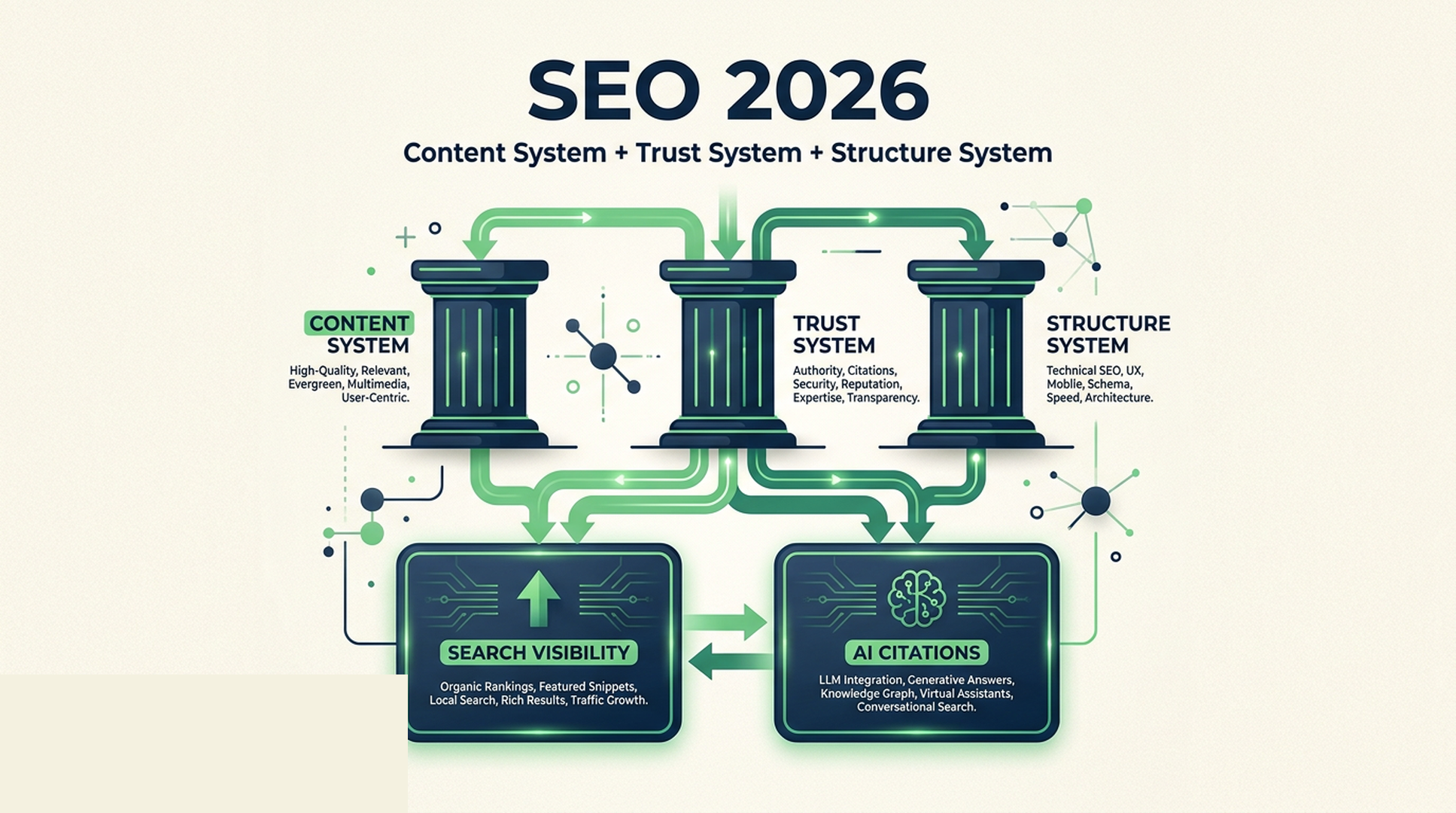
SEO in 2026 is best understood as three connected systems:
- A content system that answers real search intent better than interchangeable pages.
- A structure system that lets crawlers, users, and AI systems find, parse, and trust the page.
- A trust system built through brand evidence, links, citations, first-hand experience, and consistent external signals.
Rankings are still useful, but they are the scoreboard, not the operating system. Google now explicitly says that its generative AI features, including AI Overviews and AI Mode, rely on core Search ranking and quality systems, with retrieval-augmented generation and query fan-out used to find supporting sources. That makes old-school SEO foundations more important, not less important. The difference is that weak, generic content has less room to hide.
If you want a simple formula, use this:
SEO visibility in 2026 = crawlable structure + non-commodity content + trust signals + intent fit
That formula works for classic search results, AI summaries, comparison queries, product-led pages, and long-tail educational content. It also gives teams a way to stop arguing about "SEO hacks" and start improving the actual system.
The old mistake: treating SEO as ranking only
A lot of teams still define SEO like this:
- High ranking means traffic.
- More pages mean more keywords.
- More keywords mean growth.
That is not completely wrong. It is just too thin.
A better mental model is a library.
Search component | Library model | What it means in practice |
|---|---|---|
Search engine | The catalog and shelf system | It discovers, sorts, and serves pages. |
Website | A book collection | The whole site has a topic footprint. |
Page | A chapter | Each URL must have a clear job. |
Internal links | Cross-references | They show relationships between chapters. |
External links and mentions | Reviews and citations | They help establish confidence. |
AI answers | A librarian's answer | The system may summarize several sources before sending a visitor anywhere. |
In that model, SEO is not "write more chapters." It is making sure the right chapters exist, belong to a coherent collection, are easy to find, and are credible enough to be used as references.
This matters more in 2026 because AI search experiences do not only match one keyword to one page. They often decompose a query into related sub-questions, retrieve supporting pages, and synthesize an answer. A page that is technically accessible but shallow may be indexed. That does not mean it deserves to be cited.
System 1: technical structure is the floor, not the growth engine
Technical SEO rarely wins a market by itself. But poor technical SEO can quietly cap everything else.
Google's own SEO Starter Guide frames SEO as helping search engines understand content and helping users decide whether to visit through search. Its generative AI guidance also says technical clarity still matters because Search must find and process pages before they can be used in AI features.
For a modern site, the structure layer includes:
Layer | What to check | Why it matters |
|---|---|---|
Crawl access | robots.txt, noindex, canonical tags, status codes | Search systems cannot rank or cite what they cannot access. |
Indexing | sitemap coverage, canonical consistency, duplicate handling | Keeps important URLs in the usable index. |
Rendering | JavaScript visibility, server response, lazy-loaded content | Prevents hidden or delayed content from being missed. |
Information architecture | URL folders, breadcrumbs, hub pages, internal links | Shows how pages relate to each other. |
Page experience | mobile layout, speed, intrusive elements, readability | Helps users stay and complete tasks. |
Semantic clarity | headings, tables, schema where useful, descriptive anchors | Makes content easier to parse and quote. |
The trap is spending six months polishing technical items while the site still says nothing useful. Technical SEO is a qualification layer. It gets the book onto the shelf and makes the chapters readable. It does not, by itself, make the book worth recommending.
A practical rule: fix technical issues in the order they block discovery, comprehension, or conversion.
- Discovery blockers: robots.txt mistakes, noindex tags, broken canonicalization, orphaned pages.
- Comprehension blockers: messy templates, duplicate titles, thin pages, missing primary content, weak internal links.
- Conversion blockers: slow pages, broken mobile views, unclear calls to action, forms that do not work.
Run this audit before producing another batch of articles. If you need a fast first pass, Auspia's Website SEO Score Checker can surface crawl, metadata, performance, and page structure issues worth fixing first.
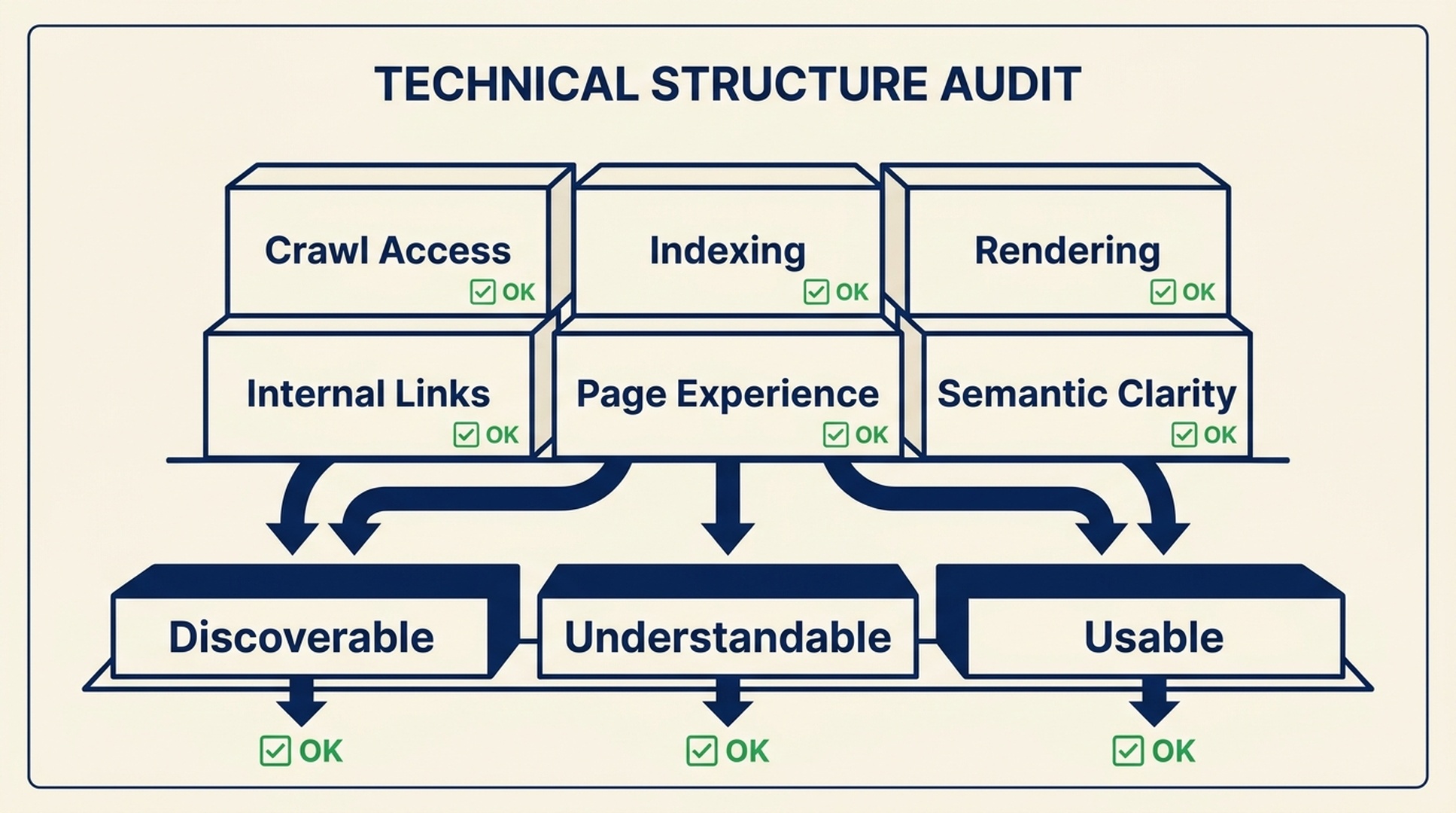
Caption: The technical structure layer decides whether strong content can be discovered, interpreted, and used by search and AI systems.
System 2: content is the competitive layer
Once pages are accessible, content quality becomes the real fight.
In 2026, the weakest content is not always badly written. Often it is tidy, readable, and useless. It restates what every competitor already said. It has no product screenshots, no original examples, no tested workflow, no hard tradeoff, no named audience, and no point of view.
Google's generative AI guidance uses a useful phrase here: non-commodity content. That is the bar. If a page could have been produced by summarizing the first five search results, it is probably not strong enough for serious SEO or GEO work.
A good content system answers five questions before anyone writes:
Question | Good answer | Weak answer |
|---|---|---|
Who is searching? | "B2B SaaS founder comparing AI search visibility tools" | "People interested in SEO" |
What do they need now? | A decision framework, checklist, and examples | General education |
What page format fits? | Comparison, template, teardown, calculator, glossary, case analysis | Blog post by default |
What can we add that others cannot? | Product data, internal workflow, field notes, real examples | Generic tips |
What should happen next? | Audit, demo, signup, template download, deeper article | "Contact us" at the end |
This is where keyword research still matters. A keyword is not just a phrase with volume. It is a clue about demand, difficulty, format, and intent.
For example:
- "what is generative engine optimization" needs a clear definition, examples, and FAQ.
- "AI search visibility checker" needs a tool page or product-led workflow.
- "how to block AI crawlers" needs technical instructions, robots.txt examples, and tradeoffs.
- "GEO vs SEO" needs a comparison that does not pretend the two are separate worlds.
The content mistake I see most often is choosing a keyword, then writing whatever is easiest to write. The better process is the reverse: study the intent, choose the page type, then write only the page that deserves to exist.
System 3: trust is the multiplier
Trust is where many small sites get impatient.
They publish a decent article, wait two weeks, see nothing dramatic, and conclude that SEO is broken. Sometimes the article is fine. The site just has no trust layer yet.
The trust system includes more than backlinks, but backlinks still matter because they are one of the clearest public signals that other sites recognize your page or brand. The broader layer includes:
Trust signal | Examples | What it proves |
|---|---|---|
Editorial links | Industry blogs, partner pages, research references | Other sites consider the content worth citing. |
Brand mentions | Podcasts, newsletters, comparison posts, communities | The entity exists outside its own website. |
Author evidence | Bio pages, first-hand experience, credentials, examples | A real person or team stands behind the advice. |
Product proof | Public tools, datasets, screenshots, changelogs | The company has operational substance. |
Consistency | Same positioning across site, socials, listings, docs | Search systems can understand the entity. |
This is why "publish and pray" rarely works. Content creates something worth referencing. Structure makes it accessible. Trust gives other systems a reason to use it.
For AI search, trust also becomes more visible. When an answer engine cites a page, it is borrowing credibility from that page. Thin affiliate-style pages, anonymous rewrites, and recycled explainers are poor candidates for that job.
Auspia's view is simple: build assets that deserve external use. A calculator, benchmark, teardown, original checklist, crawler test, or data-backed guide is much easier to promote than another "complete guide" that says the same thing as everyone else.
How to build the SEO system in the right order
Here is the order we recommend for teams that want SEO and AI-search visibility in 2026.
Step 1: map your money topics
Start with topic clusters tied to actual business value. Do not begin with a giant keyword export.
Use a simple map:
Cluster | User problem | Page types needed | Business path |
|---|---|---|---|
AI search visibility | "Can AI systems find and cite us?" | Tool page, explainer, checklist, benchmark | Run visibility check |
Technical SEO | "Why are pages not indexed?" | Audit guide, crawler checker, robots.txt examples | Fix crawl issues |
GEO strategy | "How do we get mentioned in AI answers?" | Framework, examples, operating model | Book strategy call |
Content automation | "How do we scale without spam?" | Workflow, templates, QA checklist | Use tools or service |
This prevents the classic mistake of publishing 100 loosely related pages that never form a recognizable site entity.
Step 2: separate foundation pages from growth pages
Not every page has the same job.
- Foundation pages define the entity: what you do, who you help, what categories you cover.
- Growth pages target demand: comparisons, alternatives, templates, use cases, and problem-specific searches.
- Proof pages build confidence: case studies, experiments, benchmarks, product updates.
- Utility pages earn links and repeat visits: tools, checkers, calculators, datasets.
A site with only growth pages feels opportunistic. A site with only foundation pages feels static. A healthy SEO system has both.
Step 3: make internal links behave like a knowledge graph
Internal links should not be decoration. They should show relationships.
A good internal link says: "If you are reading this, the next useful concept is over there."
Use internal links to connect:
- glossary pages to playbooks;
- tool pages to use cases;
- comparison pages to decision guides;
- case studies to the method they prove;
- category hubs to their strongest supporting pages.
For AI visibility work, connect pages around entities and tasks, not just keywords. If your site has a page about GEO strategy, it should naturally connect to AI search visibility, crawl access, content quality, and measurement. Auspia's AI Search Visibility Checker is a good example of a utility page that can sit inside a broader topic system rather than as an isolated tool.
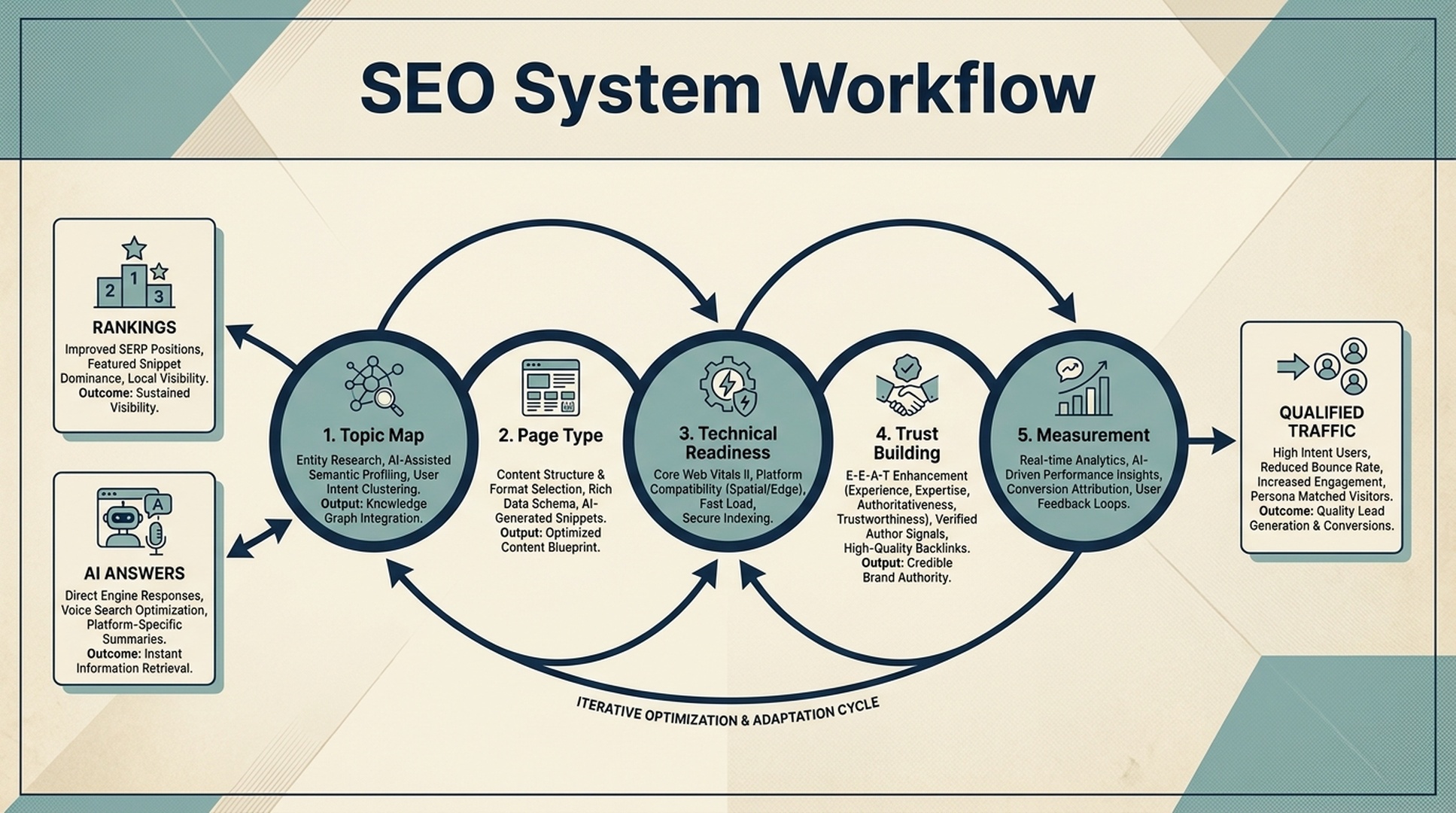
Caption: A healthy SEO system links topic strategy, page type, technical readiness, trust building, and measurement instead of treating articles as one-off tasks.
Step 4: measure the system, not just the article
Individual article rankings are noisy. The better dashboard looks at system health.
Track:
Metric | What it tells you |
|---|---|
Indexed important URLs | Whether the technical layer is working. |
Non-brand impressions by cluster | Whether the topic footprint is expanding. |
Click-through rate by intent type | Whether titles and snippets match expectations. |
Assisted conversions by page group | Whether SEO traffic has business value. |
Referring domains to assets | Whether your trust layer is compounding. |
AI answer mentions or citations | Whether content is visible beyond classic SERPs. |
Internal link depth | Whether important pages are easy to reach. |
Do not panic over one page that underperforms for three weeks. Look for bottlenecks. Is the cluster too thin? Is the page buried? Is the query too competitive? Does the page add anything original? Are there any external signals?
The 2026 checklist
Use this checklist before calling a page "done."
Area | Check |
|---|---|
Intent | The page clearly matches one primary search intent. |
Format | The page type fits the query: guide, tool, template, comparison, case, or glossary. |
Original value | The page includes examples, data, screenshots, field notes, or a clear point of view. |
Crawlability | The URL is indexable, canonicalized, linked, and included in the sitemap if important. |
Structure | Headings, tables, anchors, and schema make the page easy to parse. |
Internal links | The page links to and from related cluster pages. |
Trust | Author, brand, sources, product proof, or external evidence support the claims. |
Conversion | The next step matches the reader's stage. |
AI readiness | The answer, facts, and entities are explicit enough to be extracted or cited. |
If a page fails the original value row, do not publish it yet. That is usually the row that separates useful SEO from content inventory.
Common mistakes
The first mistake is confusing quantity with coverage. Publishing 200 pages does not mean you own a topic. It may only mean you created 200 weak URLs.
The second mistake is treating technical SEO as a one-time launch task. Sites change. Templates break. JavaScript changes. CMS migrations create duplicate URLs. Crawl rules get edited by someone who did not know what they were blocking.
The third mistake is outsourcing trust. You can buy a list of links, but you cannot outsource being worth citing. Better assets make promotion easier, safer, and more durable.
The fourth mistake is separating SEO, GEO, and AEO into three disconnected teams. In practice, they share the same foundation: clear pages, useful answers, crawlable structure, and trusted evidence. The interfaces are changing. The underlying discipline is still search visibility.
Auspia takeaway
The 2026 version of SEO is less about tricks and more about operating discipline.
A site needs a content system so it says useful things. It needs a structure system so search and AI systems can understand those things. It needs a trust system so those systems have a reason to use the site as evidence.
That is the work. Not glamorous, but very hard to fake.
If you are starting from scratch, do this in order: audit crawlability, map commercial topic clusters, build foundation pages, publish proof assets, connect the internal graph, then measure visibility across both classic search and AI answers.
FAQ
Is SEO still relevant in 2026?
Yes. Google says its generative AI features are rooted in core Search ranking and quality systems. That means technical SEO, helpful content, links, page experience, and clear site structure still matter. The output may appear in classic results, AI summaries, or both.
What is the difference between SEO, GEO, and AEO?
SEO is the broad discipline of improving search visibility. GEO focuses on visibility in generative AI answers. AEO focuses on answer extraction and answer-engine results. In practice, the work overlaps: create useful, well-structured, trusted pages that answer real user questions.
Are backlinks still important?
Yes, but they should be treated as part of a broader trust system. Editorial links, brand mentions, author evidence, product proof, and consistent entity signals all help. Links alone cannot rescue thin content.
How many articles should a new site publish?
Publish only as many as you can make genuinely useful. A smaller set of strong pages with clear internal links, original examples, and business relevance usually beats a large batch of generic articles.
How do I make content more likely to appear in AI answers?
Make the page crawlable, write direct answers, use clear entities, add specific examples, cite sources where appropriate, and include original value. Then build trust around the page through internal links, external references, and product or author evidence.
Sources
- Google Search Central: SEO Starter Guide
- Google Search Central: Optimizing your website for generative AI features on Google Search
- Google Search Central: Introduction to robots.txt
- Google Search Central: Intro to structured data