Executive summary
SEO in 2026 is not dead. It is just less forgiving.
A page now has to work in more than one place: classic Google results, Google AI Overviews, YouTube, Reddit-style discussions, comparison pages, and answer engines such as ChatGPT and Perplexity. The same weak content that used to sit quietly on page two now gets ignored by both search crawlers and AI answer systems.
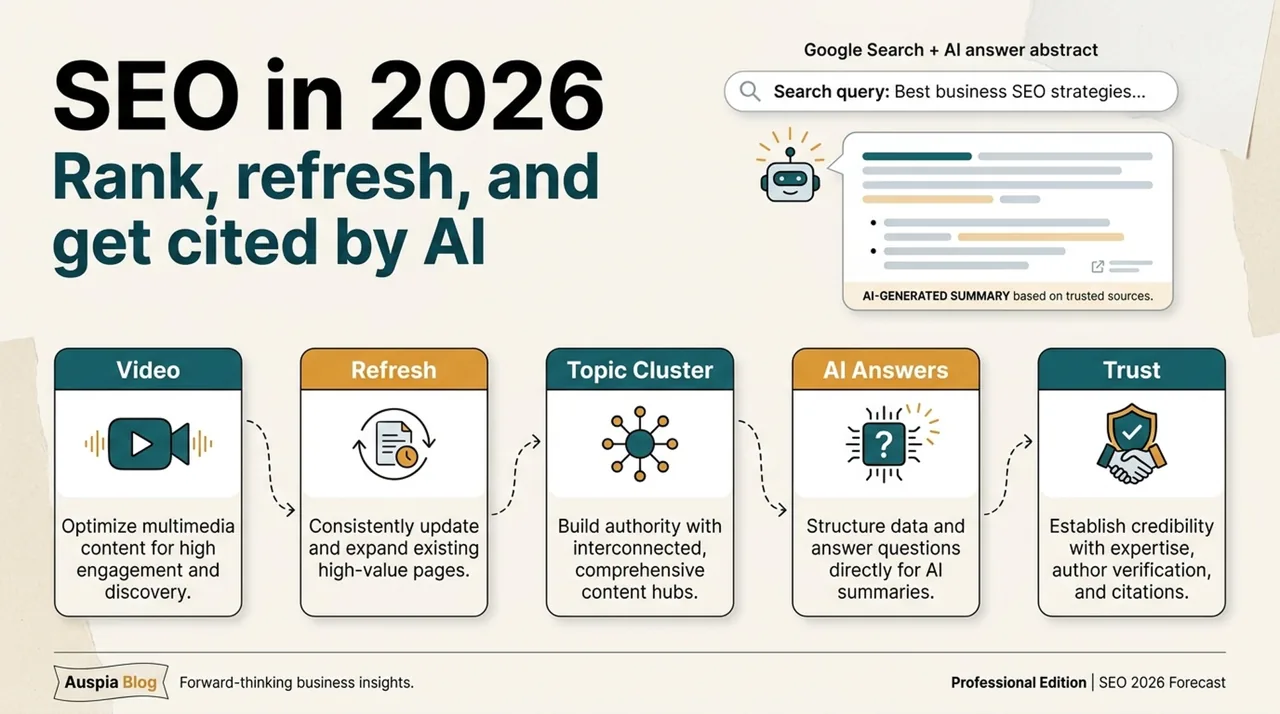
The practical move is not to chase every new acronym. Start with five actions:
- Treat video as a search asset, not a social extra.
- Refresh pages that already have impressions before writing another batch of new posts.
- Build topic clusters instead of isolated articles.
- Structure pages so AI systems can quote the answer without guessing.
- Make trust visible with author evidence, sources, reviews, and real third-party mentions.
If you can only do one thing this week, open Google Search Console and find one page ranking between positions 11 and 30 with decent impressions and weak CTR. Rewrite the intro, add a direct answer, update the evidence, add internal links, and make the page easier for both humans and AI systems to parse.
Why SEO changed again in 2026
The old SEO workflow was fairly simple: pick a keyword, write the page, optimize the title, build links, wait.
That still matters. But it is no longer enough.
Google Search now mixes web links with AI-generated summaries, videos, product grids, forum discussions, local packs, and other surfaces. Google has also said its systems use signals from its helpful content and quality systems across search experiences, while AI Overviews include links to sources when the system decides they help the answer.
Independent research has started to show why this matters. A 2026 measurement study of Google AI Overviews found that AI Overview source selection does not simply copy the normal blue-link ranking order. The study also reported that question-style queries triggered AI Overviews far more often than average queries. Another 2026 study on Wikipedia traffic found that AI Overview exposure reduced daily traffic to exposed English Wikipedia pages by about 15%.
So the job has changed. A growth team now has to win visibility and be useful when clicks shrink.
That is the real SEO problem in 2026.
1. Make YouTube part of the SEO system
Many teams still treat YouTube as a side project. Someone records a webinar, the video goes up, the description gets two sentences, and nobody connects it back to the website.
That leaves traffic on the table.
Video can now support discovery in at least three ways: YouTube search, Google Search video modules, and AI search surfaces that cite or summarize video content. Google Search Central also gives clear video SEO guidance: make videos available on a public page, use descriptive titles and thumbnails, and provide structured data when relevant.
A better 2026 workflow looks like this:
Asset | SEO role | What to do |
|---|---|---|
YouTube video | Captures video-first searches | Use a keyword-aware title, useful thumbnail, and a full description |
Blog article | Gives crawlers and AI systems a structured answer | Embed the video and summarize the key points in text |
Transcript or notes | Makes the video easier to understand | Add cleaned notes, timestamps, and links to related pages |
Internal links | Connects the topic cluster | Link from older pages to the new video article |
This does not mean every article needs a video. It means the videos you do create should not live alone.
For example, a B2B SaaS company with a guide on "how to reduce churn" could publish a short YouTube walkthrough, embed it into the guide, add a timestamped summary, and link from related pages on onboarding, retention emails, and customer success metrics. The video becomes part of the topical footprint, not a detached brand asset.
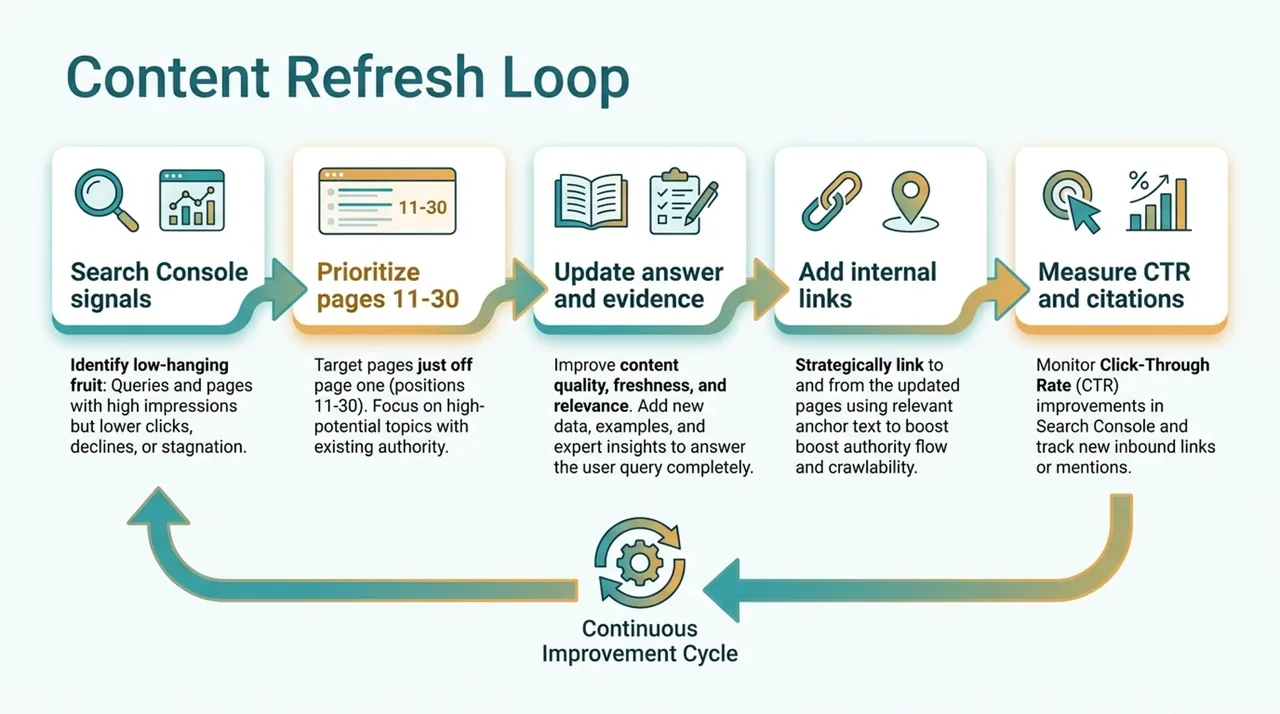
Content refresh loop: use Search Console to find near-ranking pages, improve the answer, add proof, connect internal links, and measure the result.
2. Refresh old content before you publish new content
Most content teams have a hidden pipeline of easy wins. It is not in the content calendar. It is in Google Search Console.
Look for pages with:
- High impressions but low CTR.
- Average position between 11 and 30.
- Rankings that slipped after a competitor updated their page.
- Outdated screenshots, old dates, thin intros, or missing FAQs.
- A strong topic fit but weak internal links.
These pages already have some recognition. Google has seen them. Users are seeing the result. The problem is usually that the page is not good enough, current enough, or clear enough to move into the top results.
Here is a simple refresh process:
Step | What to check | What to change |
|---|---|---|
Query review | Which searches drive impressions? | Rewrite the title and intro around the real query intent |
Content freshness | Are examples, dates, tools, or screenshots stale? | Update facts, add 2026 context, remove dead advice |
Answer clarity | Can a reader get the answer in 20 seconds? | Add a short conclusion near the top |
AI extractability | Are definitions, lists, and steps easy to quote? | Add question headings, tables, and concise summaries |
Internal links | Does the page connect to the right cluster? | Add 2-4 natural links from and to related pages |
A new article may take weeks to earn trust. A refreshed page may already be close.
Auspia's practical rule: refresh two existing pages for every one new page until your Search Console backlog is clean.
3. Build topic authority, not one-off articles
A single good article can rank. A complete topic system is harder to replace.
Search engines need to understand whether your site is a credible source for the broader subject, not just a one-time answer. AI answer systems have a similar problem. They need sources that are clear, consistent, and connected across related questions.
That is why thin variety hurts. A blog with one post on SEO, one on email, one on paid ads, one on TikTok, and one on finance may look active, but it rarely looks authoritative.
Pick one or two commercial topics and build depth.
For an AI search visibility cluster, the structure might look like this:
Layer | Example page | Purpose |
|---|---|---|
Pillar | AI search optimization guide | Defines the main topic and links to the cluster |
Comparison | GEO vs SEO | Captures evaluation intent |
Workflow | How to audit AI search visibility | Converts readers into operators |
Tool page | AI Search Visibility Checker | Gives readers an action step |
Evidence | Case study or experiment | Shows what changed and what did not |
FAQ | How do AI answers choose sources? | Captures long-tail questions |
The internal links matter. A pillar page should point to supporting pages. Supporting pages should link back to the pillar and sideways to closely related pages. Do not force every page to link to everything. Use links as a map.
If you want a quick diagnostic, use the Auspia tools hub to pair a content audit with technical and AI-readiness checks. The goal is not just more pages. The goal is a site that clearly owns a topic.
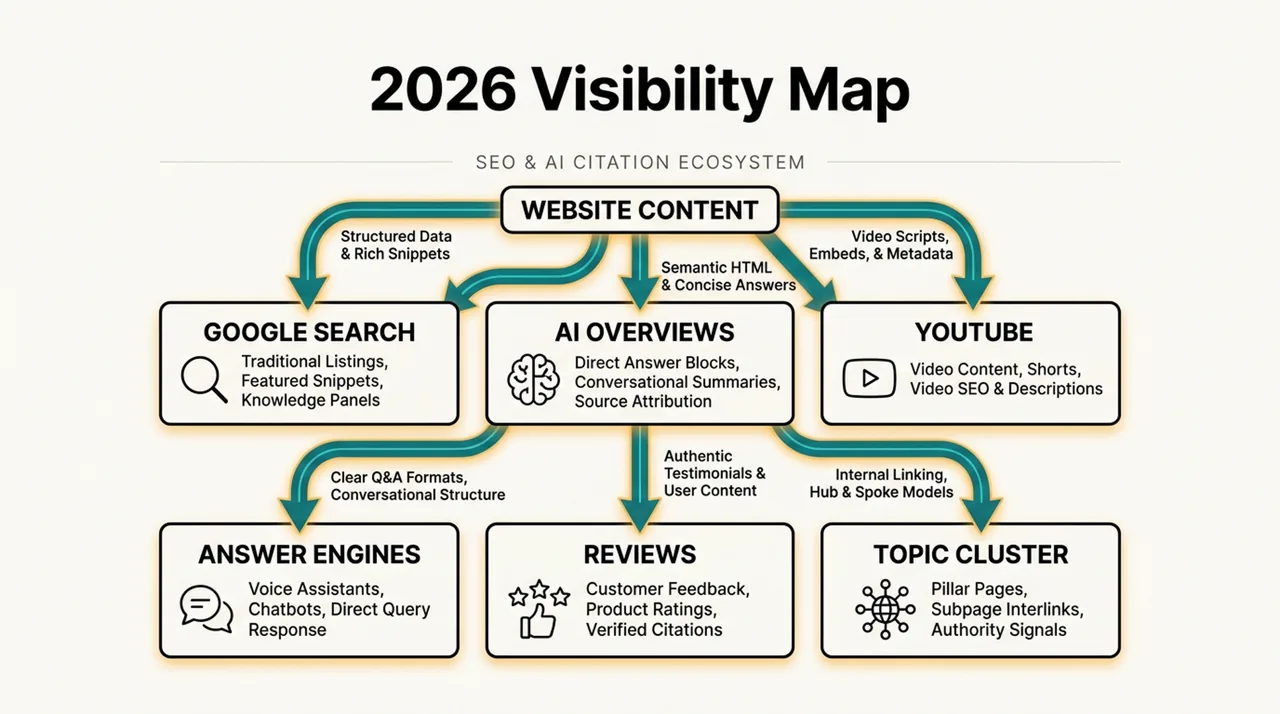
2026 visibility map: one strong content system should support Google Search, AI answers, video discovery, reviews, and topic authority.
4. Write pages that AI systems can cite
AI systems do not cite a page because it sounds clever. They cite pages that make the answer easy to verify, summarize, and attribute.
That changes how you should structure important content.
Start with the answer. If the page is about "what is generative engine optimization," do not spend five paragraphs warming up. Define it. Say where it applies. Say what it does not guarantee.
Then support the answer with:
- Short definition blocks.
- Question-style subheadings.
- Tables that compare options or steps.
- Named sources and dates for claims.
- Clear author or company expertise.
- Original examples, screenshots, or mini case studies.
This is where SEO and GEO overlap. Traditional SEO helps a page get discovered. GEO makes the page easier for AI answer systems to understand and cite. If you want a baseline, run a page through the AI Search Visibility Checker and check whether your brand, entity, sources, and answer structure are visible enough.
A weak paragraph says:
Our platform helps brands improve visibility in the AI era through advanced optimization methods.
A stronger citation-ready answer says:
Generative engine optimization is the process of making a website easier for AI answer systems to understand, trust, and cite. It usually includes clearer entity information, answer-first content, source-backed claims, third-party mentions, and technical access for AI crawlers.
The second version is not fancy. That is the point.
5. Make E-E-A-T visible outside the article
E-E-A-T stands for experience, expertise, authoritativeness, and trust. Google uses the concept in its Search Quality Rater Guidelines. It is not a simple score you can add to a page, but it is still a useful checklist for content quality.
In 2026, the important part is visibility. If your trust signals are real but hidden, they do less work.
Add the basics:
- A real author name and author page.
- A short explanation of why the author or company knows the topic.
- Sources for claims that depend on outside data.
- Dates for time-sensitive advice.
- Product screenshots, workflow examples, and methodology notes.
- Customer stories, reviews, or third-party references when they exist.
Then build trust off-site too. AI answer systems often pull from review sites, forums, comparison articles, documentation, social discussions, and industry publications. Brand mentions do not replace links, and links do not replace reputation. You need both.
For a small software company, that might mean publishing better documentation, getting listed in relevant comparison pages, answering real questions on community sites, and collecting detailed customer reviews. None of this is glamorous. It works because it creates evidence outside your own website.
The 2026 SEO action plan
If your team wants a clean starting point, use this 30-day plan.
Week | Focus | Output |
|---|---|---|
Week 1 | Search Console refresh audit | 10 pages sorted by impressions, CTR, and position |
Week 2 | Content refresh | 3 updated pages with direct answers, new evidence, and internal links |
Week 3 | Topic cluster map | 1 pillar page and 5-8 support pages planned |
Week 4 | AI citation cleanup | Author pages, sources, FAQ blocks, schema, and brand evidence reviewed |
Do not try to rebuild the whole site at once. Pick the pages already closest to visibility and make them better.
A useful first target is a page ranking in positions 11-30. It has demand. It has some relevance. It probably needs a sharper title, a stronger answer, fresher evidence, and better links.
Common mistakes
Mistake | Why it hurts | Better move |
|---|---|---|
Publishing only new posts | Old pages keep decaying | Refresh existing pages with impressions first |
Treating YouTube as separate | Video authority does not help the site | Embed videos and add transcripts or notes |
Writing broad blog topics | The site looks shallow | Build one cluster deeply |
Hiding the answer | Readers and AI systems work too hard | Put the conclusion near the top |
Claiming expertise without proof | Trust signals look thin | Show author credentials, sources, examples, and reviews |
Auspia takeaway
The best 2026 SEO programs will look less like content factories and more like evidence systems.
They will still care about keywords, titles, links, and technical health. But they will also care about video, entity clarity, third-party reputation, answer structure, and whether the brand is easy to cite when an AI system builds a response.
Start small. Refresh one nearly-ranking page. Connect it to the right cluster. Add the proof a skeptical reader would ask for. Then repeat.
That is not a hack. It is just what SEO looks like now.
FAQ
Is SEO still worth doing in 2026?
Yes. SEO is still worth doing, but the goal is broader than ranking for blue links. Strong pages now support Google rankings, AI Overview citations, brand mentions in answer engines, and higher-quality referral traffic from users who already understand the problem.
What is the fastest SEO action for an existing website?
Update pages that already receive impressions but rank outside the top results. These pages usually have more near-term potential than brand-new articles because Google already associates them with the topic.
Does GEO replace SEO?
No. GEO builds on SEO. Traditional SEO helps a page get crawled, indexed, ranked, and trusted. GEO adds answer-first structure, entity clarity, citation-friendly evidence, and off-site signals that make the page easier for AI systems to use.
Should every blog post include a YouTube video?
No. Use video when the topic benefits from demonstration, comparison, tutorial steps, or expert explanation. If you do create video, connect it to the article with an embed, summary, transcript notes, and internal links.
How many topic clusters should a small site build?
Start with one or two. A small site usually grows faster by owning a narrow commercial topic than by publishing scattered articles across many unrelated categories.
Sources and further reading
- Google Search Central: Video SEO best practices.
- Google Search Quality Rater Guidelines: E-E-A-T concepts and page quality evaluation.
- Xu, Iqbal, and Montgomery, "Measuring Google AI Overviews: Activation, Source Quality, Claim Fidelity, and Publisher Impact," 2026.
- Khosravi and Yoganarasimhan, "Impact of AI Search Summaries on Website Traffic: Evidence from Google AI Overviews and Wikipedia," 2026.