Short answer
GEO is worth doing, but not as a blind content sprint. The useful version starts from how AI answer systems retrieve, summarize, cite, and route users. Then it asks a harder question: which pages, proofs, tools, and third-party signals make your company easy to recommend when a buyer asks an AI assistant for help?
For AI startups, this matters in three places:
- acquisition, because buyers now ask ChatGPT, Perplexity, Gemini, Copilot, Reddit, YouTube, and Google AI features before they visit a vendor site;
- measurement, because an AI-sourced visit often arrives pre-qualified and may behave very differently from a normal organic search visit;
- product strategy, because GEO itself is becoming a market with monitoring tools, content systems, crawler readiness products, citation analytics, and AI-agent documentation workflows.
The mistake is treating GEO as "SEO with more FAQs." Some of the work overlaps with SEO. Much of it does not.
Why GEO feels different from SEO
Traditional SEO has a visible surface. You can see a ranked page, a title link, a snippet, and a click. The ranking may be opaque, but the result format is familiar.
AI answers are messier. A model may cite three sources, mention five brands without links, summarize a comparison from pages it does not show, or answer from a retrieval layer that changes by geography, account state, date, and prompt wording. The unit of visibility is no longer just "rank one for a keyword." It can be:
Visibility type | What it means | What to measure |
|---|---|---|
Mention | The AI answer names your brand | Share of prompts where the brand appears |
Citation | The answer links to your page | Citation frequency and cited URL type |
Recommendation | The answer says users should consider you | Prompt-level recommendation share |
Summary match | The answer describes your product accurately | Accuracy against your positioning |
Referral visit | A user clicks from an AI platform | Sessions, conversion, assisted revenue |
This is why GEO has to be both a content discipline and a measurement discipline. A startup can get mentioned and still receive no traffic. It can receive traffic and still convert poorly because the landing page does not match the AI's summary. It can rank in Google and still be invisible in AI answers because the page is hard to quote.
Auspia's view: treat GEO as an answer-readiness system. The goal is not to trick a model. The goal is to make your best evidence, positioning, and product use cases easy for retrieval systems and answer engines to reuse.
Start from how AI systems consume pages
Most teams do not need a PhD-level architecture diagram. They do need the basic mental model.
A common AI answer flow looks like this:
- A user asks a long, specific question.
- The system reformulates or expands the query.
- It retrieves web pages, documents, or indexed chunks.
- It summarizes the useful pieces.
- It generates an answer, sometimes with citations.
- The user either accepts the answer, asks a follow-up, or clicks one of the sources.
That flow changes what "good content" means. A page has to work as a human page, a search result, and a reusable evidence object.
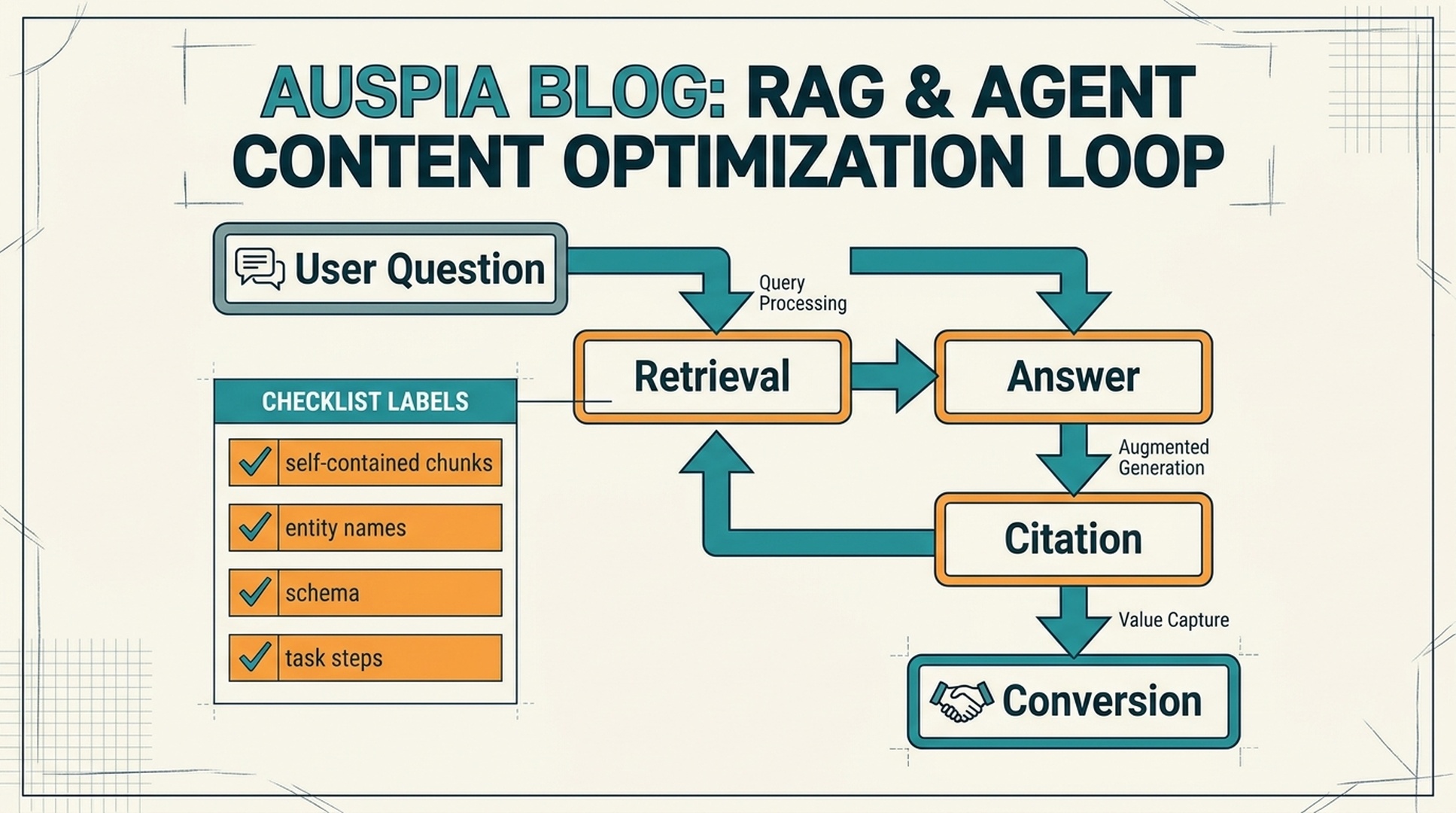
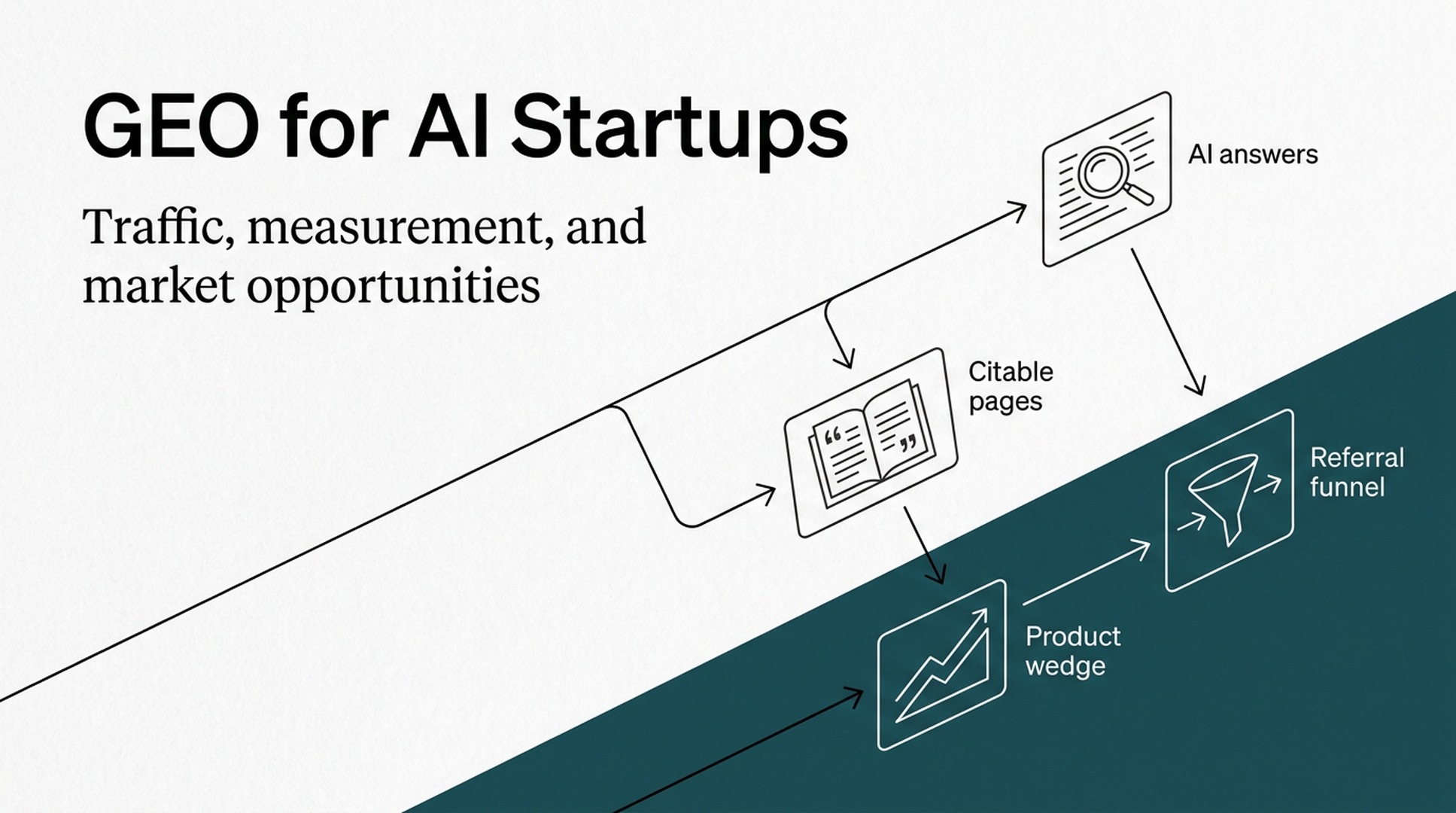
Caption: GEO content should be built so retrieval systems can chunk, understand, cite, and route users toward the next action.
Content strategy: make pages chunkable, quotable, and useful
A strong GEO page usually has five traits.
First, each section can stand alone. A paragraph that says "this is why it matters" without naming the topic is weak. A paragraph that says "AI search visibility matters because ChatGPT and Perplexity may summarize vendor comparisons before users click any website" is easier to retrieve and cite.
Second, entities are explicit. Use product names, category names, customer types, integrations, standards, and dates. Avoid vague language like "our solution" when the surrounding text will be chunked away from the page header.
Third, the page answers real buyer prompts. Not just "what is GEO," but questions like:
- "Which AI visibility tools track ChatGPT citations?"
- "How do I measure traffic from Perplexity in GA4?"
- "What pages should a B2B SaaS company create for AI answers?"
- "How do I stop AI crawlers from missing my product documentation?"
Fourth, the page includes proof that can be reused. Pricing clarity, benchmarks, methodology notes, screenshots, schema, author credentials, and customer examples all help a model decide whether a page is worth citing.
Fifth, the page has a next step. AI referrals can be impatient. If the user arrives after an assistant has already done the comparison, the landing page should quickly confirm the claim, show proof, and offer a useful action.
For a practical first pass, run your most important pages through an AI Search Visibility Checker and then rewrite the weakest sections around clear entities, questions, and proof blocks.
Agent readiness is becoming part of GEO
GEO is usually framed around AI search, but agents add another layer. An agent does not only summarize. It may choose a tool, call an API, compare options, fill a form, or prepare a shortlist.
That means product and documentation pages need to be task-readable.
A weak tool page says: "A flexible platform for modern teams."
A stronger tool page says: "Use this API to check whether a domain allows GPTBot, ClaudeBot, PerplexityBot, and Google-Extended in robots.txt. Input: domain. Output: crawler status, blocked paths, sitemap hints, and recommended fixes."
The second version is less poetic, but it is much more useful to an agent.
For AI startups, this creates a simple rule: if a human would ask an assistant to perform the task, write the page so an assistant can understand the task. That applies to API docs, product pages, pricing pages, integration pages, help center articles, and comparison pages.
A practical GEO checklist for startup teams
Do not start with 100 articles. Start with the surfaces that influence AI answers and buyer trust.
Workstream | What to do | Why it matters |
|---|---|---|
Crawl access | Review robots.txt, sitemap, status codes, and blocked AI crawlers | AI systems cannot cite pages they cannot access |
Entity clarity | Make brand, category, product, audience, and use cases explicit | Retrieval systems need names and context |
Proof blocks | Add methodology, examples, screenshots, customer quotes, and dates | AI answers prefer sources that look verifiable |
FAQ coverage | Answer real buyer questions in short, self-contained sections | Conversational queries map naturally to FAQ-style content |
Structured data | Add Article, FAQ, Product, Organization, and Breadcrumb schema where relevant | Schema reduces ambiguity for crawlers and search systems |
Third-party evidence | Earn mentions on review sites, community posts, partner pages, and independent articles | AI answers often synthesize outside your own domain |
Landing-page match | Align page copy with how AI tools describe the product | Users should see the same promise after they click |
Measurement | Segment AI referrals and track prompt-level visibility | GEO without measurement becomes content superstition |
For crawler access, a simple starting point is to inspect whether your site blocks AI-related crawlers with a robots.txt AI crawler checker. That will not solve GEO by itself, but it removes a basic failure mode.
Measurement: build a separate AI referral funnel
Many teams still ask, "How much traffic do LLMs send?" That question is useful, but too narrow.
A better question is: "When AI systems influence demand, where does the signal show up?"
Sometimes it appears as referral traffic from chat.openai.com, perplexity.ai, gemini.google.com, copilot.microsoft.com, or other AI surfaces. Sometimes it appears as branded search after a user asks an AI assistant for recommendations. Sometimes it appears as a direct visit because the user copied the brand name instead of clicking a citation.
Build a funnel that separates AI-assisted demand from normal organic search.
Funnel stage | Signal to track | Example question |
|---|---|---|
Prompt visibility | Brand mentioned or cited in AI answers | "Do we appear for high-intent prompts?" |
Referral arrival | Sessions from known AI domains | "Which AI platforms send users?" |
Fast validation | Scroll, pricing clicks, demo clicks, signup clicks | "Do users confirm the AI summary quickly?" |
Assisted conversion | Later branded search, direct return, trial, demo, purchase | "Did the AI touchpoint shorten the journey?" |
Content feedback | Which cited pages convert | "Which pages deserve more proof and updates?" |
AI visitors may not behave like SEO visitors. A user from Perplexity might read one page and convert because the assistant already narrowed the options. Another user might never click, but later search your brand because the AI answer introduced it.
This is why pageviews alone can understate GEO. Track mentions, citations, referral sessions, assisted conversions, and content updates in one loop.
Product opportunities in GEO
GEO is still early enough that the product map is not settled. That creates room for startups, but only if they pick a narrow wedge.
The obvious market is AI visibility monitoring: ask many prompts across ChatGPT, Perplexity, Gemini, Copilot, Google AI features, and vertical assistants, then report which brands appear. Companies like Profound and AthenaHQ have already pushed this category into the enterprise conversation.
But monitoring is only one layer. Other wedges may be just as interesting:
Product wedge | Customer pain | Why it may work |
|---|---|---|
AI crawler readiness | Teams do not know whether AI systems can access the right pages | Easy audit, clear before/after value |
Citation diagnostics | Brands see mentions but not why specific pages were cited | Connects visibility to page-level fixes |
Agent documentation optimizer | API and tool pages are not written for agent use | Useful for developer-tool and SaaS companies |
AI referral analytics | GA4 does not explain AI-assisted journeys cleanly | Converts vague GEO interest into budget decisions |
Content update engine | Teams need to refresh cited pages fast | Ties monitoring to execution |
Vertical GEO tools | Ecommerce, local services, travel, healthcare, and B2B SaaS have different AI answers | Narrow data models beat generic dashboards |
The hardest product is not a dashboard. It is a feedback loop: detect prompts, identify missing evidence, update pages, wait for recrawl, measure citation change, and decide the next edit.
That loop is still partly manual in most companies. A startup that can close it reliably for one vertical may have a real business.
Where SEO still matters
GEO does not replace SEO. In many cases, AI systems still rely on pages that already perform well in search, pages that earn links, and pages that demonstrate topical authority. Google AI features, Perplexity results, and browser-based assistants all touch the open web in different ways.
So the boring foundations still matter:
- fast, crawlable pages;
- descriptive titles and headings;
- clean internal links;
- strong topical clusters;
- external references from trusted sites;
- original experience and evidence;
- current content with clear dates.
The difference is the output format. SEO often optimizes for a click from a ranked result. GEO optimizes for being selected, summarized, trusted, and sometimes clicked after the assistant has already shaped the buyer's view.
What most teams should do this month
Here is a simple 30-day plan.
Week one: pick 20 high-intent prompts that buyers might ask AI assistants. Include comparison, recommendation, pricing, integration, alternative, and problem-solving prompts.
Week two: test those prompts across two or three AI answer systems. Record mentions, citations, competitors, missing pages, and inaccurate summaries.
Week three: update five pages. Add stronger section headings, direct answers, proof blocks, schema, FAQ, author context, and clearer next steps.
Week four: measure again. Do not expect instant miracles. Look for directional changes: more accurate summaries, more citations to the right pages, better referral behavior, and fewer competitor-only answers.
If the loop works, expand it. If it does not, inspect the evidence gap before publishing more content.
Auspia takeaway
GEO is not a magic channel. It is a new layer on top of search, content, reputation, analytics, and product documentation.
For AI startups, the opportunity is bigger than writing AI-friendly blog posts. The real work is building pages and tools that answer engines can trust, buyers can verify, and teams can measure. The companies that win will not be the ones that publish the most generic explainers. They will be the ones that turn AI visibility into an operating loop.
FAQ
Is GEO the same as SEO?
No. GEO overlaps with SEO because both depend on crawlable, useful, trustworthy web pages. GEO also requires prompt-level visibility tracking, citation analysis, AI referral measurement, and content that can be summarized accurately by answer engines.
How soon can a startup see GEO results?
It depends on crawl frequency, domain trust, content quality, and the platform being tested. Some changes can affect how a page is summarized quickly. Durable citation growth usually takes longer because third-party evidence and topical authority matter.
What is the first GEO page a startup should create?
Start with the page that matches high-intent buyer questions. For many SaaS companies, that means a comparison page, a use-case page, an integration page, or a methodology page with clear proof.
Should startups allow all AI crawlers?
Not automatically. Most growth teams should audit crawler access and make an intentional policy. If AI visibility is a goal, blocking major AI crawlers can create a visibility problem. Legal, security, and content-licensing concerns still matter.
How should we measure AI search visibility?
Track prompt-level mentions, citations, cited URLs, answer accuracy, referral sessions from AI domains, branded-search lift, and conversion behavior from AI-assisted journeys. A single traffic number is not enough.