Summary: the next traffic fight is about being callable
A lot of teams still treat AEO as a formatting exercise: add FAQs, write short answers, hope AI summaries quote the page. That is useful, but it is not enough anymore.
AEO is starting to mean Agent Engine Optimization. The question is no longer just "Can an answer engine summarize us?" It is "Can an AI agent understand us, trust us, and use us inside a task?"
That changes the work. A content team still needs clear definitions and structured pages. But product, engineering, support, and growth now have to expose facts, policies, comparisons, documentation, actions, and proof in a way that software can safely read. If an agent is choosing a vendor, booking a demo, comparing tools, building a shortlist, or preparing a purchase recommendation, your website needs to be more than persuasive. It needs to be usable.
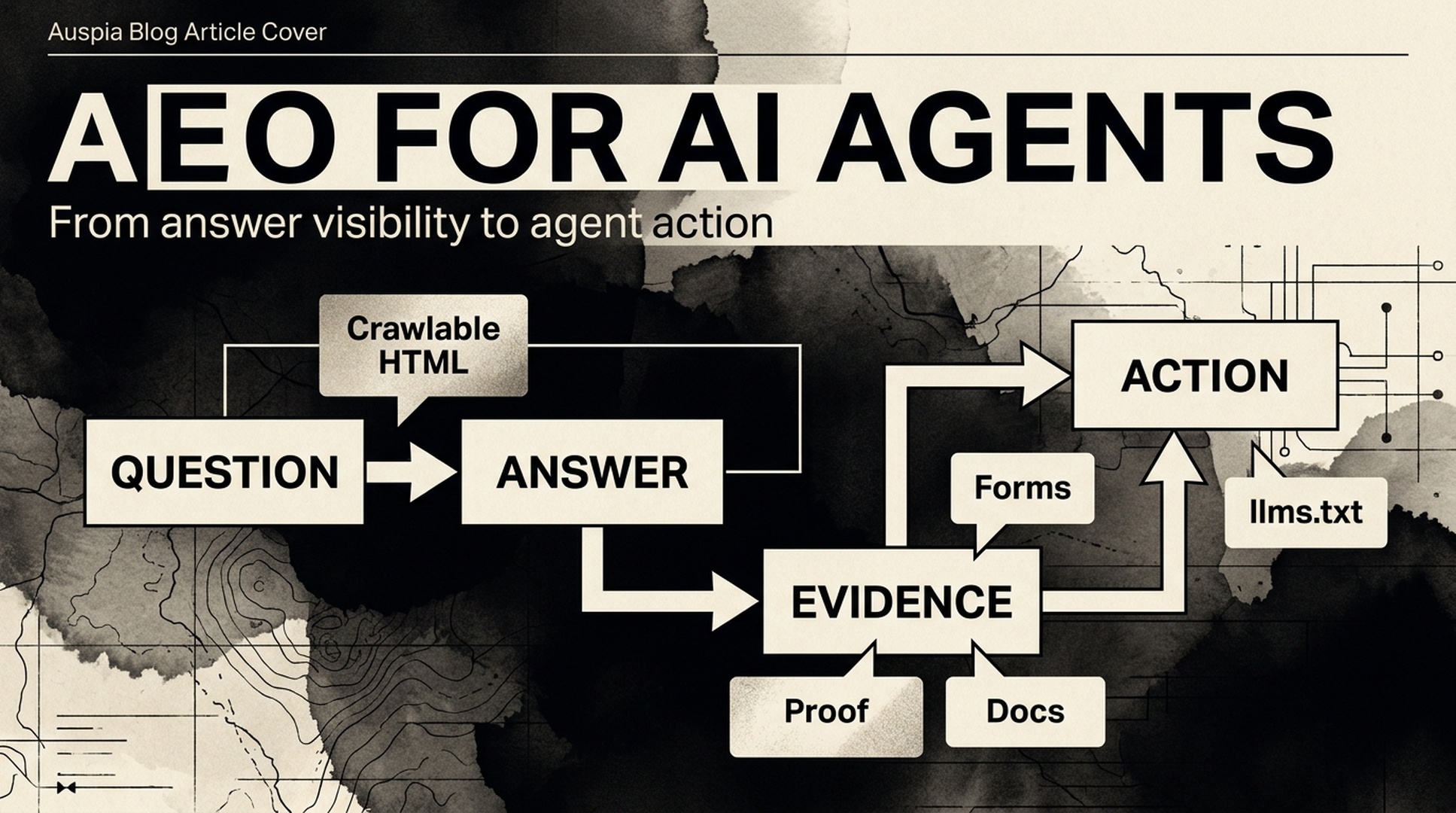
The old SEO chain was simple: keyword, ranking, click, visit. The new chain is messier: question, answer, evidence, recommendation, action. AEO sits in the middle of that chain. It decides whether your brand becomes an answer the agent can reuse, or another website the agent skips because the information is hard to parse.
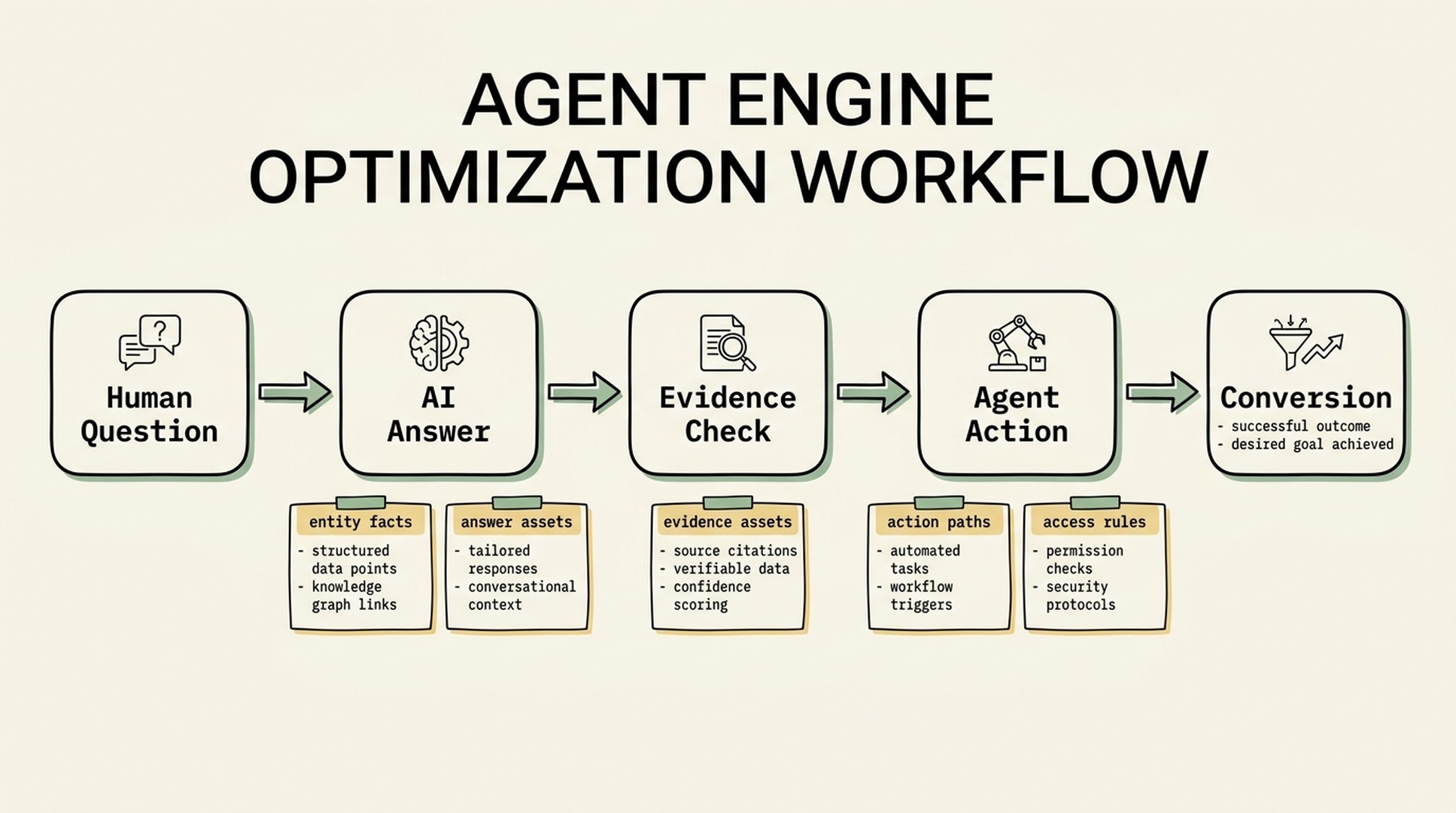
Caption: AEO now connects content structure with agent-readable evidence and action paths.
The uncomfortable problem: rankings can stay while demand disappears
Many companies notice the same pattern: rankings look acceptable, yet organic traffic and assisted pipeline soften. The team has not forgotten how to write. The search page changed around them.
Users increasingly ask longer questions inside ChatGPT, Perplexity, Gemini, Copilot, Claude, mobile assistants, vertical AI tools, and workflow agents. The user may never click ten results. The system reads, filters, compresses, compares, and returns a recommendation.
That does not mean SEO is dead. It means the click is no longer the only prize. Sometimes the prize is being mentioned in an answer. Sometimes it is being included in a shortlist. Sometimes it is being used as a source for a sales email, a procurement memo, or an automated workflow.
This is why old dashboards feel strange right now. Average ranking can look stable while branded discovery declines. Impressions may rise while clicks fall. AI-referred traffic may be small, but AI-influenced demand may be real and hard to attribute.
AEO matters because it gives teams a way to work on the part of the funnel that happens before the visit.
AEO used to mean answer engine optimization
The first useful version of AEO was about making content easier for answer systems to extract.
That work still matters. Pages should answer the main question early. Definitions should be explicit. Comparisons should be in tables. Steps should be numbered. FAQs should answer real objections, not repeat the same keyword five times. Claims should include dates, assumptions, and evidence.
A page built for answer extraction usually has a few visible traits:
Page element | Why answer engines use it | What to improve |
|---|---|---|
Direct answer near the top | It gives the model a concise answer span | Put the conclusion before the backstory |
Clear entity facts | It reduces ambiguity about who you are | State product, audience, category, locations, and use cases |
Comparison tables | They make differences easy to quote | Compare by criteria buyers actually use |
Process steps | They turn advice into reusable instructions | Use numbered workflows with inputs and outputs |
FAQ blocks | They match natural user questions | Answer objections, limits, pricing, setup, and alternatives |
Evidence links | They lower citation risk | Link to docs, cases, reviews, benchmarks, or policy pages |
This is classic answer engine optimization. It helps AI systems lift a clean answer from your content.
But agents need more than a clean paragraph.
The new AEO: agent engine optimization
An answer engine responds. An agent does work.
That difference is easy to miss. A search answer may say, "Auspia provides tools for AI search visibility and agent readiness." An agent may go further: compare Auspia with other tools, inspect a pricing page, check whether a robots.txt file allows AI crawlers, prepare a recommendation, fill a lead form, or hand off a task to another system.
Agent Engine Optimization is the practice of making your digital presence easy for AI agents to read, verify, choose, and act on.
That includes content, but it also includes product documentation, schema, API surfaces, policies, contact paths, support pages, data files, crawl permissions, and task-specific landing pages.
A plain article can win an answer. A well-structured system can win an action.
What agents need before they choose you
Agents are conservative when they are asked to make a recommendation. They need enough information to avoid a bad choice. They also need enough structure to finish the task without guessing.
In practice, they look for five kinds of assets.
First, they need identity facts. Who are you? What do you sell? Who is it for? Which regions do you serve? What integrations, languages, plans, and constraints exist?
Second, they need answer assets. These are the pages that explain categories, use cases, alternatives, workflows, and decision criteria. AEO pages belong here.
Third, they need evidence assets. Case studies, customer examples, benchmark notes, changelogs, docs, third-party mentions, and reviews give the agent confidence that the claim is not invented.
Fourth, they need action assets. Demo forms, contact pages, product docs, tool pages, API docs, pricing pages, and onboarding flows tell the agent what can happen next.
Fifth, they need access rules. Robots.txt, llms.txt, sitemap structure, canonical pages, and crawlable HTML tell AI systems what they are allowed to read and which pages should be treated as source material.
Most brands have some of these assets. Few connect them clearly.
Build pages as agent-readable answer units
A normal marketing page tries to persuade a human. An agent-readable page also has to reduce machine uncertainty.
A good page should make these statements easy to extract:
- The entity: company, product, category, market, and audience.
- The promise: what problem the product solves and where it does not fit.
- The proof: examples, data, reviews, demos, docs, or customer evidence.
- The comparison: when to choose this option instead of another.
- The next action: what a user or agent should do after reading.
This does not require robotic writing. In fact, robotic writing usually hurts. The page still needs a point of view, examples, and real experience. The structure simply helps an AI system reuse the right part.
For example, a page about an AI search visibility checker should not bury the explanation under vague product language. It should say what the tool checks, which platforms or query types it covers, what the report includes, how often to run it, and what to do after a weak score. The AI Search Visibility Checker is the kind of asset that should be connected to category education, benchmarks, and follow-up workflows, not left as an isolated tool page.
Make your website callable, not just readable
The next layer is action.
Agents will prefer brands that make the next step obvious and safe. That does not mean every site needs a public API tomorrow. It does mean common tasks should have a clear path.
Can an agent find pricing boundaries? Can it understand who the product is for? Can it locate the docs? Can it compare plans? Can it start an audit? Can it submit a lead with user permission? Can it retrieve a public policy? Can it read a product capability list without parsing a hero animation?
A callable site has boring strengths:
- Important pages are crawlable HTML, not locked inside scripts or images.
- Product and company facts are consistent across the site.
- Sitemaps, canonical tags, and internal links point to the right source pages.
- Tools and forms have stable URLs and descriptive labels.
- Documentation answers concrete implementation questions.
- Policies say what agents and crawlers may do.
- Conversion paths are short enough for a delegated task.
The work sounds unglamorous. That is the point. Agents reward clarity because clarity lowers risk.
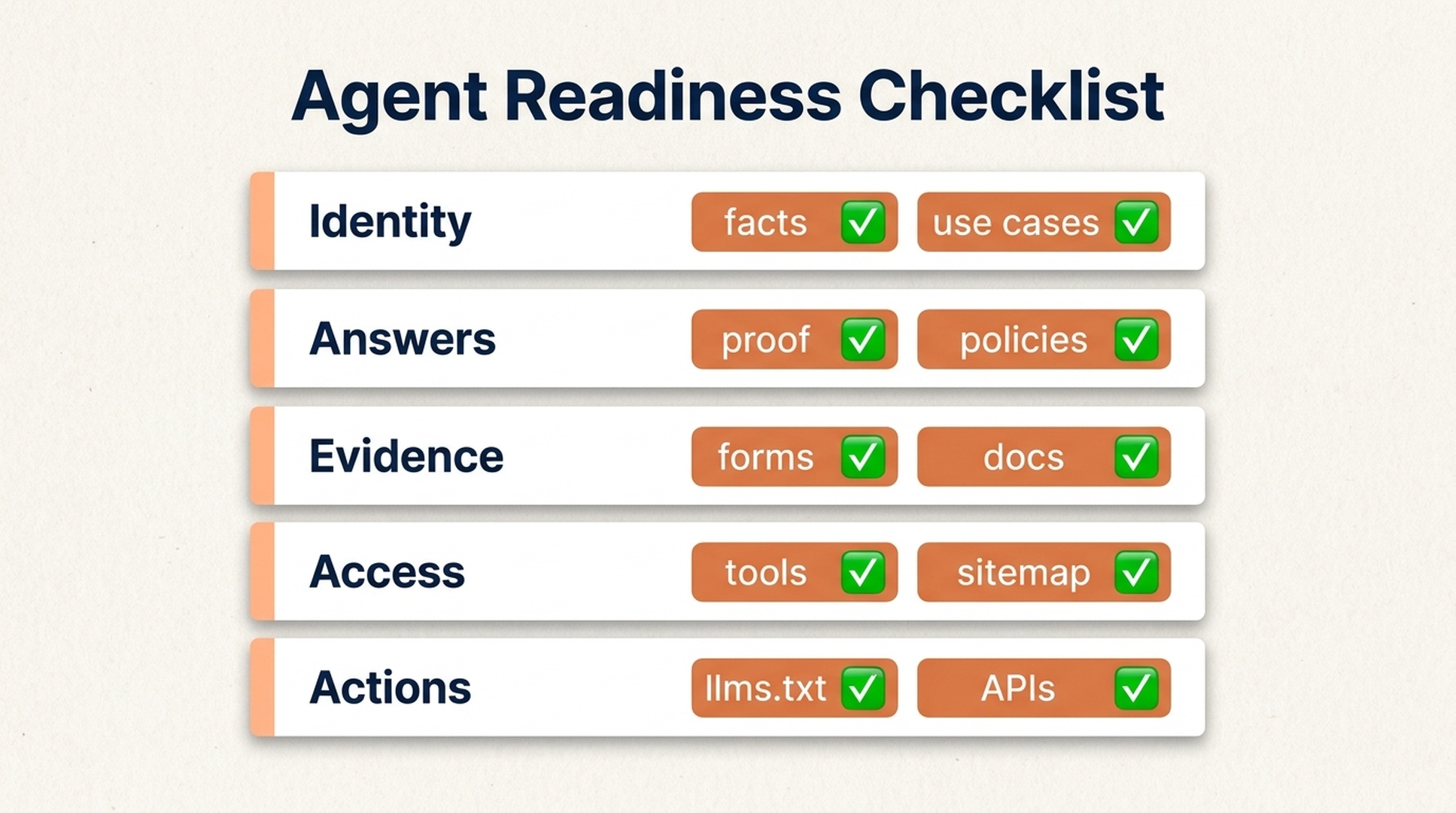
Caption: Agent readiness starts with the basics that make your site understandable and safe to use.
The AEO operating model for growth teams
AEO should not sit only with writers. It needs a small operating loop across content, SEO, product marketing, and engineering.
Start with a prompt library. List the questions a buyer, analyst, assistant, or workflow agent might ask before choosing a solution. Include comparison prompts, local prompts, pricing prompts, integration prompts, "best for" prompts, and objection prompts.
Then map each prompt to a source page. If there is no page that answers the question cleanly, create or update one. Do not write another generic blog post if the missing asset is really a pricing note, docs page, use-case page, comparison page, or FAQ.
Next, test visibility. Ask the same prompt across several AI systems and record whether the brand appears, which sources are cited, which competitors are named, and what facts are wrong. A tool like Auspia's Agent Readiness Score can help turn this into a repeatable audit rather than a one-off screenshot exercise.
After that, repair the source layer. Update pages, add evidence, fix entity confusion, improve internal links, add missing schema where useful, and make the next action clearer.
Finally, measure business impact. Track AI referral traffic where possible, but do not stop there. Watch branded search changes, demo quality, sales-call language, assisted conversions, prompt-level mentions, and the questions prospects repeat back to your team.
A practical checklist for agent engine optimization
Use this checklist before publishing or refreshing an important page.
- The page answers the core question in the first 100 words.
- The company, product, category, audience, and use case are named clearly.
- Claims include proof, examples, docs, data, or visible constraints.
- Comparisons are specific enough to help a buyer choose.
- Tables and lists use real criteria, not filler categories.
- The page links to the next useful asset: tool, docs, case, pricing, or demo.
- Important facts are consistent with the homepage, product pages, and schema.
- The page is crawlable without requiring a login, app shell, or image-only text.
- Robots.txt and llms.txt do not accidentally block the systems you care about.
- The team has tested how AI systems summarize and cite the page.
This is not a one-time migration. It is maintenance. As agents become more capable, they will punish vague sites faster because vague sites create extra work.
Common mistakes
The first mistake is treating AEO as AI content generation. More content does not help if every page says the same thing. Agents need reliable source material, not a pile of paraphrased posts.
The second mistake is hiding the answer. Some brands still write pages as if suspense creates conversion. It usually creates extraction failure. Put the answer first, then add nuance.
The third mistake is ignoring proof. A model may summarize your claim, but it is less likely to recommend you if the supporting evidence is thin.
The fourth mistake is optimizing only the blog. Agents read docs, tools, pricing pages, policy pages, and third-party sources. Your blog can introduce the answer, but it should not carry the whole trust system.
The fifth mistake is measuring only clicks. AEO may influence discovery before a visit happens. Add prompt tracking, mention tracking, and lead-source questions to the dashboard.
Auspia take: AEO is the bridge between content and execution
AEO started as a way to get into answers. It is becoming the bridge between content strategy and agent execution.
For growth teams, that is good news. The work is concrete. You do not need to chase every AI platform rumor. You need to make your brand easier to understand, easier to verify, and easier to act on.
The teams that win will not be the ones with the most AI-written pages. They will be the ones with the clearest source of truth, the best answer assets, and the least friction between a question and a useful next step.
In the old search world, the page wanted a click. In the agent world, the page has to earn trust before the click, and sometimes before the user even knows your name.
That is why AEO now deserves a broader definition: Answer Engine Optimization for visibility, Agent Engine Optimization for action.
FAQ
What is Agent Engine Optimization?
Agent Engine Optimization is the practice of making a website, content library, and product experience easy for AI agents to read, verify, recommend, and use inside a task. It extends traditional AEO beyond answer extraction into action readiness.
How is AEO different from GEO?
AEO focuses on making content answer-ready. GEO focuses on improving whether generative AI systems mention, cite, or recommend your brand. Agent-focused AEO adds the next layer: whether an AI agent can safely act on your information.
Does agent optimization replace SEO?
No. SEO still provides the crawlable foundation, entity clarity, internal links, technical hygiene, and source pages that agents and answer engines depend on. The difference is that traffic is no longer measured only by clicks from ranked pages.
Do I need an API for agent readiness?
Not always. Many teams should first fix crawlable pages, documentation, forms, policies, pricing clarity, and structured answer assets. APIs matter when agents need to complete authenticated, repeatable, or data-rich tasks.
What should a team audit first?
Start with the pages that affect buying decisions: homepage, product pages, pricing, comparisons, docs, use cases, FAQs, and top educational pages. Test whether AI systems can summarize them accurately and recommend the right next step.