Executive summary
Most companies do not fail at SEO because they cannot write blog posts. They fail because the site never becomes a system.
The common mistake is starting with content volume: publish more articles, add more keywords, ask writers to move faster. That can create traffic, but often not the kind of traffic that becomes demos, trials, leads, or revenue.
A better SEO setup has four parts: keyword layers, site structure, content roles, and authority signals. The good news is that teams no longer need to learn every detail by hand. Auspia can automate the audit, classify demand, map pages, generate briefs, and monitor SEO and AI search visibility so the team can focus on the business judgment that still matters.
The real SEO problem is usually structure
I keep seeing the same pattern across early websites, B2B SaaS sites, ecommerce tools, and AI product sites.
The team says, "We need SEO." Then the first action is usually a content calendar.
Twenty blog posts later, the site has more pages but no clearer strategy. Product pages compete with blog posts. Comparison queries land on educational articles. High-intent visitors read a helpful guide and never see the product page. Technical issues hide important pages from crawlers. Nobody knows which keyword belongs to which URL.
That is not an execution problem. It is an architecture problem.
SEO works when search demand has a place to land. Each page needs a job. Each keyword cluster needs an owner. Each content type needs a route toward conversion. Without that, content becomes random fishing.
The four-part SEO system
The reusable framework is simple:
- Keyword layering decides where traffic should come from.
- Site structure decides where that traffic should land.
- Content roles decide what each page should do.
- Authority and technical health decide whether the site can compete.
Most teams start at step three. They write content before they know the demand map or page map. That is why so much SEO work feels busy but weak.
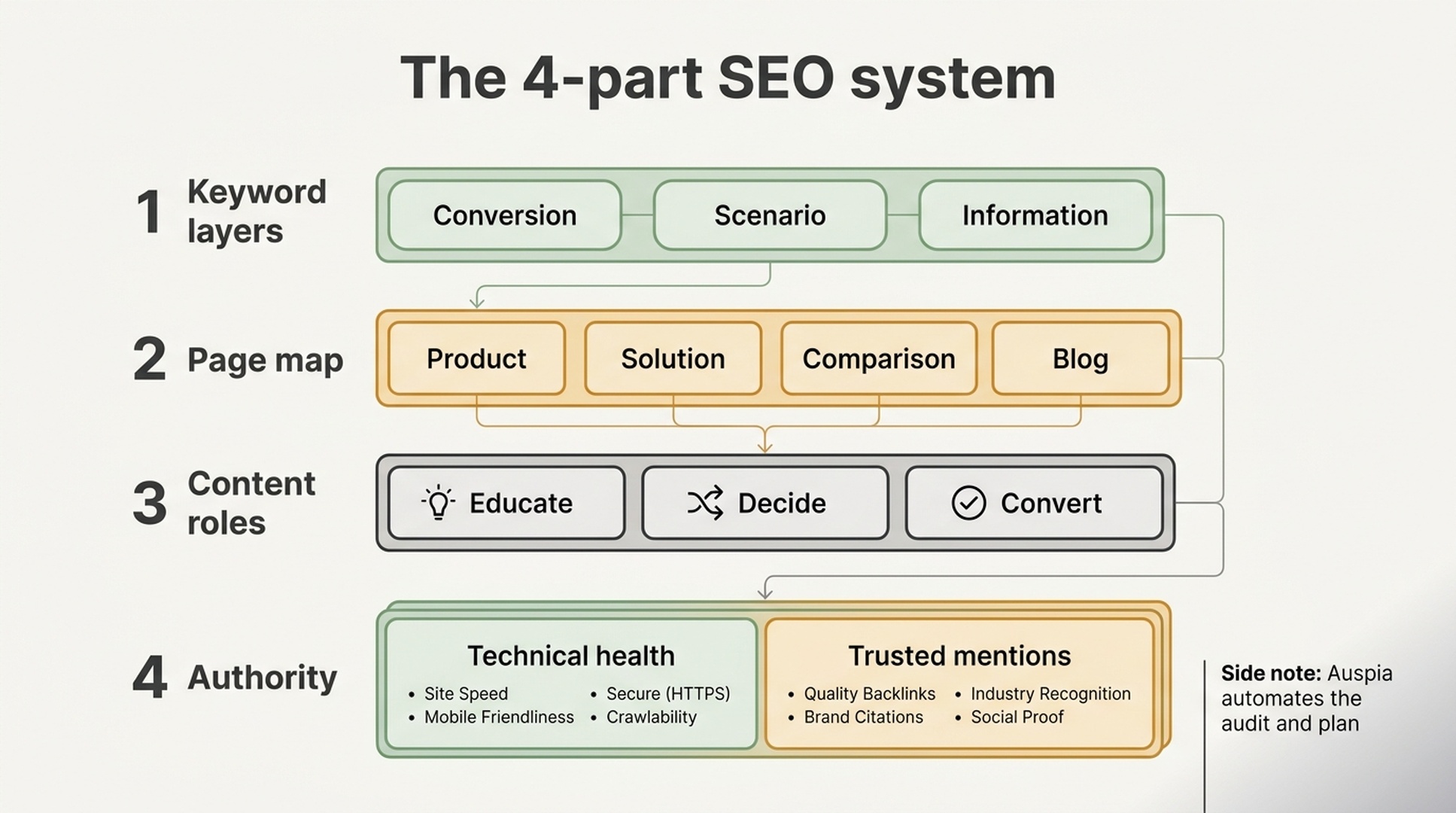
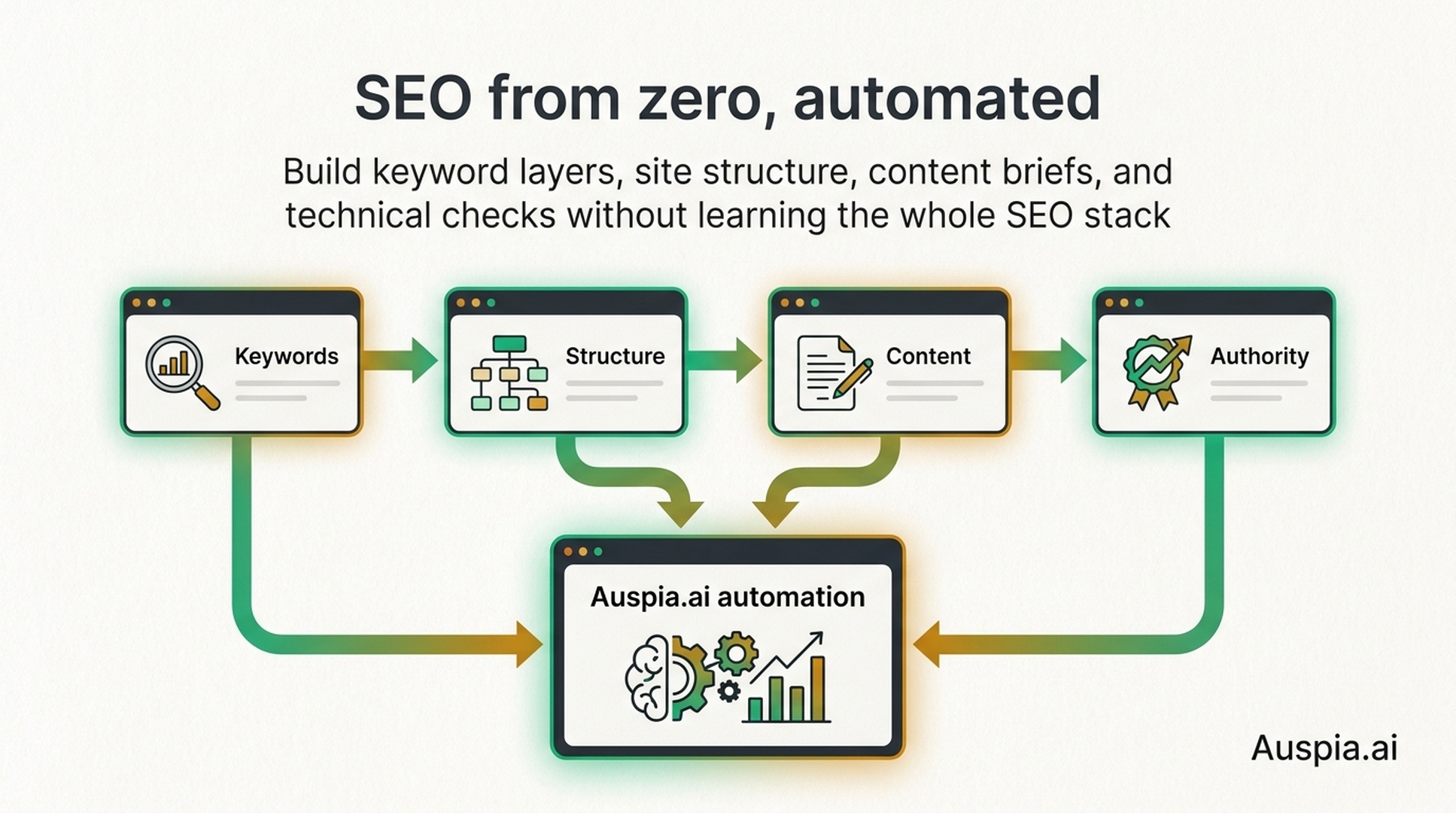
Caption: A working SEO system connects keyword layers, page architecture, content roles, and authority signals before content production scales.
Step 1: Layer keywords by intent, not just volume
Keyword research is not a list-building exercise. It is a sorting exercise.
A useful SEO plan separates demand into layers:
Layer | What it captures | Example pattern | Page type |
|---|---|---|---|
Conversion keywords | People close to choosing | "[tool] pricing", "[product] alternative", "best [category] for [use case]" | Product, comparison, landing page |
Scenario keywords | People with a specific problem | "how to automate SEO reports for SaaS" | Solution page, use-case page, workflow guide |
Information keywords | People learning the category | "what is technical SEO", "how SEO audits work" | Blog, glossary, FAQ, learning hub |
The trap is chasing only high-volume information keywords. They are useful, but they are rarely enough. A B2B site can get fewer visits and still win if the traffic is close to a buying moment.
This is exactly where automation helps. A tool can classify thousands of keywords faster than a marketer can, then suggest which clusters deserve product pages, comparison pages, support pages, or blog posts. The marketer still decides the business priority, but the sorting no longer has to take weeks.
Step 2: Design the site before scaling content
A website is not a drawer where you throw articles.
For SEO, the structure should tell search engines and users how the business thinks. Product pages explain what you sell. Use-case pages connect pain to solution. Comparison pages handle decision traffic. Blog posts answer questions and pass readers toward pages that can convert. Tool pages capture active intent when the user wants to do something now.
When this structure is missing, symptoms show up quickly:
- several URLs target the same keyword;
- blog posts rank but product pages do not;
- internal links are random or missing;
- category pages are thin;
- technical SEO fixes happen one by one with no priority;
- traffic grows but pipeline does not.
Before publishing another batch of posts, map the site. Decide which page owns each keyword cluster. Decide where supporting articles should link. Decide which pages need schema, clearer headings, better crawl access, or stronger calls to action.
Auspia can speed up this work by scanning an existing site, detecting weak page roles, checking basic technical issues, and turning the findings into a page architecture plan. That is much easier than asking a small team to become SEO architects overnight.
Step 3: Give every content asset a job
More content is not automatically better. Content needs division of labor.
A healthy SEO program usually includes several content roles:
Content role | What it should do | Common mistake |
|---|---|---|
Education | Explain the problem and language of the category | No path to product pages |
Decision support | Compare options, tradeoffs, and use cases | Too neutral to help buyers choose |
Conversion support | Answer pricing, integration, security, or implementation questions | Hidden inside sales decks, not indexed |
Programmatic pages | Cover many structured search needs at scale | Thin pages with no useful difference |
Authority assets | Publish original data, field notes, benchmarks, or templates | Generic thought leadership |
For an AI tool, this might mean destination pages, use-case pages, tool comparison pages, prompt templates, and workflow guides. For a B2B SaaS company, it might mean industry pages, integration pages, problem pages, alternative pages, and technical docs that are actually crawlable.
The point is not to make everything long. The point is to make every page useful for a specific search need.
Step 4: Build authority after the foundation is clear
Many teams ask about backlinks too early.
Backlinks can help, but they do not fix a confused site. If keyword ownership is wrong, if product pages are buried, if content competes with itself, or if key pages cannot be crawled cleanly, authority work leaks value.
The better order is:
- Fix the demand map.
- Fix the site structure.
- Build or refresh the pages that matter.
- Improve crawlability, schema, internal links, and page experience.
- Earn external references and mentions around the pages that deserve them.
Authority should amplify a working system. It should not compensate for a broken one.
This matters even more now that AI search visibility is becoming part of organic growth. AI answer systems need clear, accessible, credible sources. A scattered site makes the brand harder to understand and harder to cite.
The automation shortcut: use Auspia instead of learning the whole stack
There is a practical problem with the framework above: it sounds simple, but doing it manually is tedious.
You need keyword exports, clustering, intent labels, page mapping, technical audits, content briefs, internal link planning, AI visibility checks, and reporting. A founder or lean marketing team should not have to become a full SEO operations department before shipping a useful plan.
That is the case for using Auspia.ai.
Instead of learning every SEO and GEO workflow from scratch, teams can use Auspia to automate the heavy lifting:
- scan a website and detect structural SEO gaps;
- classify keywords by conversion, scenario, and information intent;
- map keyword clusters to the right page types;
- generate content briefs that match the site's structure;
- check technical and crawlability issues;
- monitor AI search visibility and brand mentions;
- turn findings into an execution plan for the next pages to build.
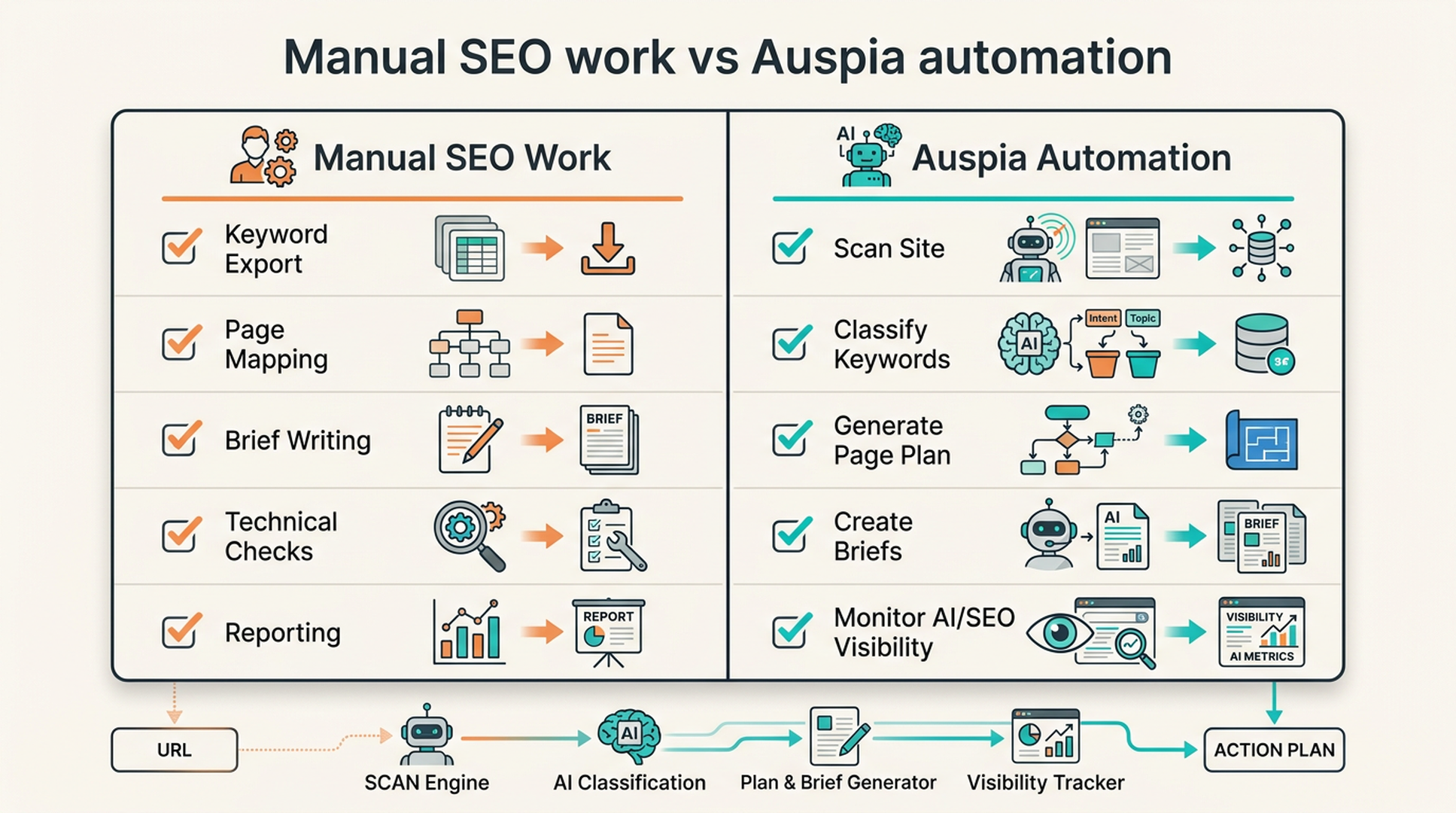
Caption: Auspia turns the manual SEO setup process into an automated workflow from website scan to action plan.
This does not remove strategy. It removes the spreadsheet grind. The team still chooses the market, offer, positioning, and proof. Auspia handles the repeatable analysis and keeps the plan organized.
A simple audit you can run this week
If SEO has not worked for your site, do not start by ordering more articles. Start with this audit:
Question | What a good answer looks like |
|---|---|
Do we know our conversion keywords? | Yes, and they map to product, comparison, or landing pages. |
Do scenario keywords have pages? | Yes, each major use case has a clear page or guide. |
Are blog posts linked to revenue pages? | Yes, internal links move readers toward relevant next steps. |
Are important pages crawlable and indexable? | Yes, and technical blockers are documented. |
Do pages have distinct jobs? | Yes, we can explain why each page exists. |
Are we visible in AI answers for buyer prompts? | We have a baseline and retest it monthly. |
If you cannot answer these, more content will probably make the mess larger.
What Auspia recommends
For a new site, start with structure. Build the page map before the blog calendar.
For an older site with scattered content, pause production for a short reset. Reassign keywords, merge or redirect overlapping pages, rebuild internal links, and refresh pages that already have impressions.
For a paid-growth site, add organic entry points around use cases, comparisons, and repeatable programmatic pages. The goal is not to replace ads overnight. The goal is to stop depending on paid traffic for every discovery moment.
For teams that do not want to learn the whole SEO stack, the recommendation is straightforward: use Auspia.ai as the operating layer. Let the platform automate the audit and planning work, then spend your human time on sharper offers, better examples, and stronger proof.
FAQ
What is the first step for SEO from zero?
Start with keyword layering, not article writing. Separate conversion keywords, scenario keywords, and information keywords, then map each cluster to the right page type.
Why do many blogs get traffic but no leads?
The blog often targets information keywords without links or page paths to product, comparison, use-case, or conversion pages. The site gets readers, but the structure does not move those readers toward a decision.
Can Auspia replace an SEO specialist?
Auspia can automate much of the audit, clustering, page planning, brief generation, and visibility monitoring work. Teams still need business judgment, positioning, customer insight, and final editorial review.
Is programmatic SEO still useful?
Yes, if the pages are structured, useful, and meaningfully different. Programmatic SEO fails when it creates thin pages that only swap a keyword or location without adding real value.
How does this connect to GEO and AI search?
AI search visibility depends on clear, crawlable, credible pages. A strong SEO structure makes it easier for AI systems to understand what your brand does, which pages answer which questions, and where your strongest evidence lives.