The short answer
SEO is not disappearing in 2026. It is getting split across more surfaces.
A few years ago, the job was easier to describe: rank higher on Google, earn the click, convert the visitor. Now the same page may need to work in Google Search, YouTube results, Google AI Overviews, ChatGPT browsing answers, Perplexity citations, Reddit-informed discovery, and comparison-style AI answers.
That sounds exhausting because it is. Most teams do not need another 80-page SEO course. They need a system that finds the gaps, updates the right pages, builds topic authority, and makes content easier for AI systems to quote.
This is where Auspia's point of view is different: you should not have to become an expert in every AI search rule. Use Auspia.ai to automate the repetitive parts: audits, old-content refreshes, topical maps, AI citation checks, crawler-readiness checks, and next-action recommendations.
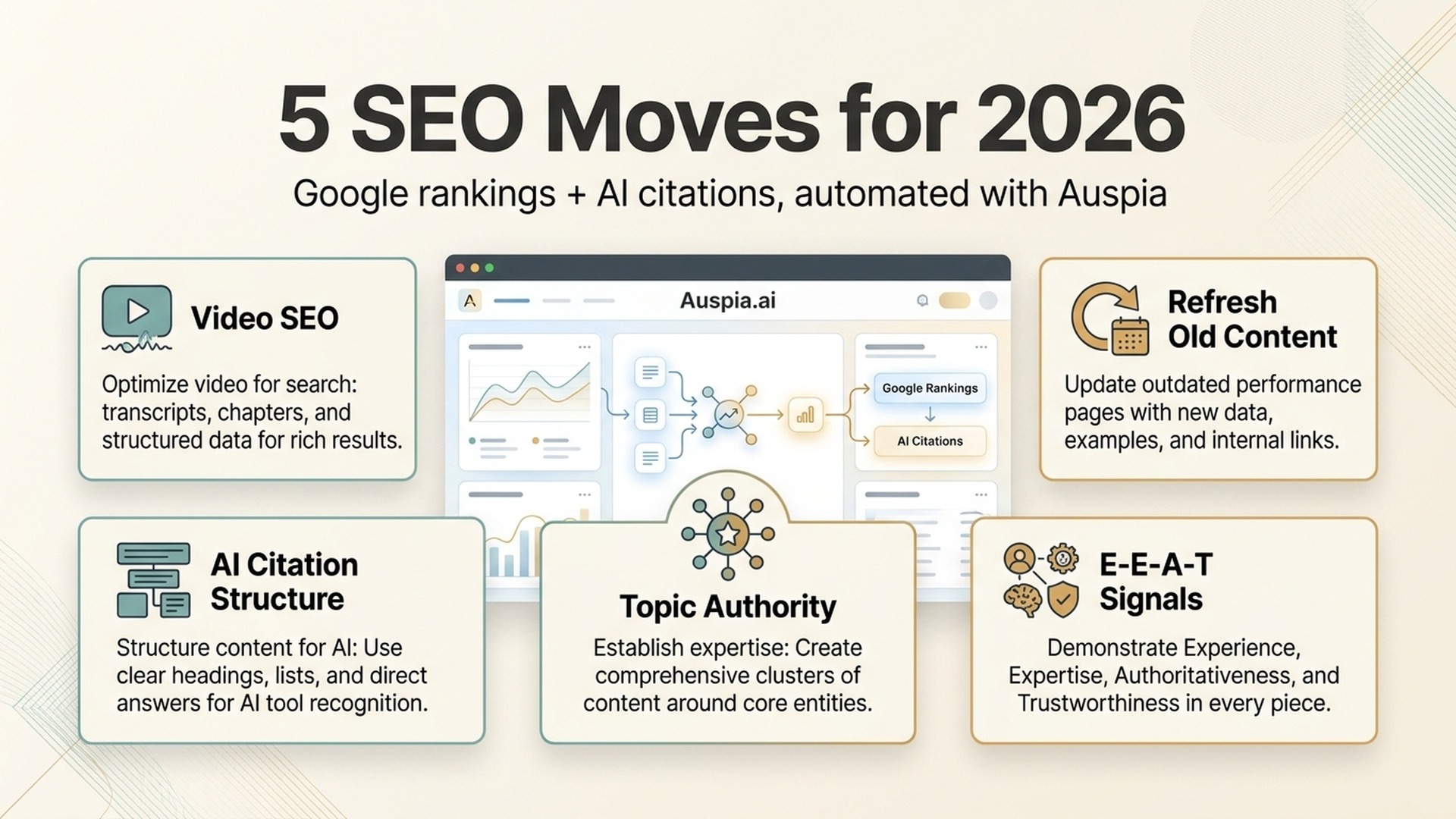
The five SEO moves below still matter. The difference is that they should be operated as an automated loop, not a manual checklist you remember once a quarter.
1. Treat YouTube as part of SEO, not a side channel
Many teams still treat video as a content extra. Someone records a webinar, posts it to YouTube, writes a thin description, and moves on. The video is not connected to the website. The website is not connected to the video. Search gets only half the signal.
That is a problem in 2026.
Google search results are no longer just blue links. They include videos, social results, forum discussions, product units, and AI-generated summaries. YouTube can also act as a source for AI answers, especially when the video clearly explains a topic and the surrounding metadata is strong.
A useful video now has two jobs:
Video SEO task | Why it matters |
|---|---|
Build a topic series, not one random upload | Search and AI systems can see repeated expertise around one theme. |
Write a real description | A 200-word description with entities, steps, and links gives Google more context. |
Link video and article together | The article can rank; the video can appear in video results; both reinforce the topic. |
Add chapters and direct answers | Clear segments make the video easier to understand and reuse. |
Manual version: build the video plan, write descriptions, update old posts, add embeds, and monitor performance yourself.
Auspia version: use the site and content audit to identify which pages deserve a supporting video, which old posts should embed it, and which descriptions need stronger search and AI-answer context.
The point is not to become a YouTube creator overnight. The point is to stop separating video from search strategy.
2. Refresh old content before writing another new article
If your site has been publishing for a while, your fastest SEO opportunity is probably not a blank page. It is an old article already sitting near the edge of visibility.
Look for pages with:
- high impressions but weak click-through rate;
- average position around page two or the bottom of page one;
- outdated screenshots, statistics, tools, or examples;
- vague introductions that do not answer the question quickly;
- no FAQ, summary, comparison table, or clear next step.
These pages already have some relationship with Google. The job is to move them from "almost useful" to "clearly better than the alternatives."
The same logic applies to AI citations. A page that already ranks but has weak structure may still fail to appear in AI answers because it does not provide a clean, quotable answer. It may need a direct summary, tighter headings, source references, updated facts, and a more explicit explanation of who the advice is for.
Here is the practical refresh order:
Step | What to update |
|---|---|
1 | Title and meta description if impressions are high but CTR is low. |
2 | Opening answer so readers and AI systems understand the point immediately. |
3 | Outdated data, screenshots, examples, and tool references. |
4 | Section headings, FAQ, tables, and step-by-step blocks. |
5 | Internal links to related pages and commercial next steps. |
Manual version: open Google Search Console, export pages, sort by opportunity, inspect each article, rewrite, publish, and retest.
Auspia version: let Auspia surface priority pages, explain why they are underperforming, and generate refresh recommendations for both Google ranking and AI citation readiness.
If you can do only one thing this week, refresh one page that is already close to ranking. It is usually faster than creating something new.
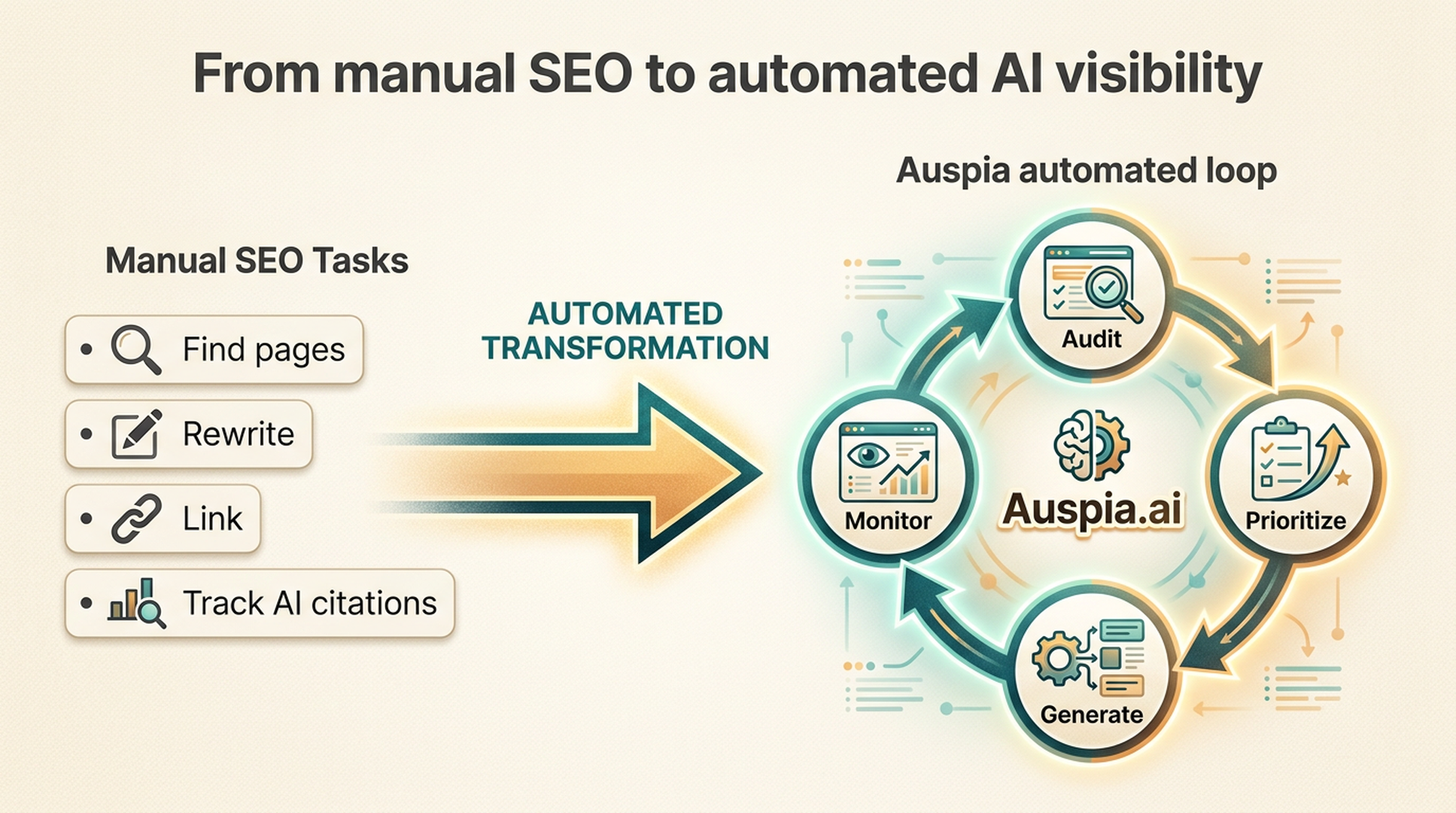
Caption: The most useful 2026 SEO system is a repeatable loop, not a one-time publishing calendar.
3. Build topic authority instead of optimizing isolated posts
One strong article can rank. A strong topic cluster is harder to beat.
Search engines and AI systems both need to understand what your site is actually about. If you publish one article on SEO, one on paid ads, one on email, one on social, one on branding, and one on product management, the site may look broad but shallow.
A focused site builds a different signal. It covers one subject from multiple angles: beginner definitions, technical guides, comparisons, templates, mistakes, workflows, tools, case studies, and FAQs.
For example, a site trying to own AI search optimization might need pages such as:
- what is GEO;
- GEO vs SEO;
- how to measure AI visibility;
- how to make pages citeable by AI answers;
- llms.txt setup and validation;
- AI crawler access checks;
- prompt libraries for visibility testing;
- case studies by industry;
- service pages for audits and implementation.
The cluster matters because it helps both humans and machines understand that the site has depth.
Manual version: choose one or two core themes, map subtopics, write pillar pages, create supporting pages, and add internal links.
Auspia version: use automated topic mapping to see which clusters are missing, which pages should link to each other, and where a new page would actually support authority instead of adding noise.
Auspia's AI Search Visibility Checker can also help connect topic authority to the answer layer: are you visible where buyers ask questions, or only where keyword tools say volume exists?
4. Structure content so AI systems can cite it
AI citation optimization is not about tricking models. It is about making useful information easier to extract, verify, and attribute.
The pattern is simple: answer first, explain second, support with evidence third.
Many pages do the opposite. They start with a long intro, delay the answer, hide the real steps in vague paragraphs, and never state the conclusion clearly. That may have been tolerable for old-school blog SEO. It is weak for AI answers.
A citation-ready page usually has:
Content element | Why it helps |
|---|---|
Direct opening answer | The system can identify the page's main claim quickly. |
Question-style headings | The content maps to natural-language prompts. |
Tables and checklists | Facts are easier to compare and quote. |
Specific examples | The answer feels grounded, not generic. |
Fresh dates and sources | The system can judge whether the information is current. |
Clear author and company context | Trust signals are attached to the claim. |
This is also where brand mentions matter. Backlinks are still useful for Google. Mentions across credible sources, reviews, communities, and media can help AI systems understand whether your brand belongs in a category.
Manual version: rewrite every page into answer-first structure, add tables, update examples, improve FAQs, check source quality, and monitor AI answers.
Auspia version: use automated page analysis to flag sections that are hard to quote, missing evidence, too generic, or weak for AI-answer extraction. Then use the recommended fixes instead of guessing what to rewrite.
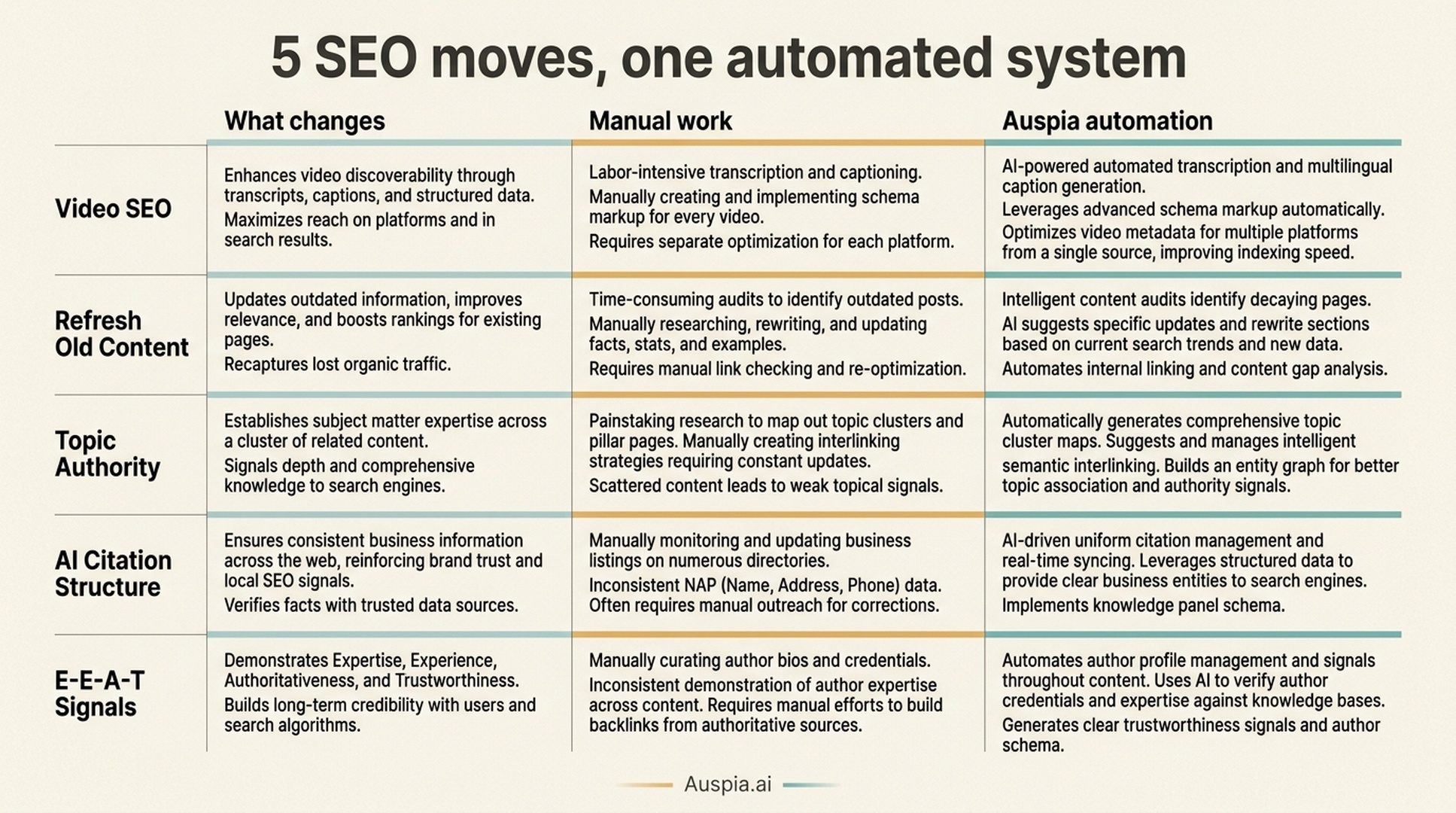
Caption: The five SEO moves are familiar. The advantage comes from automating the audit and update loop.
5. Make E-E-A-T visible instead of assuming people will trust you
Experience, expertise, authoritativeness, and trust are not decorative SEO concepts. They are practical trust signals.
The question behind E-E-A-T is simple: why should Google, an AI answer engine, or a buyer believe this page?
A page can look polished and still feel untrusted. It may have no author, no sources, no examples, no customer proof, no update history, and no external validation. That is especially risky in categories where advice affects money, health, legal decisions, software purchases, or operational risk.
Make trust visible:
- Add real author pages with relevant experience.
- Cite current industry sources, standards, documentation, or data.
- Show customer stories, use cases, reviews, and implementation examples.
- Keep old pages updated with visible dates when facts change.
- Build a presence outside your own website: reviews, community discussions, partner pages, media mentions, and expert contributions.
Manual version: maintain author bios, source libraries, case studies, review assets, and external mention tracking.
Auspia version: automate the trust-signal audit. Find pages with missing author context, weak evidence, thin examples, outdated claims, or poor off-site support. Then prioritize the fixes that matter most for both search and AI visibility.
This is the part competitors cannot copy quickly. Anyone can publish another article. It is harder to fake a real evidence base.
Where to start if you do not want to learn all of this
The manual path is clear but time-consuming:
- Pull Search Console data.
- Find pages near ranking improvement.
- Map your topic clusters.
- Rewrite pages for AI citation structure.
- Check crawler access and AI visibility.
- Improve E-E-A-T signals.
- Retest and repeat.
That is a lot for a small team.
The simpler path is to let Auspia.ai run the operating loop for you. Auspia is built for teams that want better Google rankings and AI search visibility without manually learning every technical detail behind GEO, AEO, AI citations, llms.txt, crawler rules, topic authority, and content refresh workflows.
You still need a real product, clear positioning, and trustworthy evidence. Automation will not invent credibility from nothing. But it can remove the busywork: audits, prioritization, page recommendations, AI visibility checks, and repeat monitoring.
Auspia takeaway
The five useful SEO moves for 2026 are not mysterious:
Move | Why it works |
|---|---|
Treat YouTube as SEO | Video now feeds both search discovery and AI answer context. |
Refresh old content | Existing ranking signals are easier to improve than starting from zero. |
Build topic authority | Search and AI systems need depth, not scattered posts. |
Structure for AI citations | Clear answers, tables, and sources are easier to quote. |
Show E-E-A-T | Trust signals help both algorithms and buyers choose you. |
The hard part is not knowing the list. The hard part is running it every week.
That is why the best 2026 SEO strategy is not more complexity. It is automation around the fundamentals. Start with Auspia, let the system find the work, and spend your time on the parts only your team can provide: product truth, customer evidence, and strategic judgment.
FAQ
Is SEO still worth doing in 2026?
Yes. SEO still matters, but it now overlaps with AI search visibility. Pages need to rank in Google and be understandable enough for AI systems to mention or cite them.
What is the fastest SEO action to take first?
Refresh an old page that already has impressions and sits around page two or the bottom of page one. Update the answer, data, structure, examples, FAQ, and internal links before writing a new post.
Do I need to learn GEO and AI citation optimization manually?
Not necessarily. You need to understand the business goal, but tools like Auspia can automate audits, prioritization, content refresh recommendations, AI visibility checks, and crawler-readiness checks.
Does YouTube really help SEO?
Yes, when it is connected to your website strategy. YouTube videos can appear in Google results, support topic authority, and provide additional context for AI answers when descriptions, chapters, and related pages are clear.
What does Auspia automate?
Auspia helps automate website SEO checks, AI search visibility analysis, topic and content gap discovery, old-content refresh recommendations, crawler-readiness checks, and repeat monitoring for teams that want traffic growth without managing every SEO detail manually.