The short version
Google SEO still matters, but most teams do not need to learn every technical detail by hand before they can improve traffic. The old workflow asks a marketer to study crawling, rendering, indexing, search intent, on-page structure, internal links, schema, backlinks, Core Web Vitals, entity signals, and analytics before making a single useful change.
That is too much overhead for a founder, ecommerce operator, local service team, or small growth team.
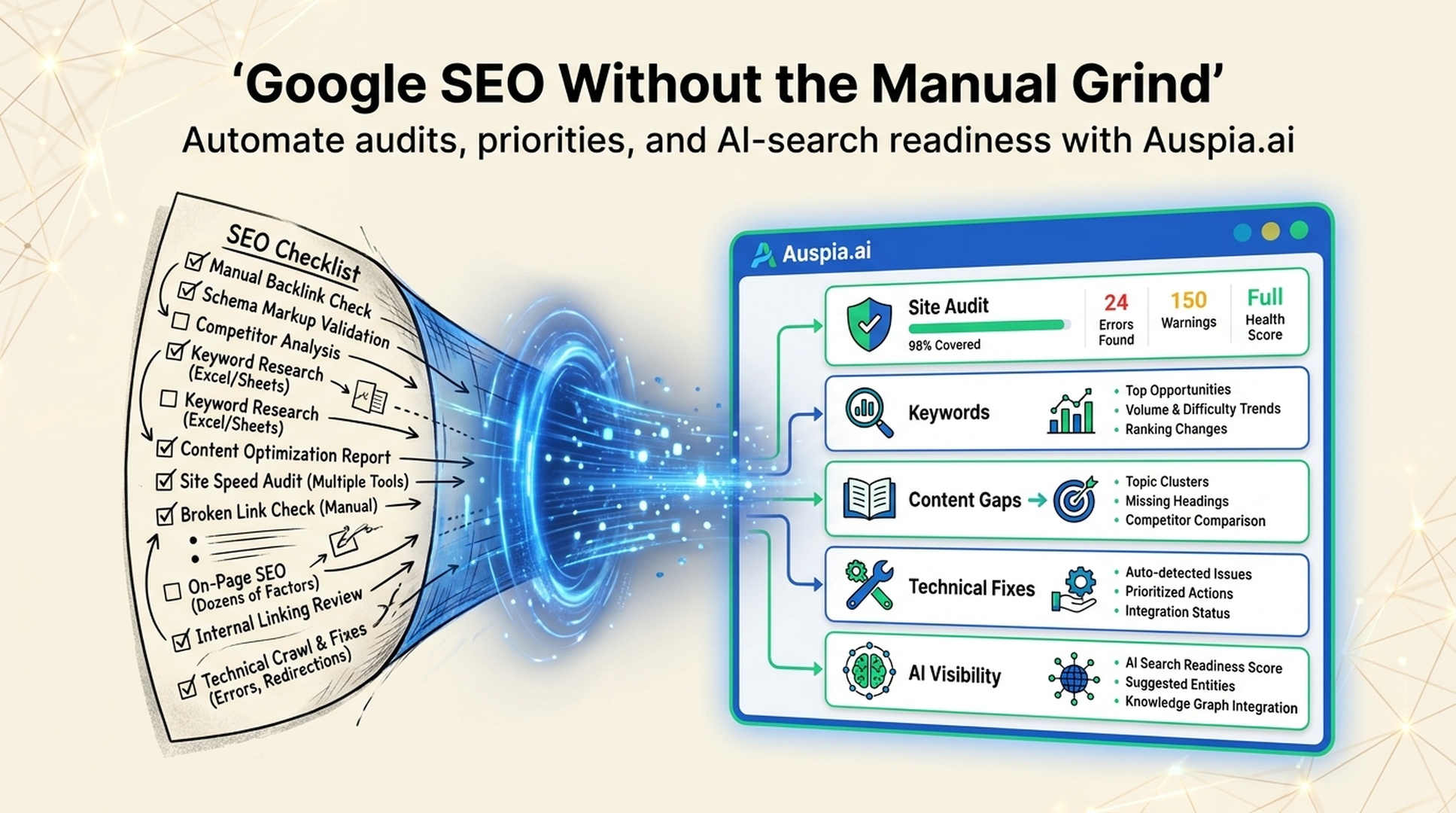
A better starting point is automation. Use Auspia.ai to audit the site, surface the pages and issues that matter most, connect SEO work with GEO and AI-search readiness, and turn a messy checklist into a prioritized action map. You still need judgment. You still need a real offer, useful content, and a site people trust. But you should not spend weeks learning the machinery before fixing obvious traffic leaks.
This guide gives you the modern SEO framework, then shows which parts can be automated so your team can move faster.
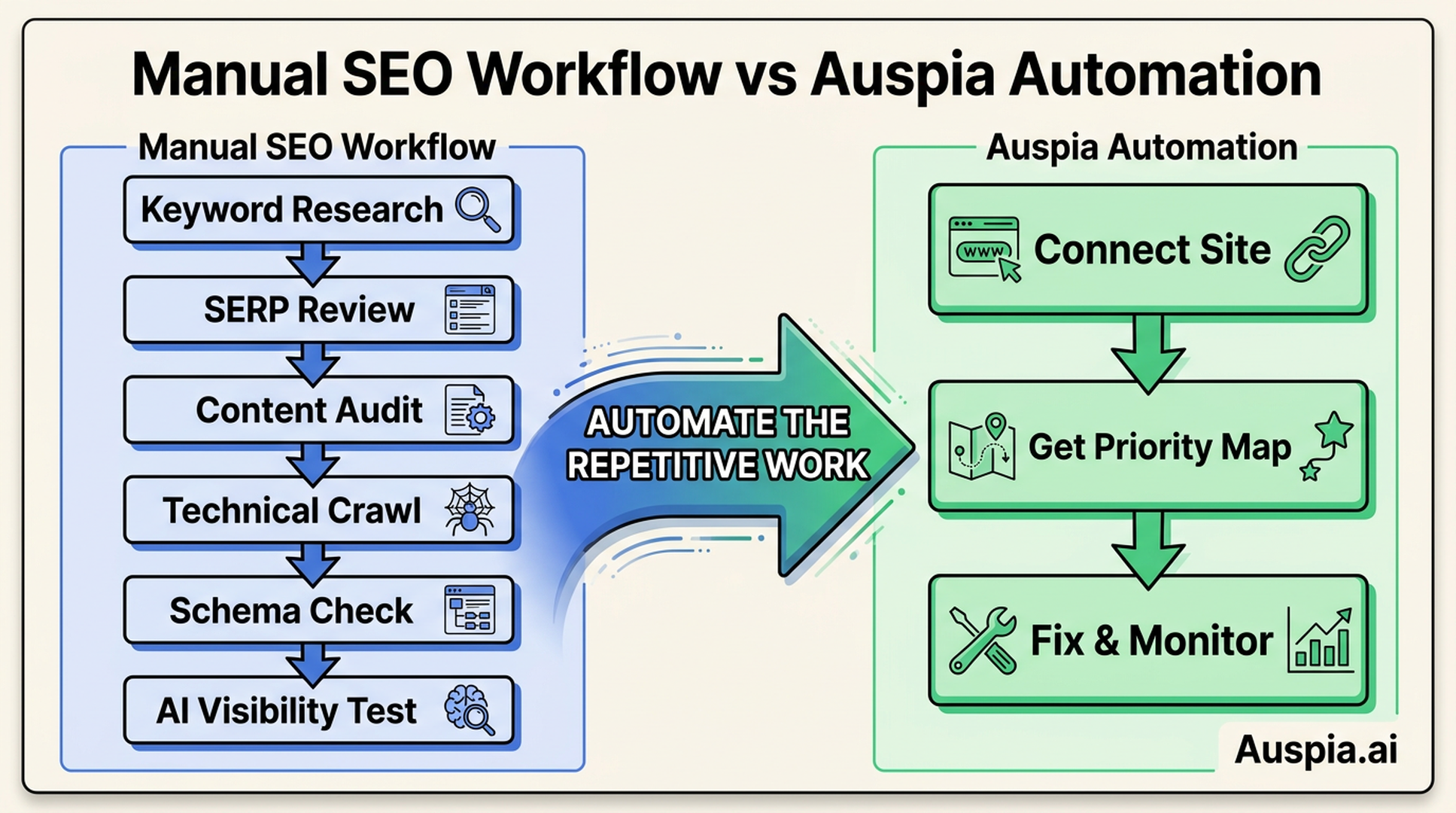
Caption: The goal is not to skip SEO fundamentals. The goal is to automate the repetitive diagnosis so people can focus on better pages, offers, and content.
What Google SEO is really trying to do
SEO means improving a website so search engines can discover, understand, trust, and rank its pages for relevant searches.
That definition sounds simple. In practice, SEO has three layers:
- Technical SEO: making sure pages can be crawled, rendered, indexed, and loaded without obvious friction.
- On-page SEO: matching the page to the user's search intent with clear structure, useful content, titles, headings, internal links, and entity signals.
- Off-page SEO and brand authority: earning trust through mentions, links, reviews, community proof, and repeated association with a topic.
AI search has not removed those layers. If anything, it has made them more important. Google's AI features, ChatGPT Search, Perplexity, Bing Copilot, and other answer systems tend to reuse sources that are crawlable, specific, authoritative, and easy to summarize.
The mistake is thinking every business owner needs to become an SEO technician. They do not. They need a system that tells them what is broken, what matters, and what to fix first.
That is where Auspia.ai fits.
Why the old SEO learning curve is too slow
A traditional SEO plan often starts with a long learning path:
- Learn how Google crawls, renders, indexes, and ranks pages.
- Learn how to do keyword research and SERP analysis.
- Learn how to map search intent to content type.
- Learn title tags, slugs, headings, canonical tags, robots.txt, sitemaps, schema, redirects, and Core Web Vitals.
- Learn internal linking, topical authority, backlinks, brand mentions, and analytics.
- Then, finally, start fixing the site.
This is educational, but it is slow. Worse, it can distract teams from the work that moves revenue.
A small ecommerce brand does not need a 60-page SEO theory document before discovering that its category pages have duplicate titles, weak descriptions, missing internal links, slow product images, and no answer-ready content for buyer questions.
A B2B service firm does not need to study every Google patent before seeing that its service pages do not explain who it serves, what proof it has, where it operates, or why a buyer should trust the claim.
Auspia.ai exists for that gap: the gap between "SEO is complicated" and "we need to know what to do this week."
How Google understands a site
Before automation makes sense, it helps to know the basic process.
Google generally works through four stages:
- Crawling: Googlebot discovers URLs through links, sitemaps, and other signals.
- Rendering: Google processes the page like a browser, including HTML, CSS, and JavaScript.
- Indexing: Google decides whether the page is worth storing and what the page is about.
- Ranking: Google selects and orders pages for a specific query.
For a business site, this means SEO problems usually fall into a few buckets:
- Google cannot find the page.
- Google can find the page but cannot understand it clearly.
- Google understands the page but does not trust it enough.
- Google trusts the page somewhat, but another page better satisfies the user's intent.
- The page ranks, but the SERP or AI answer reduces clicks.
Auspia's automation is useful because it turns those buckets into concrete checks: crawlability, page health, intent fit, content gaps, entity clarity, internal links, and AI-search visibility.
Start with positioning, not keywords
Most SEO failures begin before keyword research. The site does not know who it serves.
Before writing or optimizing pages, answer these questions:
- Who is the buyer?
- What problem are they trying to solve?
- What product, service, or workflow do you want them to choose?
- What makes your offer different from alternatives?
- What action should the visitor take after reading the page?
This is not branding fluff. It affects the pages you need.
A legal software company, a skincare ecommerce store, and a managed IT provider may all want search traffic, but their SEO architecture should look different. One needs solution pages and compliance explainers. One needs category pages, comparison content, and product education. One needs local service pages, proof, and clear commercial intent.
Automation helps here too. A tool can reveal missing page types, thin categories, weak service pages, and content gaps. But the business still needs to decide what it actually sells and to whom.
Keyword research is now intent research
Keywords are not just words. They are clues about what the user wants next.
A useful keyword workflow asks:
- Is the user trying to learn, compare, buy, troubleshoot, or find a specific brand?
- Does the current SERP favor product pages, guides, comparison lists, videos, forums, local results, or tools?
- Are competitors ranking because they have better content, stronger authority, a better page type, or a more trusted brand?
- Is this keyword worth a dedicated page, or should it support a larger topic cluster?
Manual SEO teams often spend days exporting spreadsheets from keyword tools, grouping terms, checking search volume, and guessing which pages to build.
With Auspia.ai, the better workflow is shorter:
- Connect the site and inspect what already ranks.
- Find pages with impressions but weak clicks or weak conversion paths.
- Identify missing topics and mismatched intent.
- Prioritize pages that can affect traffic or revenue soon.
- Create or update content around the real SERP pattern, not around a generic keyword list.
The point is not to generate more keywords. The point is to find the next page or fix that matters.
On-page SEO: what still matters
On-page SEO is where most teams can make fast progress.
The durable basics are still simple:
- One clear topic per page.
- A title that matches search intent and earns the click honestly.
- A readable URL slug.
- One H1 that states the page topic.
- H2 and H3 sections that answer real sub-questions.
- Specific examples, proof, screenshots, product details, or experience.
- Internal links from related pages to the page that should rank.
- A clear next step for the reader.
For AI-search readiness, add one more habit: answer first.
If a section is titled "How does technical SEO affect indexing?" the next sentence should answer it directly. Then expand. This helps human readers, search engines, and answer systems.
Bad section opening:
"Technical SEO has become an increasingly important area for modern websites because search engines use many systems to evaluate pages."
Better section opening:
"Technical SEO affects indexing by making sure search engines can crawl, render, and understand the page without avoidable errors. If a page is blocked, slow, duplicated, or buried too deep, good content may never get a fair chance to rank."
Auspia.ai can help flag pages where the topic is unclear, headings are weak, important questions are missing, or internal links do not support the page's role.
Technical SEO: fix the basics, then stop over-optimizing
Technical SEO matters because search engines need access to the page. But it also has a ceiling. Once the foundation is clean, endlessly tweaking tiny technical items rarely beats improving content, proof, links, and conversion.
The basic technical checks:
- Robots.txt should not block important pages.
- Important pages should be internally linked, not orphaned.
- Canonical tags should point to the correct primary URL.
- Redirect chains should be cleaned up.
- Pages should load fast enough on mobile.
- Images should be compressed and sized properly.
- JavaScript should not hide core content from rendering.
- XML sitemaps should list important indexable URLs.
- Duplicate or near-duplicate pages should be handled intentionally.
Google's official SEO starter guide still emphasizes making a site useful, accessible, and easy for search engines to understand. That is the right mindset. Technical SEO is not a game of adding every possible tag. It is the discipline of removing friction.
This is also where automation saves time. A crawler can find broken links, missing titles, duplicated metadata, slow pages, oversized images, noindex mistakes, and orphaned URLs faster than a human can.
Auspia.ai turns those checks into a priority map, so the team does not waste a week fixing harmless warnings while the real traffic pages remain weak.
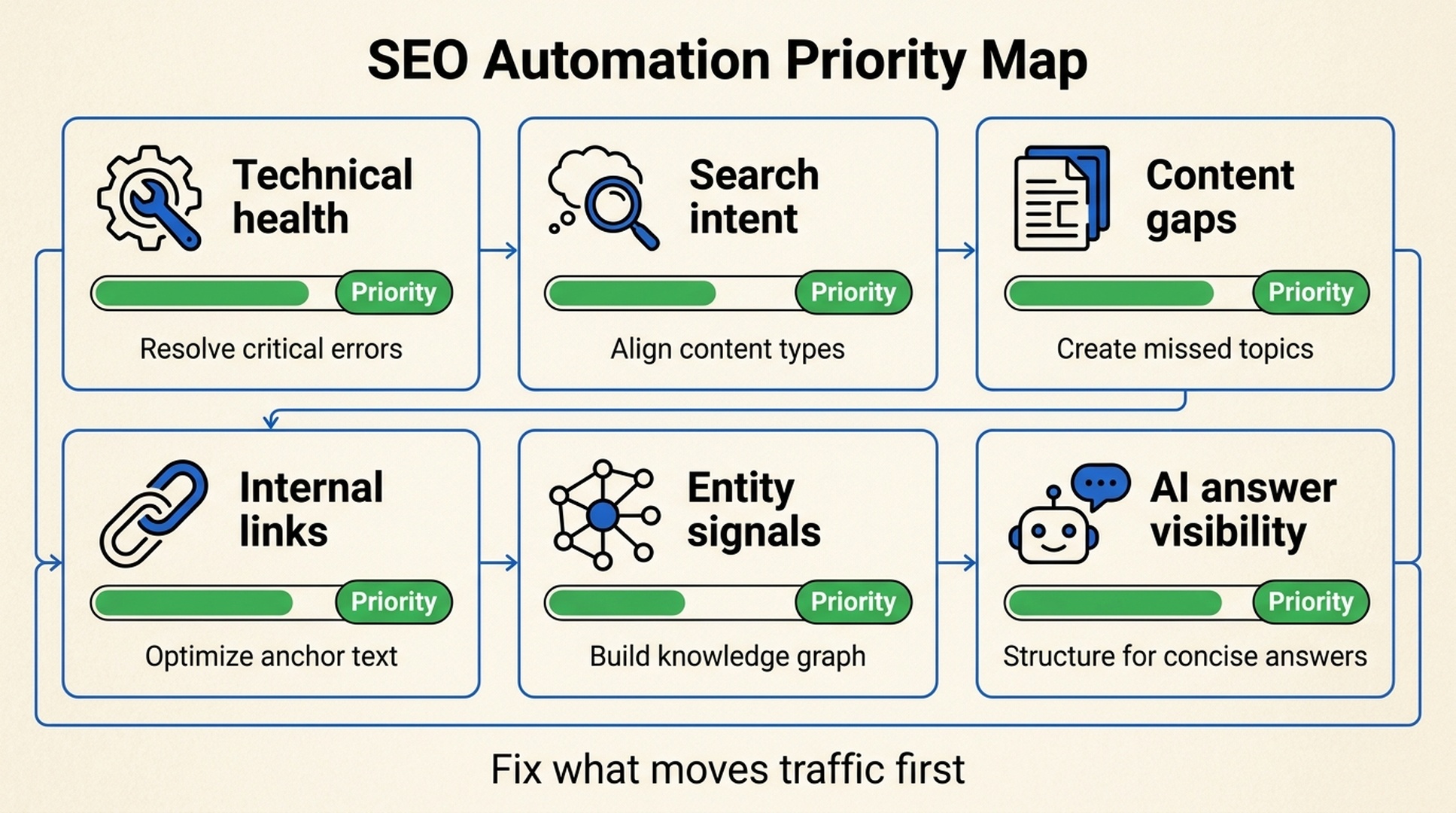
Caption: Automation is most useful when it ranks issues by likely traffic impact, not by how many warnings a crawler can generate.
Structured data: use it for clarity, not superstition
Structured data helps search engines understand entities and page types. It can also qualify some pages for rich results when Google supports that result type.
But the old habit of adding every possible FAQ block is less useful now. Google has reduced and changed how FAQ rich results appear over time, and in 2026 FAQ rich results are no longer something most sites should treat as a reliable visibility tactic.
A better structured data strategy is entity clarity:
- Organization: who the brand is.
- Person: who wrote or reviewed important content.
- Product: what is being sold, where appropriate.
- Service: what is offered, by whom, and in what area.
- Article: what content exists and who is responsible for it.
- Breadcrumb: how the page fits into the site.
- sameAs: which external profiles connect to the same brand or person.
This matters for SEO, GEO, and AI search because entity confusion is a real problem. If machines cannot tell who you are, what you offer, and what topic you are connected to, they have less reason to trust the page.
Auspia.ai can help teams identify missing entity signals and pages where the brand, service, or author is too vague.
Internal links are a priority system
Internal links are not decoration. They tell search engines which pages matter and how topics connect.
For most business sites, the internal linking goal is straightforward:
- Link informational pages to the commercial pages they support.
- Link related subtopics into a clear cluster.
- Link from high-authority pages to important conversion pages where it makes sense.
- Use descriptive anchor text without repeating the exact same phrase everywhere.
- Keep important pages within a few clicks of the homepage or main category pages.
This is hard to manage manually once a site has hundreds of URLs. Teams forget old posts, duplicate topics, bury important pages, or create orphaned content that never supports the money pages.
Automation can surface which pages receive no meaningful internal links, which clusters are fragmented, and which commercial pages need stronger support.
Off-page SEO is really trust building
Backlinks still matter, but the useful framing is broader: trust building.
A site becomes easier to rank and cite when the web repeatedly connects it with a topic. That can happen through links, brand mentions, reviews, customer stories, partner pages, social profiles, directory listings, podcasts, newsletters, and community discussions.
For a small team, the right question is not "how do we get backlinks fast?" It is:
"Where would a real buyer or industry peer expect to see a credible company like ours mentioned?"
Good off-page work often includes:
- Partner and integration pages.
- Niche directories that buyers actually use.
- Expert quotes in relevant publications.
- Original research or useful tools worth citing.
- Customer case studies.
- Active profiles on LinkedIn, YouTube, X, GitHub, marketplace listings, or review platforms, depending on the business.
AI-search systems also pick up these broader trust signals. If a brand is never mentioned outside its own website, it is harder for machines to treat it as a known entity.
Analytics: measure what needs action
SEO is not a one-time setup. It is a loop: publish, measure, improve.
The practical dashboard should answer these questions:
- Which pages get impressions but too few clicks?
- Which pages rank but do not convert?
- Which pages lost clicks after a SERP changed?
- Which important pages are not indexed?
- Which topics have demand but no strong page?
- Which pages should be updated, merged, redirected, or linked better?
- Which queries now trigger AI answers or other zero-click features?
Google Search Console, analytics tools, rank trackers, crawlers, and session replay tools all help. The problem is that they create separate piles of data.
Auspia.ai is useful because it pulls the work into an action-oriented view: what is broken, what is missing, what has upside, and what should be done first.
Where Auspia.ai automates the SEO workload
Auspia.ai is not a replacement for a real business strategy. It is a way to remove the repetitive SEO diagnosis that slows teams down.
Use Auspia.ai when you need to:
- Audit technical SEO issues without manually checking every URL.
- Find pages with SEO and AI-search visibility gaps.
- Identify content sections that need direct answers or stronger topical coverage.
- Prioritize internal linking opportunities.
- Check whether pages are ready for AI answer systems.
- Monitor changes after fixes.
- Give non-SEO teammates a clear list of next actions.
The practical advantage is speed. Instead of reading a long SEO tutorial, building a spreadsheet, exporting crawler data, and guessing the next move, a team can start with a prioritized audit and improve the site in order.
If you want the fastest starting point, run the Auspia SEO/GEO/AEO tools and begin with the pages that already have business value.
A simple automated SEO workflow
Use this weekly workflow.
Week 1: connect and audit the site.
Start with site health, indexability, important page templates, metadata, internal links, and AI-search readiness. Do not fix every warning. Mark the issues that affect important pages.
Week 2: prioritize revenue pages.
Choose the pages closest to revenue: product pages, category pages, service pages, comparison pages, location pages, and lead-generation pages. Improve intent fit, titles, headings, proof, FAQs where useful, and next-step clarity.
Week 3: build or repair topic clusters.
Find missing support content. Add or update guides that answer real buyer questions, then link them to the relevant commercial pages.
Week 4: monitor and repeat.
Check Search Console, rankings, clicks, conversions, and AI visibility. Keep what improved. Rework what did not. Add the next batch of fixes.
This rhythm is boring in the best way. It turns SEO from a course someone needs to finish into an operating system the team can run.
Common mistakes
Trying to learn everything before fixing anything
SEO has endless depth. That does not mean every business needs to study all of it before acting. Start with a site audit, fix high-impact issues, and learn the details as the problems become relevant.
Publishing content before understanding the SERP
If the SERP is full of product pages, a glossary article may not rank. If the SERP is full of comparison pages, a thin category page may not satisfy the user. Match the page type to the intent.
Treating technical SEO as the whole job
A clean site with weak content and no proof still struggles. Technical SEO removes friction; it does not create authority by itself.
Ignoring AI-search visibility
Users now ask questions in AI answer systems, not only in classic search boxes. A modern SEO workflow should check whether the brand and its pages appear in AI answers, especially for comparison, recommendation, and problem-solving queries. Auspia's AI Search Visibility Checker is a practical place to start.
Auspia take
The old SEO advice was not wrong. It was just too manual for most teams.
Yes, you should understand search intent. Yes, your pages should be crawlable. Yes, content quality, internal links, technical health, authority, and analytics still matter. But there is no reason to turn every founder or marketer into a full-time SEO operator before the site gets fixed.
The better path is simple: automate diagnosis, prioritize what can move traffic, and spend human time on the parts machines cannot do well: positioning, proof, product clarity, original experience, and better offers.
That is the point of Auspia.ai. It helps teams move from "SEO is complicated" to "here is the next fix."
FAQ
Can Auspia.ai replace learning SEO?
It can replace a lot of repetitive SEO diagnosis, but it should not replace judgment. You still need to know your customer, offer, market, and proof. Auspia.ai helps you find what to fix and in what order.
What should a small business automate first?
Start with technical health, important page audits, internal link gaps, search intent mismatches, and AI-search visibility checks. These areas are time-consuming to inspect manually and often reveal quick wins.
Is Google SEO still worth doing in the AI-search era?
Yes. AI answer systems still rely on crawlable, useful, trusted sources. Good SEO makes pages easier to discover and understand. GEO and AI-search optimization build on that foundation.
Do I still need keyword research?
Yes, but keyword research should be treated as intent research. The goal is not a bigger spreadsheet. The goal is to know which page type the user expects and what question the page must answer.
Should I add FAQ schema to every page?
No. Use structured data where it clarifies the page, product, organization, service, author, breadcrumb, or entity relationship. FAQ rich-result tactics are less reliable than they used to be, so do not treat FAQ schema as a shortcut.
Sources and further reading
- Google Search Central: SEO Starter Guide: https://developers.google.com/search/docs/fundamentals/seo-starter-guide
- Google Search Central: AI features and your website in Search: https://developers.google.com/search/docs/fundamentals/ai-search
- Google Search Central: FAQPage structured data: https://developers.google.com/search/docs/appearance/structured-data/faqpage