

The short answer
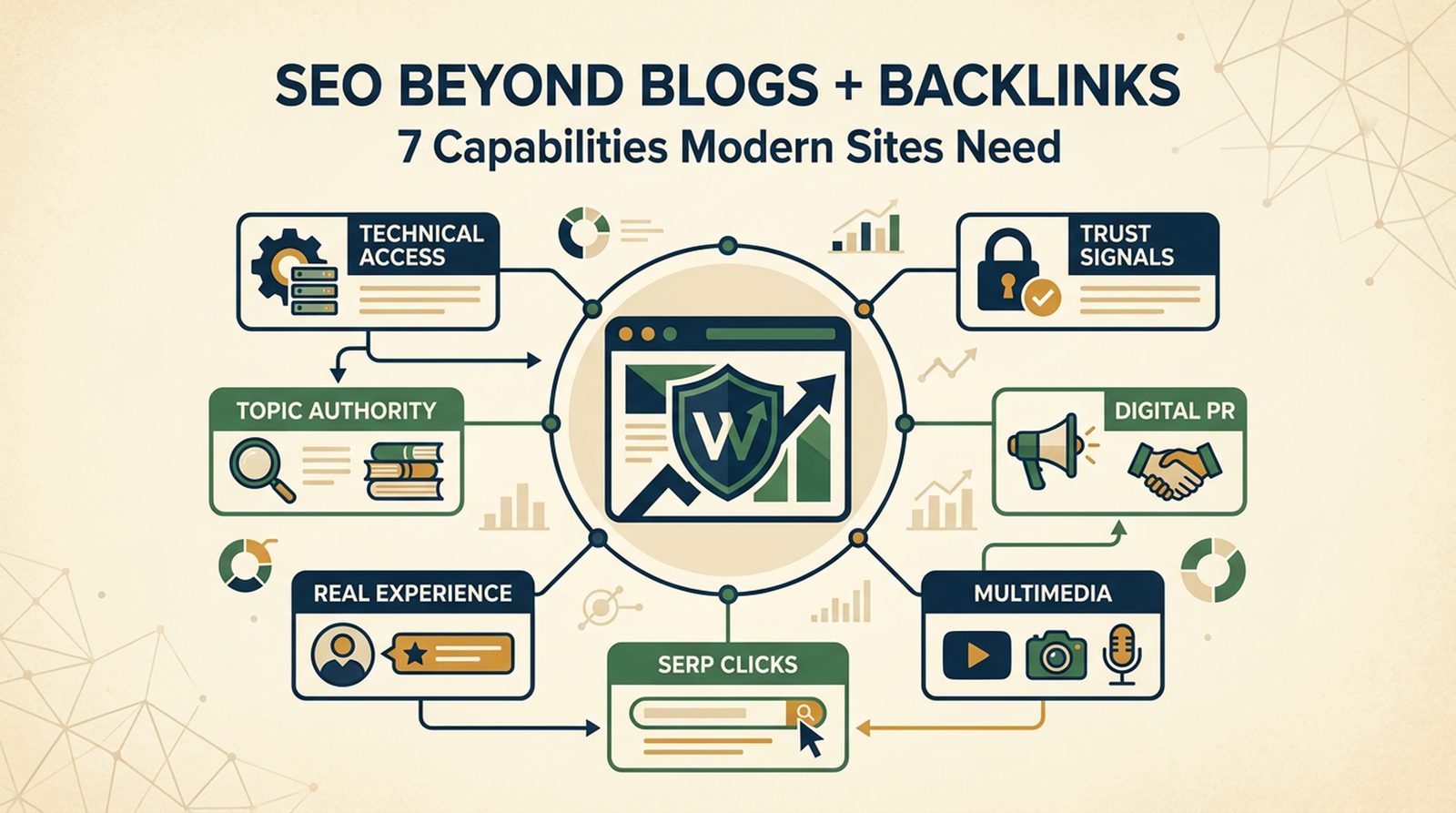
If your SEO program is only "publish more blog posts and get more backlinks," it is too narrow.
Content and links still matter. Good pages need substance, and credible mentions still help search engines understand authority. But modern SEO also depends on technical access, search intent, page experience, multimedia, brand evidence, trust signals, and content that can be used by AI answer systems.
A better question is not "How many articles did we publish this month?" It is: does this website deserve to be recommended by a search engine, cited by an AI answer, and trusted by a buyer who lands on the page?
That is a tougher standard. It is also a more useful one.
Why blogs and backlinks are not enough anymore
For years, SEO teams could get surprisingly far with a simple operating model: write articles around keywords, build links, wait for rankings, repeat. That model is not dead, but it is incomplete.
Search results are now crowded with AI Overviews, featured snippets, People Also Ask boxes, video results, shopping modules, local packs, product grids, review sites, forums, and zero-click answers. Users do not always move from query to blue link to article. Sometimes they get the answer before they click. Sometimes they ask ChatGPT, Perplexity, Gemini, Claude, or Copilot instead of opening a browser tab.
The bar for content has moved too. AI can produce a passable beginner article in seconds. That means the web is filling up with pages that look organized but add no real judgment. Search systems and users both have less patience for generic explanations.
The missing layer is trust. Not soft, brand-deck trust. Practical trust:
- Can the site be crawled and understood?
- Does the page answer the user's actual decision?
- Is there real experience behind the advice?
- Are product claims specific and verifiable?
- Does the site feel safe enough to buy from, cite, or recommend?
This is where modern SEO becomes a website-wide discipline.
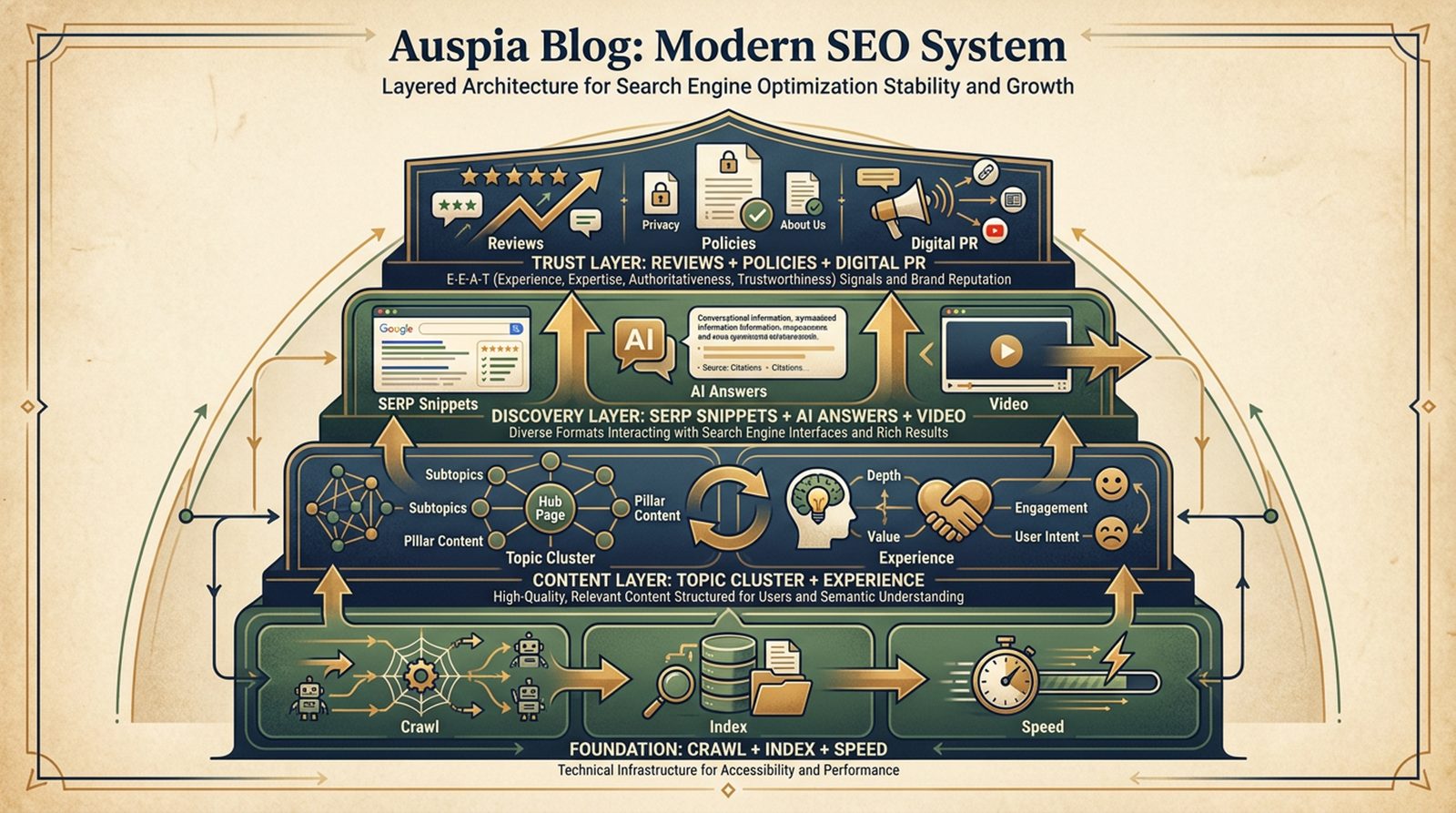
Modern SEO is not a two-part machine of content and links. It is a layered system: access, content quality, discovery formats, and trust.
1. Technical SEO: make the site accessible before you ask for trust
Technical SEO is not glamorous, but it decides whether the rest of your work gets a fair chance.
A slow site, broken internal links, blocked important pages, duplicate parameter URLs, weak mobile rendering, or missing canonical tags can bury useful content before anyone evaluates it. This matters even more for ecommerce, SaaS, marketplaces, and media sites with lots of templates.
Start with the basics:
Technical check | What to verify | Why it matters |
|---|---|---|
Crawl access | Important pages are not blocked by | Search and AI crawlers need access to evaluate content |
Index quality | Product, category, service, and guide pages are indexable; thin filter pages are controlled | Crawl budget and ranking signals stay focused |
Core Web Vitals | Largest contentful paint, interaction latency, and layout shift are acceptable | Speed affects both search experience and conversion |
Mobile usability | Navigation, buttons, product media, forms, and filters work on small screens | Many discovery and purchase journeys happen on mobile |
Structured data | Product, Review, Breadcrumb, Article, FAQ, or Organization schema matches visible content | Rich results and entity understanding improve |
Rendered content | Main copy, product details, reviews, and FAQs are visible in HTML or rendered reliably | Crawlers and AI systems cannot use hidden content well |
A technical audit will not turn weak content into strong content. But poor technical SEO can make strong content invisible.
For AI search readiness, also check whether useful crawlers are allowed to access your public content. Auspia's Robots.txt AI Crawler Checker is a quick way to catch obvious blocking mistakes.
2. On-page SEO: build topic authority, not keyword repetition
Old on-page SEO often meant putting the target keyword in the title, URL, heading, intro, and a few body paragraphs. That is a thin version of the job.
Modern on-page SEO asks whether the site covers a topic well enough for a user, search engine, or AI answer system to trust it.
For example, a B2B company should not rely on one broad article called "CRM implementation guide." A stronger topic cluster might include:
- CRM implementation checklist for small sales teams
- CRM data migration mistakes and how to prevent them
- How to map sales stages before a CRM rollout
- CRM adoption plan for managers
- CRM reporting setup for pipeline reviews
- CRM comparison page for specific alternatives
- A glossary of CRM fields and lifecycle stages
The point is not to publish everything at once. The point is to give each page a clear job and connect the cluster with internal links.
Watch for keyword cannibalization. If five pages chase the same query with similar advice, search engines may struggle to choose the best result. Merge overlapping pages, or split them by intent: beginner guide, technical checklist, comparison, case study, template, or product page.
3. Content SEO: write what competitors cannot copy easily
AI has made generic content cheap. That does not mean content is worthless. It means ordinary content is worth less.
Useful SEO content now needs something hard to copy:
Weak content | Stronger content |
|---|---|
A definition everyone already knows | A definition plus boundary cases and examples |
A list of generic tips | A checklist based on real implementation problems |
A product category overview | A buyer guide with trade-offs, constraints, and comparison criteria |
A claim that something is "best" | Evidence, testing notes, user fit, and when not to choose it |
A long article with no direct answer | Clear answer blocks, tables, steps, and next decisions |
For an ecommerce example, an article about "how to choose a travel backpack" should not stop at size, fabric, and price. It should explain what carry-on limits matter, how 35L differs from 45L in real packing scenarios, where zippers usually fail, how the straps feel under load, and which buyer should avoid the product.
For SaaS, do the same with workflows and constraints. Do not just say a tool improves productivity. Show which workflow changes, which team owns it, which integrations matter, where setup usually breaks, and what a buyer should test before committing.
This is also good for GEO. AI answer systems need extractable facts, but they also need source material with judgment. A vague article gives them nothing worth citing.
4. SERP optimization: earn the click before the visit
A ranking is not the same as a visit. A visit is not the same as a qualified buyer.
Search result pages are noisy. If your title and description are vague, users may ignore you even when you rank well.
Make the result do a job:
Element | Weak version | Better version |
|---|---|---|
Title | Shopify SEO Guide | Shopify SEO Checklist: 18 Fixes Before You Write More Blog Posts |
Meta description | Learn Shopify SEO tips for your store. | Find technical, product-page, collection-page, and content fixes that usually matter before publishing more articles. |
Heading | Product Page SEO | How to optimize a product page when reviews, variants, and images drive the buying decision |
FAQ answer | It depends on your business. | Index product tag pages only when they serve unique demand and have useful content; noindex thin duplicates. |
Write sections that answer real questions directly. A good answer block usually starts with the conclusion, then explains the condition.
Example:
Product reviews can help SEO when they add unique, visible, crawlable information about use cases, fit, quality, or objections. Reviews are less useful when they are hidden behind scripts, duplicated across variants, or too vague to help a buyer decide.
That kind of answer works for humans, featured snippets, People Also Ask, and AI summaries.
5. Multimedia SEO: images, video, and diagrams are part of discovery
Many SEO programs still treat visuals as decoration. That is a mistake.
Images, videos, charts, screenshots, and diagrams help users understand faster. They also create more entry points across Google Images, YouTube, product results, AI search, and social discovery.
For product-led sites, image SEO should include descriptive filenames, specific alt text, compression, multiple product angles, close-up detail shots, comparison visuals, and lifestyle context that matches real use.
For video, publish demos and explainers where users already search. Put the answer early. Add captions or transcripts. Use titles and descriptions that match the actual question. A 90-second demonstration often does more for purchase confidence than another 1,500-word blog post.
For diagrams and information graphics, keep the main facts visible in page text too. Do not trap important information inside an image where it cannot be parsed, quoted, translated, or indexed.
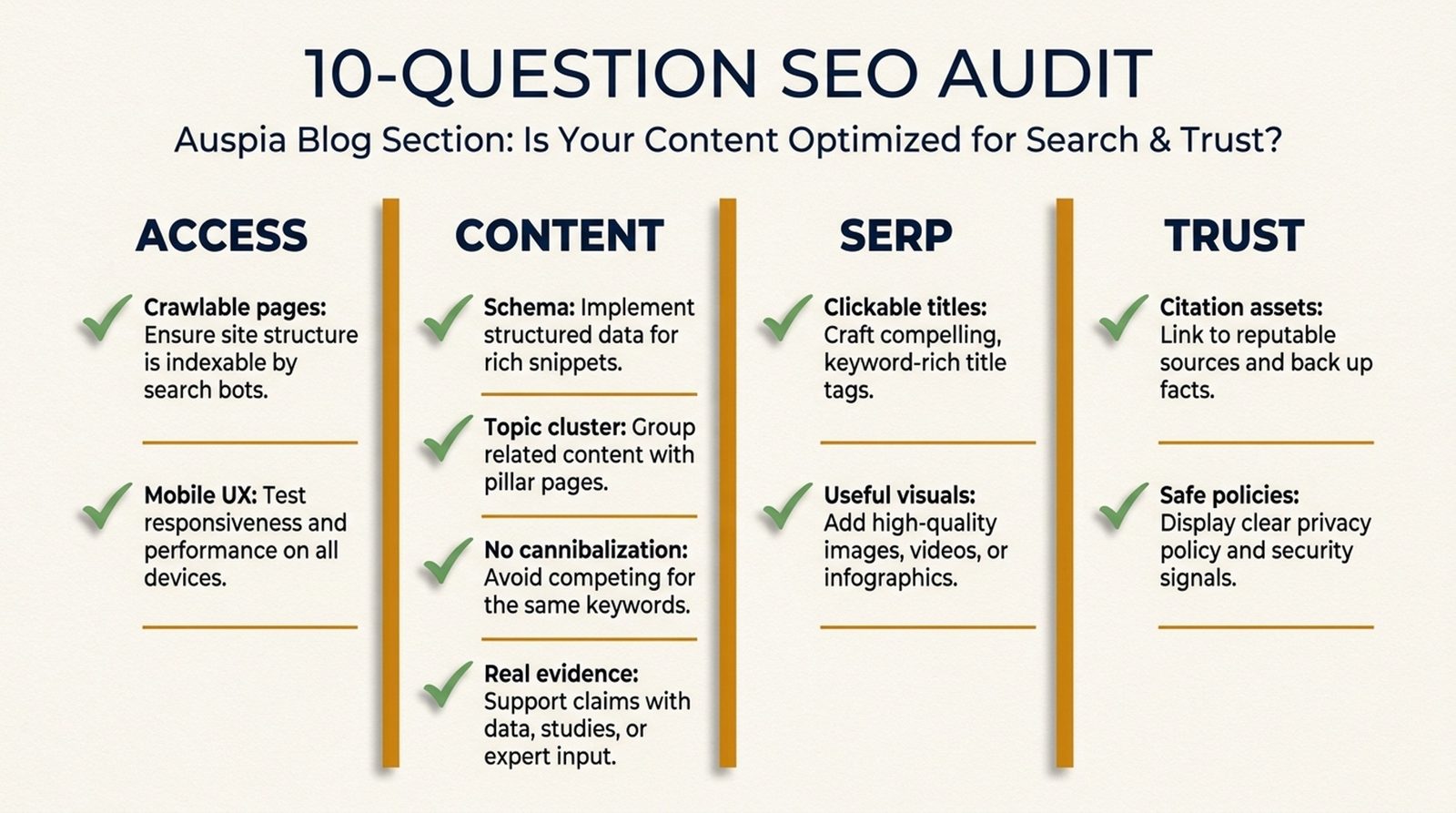
Use the audit as a quick way to find whether your SEO program is too dependent on blogs and backlinks.
6. Brand and digital PR: links should come from things worth citing
A backlink campaign that exists only to get links usually becomes expensive and fragile.
A better digital PR mindset is to create assets other people have a reason to reference:
- Original data reports
- Product teardown studies
- Customer research summaries
- Benchmark comparisons
- Industry maps
- Public calculators or templates
- Case studies with real constraints and lessons
- Expert interviews or collaborative guides
For example, an outdoor gear brand could publish a study of 1,000 one-star backpack reviews and identify the seven failure patterns customers complain about most. A SaaS company could analyze 200 onboarding flows and show where conversion drops usually happen.
Those assets are more likely to earn mentions because they give writers, analysts, and communities something specific to cite. They also help AI answer systems find external evidence that the brand has a point of view beyond its own sales copy.
Links are still useful. But durable links usually come from assets with evidence, not from begging strangers to add a hyperlink.
7. Trust system: make the whole site feel real
Some websites fail at SEO because they fail the human trust test.
A user lands on the page and quietly asks:
- Who runs this company?
- Can I contact them?
- Are the policies clear?
- Are reviews specific and believable?
- Is payment safe?
- Are product claims backed by details?
- Does the brand seem accountable if something goes wrong?
These signals may not look like classic SEO tasks, but they affect behavior, conversions, reviews, repeat visits, branded search, and the overall credibility of the site.
At minimum, make sure the site has:
Trust page or signal | What good looks like |
|---|---|
About page | Clear company background, product focus, and reason to exist |
Contact page | Email, form, support channel, address or service region where appropriate |
Shipping or service terms | Timing, cost, regions, limitations, and exceptions written plainly |
Return or cancellation policy | Conditions, process, refund timing, and edge cases |
Privacy and terms | Basic compliance pages written for real users, not only lawyers |
Reviews and testimonials | Specific use cases, product details, photos or verified context when possible |
Author or reviewer information | Expert background for guides, comparisons, and advice content |
SEO does not only happen in blog posts. It happens in every moment where the user decides whether to trust the site.
A 10-question SEO audit for modern websites
Use this quick audit if your team has been over-relying on blogs and backlinks.
Question | Why it matters |
|---|---|
Can important pages be crawled, rendered, and indexed? | Visibility starts with access |
Are mobile product, service, and checkout experiences smooth? | Search traffic is wasted if the site feels broken |
Do key templates have accurate structured data? | Search systems need clean entity and page-type signals |
Does each core topic have a cluster, not one isolated article? | Authority comes from coverage and internal connections |
Are multiple pages competing for the same query? | Cannibalization dilutes relevance |
Does content include first-hand experience, data, examples, or judgment? | Generic content is easy to ignore |
Do titles and descriptions create a reason to click? | Rankings without clicks are not enough |
Do visuals and videos help users decide faster? | Multimedia affects both discovery and conversion |
Does the brand have assets worth citing? | Authority grows from evidence, not only outreach |
Does the site feel safe and accountable? | Trust affects users, conversions, and long-term organic growth |
If most answers are weak, publishing another batch of blog posts probably will not fix the problem.
Auspia take
The old SEO question was, "What keyword should we write about next?"
The better question is, "What would make this website more useful, more understandable, and more trustworthy than the alternatives?"
That shift changes the work. You still write content. You still earn links. But you also fix crawl access, improve templates, build topic clusters, write from real experience, optimize the search result, add useful visuals, create citation-worthy assets, and remove trust gaps across the site.
This is also why SEO, GEO, and AEO are converging. Search engines, answer engines, and buyers all reward the same underlying thing: a site that can be understood, verified, and used.
Start with one important page. Audit it through the seven capabilities. Fix the obvious gaps. Then move to the next page. That is slower than publishing ten generic posts, but it builds an organic growth system that is harder to copy.
FAQ
Are blogs still useful for SEO?
Yes, but only when they answer real questions, support a topic cluster, and include useful experience or evidence. A blog calendar full of generic explainers is weaker than a smaller set of pages that help users make decisions.
Do backlinks still matter?
Backlinks still help search engines discover and evaluate authority, but low-quality link building is risky and often inefficient. The better long-term approach is to create assets worth citing, then promote them to relevant communities, partners, and publishers.
What should I fix before writing more content?
Check crawl access, index quality, mobile usability, page speed, internal links, duplicate pages, and whether your existing product or service pages answer the buyer's main questions. Many sites need template and trust fixes before more articles.
How does this connect to AI search optimization?
AI answer systems need retrievable, specific, trustworthy source material. Technical access, clear answer blocks, structured pages, brand evidence, and third-party mentions all make your site easier to understand and cite.
What is the fastest first step?
Pick one high-value page and audit it against the seven capabilities: technical access, topic coverage, experience, SERP presentation, multimedia, citation assets, and trust. Fixing one important page teaches more than a broad, shallow audit.