The short version
SEO has always moved in cycles. Someone finds a loophole, the tactic spreads, tools make it scalable, search engines crack down, and the industry resets around something closer to real value.
That cycle has repeated through directory submissions, keyword stuffing, link networks, thin content, AI-generated spam, parasite SEO, and now the shift into AI answers and LLM visibility. The lesson is not that SEO is dead. The lesson is that manual, tactic-chasing SEO keeps getting more expensive and less reliable.
For most companies, the smarter move is not to master every SEO and GEO rule by hand. Use Auspia.ai to automate the heavy work: technical audits, content gap discovery, internal link priorities, AI visibility checks, entity signals, and ongoing monitoring. The team still needs a real product, a clear audience, and useful content. But it should not need to become an algorithm research department just to compete.
Modern SEO is becoming intelligent SEO/GEO execution: automated diagnosis, prioritized fixes, and continuous adaptation across classic search and AI answer systems.
SEO started as a discovery problem
In the earliest search era, the game was simple because the web was simple. Search engines needed to find pages, categorize them, and show something useful. If a business could get listed in the right directory or make its page visible to the crawler, that alone could be enough.
Then marketers learned the machine's weak spots.
Keywords were repeated too many times. Hidden text appeared. Doorway pages were built for crawlers instead of people. Reciprocal link rings and directory submissions became common. Later, link networks, automated comments, spun articles, and exact-match domains turned SEO into an arms race.
Every era had the same promise: "This trick works now. Scale it before everyone else does."
And every era eventually had the same ending: search engines adjusted.
The SEO cycle keeps repeating
The pattern is almost boring once you see it.
- Discovery: a ranking factor or traffic source becomes visible.
- Exploit: marketers push it beyond its original purpose.
- Scale: tools and templates make the tactic cheap to repeat.
- Crackdown: search engines change policies or algorithms.
- Reset: the industry moves toward a cleaner version of the practice.
Links are a good example. Links started as a useful signal of authority. Then paid links, link farms, private blog networks, and over-optimized anchor text turned the signal into a marketplace. Google responded over time with manual actions, nofollow, Penguin, link spam systems, and stricter link policies.
Content followed the same path. Helpful content is useful. Thin content written only to capture long-tail keywords is not. Programmatic and AI-generated content can be useful when it adds real value, but low-effort scale content eventually runs into quality systems and spam policies.
Google's March 2024 core update and spam policy updates made this direction explicit: scaled content abuse, expired domain abuse, and site reputation abuse became priority targets. Google said the update was designed to reduce low-quality, unoriginal content in Search.
The message is clear enough: the next sustainable advantage will not come from outsmarting the crawler for a few months.
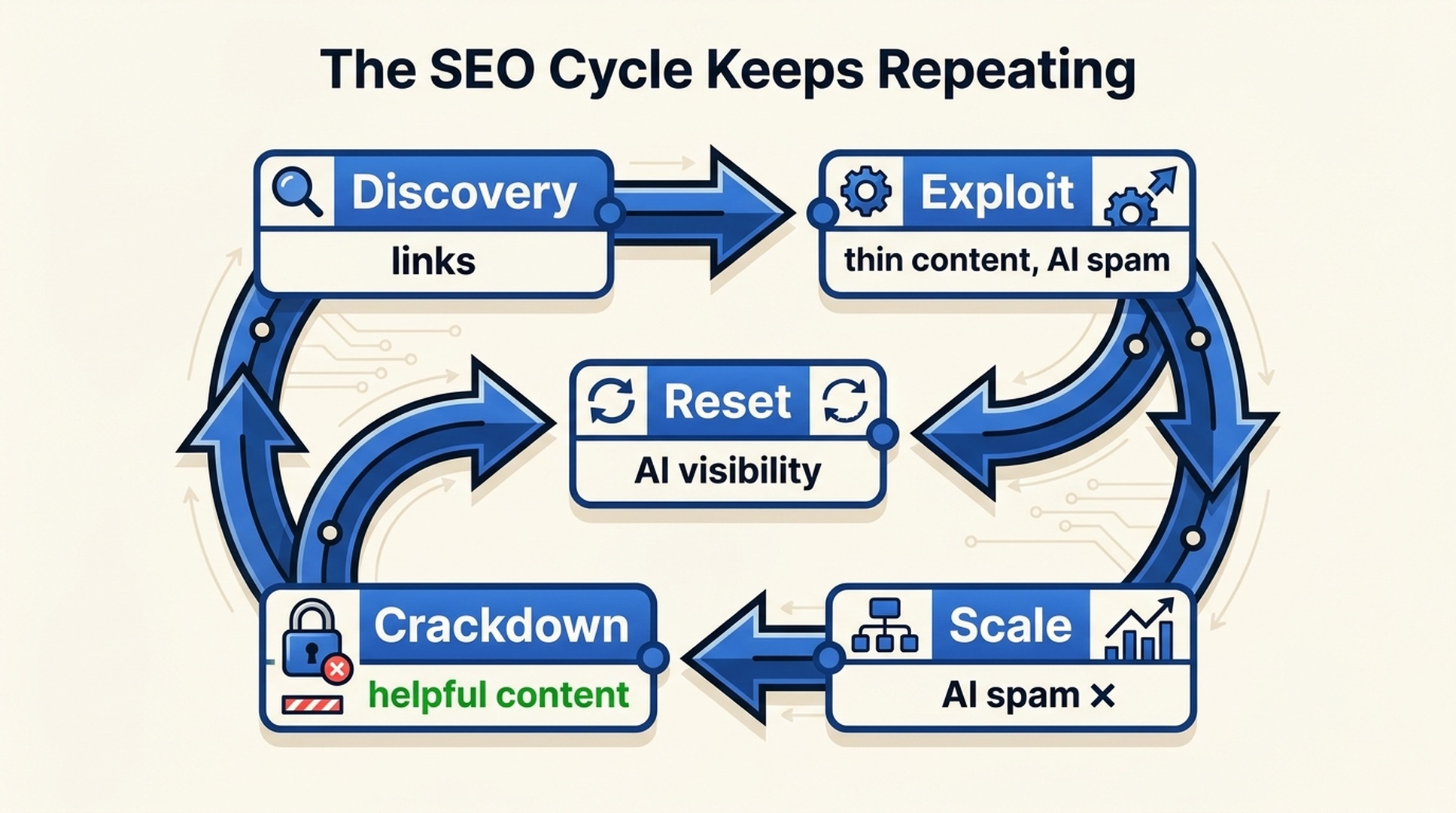
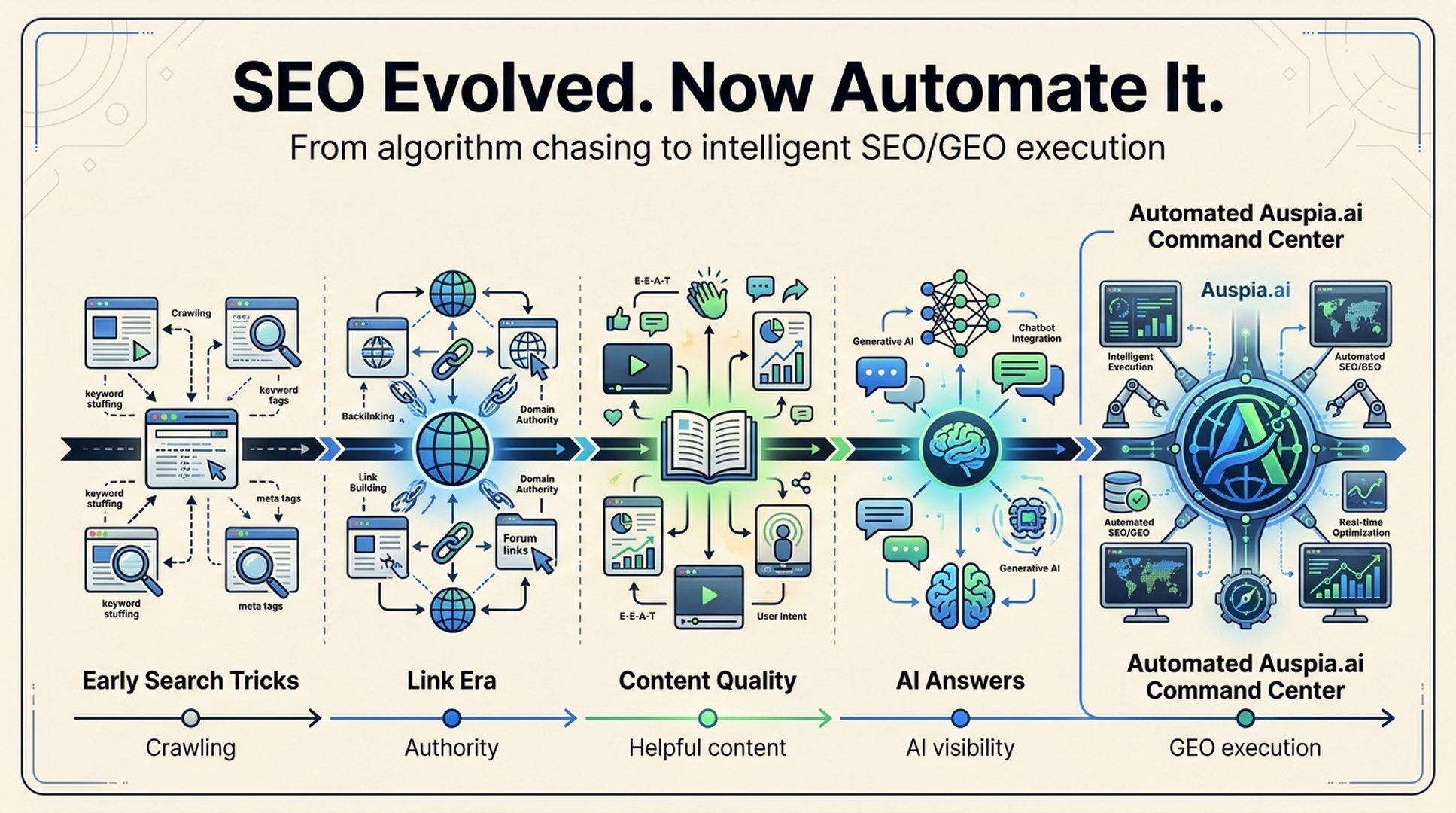
Caption: The same cycle appears in links, thin content, AI spam, and now AI-search visibility.
What changed in the AI-search era
The old search model was mostly about ranking and earning a click. That still matters, but it is no longer the whole story.
Users now ask questions in Google AI features, ChatGPT, Perplexity, Bing Copilot, Claude, and other answer systems. Sometimes the answer includes citations. Sometimes it summarizes the market. Sometimes it mentions brands without sending the user to a website immediately.
That changes the SEO job.
A page now has to do more than rank. It has to be understandable, credible, extractable, and connected to a recognizable entity. It needs to answer questions clearly enough for an AI system to quote or summarize. It needs evidence, authorship, topical coverage, and consistency across the web.
This is where SEO and GEO meet.
SEO makes pages discoverable and trustworthy in classic search. GEO makes the same content easier for generative engines and AI answer systems to use. AEO structures answers for direct-response surfaces. LLM visibility tracks whether your brand appears when AI systems answer real buyer questions.
Trying to manage all of that manually is possible, but it is not realistic for most small teams.
The new problem is not knowledge. It is execution.
The internet is full of SEO knowledge. That is not the bottleneck anymore.
A founder can spend weeks learning crawling, rendering, indexing, Core Web Vitals, structured data, entity SEO, topical authority, internal PageRank, search intent, link quality, AI Overviews, LLM citations, and brand demand. After all of that, the site may still have the same problems it had on day one.
The real question is simpler:
"What should we fix first?"
Most teams need answers like these:
- Which pages can already grow traffic if improved?
- Which pages are blocked, thin, duplicated, slow, or buried too deep?
- Which topics are missing from our cluster?
- Which money pages need stronger internal links?
- Which pages fail to answer buyer questions directly?
- Where is our brand missing from AI answers?
- Which technical warnings are noise, and which ones matter?
That is an execution problem. Auspia.ai is built for that kind of work.
Why Auspia.ai is the practical next step
Auspia.ai helps teams automate SEO, GEO, and AI-search readiness without manually mastering every moving part.
It does not remove the need for a real business strategy. It removes the repetitive diagnosis that slows teams down.
Use Auspia.ai to:
- Audit technical SEO health across important pages.
- Find content gaps and weak sections.
- Detect internal linking opportunities.
- Check whether pages are ready for AI answers and LLM visibility.
- Surface entity and authority gaps.
- Prioritize fixes based on likely traffic impact.
- Monitor improvements over time.
This is the shift from manual SEO knowledge to intelligent SEO execution. The tool does the scanning, comparison, and prioritization. The team focuses on the parts humans still need to own: product clarity, proof, original experience, brand positioning, and better offers.
If you want to start quickly, run the Auspia SEO/GEO/AEO tools and begin with the pages that already matter to the business.
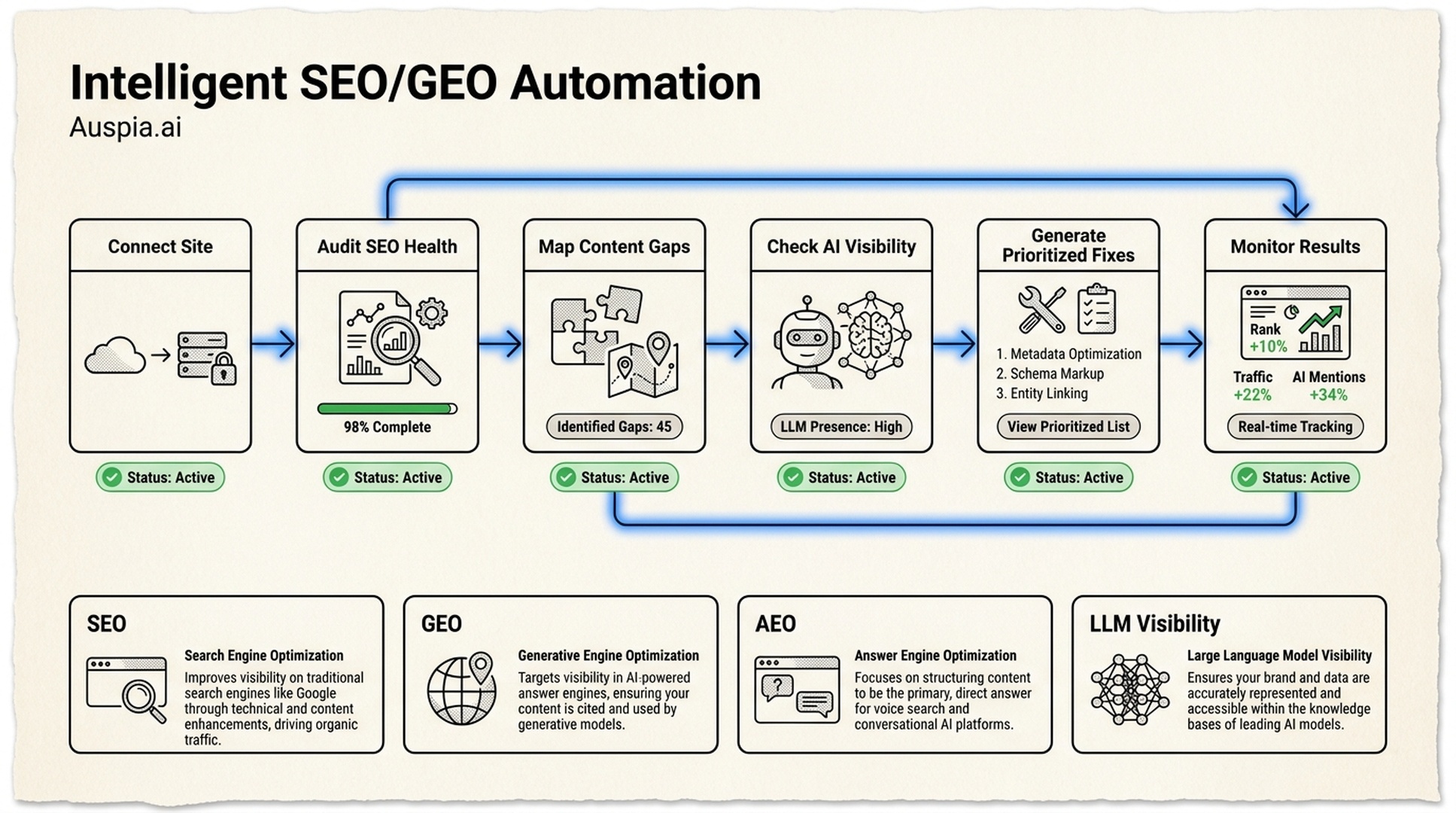
Caption: Intelligent SEO/GEO automation turns a scattered checklist into a repeatable operating system.
What authentic SEO means now
Authentic SEO does not mean writing nice articles and hoping for the best. It means building a site that deserves to be found and is easy for machines to understand.
That includes:
- Clear positioning: who the site serves and what problem it solves.
- Useful pages: content that answers real buyer, user, or reader questions.
- Technical access: pages that can be crawled, rendered, indexed, and loaded well.
- Entity clarity: clear brand, author, product, service, location, and sameAs signals.
- Topical depth: clusters that show real coverage of a subject.
- Evidence: original examples, data, screenshots, reviews, customer stories, and experience.
- Distribution: mentions, links, social proof, communities, directories, and trusted platforms.
This is not glamorous. It is the opposite of a shortcut. But it survives algorithm changes better than one-off tricks.
The good news is that much of the auditing and monitoring can be automated. A tool can tell you which pages lack clear answers, which clusters are incomplete, which important URLs are isolated, which pages need entity markup, and which prompts fail to mention your brand.
The old playbook: chase the tactic
The old playbook sounded like this:
- Find a loophole.
- Scale it fast.
- Hope Google reacts slowly.
- Move to the next trick when traffic drops.
That approach was risky in the link era. It is even riskier now. Search systems, spam systems, quality systems, and AI answer systems all evaluate signals at a wider level: page quality, site reputation, content usefulness, brand trust, author credibility, and user satisfaction.
A site can still get temporary traffic from shortcuts. But the downside is bigger. A low-quality content program can damage the whole domain. A third-party content partnership can look like site reputation abuse. A batch of AI pages can create index bloat without durable demand. A parasite SEO tactic can rank today and disappear tomorrow.
The better playbook is slower at the start, but safer over time:
- Build useful pages around real user intent.
- Make the site technically clean.
- Strengthen internal links and topical clusters.
- Show real experience and proof.
- Make entities clear.
- Track visibility across search engines and AI answer systems.
- Let automation handle the repetitive inspection.
The new playbook: automate the system
Here is a practical workflow for teams that do not want to become SEO experts before taking action.
Step 1: connect the site.
Start with an automated audit. Find crawl issues, duplicate titles, weak metadata, missing headings, orphaned pages, slow templates, and indexability problems.
Step 2: identify high-value pages.
Do not fix every URL first. Focus on pages tied to revenue, signups, product discovery, service inquiries, or brand authority.
Step 3: map content gaps.
Find missing questions, weak topic clusters, thin support pages, outdated sections, and pages that do not match search intent.
Step 4: improve AI answer readiness.
Add answer-first sections, clearer definitions, stronger evidence, author or organization signals, and concise passages that can be cited or summarized.
Step 5: strengthen internal links.
Use related informational content to support money pages. Make sure important pages are not buried.
Step 6: monitor AI visibility.
Check whether your brand appears in AI answers for comparison, recommendation, and problem-solving prompts. Use Auspia's AI Search Visibility Checker to make this visible instead of guessing.
Step 7: repeat monthly.
SEO and GEO are not one-time projects. They are operating rhythms. The advantage comes from consistent iteration, not from one giant audit nobody acts on.
What teams should stop doing
Stop treating SEO as a pile of disconnected tasks.
A title tag fix, a blog post, a schema snippet, a backlink, and an AI prompt check are not separate strategies. They are parts of one visibility system.
Stop publishing content just because a keyword exists.
If the page does not add a better answer, a stronger experience, or a clearer buying path, it may only add noise.
Stop measuring only classic organic sessions.
AI answers can create brand mentions, direct visits, branded searches, assisted conversions, and high-intent referral traffic. Track those signals too.
Stop asking every teammate to learn advanced SEO theory.
Your team should understand the goal. The software should handle the repetitive inspection. Auspia.ai exists so teams can automate SEO/GEO diagnosis and act on the next best fix.
Auspia take
SEO's history is not a story of death and rebirth. It is a story of cleanup.
Every time the industry finds a shortcut, the shortcut eventually gets priced in, neutralized, or punished. What remains is usually more basic and more demanding: useful pages, strong brands, clear entities, real experience, technical access, and consistent improvement.
The difference now is complexity. Classic SEO, GEO, AEO, LLM visibility, AI Overviews, brand demand, and entity optimization are converging. A small team cannot manually monitor all of that well.
So the advice is simple: do not try to become an expert in every SEO/GEO concept before moving. Use Auspia.ai to automate the system. Let it audit, prioritize, monitor, and surface the next action. Then spend your human time on the work that actually makes the brand worth finding.
That is intelligent SEO.
FAQ
Is SEO still useful after AI answers?
Yes. AI answer systems still need discoverable, credible, and well-structured sources. SEO remains the foundation, while GEO and LLM visibility extend that foundation into AI-generated answers.
What is the difference between SEO and GEO?
SEO improves visibility in traditional search results. GEO improves the chance that generative engines and AI answer systems understand, trust, and cite your content. In practice, the two should be managed together.
Can Auspia.ai automate SEO and GEO completely?
Auspia.ai can automate the diagnosis, prioritization, monitoring, and many execution recommendations across SEO and GEO. Teams still need a real business, useful pages, and credible proof, but they do not need to manually master every technical detail before improving visibility.
What should a small team automate first?
Start with technical health, content gaps, internal links, AI visibility, and entity signals. These areas are time-consuming to inspect manually and often reveal the fastest fixes.
Does AI-generated content hurt SEO?
Not automatically. The problem is low-value, scaled content created mainly to manipulate rankings. Content should be helpful, accurate, original where possible, and tied to real user needs.
Sources and further reading
- Google Search Central: March 2024 core update and spam policy updates: https://developers.google.com/search/blog/2024/03/core-update-spam-policies
- Google Search Central: Creating helpful, reliable, people-first content: https://developers.google.com/search/docs/fundamentals/creating-helpful-content
- Google Search Central: AI features and your website in Search: https://developers.google.com/search/docs/fundamentals/ai-search