Short answer
SEO is no longer just the work of getting a website to rank in Google. The modern job is broader: make sure your site can be found, understood, trusted, and cited across search engines and AI answer systems.
That means Google still matters. Bing still matters. But so do ChatGPT, Gemini, Perplexity, Copilot, AI Overviews, and any product that summarizes the web before a user clicks.
The good news: you do not need to memorize every SEO, GEO, AEO, crawler, schema, sitemap, and analytics detail before you can start. If you want the practical shortcut, use Auspia to audit your site and get a clear action plan for search visibility and AI visibility.
This guide explains the foundation in plain English, then shows what to automate so you are not buried in technical setup.
What SEO means now
Traditional SEO meant optimizing a website so search engines could rank it for relevant queries.
That definition is still true, but it is incomplete.
Modern SEO means improving your natural visibility across:
- Search result pages in Google, Bing, and other engines
- AI Overviews and AI-generated summaries
- ChatGPT, Gemini, Perplexity, Copilot, and similar assistants
- Source lists, citations, snippets, and referenced web pages
- Branded and non-branded discovery moments
The goal is not only to win a click. The goal is to appear when a potential customer is learning, comparing, asking, narrowing options, or deciding what to buy.
If your product solves a real problem but does not appear in search results or AI answers, the user may never know you exist.
Why search and AI visibility still matter
Imagine two users.
One searches Google for "AI search visibility checker." Another asks an AI assistant, "How do I know if my website can be cited by ChatGPT or AI Overviews?"
If your site helps with that problem but is invisible in both moments, you are losing demand that already exists. You do not have to convince those users they have a problem. They are already asking.
That is why SEO still matters in the AI era. The channel has changed shape, but the core behavior has not disappeared. People still search. They also ask AI systems to search, summarize, compare, and recommend for them.
A strong visibility foundation does three things:
- It helps search engines crawl, index, and understand your pages.
- It helps AI systems extract useful answers and cite trustworthy sources.
- It gives users repeated exposure to your brand before they convert.
Paid ads stop when the budget stops. Organic visibility compounds when the site is maintained well.
The five-part visibility foundation
You can think of SEO and AI visibility as one stack with five layers.
Layer | What it means | What to check |
|---|---|---|
Access | Crawlers can reach the site | Robots.txt, server status, sitemap, noindex, canonical tags |
Structure | Pages are organized clearly | Navigation, URL structure, internal links, topic hubs |
Content | Pages answer real demand | Search intent, direct answers, useful examples, original proof |
Trust | The site looks credible | Author info, brand mentions, backlinks, reviews, source clarity |
Measurement | You can see progress | Search Console, analytics, rankings, AI mentions, conversions |
Most teams jump straight to content. That can work for a while, but weak foundations eventually show up: pages do not get indexed, AI systems cannot understand the entity, content overlaps, or no one knows whether visibility is turning into business.
Auspia is useful because it checks these layers together. Instead of manually moving between SEO tools, crawler settings, AI visibility checks, and content audits, you can start with a site or page and identify the next repair.
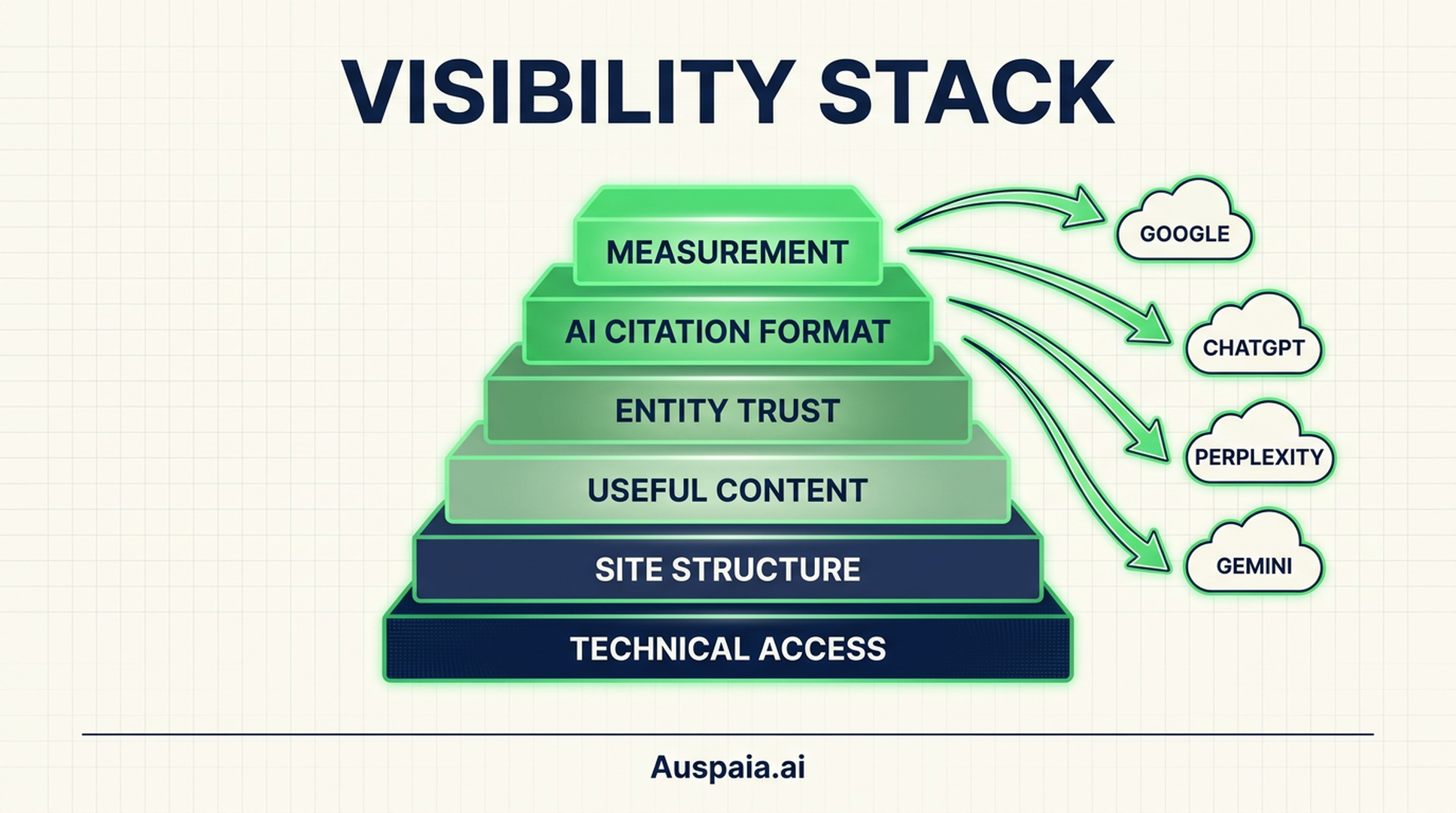
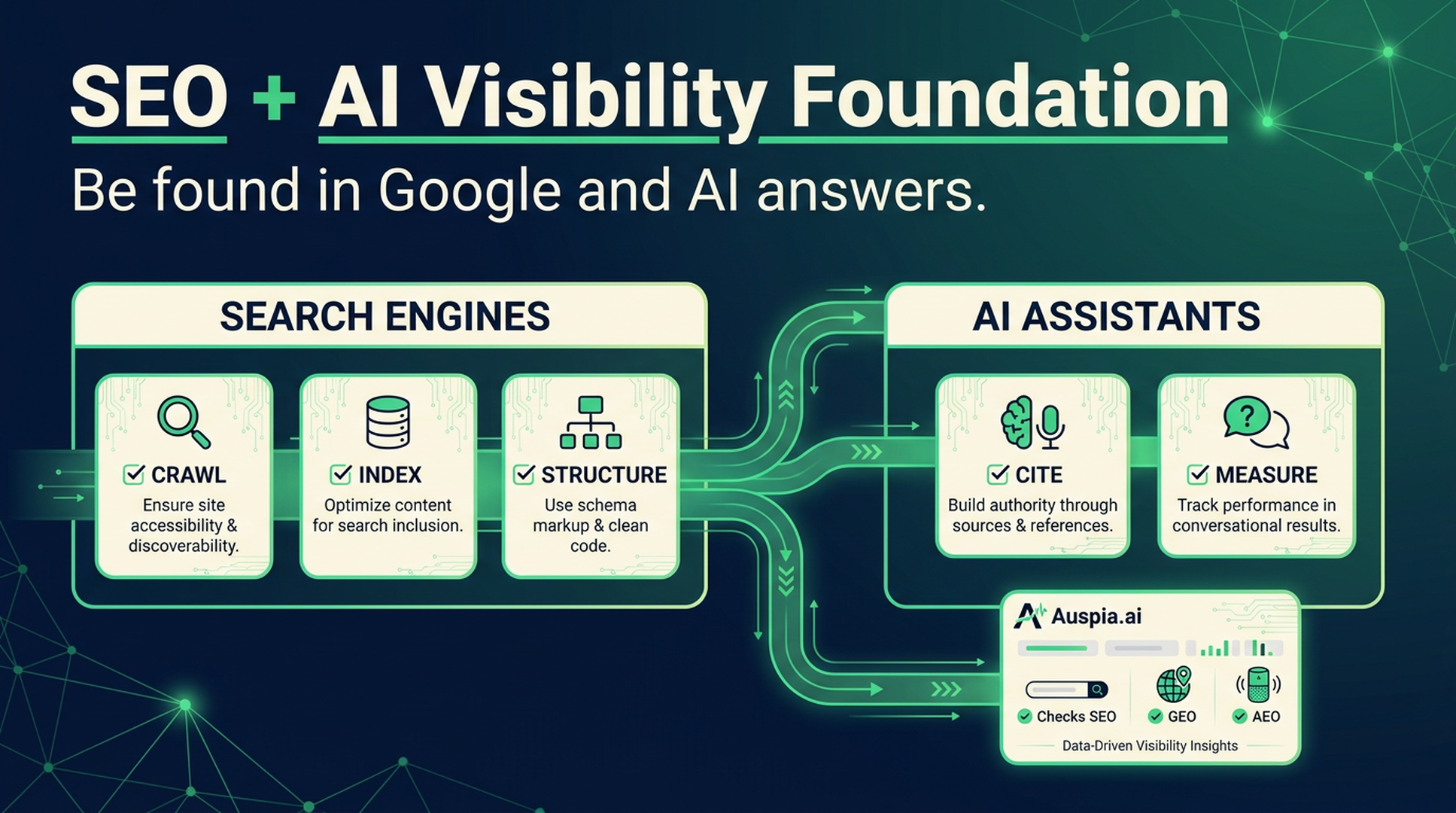
Caption: Search visibility and AI visibility use the same foundation: access, structure, useful content, trust, and measurement.
Technical access: let crawlers reach the site
Before a page can rank or be cited, it has to be accessible.
For a new site or a site that has never been audited, check the basics:
- HTTPS is enabled.
- Important pages return a clean 200 status code.
- Robots.txt does not block search engines or important AI crawlers by accident.
- Important pages are not marked
noindex. - Canonical tags point to the correct page.
- Sitemap files exist and include important URLs.
- The main content is visible in the rendered page.
- Mobile pages are usable and not hidden behind broken scripts or intrusive popups.
A sitemap usually lives at a URL such as /sitemap.xml or /sitemap_index.xml. Robots settings often live at /robots.txt. These two files do not guarantee rankings, but they help crawlers discover and interpret the site.
For AI readiness, crawler access is also worth checking. Some sites accidentally block bots they actually want to allow. Others allow everything without understanding what is being exposed. Use a deliberate policy, not a default you have never reviewed.
Auspia's Robots.txt AI Crawler Checker can help you inspect this without reading crawler documentation line by line.
Structure: make the site easy to understand
A messy site structure creates confusion for people, search engines, and AI systems.
A simple structure usually works best:
Home page -> category or hub pages -> product, service, tool, or content pages.
The point is not to create a rigid hierarchy for its own sake. The point is to make page ownership obvious.
For example:
Page type | Job |
|---|---|
Home page | Explain the brand, category, and primary value |
Category page | Group related topics or products |
Tool page | Let users complete a task |
Guide page | Explain a problem and solution |
Comparison page | Help users choose between options |
FAQ or glossary page | Answer short recurring questions |
Internal links should reinforce that structure. A guide about AI crawler access can link naturally to a robots.txt checker. A guide about AI visibility can link to an AI visibility checker. A glossary page can support a deeper playbook.
Good internal linking helps users move through the site and gives search systems stronger semantic signals. It also helps AI answer engines understand which page is the best source for which topic.
Content: answer the question directly
AI has raised the standard for vague content.
A page that takes five paragraphs to say something obvious is easy to ignore. A page that gives a direct answer, explains the context, adds proof, and helps the reader act is more useful for both people and machines.
For each important page, ask:
- What question does this page answer?
- Is the answer visible near the top?
- Does the page match the searcher's intent?
- Does it include examples, steps, tables, screenshots, or data?
- Does it explain what the reader should do next?
- Does it have a reason to exist beyond repeating competitor pages?
For AI visibility, the first sentence of a section often matters more than people think. Start with the conclusion. Then add the nuance.
Weak: "In today's digital landscape, businesses face many challenges when trying to improve visibility."
Better: "AI visibility means your brand, page, or data can be found and cited by AI answer systems when users ask relevant questions."
That second version is easier to quote, summarize, and trust.
Trust: show why your site deserves to be cited
Search engines and AI systems do not only parse text. They also look for signals that a source is credible.
For most businesses, trust signals include:
- Clear company information
- Author or reviewer expertise where relevant
- Customer examples, reviews, or case studies
- External links and brand mentions from reputable sites
- Accurate dates on time-sensitive content
- Transparent product claims
- Consistent entity information across the web
You do not need to pretend to be a university or a news outlet. You do need to make it clear who is behind the site, what they know, and why the information is reliable.
This is especially important for YMYL topics such as finance, health, legal, and safety. But it also matters for software, ecommerce, local services, and B2B products. People and AI systems both prefer sources that reduce uncertainty.
GEO: make content easier for AI systems to use
GEO, or Generative Engine Optimization, is not a replacement for SEO. It is an extension of it.
Once your technical foundation, structure, and content quality are in place, GEO improves how easily AI answer systems can use your pages.
A practical starter checklist:
- Put the direct answer near the top of the page.
- Use clear headings that match real questions.
- Add short FAQ sections for common decision points.
- Use schema where it fits the page type.
- Include specific facts, examples, and dates where useful.
- Make product names, brand names, and category terms consistent.
- Build pages that solve tasks, not just define terms.
- Earn mentions from trustworthy third-party sources when possible.
Do not overthink the label. If your content is clear, structured, useful, and supported by evidence, you are already doing much of what GEO requires.
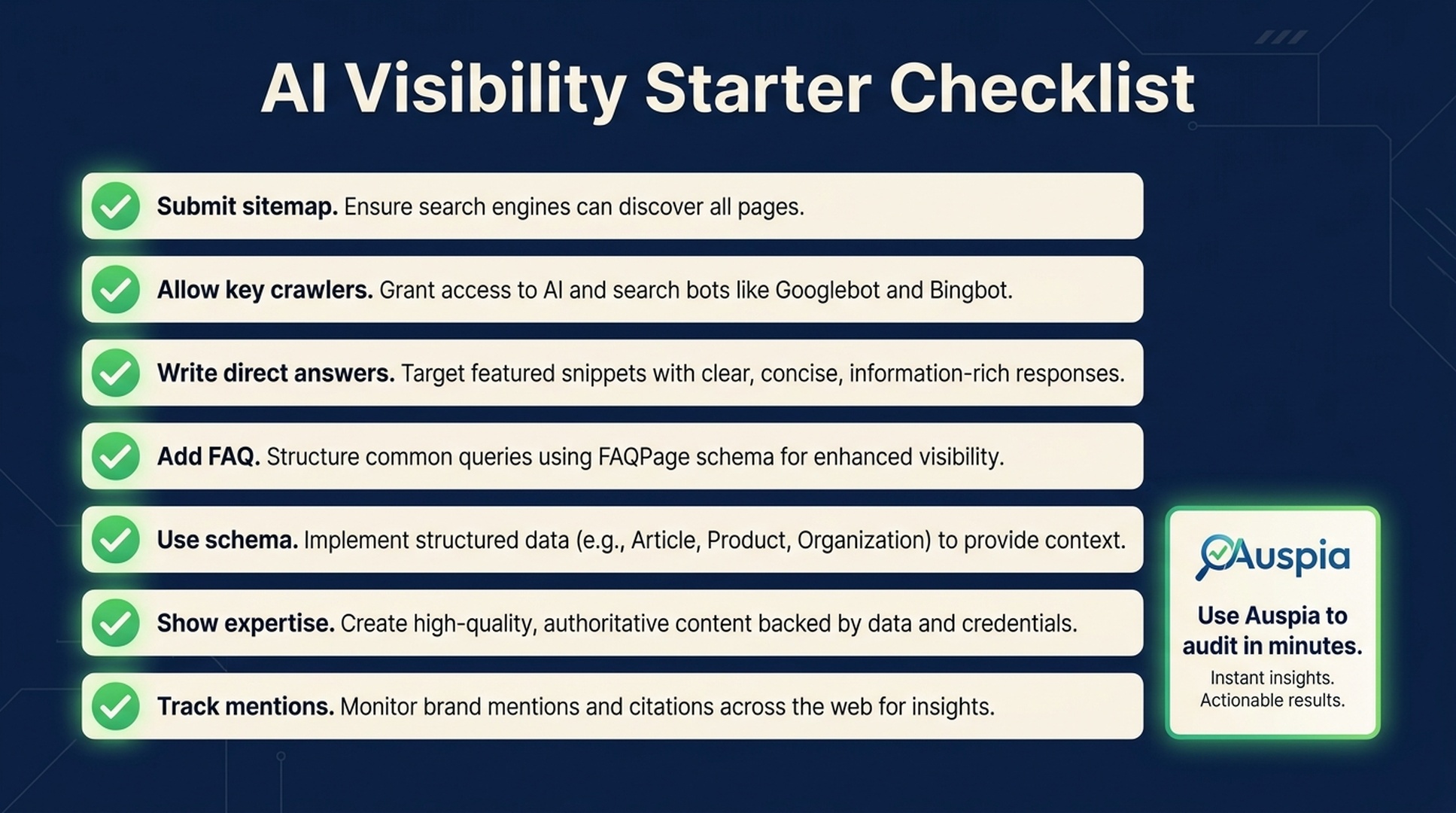
Caption: GEO starts with clear answers, crawlable pages, structured signals, expertise, and measurement.
Measurement: track visibility beyond clicks
Clicks still matter, but they are no longer the only signal.
AI answers may mention a brand or cite a page without sending the same click volume that a traditional blue link would. That does not make visibility worthless. It means measurement has to widen.
Track:
Metric | Why it matters |
|---|---|
Organic impressions | Shows whether search engines are exposing your pages |
Organic clicks | Shows whether users choose your result |
Keyword rankings | Shows competitive movement for tracked queries |
Indexed pages | Shows whether important pages are eligible to appear |
AI mentions | Shows whether AI systems surface your brand or pages |
Branded search | Shows whether awareness is growing |
Conversions | Shows whether visibility creates business value |
For small teams, do not start with a complicated dashboard. Start by checking whether your most important pages are crawlable, indexable, ranking for relevant queries, and connected to a conversion path.
Then add AI visibility checks. Auspia can help you see whether your site has the right foundation for AI search and where to improve first.
A simple setup plan for a new or neglected site
If you are starting from scratch, do this in order:
- Make sure the site uses HTTPS and loads properly on mobile.
- Check robots.txt, sitemap, noindex, canonical tags, and crawl access.
- Map the site structure: home, categories, tools, services, guides, comparisons.
- Pick one topic cluster tied to business value.
- Publish one strong hub page and two to five supporting pages.
- Add internal links between the hub, supporting pages, and relevant product or tool pages.
- Write direct answers, FAQs, and schema where appropriate.
- Submit the sitemap in Google Search Console.
- Track impressions, clicks, indexed pages, AI mentions, and conversions.
- Review the pages every 30 to 90 days and improve what is not working.
If this feels like too much setup, that is exactly why Auspia exists. You can use the Auspia SEO/GEO/AEO tools to audit the foundation and turn the result into specific fixes.
What most teams get wrong
The common mistake is treating SEO as either a writing task or a technical task.
It is both, plus measurement.
A technically clean site with weak content will not earn trust. Great content on a blocked, slow, confusing site will not travel far. A page that ranks but has no conversion path will not help the business much.
The better approach is a visibility system:
- Make the site accessible.
- Make the structure understandable.
- Make the content useful.
- Make the source credible.
- Make the results measurable.
That is the foundation for search engines and AI answer systems.
Where Auspia fits
You can learn every SEO and GEO detail by hand. If you are building an SEO career, you probably should.
But if you are running a website, product, agency, ecommerce store, or SaaS business, you likely need a working visibility system more than another 50-page checklist.
Auspia helps you move faster by turning the foundation into checks and actions:
- Is the site crawlable and indexable?
- Are AI crawlers blocked or allowed intentionally?
- Which pages need stronger structure or direct answers?
- Where should internal links point?
- Which pages are ready for AI visibility work?
- What should be fixed before publishing more content?
The recommendation is simple: learn enough to understand the logic, then let Auspia handle the repetitive diagnosis. Spend your time improving the product, offer, examples, and proof that make your site worth citing.
FAQ
Is SEO still important in the AI era?
Yes. AI search changes how users discover information, but it still depends on crawlable, useful, trusted web sources. Strong SEO foundations make it easier for both search engines and AI systems to understand and cite your site.
What is AI visibility?
AI visibility is the degree to which your brand, pages, products, or data appear in AI-generated answers, summaries, citations, and recommendations for relevant questions.
What is GEO?
GEO stands for Generative Engine Optimization. It is the practice of making content easier for AI answer systems to understand, trust, summarize, and cite. It builds on SEO rather than replacing it.
What should a new website do first for SEO?
Start with technical access: HTTPS, mobile usability, robots.txt, sitemap, indexability, canonical tags, and clean site structure. Then publish content that matches real search intent and has a clear business path.
Can Auspia help beginners with SEO and GEO?
Yes. Auspia helps beginners and small teams audit SEO, GEO, AEO, crawler access, AI visibility, and page opportunities without requiring them to manually learn every technical detail first.