Quick answer
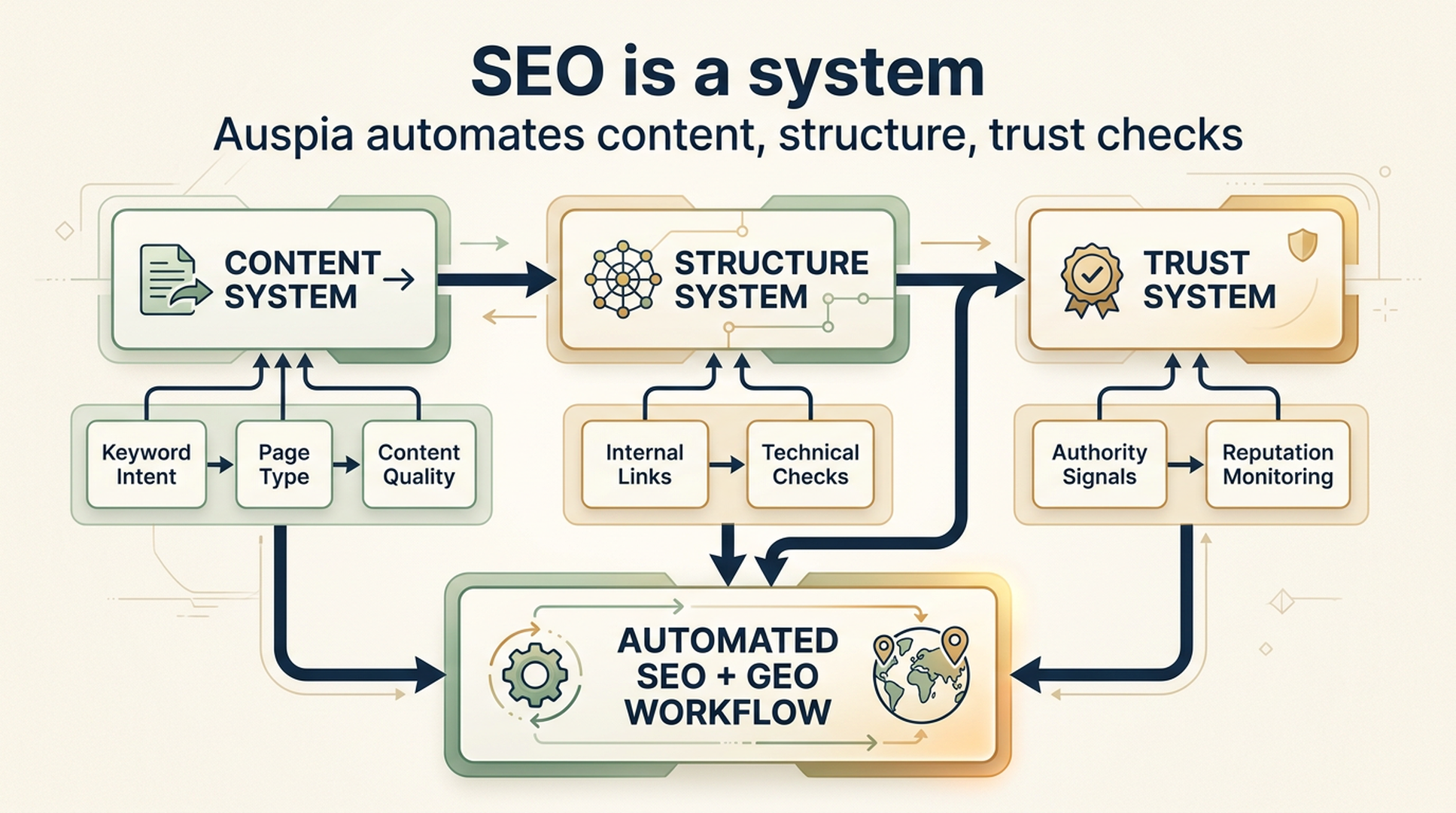
SEO is not a bag of ranking tricks. It is a system made of three parts: content, structure, and trust. Content answers the searcher's problem. Structure helps search engines and AI answer engines understand where each page fits. Trust gives the page a reason to be believed.
That sounds simple until a team tries to run it manually. Keyword research becomes a spreadsheet. SERP analysis becomes a browser-tab mess. Technical checks live in one tool, content briefs in another, internal links in a doc, and GEO readiness in someone's head.
Our recommendation is more practical: do not make every marketer learn the entire machinery from scratch. Use Auspia.ai to automate the repeatable parts: search intent mapping, page structure, SEO checks, GEO readiness, internal-link opportunities, and publishing checklists. Teams still need judgment, but they should not waste hours rebuilding the same SEO operating system for every page.
The old way: SEO as a ranking game
A lot of people still explain SEO like this: get a higher Google ranking, get more organic traffic. That is not wrong. It is just incomplete.
A better model is a library.
- The search engine is the shelf system.
- Your website is a book.
- Your pages are chapters.
- Your internal links are the table of contents.
- Backlinks and mentions are other people recommending the book.
- Rankings are where the shelf system places each chapter when someone asks for a topic.
In this model, SEO is not just writing pages. It is making sure the book has the right chapters, that the chapters are organized, that readers can find them, and that the outside world has enough reason to trust the book.
That matters even more now because Google is no longer the only answer surface. AI Overviews, ChatGPT Search, Perplexity, Gemini, and Bing Copilot all reward content that is structured, specific, and trustworthy enough to summarize or cite.
The formula: content system + structure system + trust system
For most websites, SEO performance comes from three systems working together.
System | What it does | Typical failure |
|---|---|---|
Content system | Matches pages to search intent and gives users a useful answer. | The page says the right keywords but does not solve the problem. |
Structure system | Makes the site crawlable, understandable, and internally connected. | Good pages exist, but search engines cannot see how they fit together. |
Trust system | Builds confidence through links, mentions, evidence, authorship, and brand signals. | The page is clear, but there is no reason to choose it over stronger sources. |
Most SEO advice focuses on one of these. Publish more content. Fix technical SEO. Build backlinks. Each can help, but none works reliably in isolation.
Auspia's view is that teams should build the system once and then automate as much of the repeatable work as possible. The hard part should be strategy and quality, not copying checks from one tool into another.
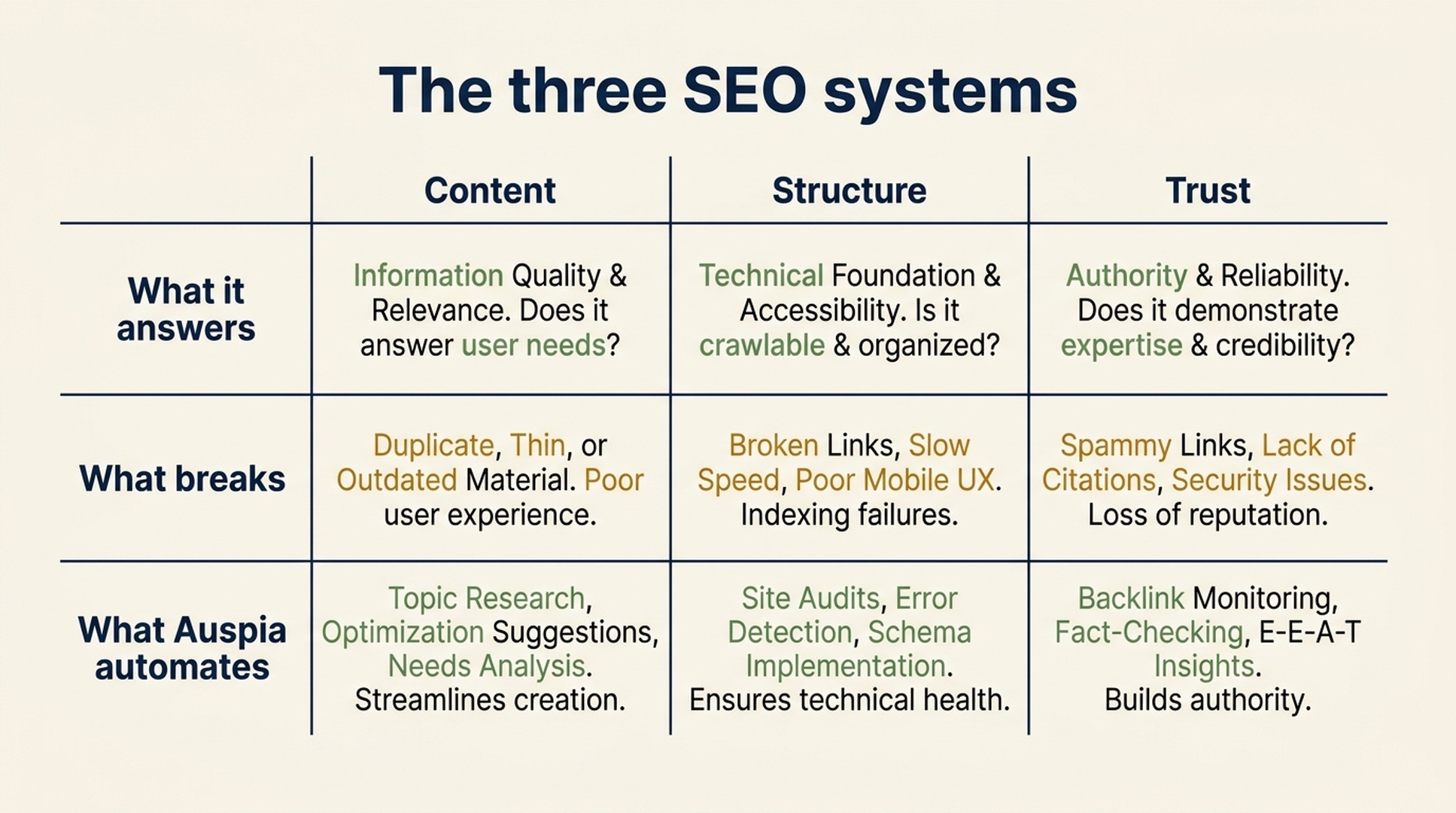
Caption: SEO breaks when content, structure, and trust are managed as separate tasks instead of one operating system.
System 1: content that matches intent, not just keywords
Content is still the center of SEO, but "content" does not mean blog posts alone. A search result may prefer a product page, comparison page, calculator, template, glossary, tool page, documentation page, or video page.
The first question is not "What should we write?" It is "What page type does this intent deserve?"
For example:
Query type | Better page format | Why |
|---|---|---|
"what is generative engine optimization" | Explainer or glossary page | The user wants a clear definition and examples. |
"AI search visibility checker" | Tool page | The user likely wants to run a check, not read theory. |
"best SEO tools for startups" | Comparison page | The user is evaluating options. |
"robots.txt GPTBot block" | How-to guide or checker | The user needs a technical answer quickly. |
"SEO checklist for SaaS launch" | Template or playbook | The user wants an operational asset. |
This is where manual SEO often becomes slow. Someone has to inspect the SERP, classify intent, choose a page format, build a brief, decide headings, list related questions, and define internal links.
Auspia can automate that first pass. The team can then edit the brief instead of starting with a blank page. That is a better use of human time.
System 2: structure that search engines can understand
Structure is the part of SEO that feels invisible until it breaks.
A page can have strong writing and still struggle if the site has messy URLs, weak internal links, slow templates, broken canonicals, blocked crawlers, duplicate pages, missing schema, or poor mobile rendering. In library terms, the chapter exists, but it is filed in the wrong section or the shelf label is missing.
The structure system includes:
- URL patterns and directory logic.
- Navigation and internal links.
- Crawlability and indexability.
- Sitemap and robots.txt configuration.
- Canonical tags and redirects.
- Page speed and Core Web Vitals.
- Hreflang and localization rules.
- Structured data and page-level semantics.
- AI crawler access for tools that may retrieve or cite the page.
Some of this is one-time engineering. Some of it should run before every important page goes live. The problem is that teams forget the second part. They fix the site once, then publish new pages without checking whether the page is actually accessible, internally linked, or structured for extraction.
That is why automation helps. A repeatable SEO workflow should check the page before launch and again after launch. It should catch boring issues before they become traffic problems.
System 3: trust that compounds over time
Trust is the slowest system to build and the easiest to fake badly.
For traditional SEO, trust often shows up as backlinks, brand mentions, author reputation, topical authority, and engagement signals. For AI search, trust also affects whether a page feels safe to cite. If two pages answer the same question, the one with clearer evidence, stronger entity signals, and better external validation is more likely to be used.
Trust signals can include:
- Links from relevant, credible websites.
- Brand mentions in trusted sources, even without links.
- Named authors and visible editorial ownership.
- Original data, benchmarks, screenshots, or examples.
- Consistent company and product information across the web.
- Clear dates, methodology, and limitations for claims.
- A cluster of related pages that shows topic depth.
The mistake is treating trust as link buying. That may produce a short-term graph, but it rarely produces durable authority. The better approach is to create pages and tools worth referencing, then make sure the wider web can discover them.
Auspia cannot magically create genuine trust for a brand. No tool can. But it can identify which pages are worth supporting, where internal authority is weak, which topics need more evidence, and whether a page has enough citation-ready detail for AI answers.
Why the manual workflow gets too complicated
A serious SEO workflow can include dozens of steps:
- Build a keyword universe.
- Cluster keywords by intent.
- Check SERP page types.
- Choose the page format.
- Build the brief.
- Map headings and FAQs.
- Add internal links.
- Check crawlability.
- Add schema.
- Review page speed.
- Publish.
- Submit or surface the URL.
- Track rankings.
- Track clicks and conversions.
- Check AI citations.
- Refresh the page when results shift.
This is not too hard because marketers are lazy. It is hard because the work crosses content, technical SEO, analytics, product marketing, and GEO. Most small teams do not have one person who is strong at all of it.
So the realistic choice is not "learn everything" versus "ignore SEO." The realistic choice is: automate the operating system, then use human judgment where it matters.
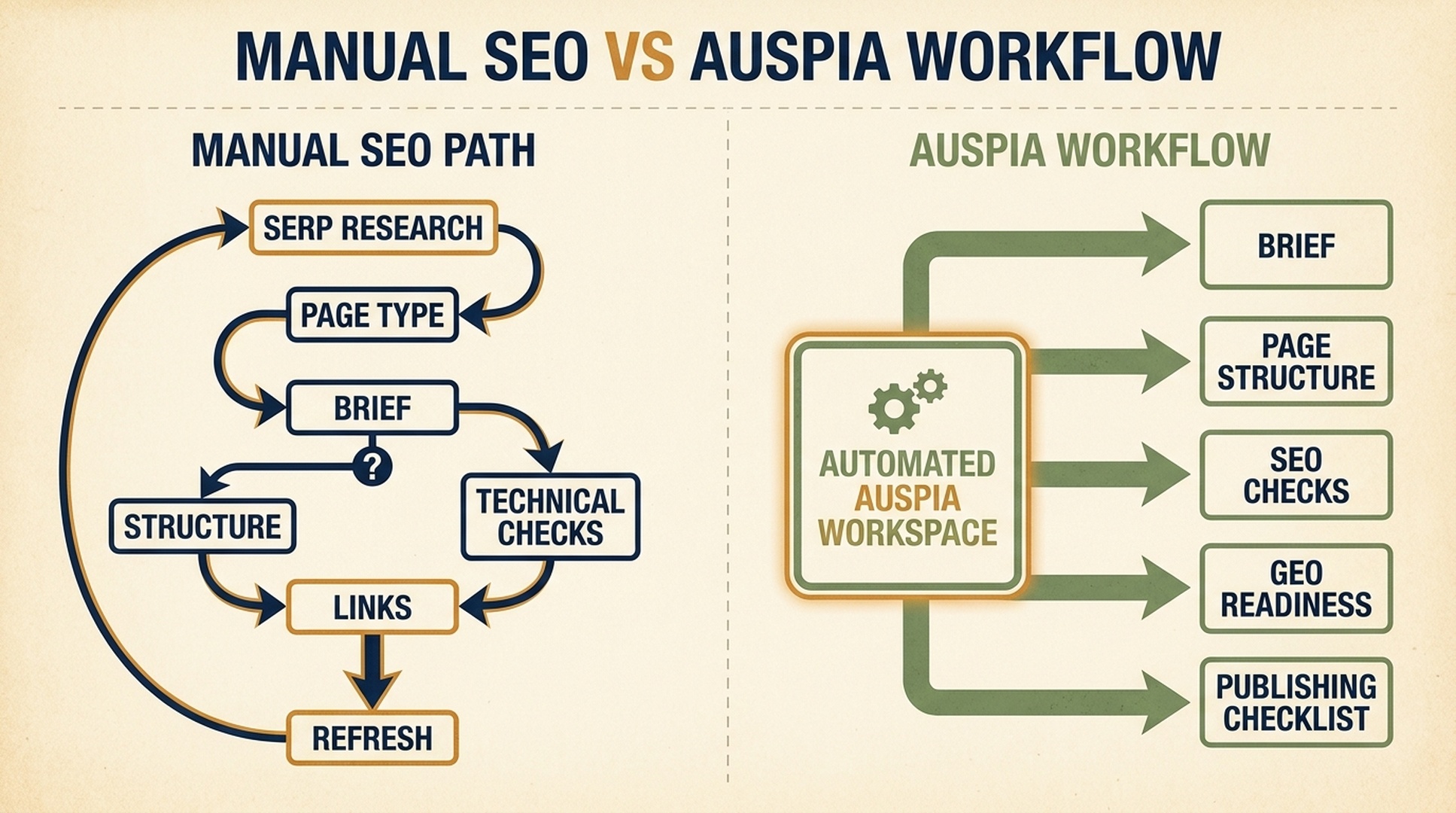
Caption: The goal is not to remove strategy. It is to remove the repeated setup work that slows teams down.
What Auspia automates
Auspia.ai is built for teams that need SEO, GEO, and AEO output without turning every content marketer into a technical SEO specialist.
A practical Auspia workflow can help with:
Workflow step | Manual version | Auspia version |
|---|---|---|
Intent mapping | Inspect SERPs and classify queries by hand. | Generate intent groups and page-type recommendations. |
Page brief | Build headings, questions, and angle manually. | Produce a structured brief that maps to search and AI answer needs. |
Content structure | Guess which sections are needed. | Create answer-first outlines, FAQ blocks, tables, and internal-link prompts. |
Technical checks | Run separate audits and copy findings into docs. | Surface crawl, index, robots, schema, and page-readiness checks in workflow. |
GEO readiness | Manually decide whether a page is citable. | Check clarity, entity signals, answer extraction, and AI visibility gaps. |
Refresh planning | Wait until traffic drops. | Flag pages that need updates based on performance and answer-surface changes. |
This does not mean every page should be auto-published without review. Bad automation creates more bad pages. The useful version gives teams a working draft, a checklist, and a diagnostic layer so humans can spend their time improving the argument, examples, and offer.
If you want a starting point, use the Auspia SEO/GEO/AEO tools to check visibility, crawler access, page readiness, and AI search exposure before building a larger content system.
A simpler operating model for small teams
For startups, agencies, and lean growth teams, the full SEO playbook can be reduced to a weekly operating loop.
Day | Action | Output |
|---|---|---|
Monday | Pick topics by intent and business value. | Prioritized page queue. |
Tuesday | Generate or update briefs in Auspia. | Page structure, FAQs, internal-link targets. |
Wednesday | Draft and edit pages. | Human-reviewed content with examples and evidence. |
Thursday | Run SEO, technical, and GEO checks. | Fix list before publish. |
Friday | Publish, interlink, and measure. | Live pages with tracking and refresh notes. |
This is enough for most teams. It keeps SEO moving without turning the week into a research maze.
The important part is the order. Do not write first and optimize later. Decide intent, page format, and structure before writing. Then use automation to catch the details that people usually miss.
Where human judgment still matters
Automation should not decide your positioning. It should not invent proof. It should not make exaggerated claims about results you do not have. It should not replace an actual understanding of the buyer.
Humans still need to decide:
- Which topics are commercially worth pursuing.
- What the company believes that competitors do not.
- Which examples, screenshots, and data are real.
- How the offer should connect to the page.
- Which pages deserve authority-building support.
- When a generated outline is too generic and needs a sharper angle.
The best workflow is not full manual control or full autopilot. It is assisted execution: automate the repetitive SEO system, then apply human taste and business judgment.
Auspia take
The next stage of SEO will be less about memorizing tactics and more about operating a reliable system. Content, structure, and trust still matter. AI search makes them matter more, because vague pages are harder to cite and weak pages are easier to skip.
For a small team, the right answer is not to study every SEO framework for months. Learn the basic model, then use Auspia.ai to automate the workflow: map intent, choose page types, generate briefs, check technical readiness, improve GEO clarity, and monitor what needs refresh.
SEO is system engineering. Auspia exists so teams do not have to build the whole system by hand.
Checklist: launch a page without overcomplicating SEO
Use this before publishing:
- The page has a clear business reason to exist.
- The target query group has the same intent.
- The page type matches what users expect in the SERP.
- The opening section gives a direct answer.
- The page includes examples, comparison tables, or practical steps.
- The title, headings, and metadata are specific without keyword stuffing.
- Internal links point to and from related pages.
- The page is crawlable, indexable, fast enough, and mobile-friendly.
- Robots.txt and AI crawler rules do not block the traffic you want.
- The page has enough evidence to be cited, not just summarized.
- Measurement includes rankings, clicks, conversions, and AI answer visibility.
FAQ
Is SEO still worth doing if AI answers reduce clicks?
Yes, but the goal is broader now. SEO still earns rankings and clicks, especially for commercial and decision-heavy searches. AI answers add another visibility surface, where being cited or mentioned can influence buyers before they visit your site.
Do small teams need to learn technical SEO deeply?
They need to understand the basics: crawlability, indexability, internal links, speed, structured data, and robots rules. They do not need to run every check manually. A tool like Auspia can automate much of the diagnostic work and turn it into a simple fix list.
What should I automate first?
Start with intent mapping, page briefs, technical checks, internal-link opportunities, and GEO readiness checks. These are repeated across almost every page and are easy to standardize. Keep positioning, proof, examples, and final editorial judgment human.
Are backlinks still part of the system?
Yes. Links and credible mentions still help search engines and AI systems judge trust. The safer strategy is to earn references through useful pages, tools, data, and partnerships rather than buying unnatural link patterns.
How is Auspia different from a generic writing tool?
A generic writing tool produces text. Auspia is designed around the SEO, GEO, and AEO workflow: search intent, page type, structure, crawl readiness, AI visibility, internal linking, and refresh planning. The output is not just a draft; it is a page operating plan.