


Quick answer
You do not need to become a full-time SEO specialist before your site can earn search traffic. You still need the basics: clear positioning, crawlable pages, useful content, internal links, and proof that your business is real. But the old learning path is too heavy for many teams. Most founders and small marketing teams do not need to memorize every Google update, inspect every crawl log, or build a spreadsheet for every keyword cluster.
A better path is simpler: use a system that checks the site, finds the obvious gaps, builds the content plan, and keeps score while you work. That is the reason Auspia exists. Instead of spending months learning technical SEO, GEO, AEO, robots.txt, schema, and AI search visibility as separate disciplines, you can start with Auspia and let the workflow tell you what to fix first.
This guide explains the modern SEO foundation in plain English, then shows which parts should be automated from day one.
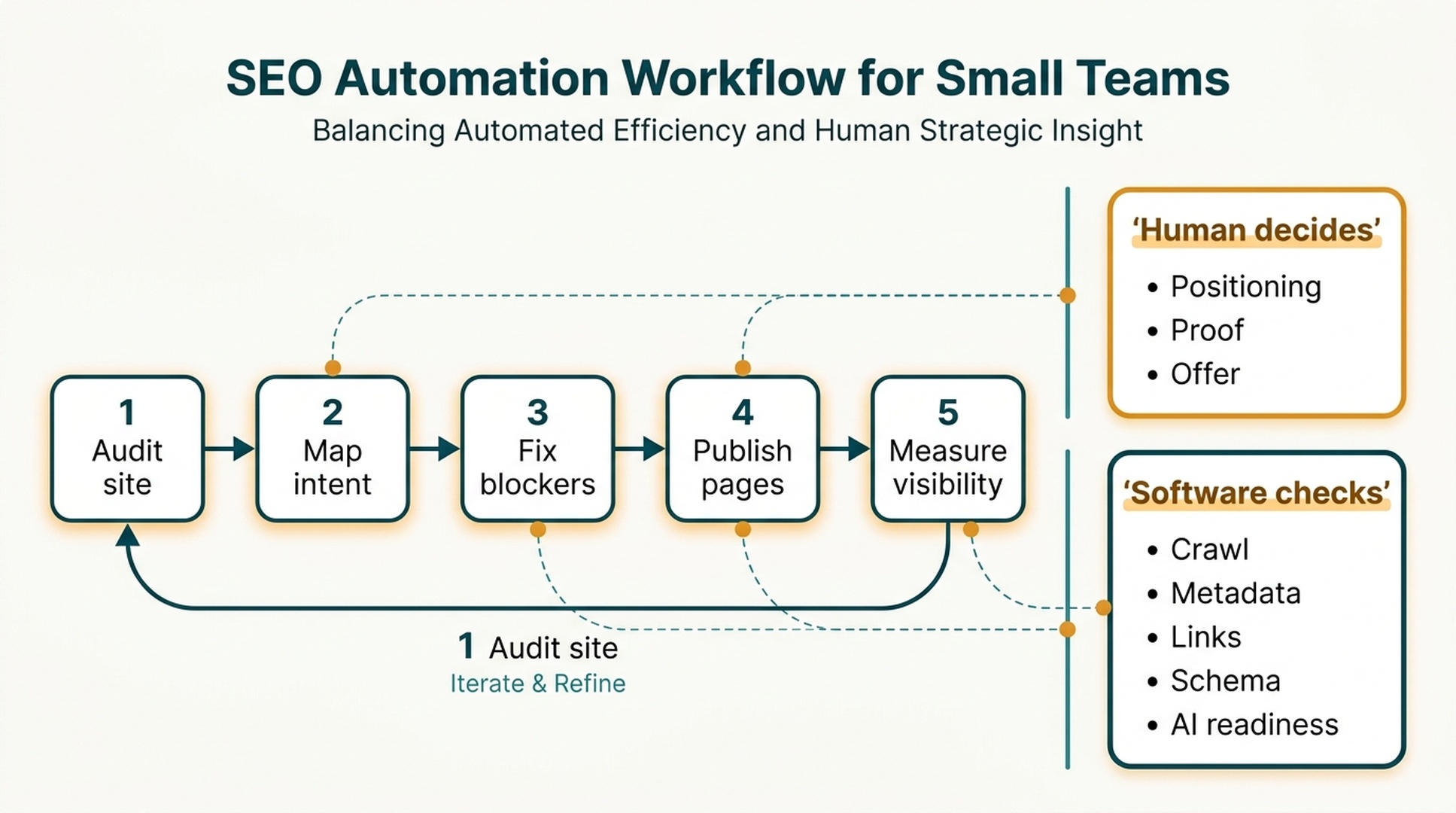
Caption: A practical SEO workflow should move from diagnosis to action, not from theory to another spreadsheet.
Why the old SEO learning path feels so complicated
Most SEO tutorials are not wrong. They are just written as if the reader wants to become an SEO consultant.
They usually start with definitions, then move into crawling, indexing, ranking factors, keyword research, search intent, metadata, internal linking, schema, backlinks, E-E-A-T, analytics, algorithm updates, AI Overviews, and a dozen tools. By the end, the reader understands why SEO is hard, but still does not know what to do next Monday.
That is a real problem for business owners.
A local service company does not need a 200-line technical audit before fixing missing title tags. A B2B SaaS team does not need to debate whether one keyword is informational or commercial for three hours before publishing a comparison page. An ecommerce store does not need to read another thread about the death of SEO before checking whether its category pages are indexable.
The work matters. The ceremony around the work often does not.
What SEO still means in 2026
SEO is the process of making a website easier for search engines and users to understand, trust, and recommend. In practice, that means four things:
Area | Plain-English meaning | What usually goes wrong |
|---|---|---|
Technical SEO | Search engines can crawl, render, and index the pages | Broken robots rules, slow pages, duplicate URLs, missing sitemaps |
Content SEO | Pages answer real search intent better than alternatives | Thin pages, vague headings, weak examples, no clear target query |
Authority | Other sites and users give signals that the brand is credible | No mentions, no reviews, no citations, no trustworthy external footprint |
Measurement | The team can see what is improving and what is wasting time | No Search Console review, no ranking checks, no content refresh cycle |
The AI search layer adds one more requirement: your pages must be easy for answer engines to extract, summarize, and cite. That does not replace SEO. It raises the bar for structure, clarity, entity signals, and evidence.
If your site is messy for Google, it is probably messy for AI answer engines too.
SEO, GEO, and AEO are converging
For years, teams treated SEO as Google ranking work, AEO as answer-box work, and GEO as visibility inside AI-generated answers. That separation is becoming less useful.
A page that performs well now tends to share the same traits across all three surfaces:
Requirement | SEO value | AI search and GEO value |
|---|---|---|
Clear page purpose | Helps Google match intent | Helps LLMs identify what the page is about |
Direct answer near the top | Improves snippet and engagement potential | Gives AI systems an extractable answer |
Structured headings | Improves crawl understanding | Makes passages easier to retrieve |
Specific examples and data | Builds usefulness and trust | Gives answer engines citation-worthy details |
Entity consistency | Supports brand and topical authority | Helps AI systems connect the brand, product, and topic |
Freshness signals | Helps with competitive queries | Reduces risk of outdated citations |
This is why treating GEO as a separate magic tactic is a distraction. The better question is: can a machine understand your page quickly, and would a human trust it after reading it?
The crawl-to-ranking model, without the jargon
Search engines have to do four jobs before your page can bring traffic.
First, they need to discover the page. Links, sitemaps, and clean site architecture help with that.
Second, they need to render the page. If important content is hidden behind broken JavaScript, aggressive popups, or inaccessible UI patterns, the page may look weaker than it really is.
Third, they decide whether to index it. Not every crawled URL deserves a place in the index. Duplicate product filters, thin blog posts, empty category pages, and near-identical AI pages can drag down the perceived quality of the site.
Fourth, they rank it. Ranking depends on intent match, page quality, authority, freshness, links, user satisfaction signals, and the competitive set for that query.
You do not need to reverse-engineer every ranking factor. You need a repeatable way to find where the pipeline is leaking.
That is exactly the kind of check that should be automated. A human should make decisions about positioning and offer quality. Software should tell you if your pages are crawlable, whether metadata is missing, which pages have weak structure, and where AI-readiness is low.
Start with positioning before keywords
Keyword research is useful, but it is not the first step.
Before chasing search volume, answer three questions:
- Who is the site for?
- What action should the visitor take?
- What problems does the product or service solve better than alternatives?
If those answers are unclear, keyword research becomes noise. You end up with a long list of phrases and no editorial logic.
A practical keyword map should separate four groups:
Keyword group | Example | Best page type |
|---|---|---|
Problem-aware | "why is my website not showing on google" | Guide, checklist, diagnostic tool page |
Solution-aware | "seo audit tool for small business" | Tool landing page or comparison page |
Product-aware | "Auspia AI search visibility checker" | Product page, use-case page, support article |
Decision-stage | "best seo automation platform for startups" | Comparison page, case study, buyer guide |
New sites should not only publish long-tail blog posts. They need a mix of core commercial pages, tool pages, comparison pages, and supporting explainers. The supporting pages help the money pages by sending internal relevance signals.
Search intent beats keyword volume
A keyword with 5,000 searches per month can be useless if your page does not match the search result page.
Before writing, look at what already ranks. Are the results mostly product pages, tutorials, listicles, videos, forums, or comparison pages? If Google is showing tools and calculators, a 3,000-word essay may not be the right format. If the results are full of Reddit and Quora threads, users may want lived experience rather than another polished brand article.
This is where automation helps, but judgment still matters. A tool can collect SERP patterns. A person still needs to decide the angle: beginner guide, product-led workflow, competitor comparison, pricing explanation, or operational checklist.
The best workflow is not "AI writes a blog post." It is:
- Diagnose the intent.
- Choose the correct page type.
- Draft with a clear answer near the top.
- Add examples, screenshots, tables, or checklists.
- Publish with clean metadata and internal links.
- Refresh when the page starts slipping or the market changes.
On-page SEO: the parts worth caring about
For most teams, on-page SEO comes down to a small set of habits.
Write one clear title. The title should say what the page is about and why someone should click. Do not stuff five variants of the same keyword into it.
Use headings that describe the actual section. Clever headings are fine in essays. SEO pages need headings that help readers scan and help machines parse the answer.
Put the direct answer early. If the page answers a question, answer it before the deep explanation. This helps readers, snippets, and AI answer systems.
Make URLs short and stable. A URL should be readable, not a dumping ground for dates, categories, and tracking fragments.
Add internal links where they help. Link from supporting articles to commercial pages. Link from high-authority pages to new pages that deserve discovery. Do not turn every paragraph into a link farm.
Use tables when comparison matters. Tables are good for extraction because they make relationships explicit.
Add schema when it reflects the content. FAQ schema, article schema, product schema, and local business schema can help, but fake markup does not create trust.
If you want a fast first pass, run your site through the Website SEO Score Checker. It will not replace strategy, but it can stop you from missing the obvious.
Technical SEO: automate the boring checks
Technical SEO can become a rabbit hole. The goal is not to make every Lighthouse number perfect. The goal is to remove blockers that keep good pages from being discovered, indexed, and trusted.
Start here:
Check | Why it matters | Automate it? |
|---|---|---|
robots.txt | A bad rule can block important pages | Yes |
XML sitemap | Helps discovery and index monitoring | Yes |
canonical tags | Prevents duplicate URL confusion | Yes |
status codes | Finds 404s, redirect chains, and server errors | Yes |
page speed | Affects user experience and crawl efficiency | Yes |
mobile usability | Most searches happen on mobile devices | Yes |
structured data | Helps machines understand entities and page type | Partly |
index coverage | Shows which pages Google accepts or ignores | Yes |
The point is not to become a technical SEO engineer. The point is to build a habit: check the site, fix the blocker, measure the result.
For AI-era sites, also check whether your crawling rules accidentally block the bots that power AI discovery. Auspia's Robots.txt AI Crawler Checker is built for that exact job.
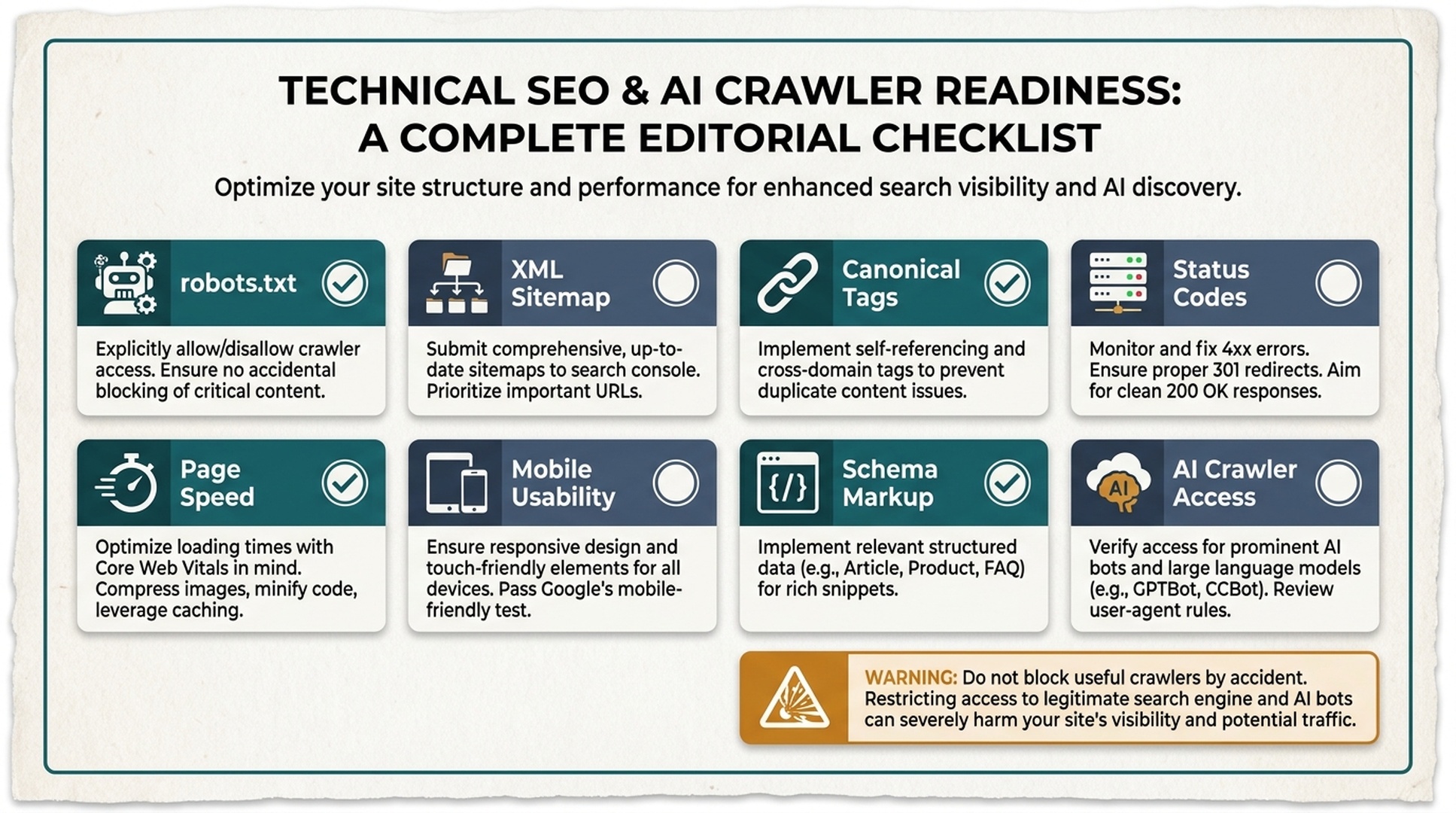
Caption: Technical SEO should be a recurring health check, not a once-a-year panic project.
Content quality is not word count
Long content can rank. Short content can rank. The real question is whether the page satisfies the intent better than the alternatives.
A strong page usually has:
- A specific audience and use case
- A clear answer in the first section
- Original examples, not generic filler
- Screenshots, diagrams, tables, or templates when they help
- Enough depth to solve the problem
- A next step that makes sense
A weak page usually has:
- A broad title with no point of view
- Rewritten definitions from other sites
- Repeated phrases that sound polished but say little
- No evidence, no examples, no constraints
- No internal path to a product, tool, or related guide
AI has made cheap content easier to produce. That means average content is less useful than before. The winning pages are not the ones that sound the smoothest. They are the ones that help a reader make a decision, finish a task, or understand a tradeoff.
Off-page SEO is really trust building
Backlinks still matter, but the old shortcut mindset is dangerous. Buying random links, publishing thin guest posts, or chasing irrelevant directory listings can waste money and create risk.
A better trust strategy is slower but more durable:
Trust asset | Good example |
|---|---|
Customer proof | Case studies, reviews, testimonials, before-and-after examples |
Third-party mentions | Industry blogs, podcasts, newsletters, software directories |
Useful tools | Free calculators, checkers, templates, and diagnostics people cite |
Expert content | Articles with named experience, real screenshots, and practical constraints |
Entity consistency | Same brand, product, address, founder, and category signals across the web |
For GEO, this matters even more. AI answer systems often lean on the sources they can recognize and cross-check. If your brand barely exists outside your own site, it is harder to become a trusted answer.
What to measure each month
Do not measure SEO only by rankings. Rankings move around, and AI answer pages can change the click curve.
Track a small set of metrics:
Metric | What it tells you |
|---|---|
Indexed pages | Whether Google accepts your pages |
Organic clicks | Whether search visibility turns into visits |
Impressions | Whether pages are being considered for queries |
Query growth | Whether topical coverage is expanding |
Conversions | Whether traffic has business value |
AI visibility checks | Whether your brand appears in relevant AI answers |
Refresh backlog | Which pages need updates or consolidation |
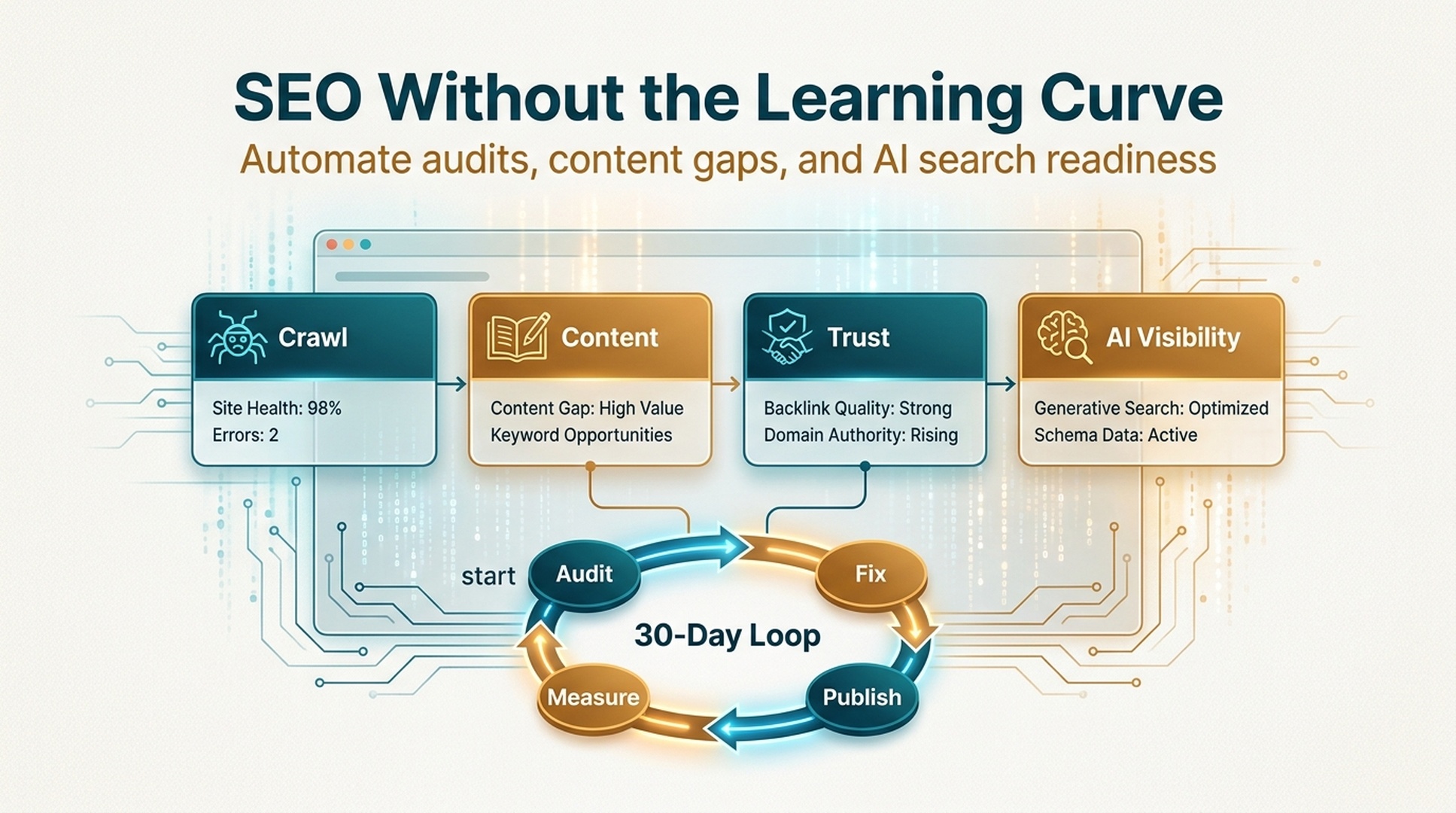
Auspia's view is simple: SEO should become an operating loop, not a one-time project. Audit, prioritize, fix, publish, measure, refresh. Repeat monthly.
The 2026 SEO trend that matters most
The biggest change is not that AI will kill SEO. The bigger change is that mediocre SEO work is becoming easier to spot.
Search engines and answer engines are both getting better at ignoring pages that add no new value. They are also rewarding pages that are clear, structured, credible, and useful. That makes the basics more important, not less.
For small teams, the winning move is not to study every update. It is to automate the checks, publish pages with a real purpose, and build enough authority that both humans and machines can trust the site.
What Auspia automates for you
Auspia is designed for teams that want the outcome of SEO, GEO, and AEO work without building a complicated internal stack.
Use it to:
- Scan a website for SEO and technical issues
- Check whether pages are ready for AI search extraction
- Find crawler and robots.txt problems
- Build a practical content improvement backlog
- Monitor whether the site is becoming easier to understand, cite, and rank
- Turn SEO work into a repeatable operating loop
The work still needs your business knowledge. No tool can decide your positioning, your customer promise, or the proof only your company has. But the repetitive diagnostic work should not live in someone's spreadsheet.
Start with Auspia's SEO/GEO/AEO tools. Run a check, fix the first set of blockers, then build the next month of content from the gaps the audit exposes.
A simple 30-day SEO automation plan
Week | What to do | Output |
|---|---|---|
Week 1 | Run SEO, AI visibility, and crawler checks | Baseline score and blocker list |
Week 2 | Fix metadata, crawl rules, broken links, sitemap, and obvious page issues | Cleaner indexation path |
Week 3 | Build a keyword and intent map around core offers | Prioritized page list |
Week 4 | Publish or refresh 3-5 high-value pages | New pages, internal links, measurement plan |
Keep the first month boring. Boring is good. Most sites do not fail because they missed an advanced tactic. They fail because the important pages are unclear, thin, slow, blocked, duplicated, or disconnected from the rest of the site.
FAQ
Do I still need to learn SEO if I use Auspia?
You need to understand the basics, but you do not need to become an SEO technician. Learn enough to make good business decisions. Let software handle audits, repetitive checks, and monitoring.
Is SEO still worth doing with AI search growing?
Yes. AI search often depends on the same web signals that make pages crawlable, understandable, and trustworthy. Strong SEO gives AI systems better source material to work with.
What should a new site fix first?
Start with crawlability, page purpose, titles, headings, internal links, and a small set of pages tied to real business intent. Do not begin with 100 generic blog posts.
Can AI-generated content rank?
It can, but only if the final page is useful, accurate, specific, and edited with real judgment. Generic AI content that repeats existing pages is unlikely to build durable search visibility.
How long does SEO take?
Most sites should expect months, not days. Technical fixes can improve quickly, but rankings, authority, and conversions usually need repeated publishing and refresh cycles.
What is the fastest way to start?
Run a baseline audit, fix the blockers, then publish a small number of pages that match high-intent searches. If you want the fastest path, start at auspia.ai and let the tool generate the first action list.


