The short version
If you are learning SEO in 2026, you are not late. You may even be lucky. You do not have to inherit ten years of bad habits built around keyword stuffing, thin affiliate pages, and backlink shortcuts.
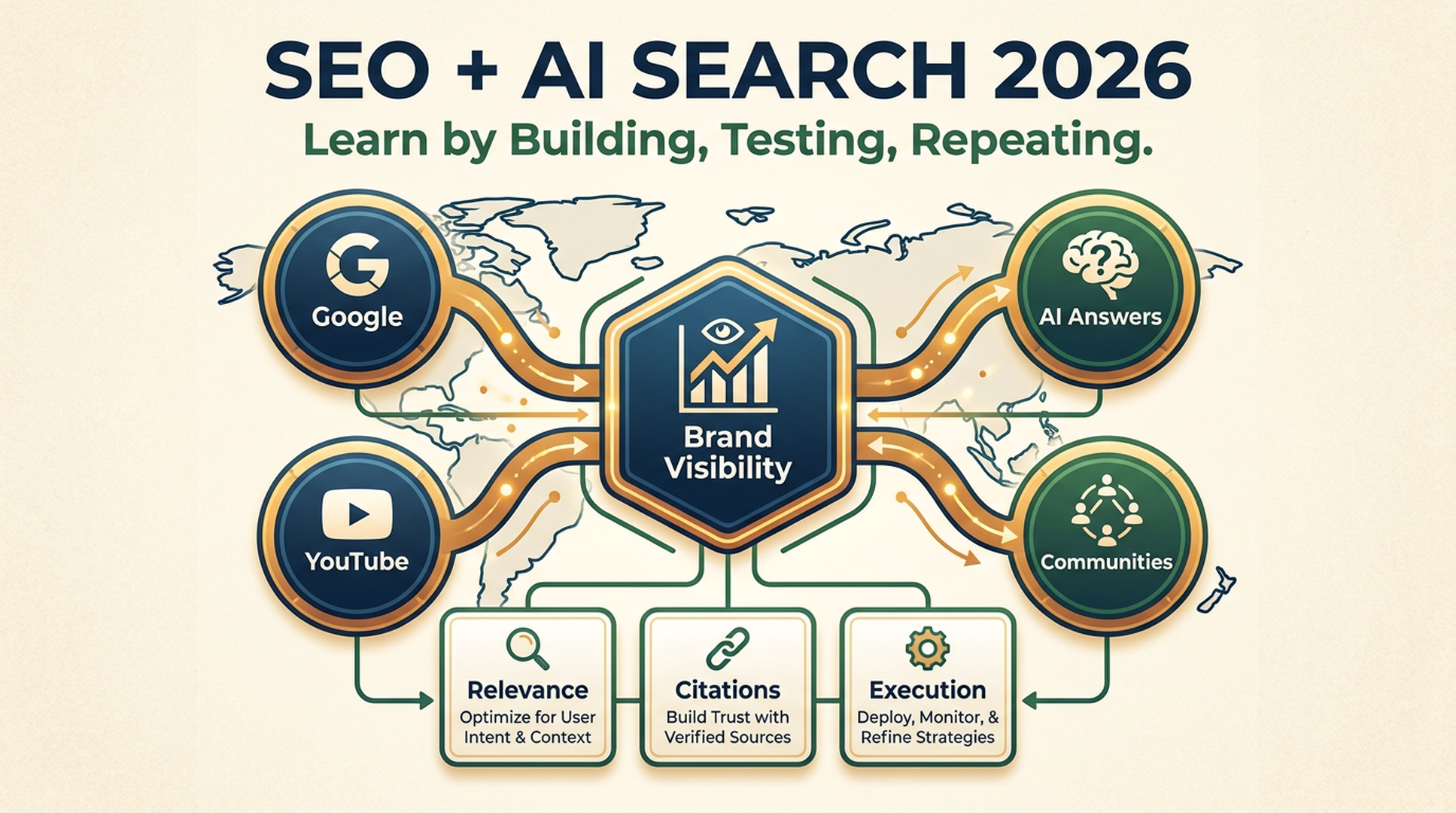
But the job is harder now. SEO is no longer just "rank on Google and wait for clicks." Google answers more questions directly. ChatGPT, Perplexity, Gemini, Claude, and Copilot can search, summarize, and recommend. YouTube, Reddit, LinkedIn, review sites, and niche communities all feed the discovery loop.
The useful way to learn is not to watch a month of tutorials before touching a website. Build a small site, pick one topic, publish, inspect the results, use AI to fix the next bottleneck, and repeat. SEO has become search everywhere optimization. You learn it by doing the work in public enough times that the patterns become obvious.
The old SEO learning path is broken
The old beginner playbook was tidy:
- Find keywords
- Write pages
- Build links
- Wait for rankings
- Report traffic
That still describes part of the job, but it misses the messy part of modern discovery. A user may ask Google and read an AI Overview without clicking. Another may ask ChatGPT for a product shortlist. A third may search YouTube, then check Reddit, then ask Perplexity to compare options.
If your learning plan only teaches "how to rank a blog post," you are learning one lane of a larger road.
The bigger shift is this: SEO used to feel like a ranking game. In 2026, it is closer to an exposure game. Can your brand, page, product, or expert point of view appear wherever the user asks the question?
That does not make classic SEO useless. Technical SEO, crawlability, internal links, page speed, content quality, and authority still matter. They are the floor. The ceiling now includes AI answer visibility, brand mentions, source diversity, and content that can be quoted without an editor cleaning it up.
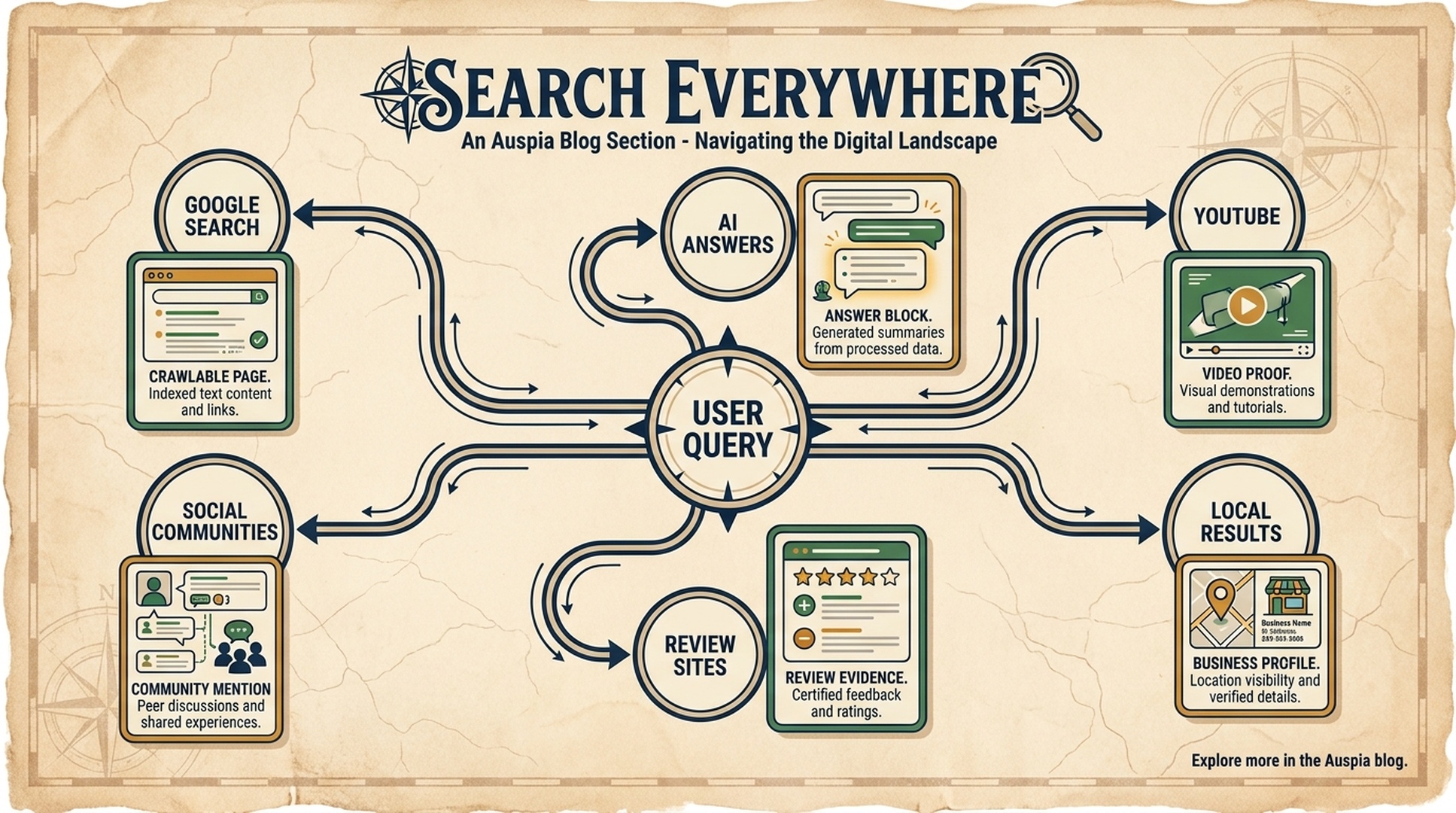
Modern SEO has become a source ecosystem. A useful page is only one signal among answers, videos, reviews, community mentions, and local data.
Learn by building, not by preparing forever
Most beginners over-prepare. They buy courses, collect templates, save threads, build a reading list, and spend weeks feeling productive. Then they open a CMS and freeze.
SEO is not learned that way.
A better path:
- Buy a domain or use a small existing site.
- Pick a narrow topic you can write about for 30 days.
- Publish five useful pages.
- Submit the site to search engines.
- Check what gets indexed, ignored, cited, or rewritten by AI answers.
- Use AI tools to solve one concrete problem at a time.
- Repeat the loop.
The important part is the loop. You will learn more from one real indexing issue than from ten lectures about indexing. You will learn more from comparing two search results pages than from memorizing a keyword research framework.
Use ChatGPT, Claude, Gemini, or another assistant as a tutor, not as a replacement operator. Ask it why a title is weak. Ask it to inspect a page outline. Ask it to turn a vague claim into a sourced answer block. Then you still have to publish, test, edit, and measure.
AI can shorten the feedback cycle. It cannot give you the scar tissue.
SEO now means search everywhere
The phrase "search everywhere optimization" sounds like a slogan, but it describes what users already do.
They search in more places:
- Google Search and Google AI Overviews
- ChatGPT with browsing or search connectors
- Perplexity and other answer engines
- YouTube and podcast platforms
- Reddit, Quora, Stack Overflow, and niche forums
- LinkedIn, TikTok, Instagram, and industry communities
- App stores, directories, review sites, and marketplaces
A brand does not need to dominate every platform on day one. That is how teams burn out. But a beginner should understand the map. The search journey now crosses web pages, videos, reviews, community comments, documentation, and AI-generated answers.
For Auspia readers, this is where SEO and GEO meet. SEO makes your pages discoverable. GEO makes your content easier for AI systems to retrieve, summarize, and cite. AI search optimization connects both to the broader source ecosystem.
Google itself is no longer one surface
Many people say they are "doing Google SEO" as if Google were still one list of ten blue links. It is not.
Google surface | What changed | How to learn it |
|---|---|---|
Traditional organic results | Blue links still send traffic, especially for commercial and long-tail queries | Study titles, intent match, internal links, snippets, and competing page formats |
AI Overviews | Google may answer the question before the click | Write clear explanatory sections, direct definitions, comparison tables, and source-backed claims |
AI Mode and conversational search | The journey becomes more like a guided recommendation flow | Test question chains, product criteria, and follow-up prompts |
Gemini | Google has an AI assistant surface outside the classic SERP | Build brand clarity and consistent entity signals across the web |
Local results | Maps, reviews, proximity, and business profiles decide many service searches | Maintain local pages, reviews, categories, photos, and accurate business data |
The beginner mistake is to study only ranking position. Modern SEO practice also asks: did the page appear in an AI answer? Was it cited? Did Google use a competitor's definition? Did the answer mention a marketplace, a forum, or a YouTube video instead of a blog post?
The search result is the textbook. Open it every day.
AI search rewards brands, not just pages
Traditional SEO often rewarded the best-optimized page. AI search tends to reward the source that looks safest to recommend.
That usually means a brand has more than one signal:
- A clear website with useful pages
- Consistent descriptions across profiles and directories
- Mentions from credible third parties
- Reviews, comparisons, and community discussion
- Content on platforms where the audience already searches
- Pages with direct, quotable answers
This is uncomfortable for beginners because it sounds bigger than writing blog posts. But it also creates a simpler learning principle: build evidence, not just content.
If you sell project management software, a generic article about "best productivity tips" does little for AI search. A stronger source ecosystem would include a comparison page, a use-case page for agencies, a YouTube walkthrough, real customer reviews, a help doc with clear feature limits, and a few third-party mentions that confirm the product exists and who it serves.
The page matters. The footprint around the page matters too.
Study results before studying opinions
There is too much SEO advice. Some of it is useful. Some of it is recycled from a search environment that no longer exists.
The fastest way to build judgment is to study live results.
Pick one query and ask:
Question | What to look for |
|---|---|
What format wins? | Blog post, category page, product page, video, forum thread, listicle, local pack |
Who gets cited by AI answers? | Publisher, vendor, marketplace, documentation, review site, community comment |
What does the answer repeat? | Definitions, feature criteria, statistics, pros and cons, steps |
What is missing? | Better examples, fresher data, clearer comparisons, stronger proof |
Where else does the winning brand appear? | YouTube, LinkedIn, Reddit, directories, podcasts, partner pages |
Do this for ten queries in one niche and you will notice patterns that no course can hand you cleanly. Some niches are still blog-heavy. Some are review-heavy. Some are video-first. Some are dominated by local packs or marketplaces.
Auspia's AI Search Visibility Checker is useful for this kind of habit because it turns a vague question, "Are we visible in AI search?", into a repeatable check across prompts and sources.
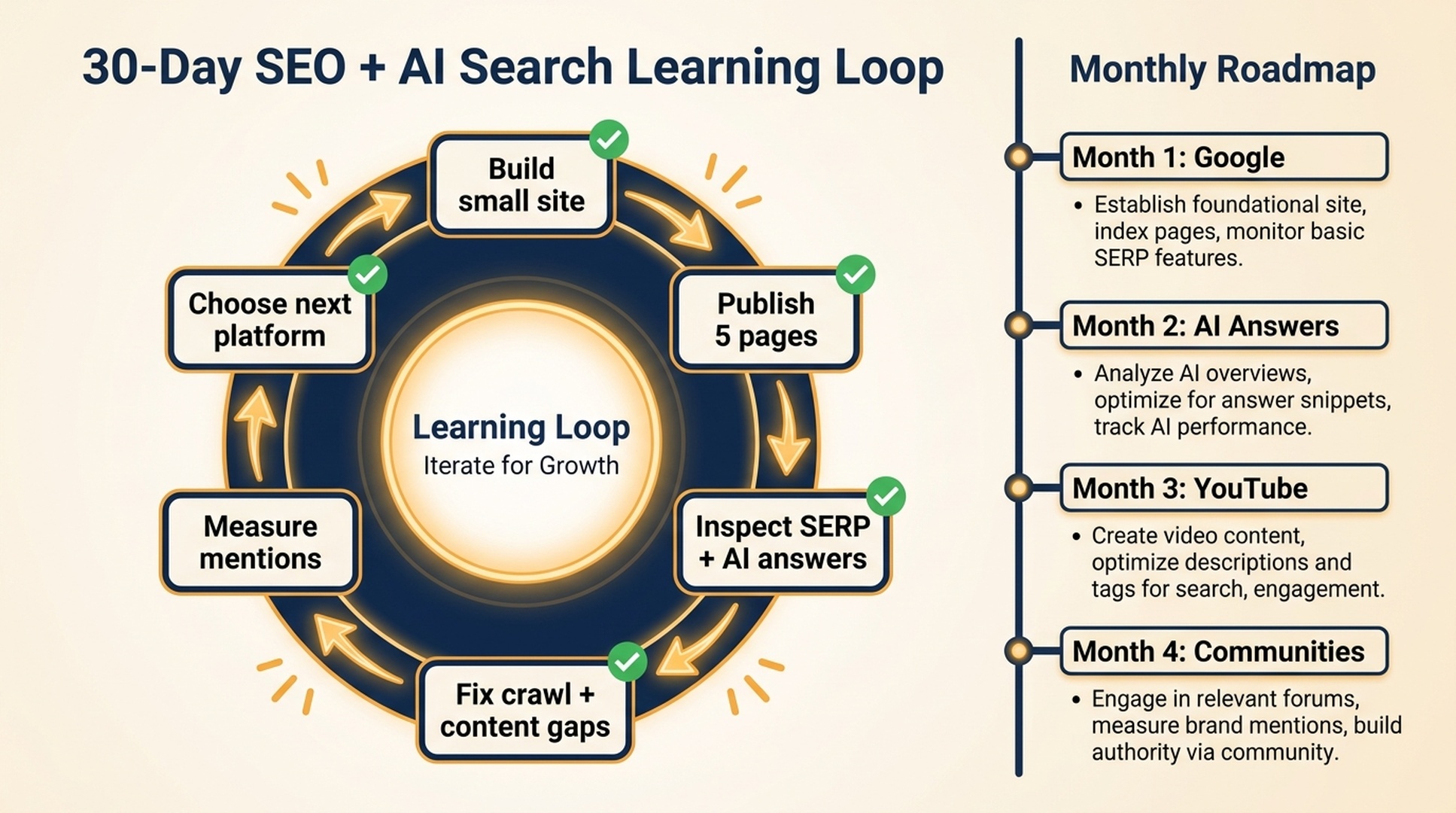
A beginner does not need to master every platform at once. The better path is a monthly loop: build, inspect, fix, measure, then expand.
Do not attack every platform at once
The new search map can make a beginner panic. Google, ChatGPT, Perplexity, YouTube, Reddit, LinkedIn, local SEO, schema, reviews, AI crawlers. It is too much if you treat it as a checklist for one weekend.
A better rhythm is one platform per month.
Month | Focus | Output |
|---|---|---|
1 | Google organic and AI Overviews | Publish and improve five pages around one topic cluster |
2 | ChatGPT and Perplexity visibility | Rewrite pages into answer-ready sections and test prompts weekly |
3 | YouTube or short-form video | Turn the strongest pages into explainers, demos, or comparisons |
4 | Community and review signals | Answer real objections, update profiles, collect credible mentions |
Slow is faster here. If you spend one month learning how one surface behaves, you build a real mental model. If you touch six platforms in the same week, you collect screenshots and anxiety.
Relevance is still the base layer
Under all the platform complexity, the basic rule is still relevance.
Specific content beats broad content because AI systems and search engines need to match a user situation to a source. "Best shoes" is vague. "Best baseball cleats for pitchers with wide feet" gives the system a job.
The same applies to B2B pages.
Weak topic: "CRM software"
Better topic: "CRM workflow for a 12-person B2B sales team using HubSpot and Slack"
Weak topic: "AI marketing"
Better topic: "How a SaaS startup can measure brand mentions in AI answer engines"
Specificity helps humans decide and helps machines retrieve. It also protects you from writing the same generic article as everyone else.
A 30-day beginner plan
If you are starting from zero, use this plan instead of trying to learn everything first.
Day range | Action | What you should learn |
|---|---|---|
Days 1-3 | Choose one niche, one audience, and one small site | Search intent and topic focus |
Days 4-7 | Research 20 live queries across Google and AI answer engines | What formats and sources already win |
Days 8-14 | Publish three foundational pages and two comparison or use-case pages | Page structure, titles, internal links, answer blocks |
Days 15-18 | Check indexing, crawl access, and page rendering | Technical SEO basics without theory overload |
Days 19-23 | Test prompts in ChatGPT, Perplexity, Gemini, and Google AI surfaces | AI visibility and citation gaps |
Days 24-27 | Rewrite weak sections with clearer answers, proof, and tables | GEO-ready content editing |
Days 28-30 | Record results and choose the next month’s platform focus | Measurement discipline |
Do not expect dramatic traffic in 30 days. Expect a working system. That is the win.
Common mistakes
The first mistake is chasing hacks before understanding search intent. Beginners ask which tool to use, which schema to add, or which AI crawler to allow before they can explain why a search result looks the way it does.
The second mistake is publishing content that has no reason to exist. If a page does not add a clearer answer, a better example, fresher data, or a more honest comparison, it is just another page.
The third mistake is letting AI create endless drafts without publishing discipline. AI can help you outline, rewrite, summarize, and compare. It can also produce a mountain of average content that no one needed.
The fourth mistake is measuring only clicks. In AI search, a useful measurement set includes impressions, mentions, citations, branded search lift, assisted conversions, demo quality, and which third-party sources answer engines trust.
Auspia take
The best way to learn SEO and AI search optimization in 2026 is to build a small search system, not a folder of notes.
Pick one niche. Publish useful pages. Study the live results. Rewrite for clarity. Check AI answer visibility. Add proof where your claims are thin. Expand to one new platform at a time.
The winners will not be the people who know the most terminology. They will be the people who can keep shipping useful content, reading the results honestly, and improving the source ecosystem around their brand.
FAQ
Is SEO still worth learning in 2026?
Yes. SEO is still the foundation for organic discovery, but it now includes AI answer visibility, brand evidence, and multi-platform search behavior. Learn classic SEO basics, then add AI search testing and source ecosystem work.
Should beginners start with Google or ChatGPT optimization?
Start with Google basics if you have no site experience: crawlability, titles, internal links, search intent, and useful pages. Then test the same topics in ChatGPT, Perplexity, Gemini, and Google AI surfaces to see whether your content is being used or ignored.
Can AI tools do SEO for me?
AI tools can speed up research, outlining, editing, technical checks, and content repurposing. They cannot replace publishing, judgment, testing, relationships, product knowledge, or the patience needed to improve real results.
What is the difference between SEO, GEO, and AI search optimization?
SEO focuses on organic search visibility. GEO focuses on making content easier for generative engines to retrieve, cite, and summarize. AI search optimization is the broader practice of improving visibility across AI answer engines, search assistants, and the source ecosystems they use.
What should I measure first?
Track whether pages are indexed, which queries trigger impressions, whether AI answers mention or cite your brand, which competitors appear, and whether leads from organic or AI-assisted journeys are qualified. Do this monthly so you can see movement instead of guessing.