Quick answer
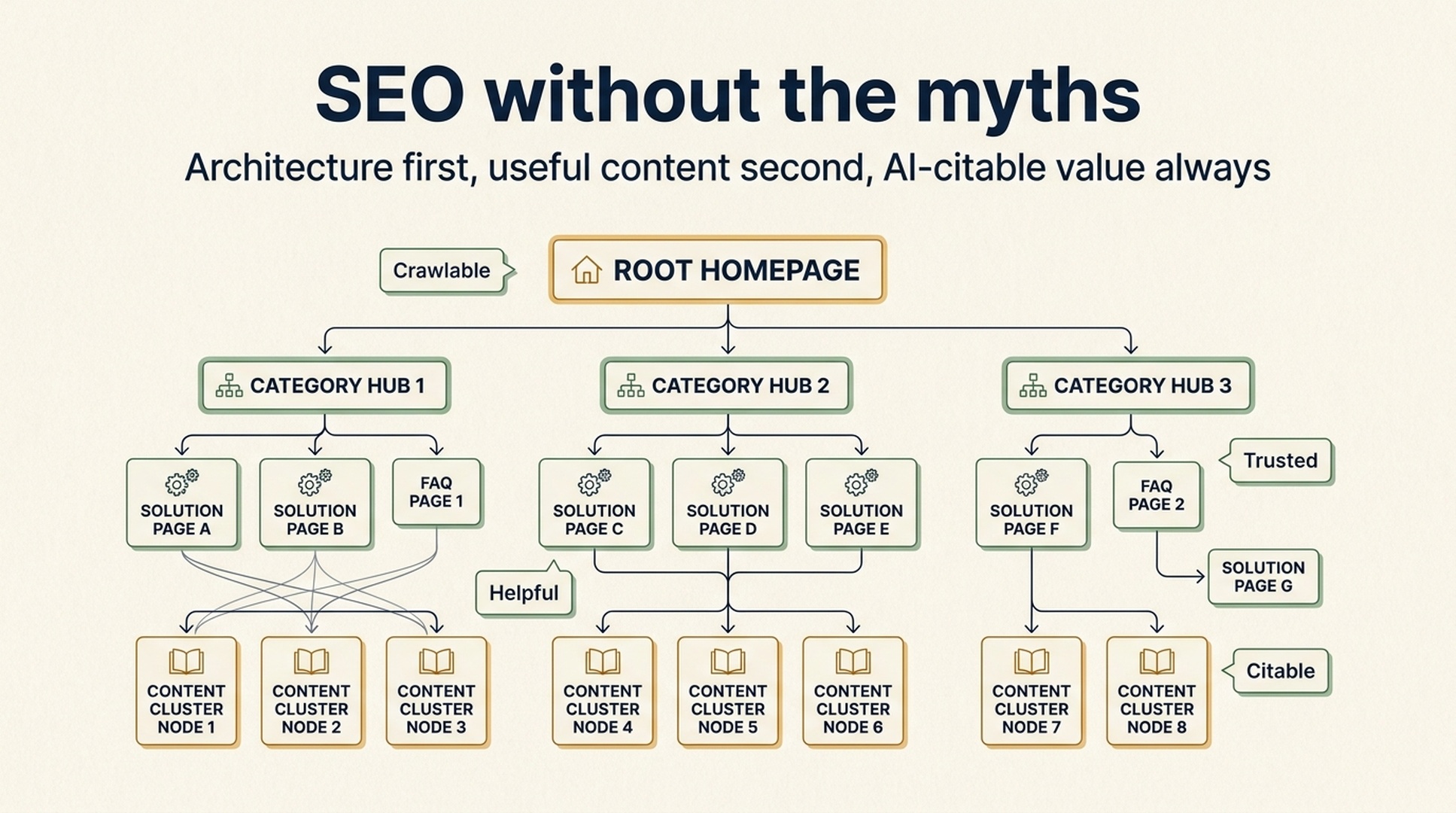
The durable logic of SEO is simple: architecture is the root, useful content is the engine, and trust is what lets the system compound. If your site is hard for Google to understand, publishing more articles will not fix the problem. If your content does not help the buyer make a decision, better keyword placement will not save it either.
The same logic now applies to AI search. Pages that are structured, specific, and genuinely useful are easier for Google, ChatGPT Search, Perplexity, Gemini, and other answer systems to retrieve, summarize, and cite.
So the practical rule is this: stop treating SEO as a collection of tricks. Build a site that is easy to crawl, easy to understand, useful for real buyers, and clear enough for AI systems to quote without guessing.
The mistake: treating SEO as either magic or article volume
Most struggling SEO programs fall into one of two traps.
The first trap is algorithm obsession. Teams spend too much time chasing keyword density, TF-IDF scores, quick-indexing hacks, AI rewriting workflows, link shortcuts, or rumors about the latest ranking factor. Some of those details may matter in narrow cases, but they rarely fix a weak site.
The second trap is article volume. The team decides that SEO means publishing a blog post every day. A few months later, the site has one hundred thin articles, no clear topic architecture, weak internal links, and no commercial pages strong enough to convert the traffic.
Both mistakes come from the same misunderstanding. SEO is not a publishing habit. It is a site system.
Architecture first: can search engines understand the site?
Before writing more content, ask a less glamorous question: does the site have a structure that search engines can understand?
SEO architecture is the way pages are grouped, named, linked, and prioritized. It tells search engines which pages are central, which pages support them, and how topics relate to each other.
A strong architecture usually includes:
- Clear page hierarchy.
- Logical URL patterns.
- Category or hub pages around important topics.
- Product, solution, use case, comparison, and FAQ pages where they fit search intent.
- Internal links that connect related pages instead of leaving them isolated.
- Crawlable pages, clean canonical rules, and an accurate sitemap.
- Structured data where it clarifies page meaning.
Search engines do not want a pile of disconnected pages. They reward sites that look like they know their subject.
For example, a B2B site selling warehouse automation software should not publish random news posts and hope Google understands the business. It needs a structure like this:
Site layer | Example page type | SEO role |
|---|---|---|
Core category | Warehouse automation software | Main commercial target and topical anchor. |
Solution pages | Inventory accuracy, labor planning, picking optimization | Match high-intent operational problems. |
Industry pages | 3PL, ecommerce fulfillment, manufacturing warehouses | Connect the product to buyer context. |
Comparison pages | Warehouse automation software vs WMS | Capture evaluation-stage searches. |
FAQ and guides | How to reduce warehouse picking errors | Answer long-tail questions and support hubs. |
Tools or templates | Warehouse labor cost calculator | Earn links, citations, and qualified leads. |
This is not just neat organization. It is how the site proves that it owns the topic.
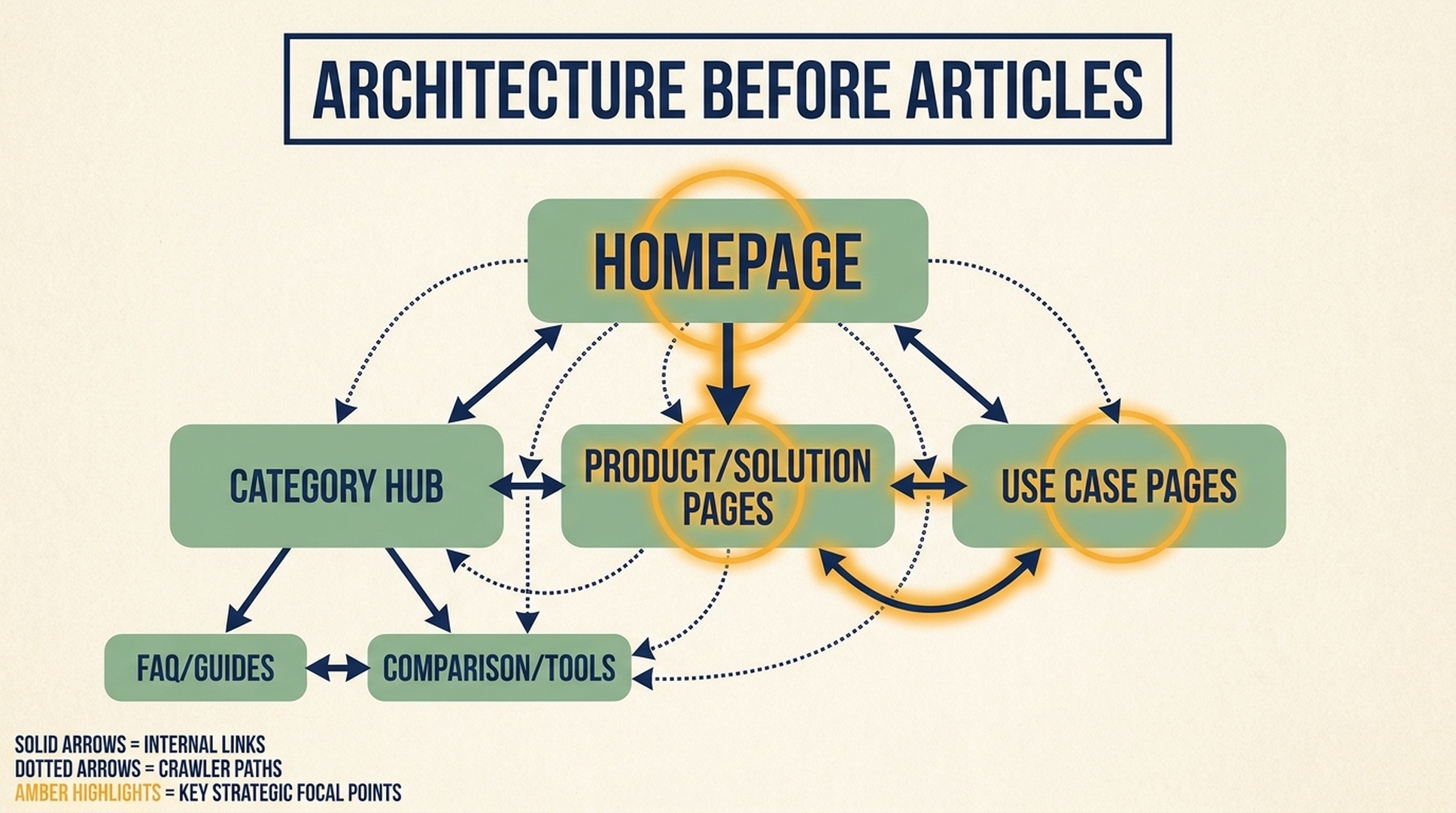
Caption: SEO architecture turns isolated pages into a topic system that search engines and AI answer systems can understand.
Content second: does the page solve the search problem?
Content is still king, but only if it has search value. Google and AI answer systems do not need more generic paragraphs. They need pages that answer the user's actual question better than the alternatives.
Take a query like "best project management software for construction teams." A weak page says, "Our software is powerful, easy to use, and built for modern teams." That does not help much.
A useful page answers the buyer's real questions:
- Does it handle subcontractor communication?
- Can field teams use it on mobile with poor connectivity?
- Does it support RFIs, change orders, drawings, and punch lists?
- How does it compare with general project management tools?
- What is the pricing model?
- Which team size is it best for?
- What are the trade-offs?
Useful SEO content has parameters, examples, comparisons, visuals, decision criteria, and constraints. It helps the reader decide.
The same principle applies outside software. If someone searches "fiber laser cutting machine for stainless steel," a serious page should discuss material thickness, power range, cutting speed, edge quality, gas choice, maintenance, safety, use cases, and buyer considerations. A page that only says the supplier is professional will not compete for long.
What useful content looks like
A useful page usually does five jobs:
Job | What the page should provide |
|---|---|
Answer | A direct response near the top, not a long warm-up. |
Explain | Enough context for the reader to understand the issue. |
Compare | Trade-offs, alternatives, or decision criteria. |
Prove | Evidence, examples, screenshots, data, or experience. |
Convert | A logical next step, such as a tool, checklist, demo, or related guide. |
That structure also improves GEO readiness. AI systems are more likely to extract and cite a page when the answer is explicit, the claims are grounded, and the sections are easy to parse.
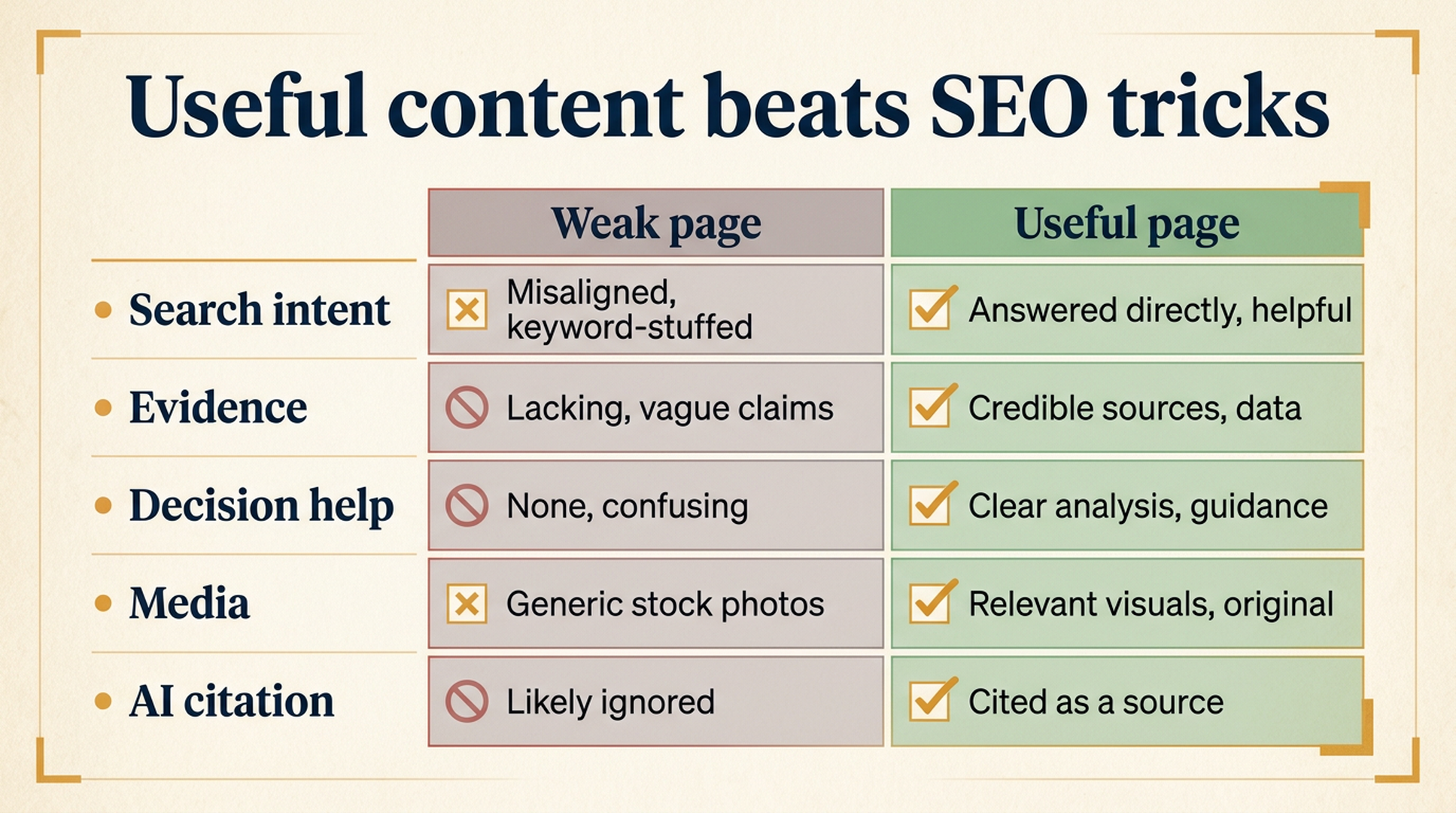
Caption: Useful content gives readers decision support. SEO tricks mostly create the appearance of optimization.
The myth problem: tactics cannot replace value
SEO myths survive because they sometimes produce small short-term wins. A title tweak can lift clicks. A better internal link can help a page get crawled. A few good backlinks can improve authority. None of that is fake.
The problem starts when tactics become the strategy.
If a page is shallow, keyword density will not make it valuable. If a site has no topic architecture, publishing more articles will not automatically create authority. If a brand has no proof, AI-generated rewrites will not create trust. If buyers need specifications, comparisons, or implementation guidance, a generic article will feel useless no matter how many H2 tags it has.
The better question is blunt: does this website deserve to rank for the topic?
A site earns that right through clear architecture, helpful content, technical reliability, visible expertise, and consistent improvement.
B2B SEO: traffic is not the goal
For B2B companies, the goal is not traffic by itself. The goal is qualified demand.
That changes keyword prioritization. The biggest keyword is often not the best keyword. Broad terms bring volume, but long-tail and use-case terms often bring buyers who know their problem.
Compare these two groups:
Broad keyword | Higher-intent alternative |
|---|---|
CRM software | CRM for commercial real estate brokers |
payroll software | payroll software for distributed teams |
laser cutting machine | fiber laser cutter for stainless steel kitchenware factories |
SEO tools | AI search visibility checker for SaaS websites |
warehouse automation | warehouse picking optimization software for 3PLs |
The higher-intent version may have less search volume, but the user is closer to a decision. That is where many smaller sites can win. They do not need to beat every giant website for the broad category term first. They need to own the questions that matter to their best buyers.
The right order of operations
A sensible SEO program follows a different order than most teams use.
- Map the market and search intent.
- Decide the site architecture and page types.
- Build the core commercial pages.
- Create supporting content clusters.
- Add internal links that reflect priority.
- Fix crawl, index, speed, schema, and mobile issues.
- Publish with measurement in place.
- Refresh pages based on rankings, clicks, conversions, and AI citation visibility.
The wrong order is easier and more common: publish many articles, wait, and hope some of them rank.
That approach wastes effort because it treats SEO as content output rather than a search product. A website is a product for searchers. The architecture, content, and user experience all shape whether that product deserves attention.
Where Auspia fits
The challenge is not that teams disagree with this logic. The challenge is execution. Architecture mapping, intent grouping, page planning, technical checks, internal links, GEO readiness, and refresh planning are a lot to manage manually.
Auspia.ai is built to make that workflow easier. Instead of forcing every team to learn the entire SEO and GEO playbook from scratch, Auspia helps automate the repeatable parts:
- Identify intent groups and page-type opportunities.
- Turn keywords into a site structure and content roadmap.
- Generate answer-first briefs with sections, FAQs, and comparison ideas.
- Check whether pages are crawlable, indexable, and technically ready.
- Surface internal-link opportunities.
- Review whether content is clear enough for AI answer extraction and citation.
- Track which pages need updates as search results and AI answers change.
This does not remove human judgment. It removes the spreadsheet-heavy setup work that keeps teams from shipping better pages.
If you are auditing an existing site, start with Auspia's SEO/GEO/AEO tools. For AI-specific visibility, the AI Search Visibility Checker can help reveal whether your important pages are being surfaced and cited in answer environments.
A practical checklist for architecture-first SEO
Use this checklist before creating or refreshing a content cluster:
- The target audience and buying situation are clear.
- The keyword group is organized by intent, not just volume.
- The site has a hub page for the main topic.
- Supporting pages map to use cases, comparisons, questions, tools, or decision points.
- URLs and navigation make the hierarchy obvious.
- Internal links point from supporting pages back to the hub and between related pages.
- Each page answers the main question in the first section.
- Content includes examples, specifications, trade-offs, or evidence.
- Technical SEO checks pass before publishing.
- The page is written so both humans and AI systems can extract the useful answer.
- Performance is measured by qualified traffic, conversions, and citation visibility, not pageviews alone.
Auspia take
SEO has become less mystical, not more. The long-term winners will not be the sites that discover secret loopholes. They will be the sites that understand their users, organize knowledge clearly, publish genuinely useful pages, and make that value easy for search engines and AI systems to understand.
Architecture is the root. Content is the core. User value is the ranking logic that keeps surviving algorithm changes.
The work is systematic, but it does not have to be slow or messy. Use automation for the repeatable parts. Spend human time on the parts that actually need judgment: the buyer insight, the proof, the examples, and the offer.
FAQ
What matters more for SEO: architecture or content?
Both matter, but architecture should come first. Without clear architecture, good pages can remain isolated and hard for search engines to interpret. Once the structure is in place, useful content can compound across the topic cluster.
Is publishing more blog posts still a good SEO strategy?
Only if the posts fit a clear content system. Publishing more disconnected articles usually creates clutter. A smaller set of pages that match search intent, link together, and support commercial goals is often stronger than a large archive of generic posts.
Do SEO tricks still work?
Some tactics can help at the margins, such as improving titles, internal links, schema, and crawl paths. But tactics cannot replace a site that deserves to rank. Search systems are getting better at rewarding real usefulness, expertise, and trust.
How does AI search change SEO architecture?
AI search makes clarity more important. Pages need direct answers, clean sections, entity signals, evidence, and crawl access. A well-structured topic cluster also gives AI systems more context about what the site knows.
Can Auspia automate the whole SEO process?
Auspia can automate a large part of the workflow: intent mapping, page planning, technical checks, internal-link suggestions, GEO readiness, and refresh monitoring. Humans still need to provide real expertise, positioning, proof, and final editorial judgment.