Stop Optimizing Your Top Pages: Why Positions #4–#15 Are Your Fastest SEO Growth Lever
Most SEO teams spend their time on pages that already work. They polish the #1 ranking, tweak the #2 page, and celebrate the #3 spot. Meanwhile, their biggest growth opportunity sits quietly on pages 4 through 15 — pages that Google already trusts enough to rank on the first page's bottom half or the second page, but hasn't yet pushed into the top three.
Here's the counterintuitive truth: pages ranking in positions 4–15 grow faster than your top-performing pages when you optimize them. A page at position 1 has almost nowhere to go up. A page at position 8, with the right push, can jump to position 2 within weeks — and that move often means 2–5x more organic traffic.
We've seen this pattern repeatedly. Teams that redirect their optimization energy from "already winning" pages to "almost winning" pages see 10–20% traffic increases within 30 days. Here's the exact framework.
The Math Behind Striking Distance Pages
Before diving into tactics, let's look at why this works.
Google's ranking algorithm operates on margins. The difference between position 3 and position 8 is often not a massive content gap — it might be a slightly better title tag, a few more internal links, or a more recent content update. These small signals compound.
Consider the traffic distribution for a typical commercial keyword:
Position | Estimated CTR | Monthly Clicks (1,000 searches) |
|---|---|---|
#1 | 27.6% | 276 |
#2 | 17.3% | 173 |
#3 | 10.2% | 102 |
#4 | 7.2% | 72 |
#5 | 5.1% | 51 |
#8 | 2.1% | 21 |
#10 | 1.4% | 14 |
#15 | 0.5% | 5 |
Moving from position 8 to position 3 doesn't just add a few clicks — it nearly quintuples your traffic from that keyword. Meanwhile, moving from position 1 to... position 1? There's nowhere to go.
This is why the striking distance framework focuses on pages that are already relevant but underperforming relative to their potential.
How to Find Your Striking Distance Pages
The first step is identifying which pages to prioritize. You need Google Search Console for this.
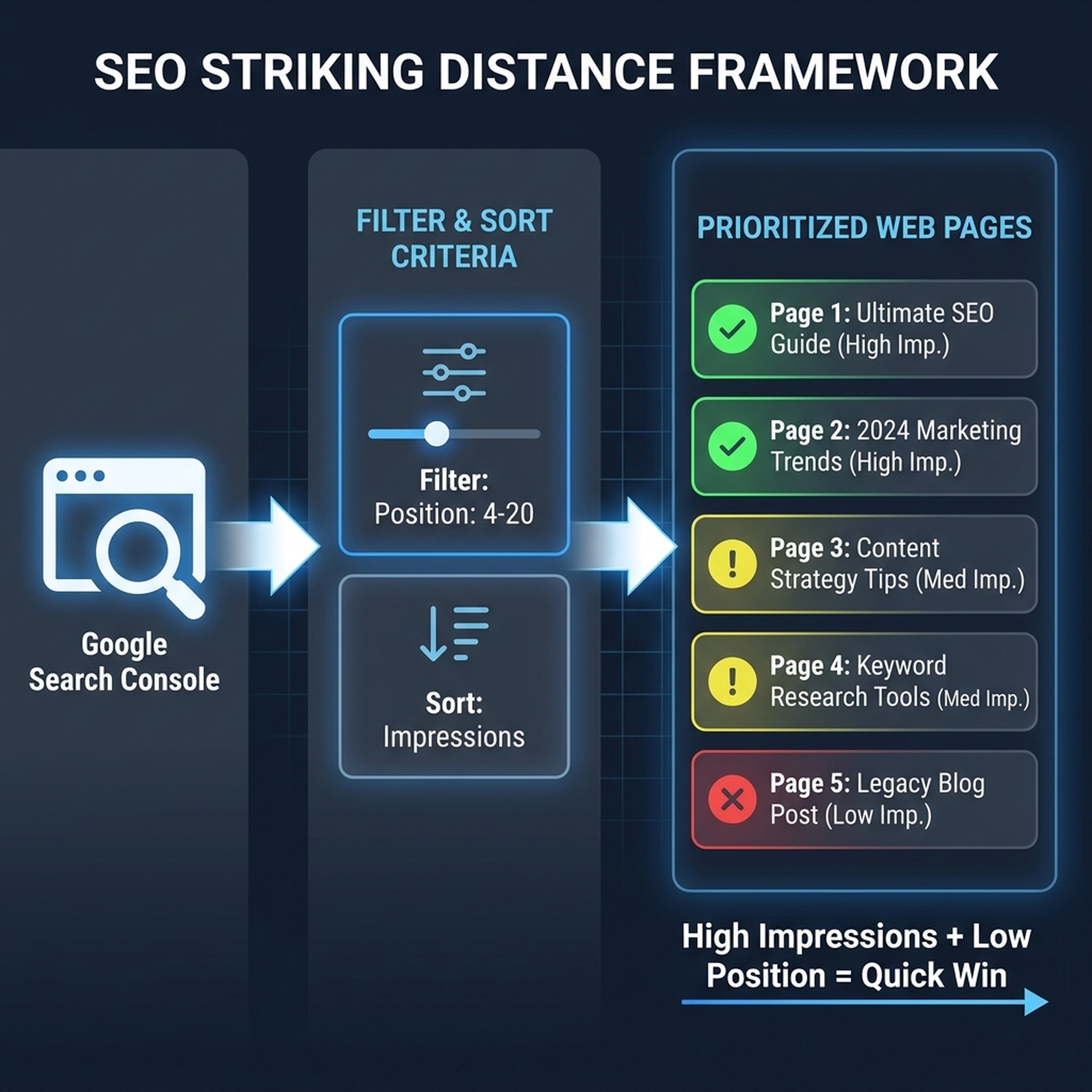
Step 1: Open GSC Performance Report
Go to Search Console → Performance → Search Results. Set the date range to the last 90 days (to smooth out weekly fluctuations).
Step 2: Filter by Position
Use the filter options to show pages with Average Position between 4 and 20. This captures pages on the bottom half of page 1 and all of page 2.
Step 3: Sort by Impressions
Sort the results by impressions (descending). Pages with high impressions but middling positions are your best targets — Google is already showing them to users, but they're not earning clicks.
Step 4: Cross-Reference with Business Value
Not all striking distance pages are equal. A page ranking #7 for "best project management software" is worth more than a page ranking #5 for an obscure long-tail query. Prioritize pages that:
- Target keywords with commercial intent
- Already convert at a reasonable rate
- Serve your core audience
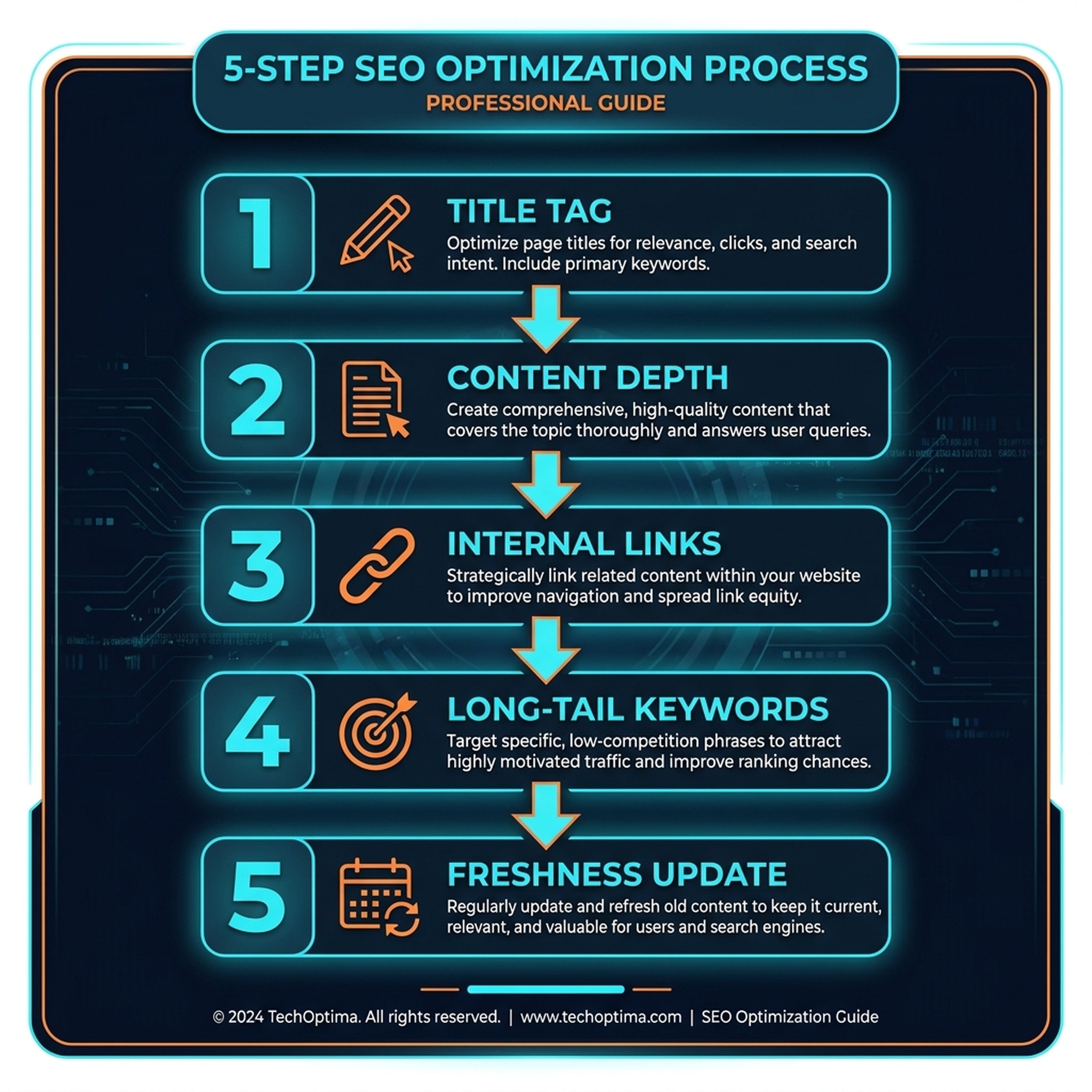
The 5-Step Optimization Framework
Once you've identified your targets, here's how to push them up.
1. Fix the Title Tag (15 Minutes, Often the Biggest Win)
Your title tag is the single most influential on-page element for both rankings and click-through rate. Most pages stuck in positions 4–15 have titles that are either:
- Too generic ("Our Services" or "About Us")
- Missing the primary keyword
- Not compelling enough to earn clicks over competitors
The fix: Rewrite the title to include the primary keyword near the front, add a differentiator (year, data point, or benefit), and keep it under 60 characters.
Before: "SEO Tools for Your Business" After: "SEO Score Checker: Audit Your Site in 60 Seconds (Free, 2026)"
We've seen title tag updates alone move pages 3–5 positions within 2–4 weeks, especially when the new title better matches search intent.
2. Add Content Depth Where Competitors Are Thicker
Check the pages ranking above you. What are they covering that you're not? Common gaps include:
- Specific data points or statistics
- Step-by-step instructions
- Comparison tables
- FAQ sections answering related queries
- Updated information from the current year
You don't need to rewrite the entire page. Add 300–500 words addressing the gaps. Focus on the subtopics that the top 3 results cover but your page misses.
Pro tip: Use the "People Also Ask" section in Google for your target keyword. Each PAA question is a subtopic Google considers relevant — if your page doesn't address it, that's a gap.
3. Build Internal Links from Your Strongest Pages
This is the fastest way to pass authority without building external links. Find your highest-traffic pages or pages with the most backlinks, and add contextual links pointing to your striking distance pages.
The key is relevance. Don't just add links randomly. The anchor text should describe the target page's topic naturally:
- ✅ "If you're looking to measure your AI search visibility, our [GEO Checker tool] shows exactly how often AI engines cite your brand."
- ❌ "Click here" or "Read more"
Aim for 3–5 internal links from high-authority pages to each striking distance page. This signals to Google that the target page is important within your site's architecture.
4. Optimize for the Long-Tail Keywords You're Already Ranking For
Here's a hidden gem in Google Search Console: switch to the "Queries" view and look at the specific queries your striking distance page ranks for. You'll often find long-tail variations where the page ranks in positions 8–30 but gets almost no traffic.
The fix: Add a short section or FAQ entry that directly answers these long-tail queries. This helps Google understand that your page is relevant for these variations too, often pushing both the primary keyword and the long-tail terms up simultaneously.
For example, if your page about "SEO audit tools" also shows impressions for "free SEO audit tool for small business," add a section specifically addressing small business needs and budget constraints.
5. Update the Content Freshness Signal
Google prefers fresh content. A page last updated in 2023 will lose ground to competitors who updated theirs in 2026 — even if the core information hasn't changed.
The minimum freshness update:
- Change the published/updated date
- Update any statistics or data points
- Add a "Last updated: [Month Year]" note
- Refresh any screenshots or examples
- Add a paragraph about recent developments in the topic
This doesn't require a full rewrite. A 30-minute freshness pass signals to Google that the content is current, which can be the tiebreaker between your page and a competitor's outdated one.
What NOT to Do With Striking Distance Pages
A few common mistakes can actually hurt your progress:
Don't change the URL. If the page already has backlinks and ranking signals, changing the URL resets much of that equity. Optimize in place.
Don't stuff keywords. Adding the target keyword 15 times won't help. Google's algorithm in 2026 is sophisticated enough to understand topical relevance without exact-match repetition. Write naturally.
Don't neglect mobile experience. A page might rank well on desktop but poorly on mobile if the mobile experience is slow or broken. Check Core Web Vitals specifically for mobile users.
Don't expect overnight results. Most striking distance optimizations take 2–6 weeks to show measurable movement. Track your changes and give Google time to re-evaluate.
Measuring Results: The 30-Day Check
After implementing changes, monitor these metrics in Google Search Console:
Metric | What to Watch | Expected Timeline |
|---|---|---|
Average Position | Should improve 2–5 spots | 2–4 weeks |
Impressions | May increase before clicks | 1–2 weeks |
Clicks | The ultimate measure of success | 3–6 weeks |
CTR | Should improve with better titles | 1–3 weeks |
If after 6 weeks a page hasn't moved, revisit the optimization. Common reasons for stalled progress:
- The competition is stronger than expected (check their backlink profiles)
- Search intent has shifted (the keyword may now mean something different)
- Technical issues are holding the page back (slow load time, crawl errors)
How This Connects to AI Search Visibility
The striking distance framework isn't just for traditional Google rankings. The same logic applies to AI search engines like Perplexity, ChatGPT Search, and Google AI Overviews.
Pages that are "almost cited" by AI engines — appearing in retrieval but not in the final answer — are the AI equivalent of striking distance pages. Tools like the Auspia GEO Checker can identify these near-miss citations and help you understand what's preventing full citation.
The optimization tactics are similar: improve content clarity, add structured data, ensure factual accuracy, and make your content easy for AI systems to parse and cite.
Your Action Plan for This Week
- Open Google Search Console and identify 5–10 pages ranking in positions 4–15 with high impressions
- Prioritize by business value and impression volume
- Fix title tags on your top 3 targets (15 minutes each)
- Add 300–500 words of content depth to address competitor gaps
- Build 3–5 internal links from your strongest pages to each target
- Update the freshness date and refresh any outdated statistics
- Set a calendar reminder for 30 days from now to check results
This entire process takes about 2–3 hours for 3–5 pages. The potential payoff — 10–20% traffic increases within a month — makes it one of the highest-ROI activities in SEO.
Stop spending all your time on pages that already work. Your fastest growth is hiding in positions 4 through 15.
Author: Simon Vale, 11-Year Search Intent Researcher at Auspia. Simon writes about ranking patterns, SERP analysis, and the strategic decisions that separate growing sites from stagnant ones.