The bottom line
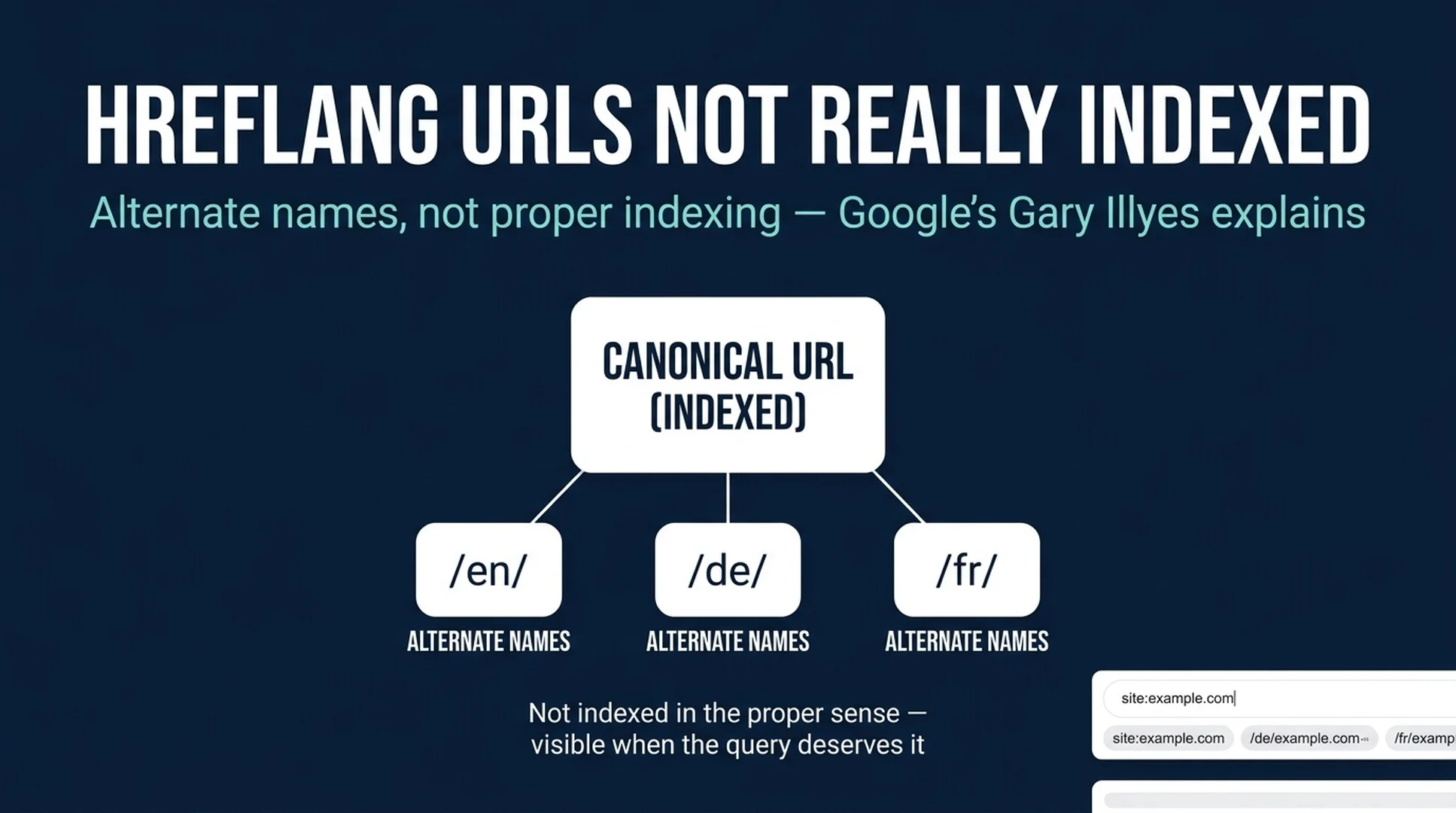
Your hreflang versions showing "Not indexed" in Google Search Console may not be broken at all. Google's Gary Illyes said this week that hreflang alternate URLs are not "indexed in the proper sense." Google stores them as alternate names of the canonical URL, and they can still surface in search results when a query deserves them.
That changes how teams should read index reports for multilingual sites. An unindexed URL is not the same as an invisible URL. Chasing every "Not indexed" row as a hreflang defect will send you fixing things that were never broken.
What Google actually said
The clarification came as a reply on LinkedIn. SEO practitioner Faiez Javaid asked how Google can show alternate language versions in search results when it picks one /lang/ URL as canonical and reports the others as not indexed in Search Console.
Gary Illyes broke the answer into two parts:
- Alternate names. When Google canonicalizes a URL, the other URLs in its duplicate cluster can become what Google calls alternate names. They may be used in search results if the user's query deserves one of those alternate names. The clearest example is
site:queries. Search for[site:bit.ly]and Google may show URLs that actually redirect. Those URLs are not indexed in the proper sense; they are alternate names of a canonical URL. - Hreflang alternates work the same way. The URLs you list in hreflang annotations become alternate URLs of this kind. They are not, in fact, indexed in the proper sense.
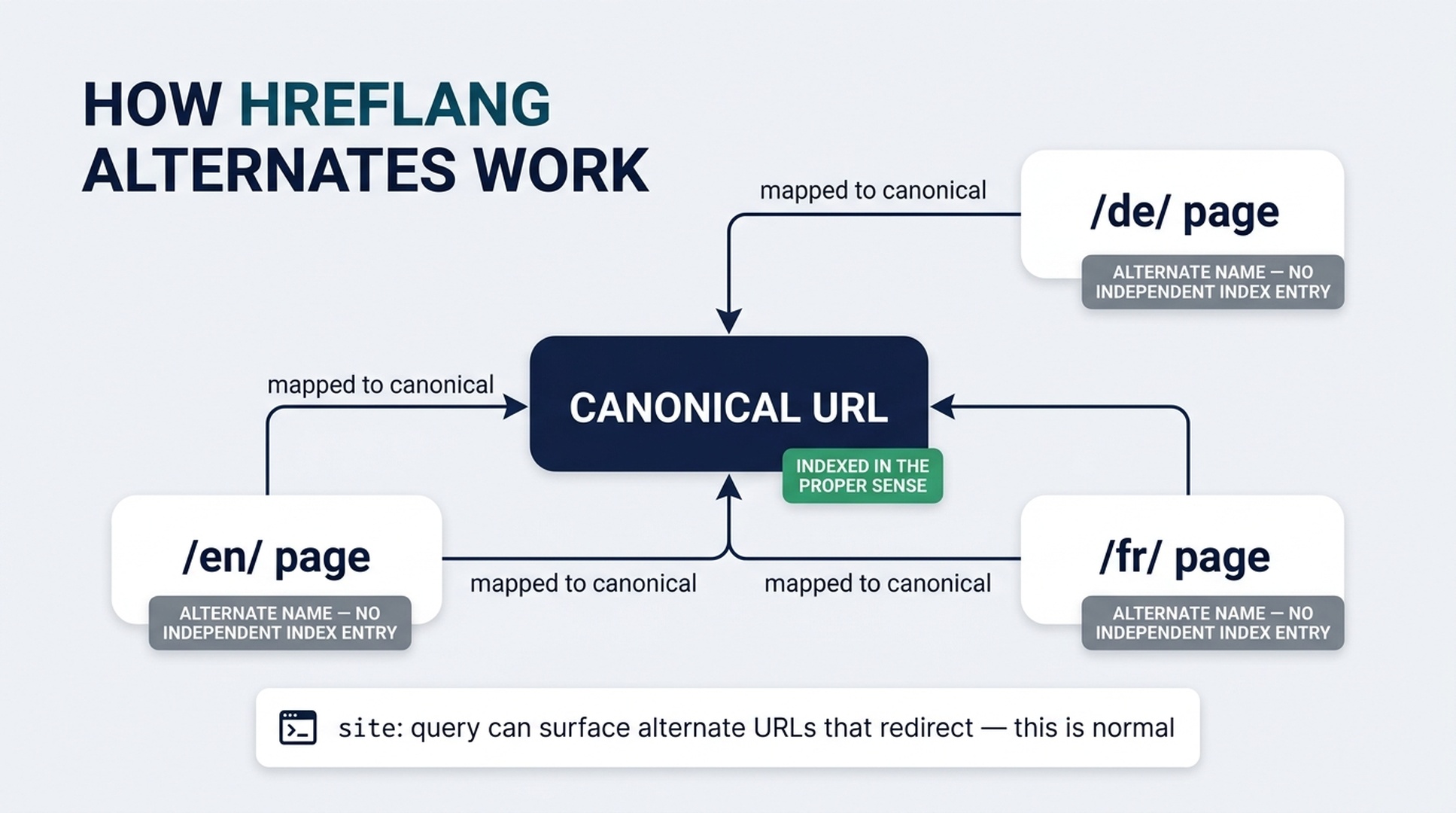
So the specific URL may not have its own index entry, but it is mapped to the canonical page that is indexed. Barry Schwartz reported the exchange on Search Engine Roundtable on August 10, 2026.
The mechanism: alternate names, not proper indexing
Indexing in the "proper sense" means Google decided the URL itself deserves a place in the index: it crawled and rendered the page, evaluated it, and stores it as an independent entry.
Alternate names work differently. They exist in relation to a canonical URL:
- URL A is chosen as canonical
- URL B and URL C sit in the same duplicate cluster, connected by canonical tags, redirects, or hreflang annotations
- Google keeps B and C as alternate names of A
- When a query matches B's language or region better, Google can still return B, but B's visibility is borrowed from A's index entry, not its own
This explains two behaviors that confuse international SEO teams. A site: search can surface URLs that redirect elsewhere. Translated pages can appear in the right country's results while Search Console reports "Crawled - currently not indexed" or "Duplicate, Google chose different canonical than user."
What this means for international SEO teams
Observation in GSC | What it means | What to do |
|---|---|---|
Language version shows "Duplicate, Google chose different canonical" | Google canonicalized toward one URL; the rest are alternates | Check that the chosen canonical is the right language version |
Translated pages show "Crawled - currently not indexed" | Expected for hreflang alternates; they don't need independent index entries | Verify the canonical URL is indexed |
A | Alternate names at work, not a rendering bug | Don't chase these URLs with fixes |
The canonical page itself shows "Not indexed" | This is the real problem | Fix indexing of the canonical URL first |
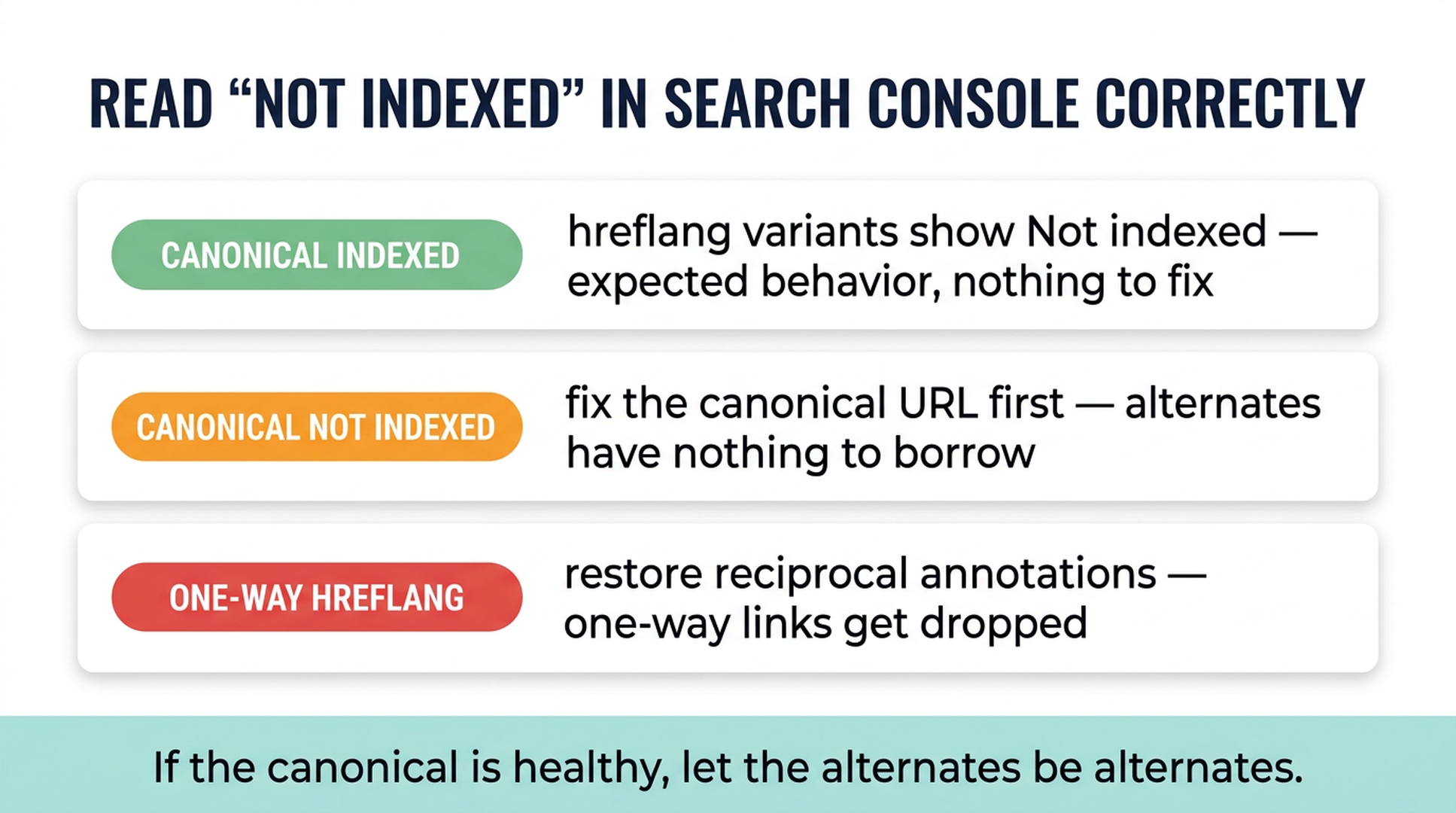
The last row is the one that matters. Hreflang does not make URLs indexable on its own; it tells Google which variants belong together. If the canonical page is not indexed, alternate names have nothing to borrow from. If it is, "Not indexed" rows for language variants are usually fine.
How to check your hreflang setup this week
A 15-minute pass is enough to separate real problems from expected behavior:
- Confirm the canonical is indexed. Run URL Inspection on the canonical version of each language group. If it says "URL is on Google," your hreflang alternates have a home.
- Look at why, not just what. In the Page indexing report, filter by "Duplicate, Google chose different canonical than user" and read which URL Google chose before changing anything.
- Check reciprocal hreflang. Every URL in a hreflang set should point back to its siblings. One-way annotations get dropped.
- Don't remove hreflang to force indexing. Dropping it won't make variants independently indexable, and it removes the signal that connects your language versions.
- Validate language and region codes. Mistakes here, like marking a German page as
en-us, break the relationship before indexing is ever considered.
If the canonical is healthy, let the alternates be alternates.
FAQ
Why does Google show my hreflang version in search results if it's not indexed? Because the URL is stored as an alternate name of the indexed canonical URL. When the query matches the alternate's language or region, Google can surface it even though the URL has no independent index entry.
Does "Crawled - currently not indexed" mean my hreflang is broken? Not necessarily. For hreflang alternates this status can be expected behavior. First confirm the canonical page is indexed; that's the signal that matters here. If you're new to the indexing pipeline, our technical SEO guides cover the underlying concepts.
Should I make every language version independently indexable? Not as a hreflang goal. Google canonicalizes near-duplicate variants by design. Your job is to make sure the right URL wins canonicalization and the hreflang relationship is complete and accurate.
Can an alternate-name URL rank for its own keywords? Alternate names may appear when the query deserves them, per Google. Treat them as a presentation layer over the canonical URL, not as independent ranking entities.
Author: Dominic Hale, International SEO Specialist Across 18 Markets at Auspia. Dominic writes about multilingual SEO, hreflang implementation, localization, and regional search behavior.