The short answer
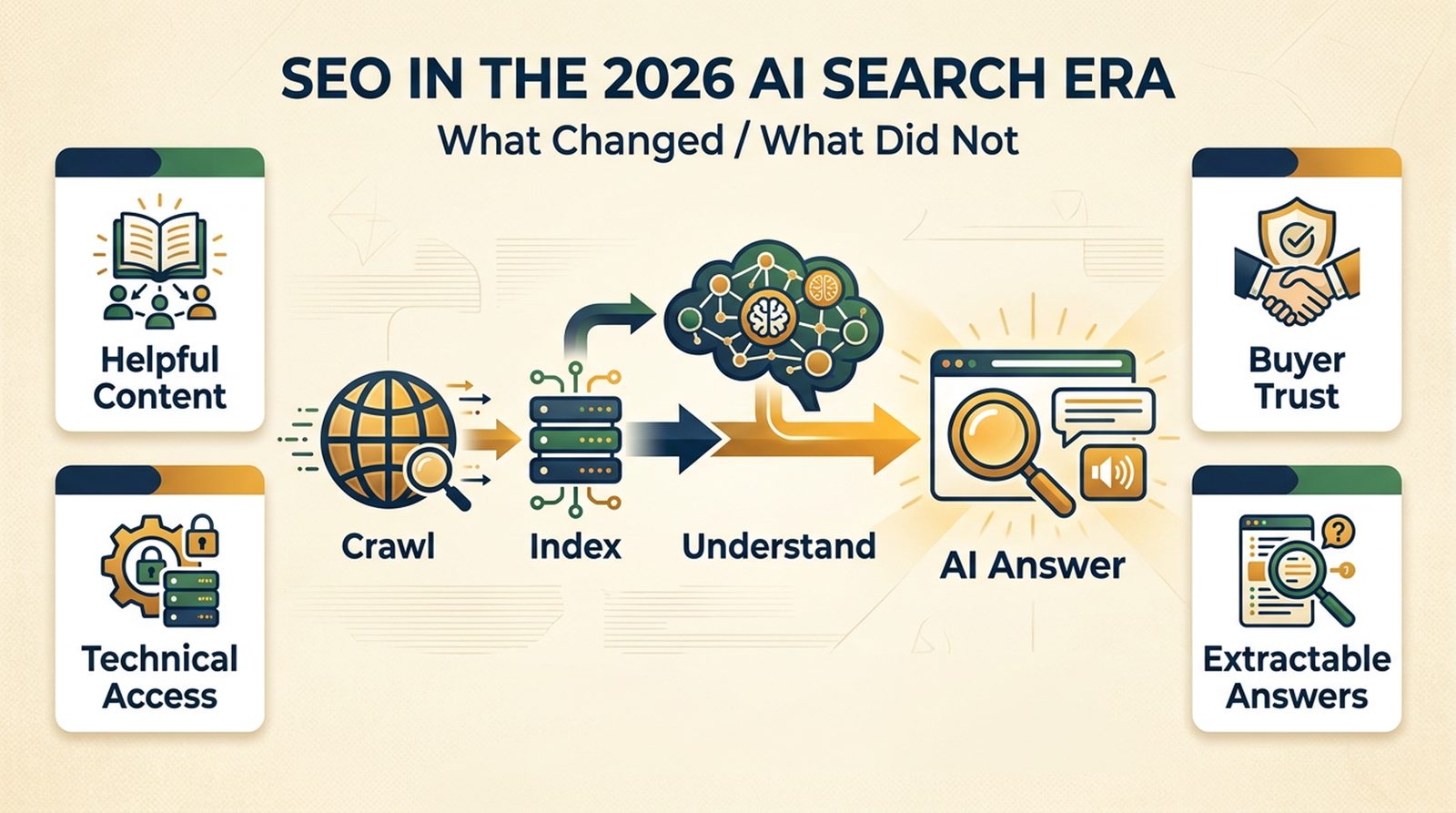
In 2026, AI search has changed how users see search results, but it has not erased the foundations of SEO. Search systems still need to discover pages, understand content, evaluate usefulness, and choose sources that deserve trust.
The real shift is in the standard of content. Thin pages written only to match keywords are easier to ignore. Pages with clear technical access, real experience, product detail, original judgment, useful media, and strong site trust are more likely to survive across traditional search, AI Overviews, answer engines, and buyer research journeys.
So the 2026 SEO question is not "Will AI kill SEO?" It is: "Is this page useful enough, specific enough, and trustworthy enough to be selected when the answer is generated?"
AI search changes the result, not the whole game
It is easy to overreact to AI search. A screenshot of an AI answer can make it feel as if the old search system disappeared overnight.
It did not.
Google AI Overviews, AI Mode, Gemini-style assistants, Perplexity, ChatGPT search, Claude browsing, and Copilot all change the way information is packaged. The user may see a summary before a link. The answer may cite several sources. The query may become conversational, visual, voice-based, or multi-step.
But the underlying need is familiar: the system still needs source material. It has to find pages, judge whether they are worth using, and decide which claims are safe to repeat.
That is why the boring parts of SEO still matter:
Foundation | Why it still matters in 2026 |
|---|---|
Crawl access | Search and AI systems cannot use pages they cannot reach |
Index quality | Thin, duplicate, or blocked pages weaken discovery |
Internal links | Page relationships help systems understand topic coverage |
Canonicals | Duplicate versions confuse selection and attribution |
Structured data | Product, organization, article, FAQ, and breadcrumb signals clarify context |
Helpful content | AI summaries still need useful, accurate source material |
Trust signals | Buyers and systems both look for evidence that a source is real |
AI search did not make SEO easier. It made weak SEO more visible.
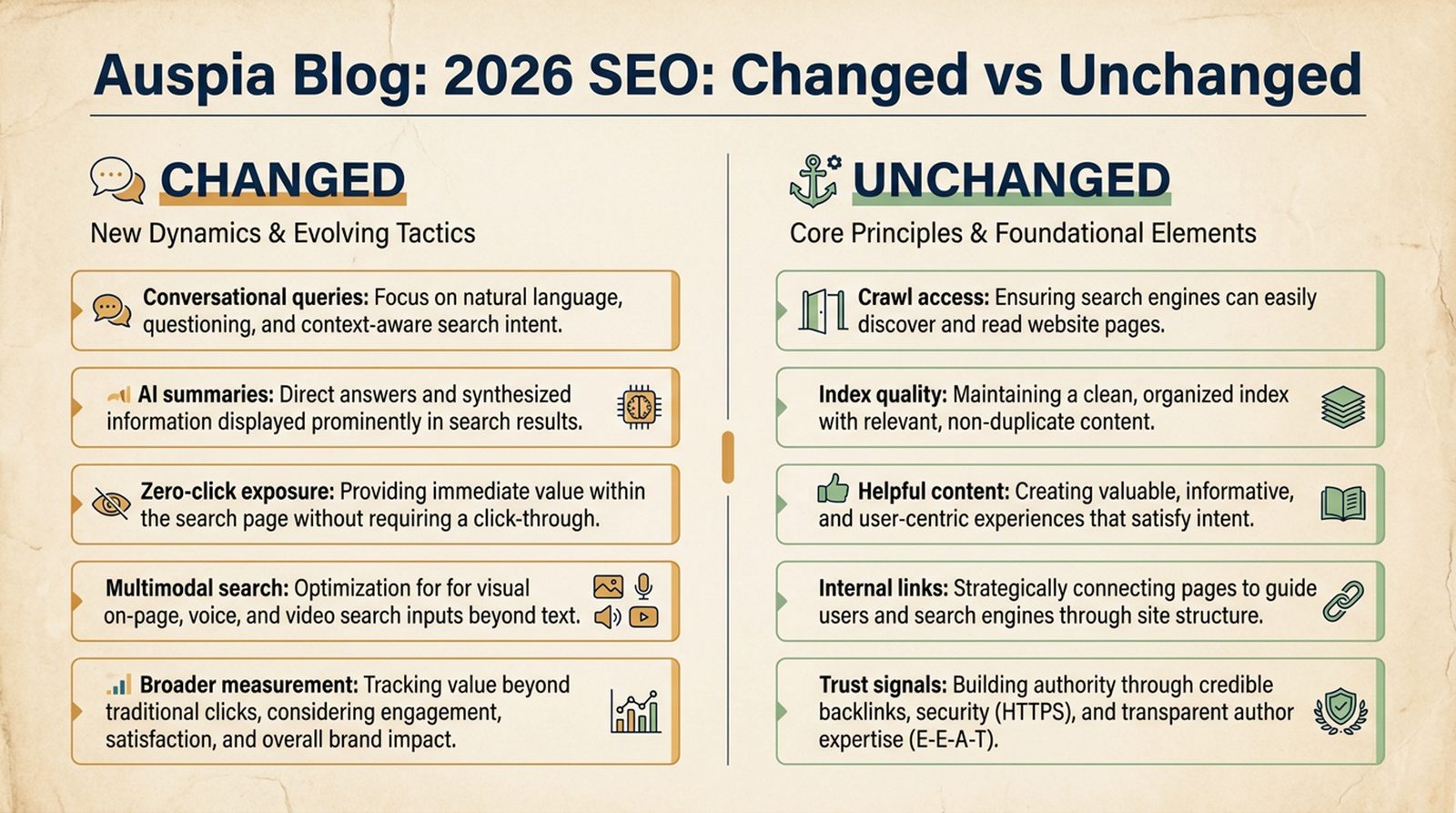
AI search changes how results are packaged. The foundations still depend on access, index quality, useful content, and trust.
What changed in 2026
The first change is query behavior. People no longer search only with short keywords. They ask full questions, upload images, use voice, compare options, and continue the conversation after the first result. A query like "stainless steel valve supplier" may become "which valve material should I choose for a high-pressure food processing line, and what certifications should I ask suppliers for?"
The second change is the search result page. A page can win exposure without winning a traditional blue-link click. Featured snippets, AI Overviews, product grids, local packs, YouTube results, image results, forums, and review sites can all sit between the user and your website.
The third change is content supply. AI has made generic content cheap. A basic explainer with clean headings is no longer impressive. If ten pages say the same thing with different wording, the system and the user have little reason to prefer yours.
The fourth change is measurement. Clicks still matter, but they are no longer the whole picture. Teams now need to track impressions, citations, brand mentions, AI answer inclusion, source diversity, assisted conversions, and whether high-intent users are better informed when they arrive.
None of this means SEO is dead. It means SEO has moved closer to product knowledge, customer research, technical quality, and brand evidence.
What did not change
The goal of search is still to help users find useful information.
That sounds obvious, but it cuts through a lot of noise. If a page exists only to cover a keyword, repeat a phrase, or satisfy a content quota, it is fragile. If a page helps a buyer understand a product, compare options, avoid mistakes, and trust the company behind the claim, it has a reason to exist.
The basic questions are still the same:
- What is the user trying to decide?
- What information would help them decide faster?
- What proof can we show?
- What details can only someone with real experience provide?
- What should the user do next?
In 2026, the answer just needs to be easier to extract. A good page should work for a human scanning on mobile, a search engine ranking a result, and an AI system assembling an answer.
Stop writing for keyword density
Keyword stuffing was never good writing, but AI search makes it look even worse.
A page that repeats "industrial lithium battery supplier" in the title, intro, alt text, FAQs, and every other paragraph does not become more useful. It becomes harder to trust.
Search systems are better at understanding context. They can connect related terms, product attributes, use cases, materials, problems, and buyer intent. A strong B2B page does not need to force the same phrase into every corner. It needs to answer the questions behind the query.
For example, a procurement-focused product page should explain:
Buyer question | Useful page content |
|---|---|
What is this product for? | Use cases, operating environment, and constraints |
Which specification matters? | Materials, dimensions, tolerances, certifications, performance limits |
How do I compare options? | Trade-offs between models, materials, price, lead time, and durability |
Can this supplier handle my case? | Customization options, production capacity, quality process, case examples |
What could go wrong? | Common mistakes, maintenance issues, compatibility limits, risk notes |
When a page does this well, relevant keywords appear naturally. More important, the page helps the buyer make progress.
High-quality content now means real judgment
High-quality content is not just longer content. It is not prettier formatting. It is not an AI-generated article with a few bullet lists.
For 2026 SEO, high-quality content usually has four traits:
Trait | What it looks like |
|---|---|
Investment | The page shows research, product knowledge, examples, testing, or customer understanding |
Originality | The content includes experience, data, process detail, cases, or a point of view competitors cannot copy instantly |
Expertise | The writing shows practical knowledge of the category, buyer decision, and constraints |
Accuracy | Claims, specifications, certifications, and use cases are stated carefully and updated when they change |
The opposite is what I call universal content: phrases that fit every industry and help no one. "Choose a reliable supplier." "Quality is important." "Customization can meet different needs." These lines are not wrong. They are just empty.
A better B2B page gets specific. If it is about packaging equipment, talk about line speed, material compatibility, downtime, spare parts, maintenance windows, and operator training. If it is about cybersecurity software, talk about deployment model, log sources, compliance mapping, incident workflow, false positives, and who owns the daily review.
Specificity is not decoration. It is the proof that someone who understands the buyer helped create the page.
AI can help with content, but it cannot replace expertise
There is nothing wrong with using AI in SEO content production. The problem is using AI to replace the only part that matters.
AI is useful for:
- Turning messy notes into a draft outline
- Comparing page structures
- Finding missing buyer questions
- Rewriting dense explanations for clarity
- Creating FAQ candidates from sales calls
- Summarizing technical documentation
- Generating first-pass schema or metadata ideas
AI is not enough for:
- Product truth
- Customer stories
- Test results
- Procurement constraints
- Regulatory claims
- Pricing and delivery realities
- Competitive judgment
- Real examples from implementation work
The better workflow is human-led and AI-assisted. Let AI speed up structure and wording. Then let domain experts add details, constraints, examples, and corrections. That is how content becomes more useful instead of merely faster.
B2B SEO needs decision pages, not brochure pages
A lot of B2B websites still treat product pages as digital brochures. They list features, add a few images, mention customization, and end with a contact form.
That is not enough for 2026 search behavior.
A strong B2B page should help a buyer decide whether to keep you on the shortlist. It should answer what the product does, who it is for, how to choose the right specification, what trade-offs matter, what proof exists, and what the next conversation should cover.
A practical product page structure might look like this:
- Direct answer: what this product is and who it fits
- Application scenarios: where it is commonly used and where it is not ideal
- Specification guide: how to choose materials, dimensions, capacity, or configuration
- Comparison table: options, trade-offs, and buyer fit
- Customization or integration notes
- Quality, certification, or testing process
- Real case or use example
- FAQ based on sales and support questions
- Clear next step: quote, sample, audit, demo, or technical consultation
That structure helps users. It also gives search and AI systems clearer source material.
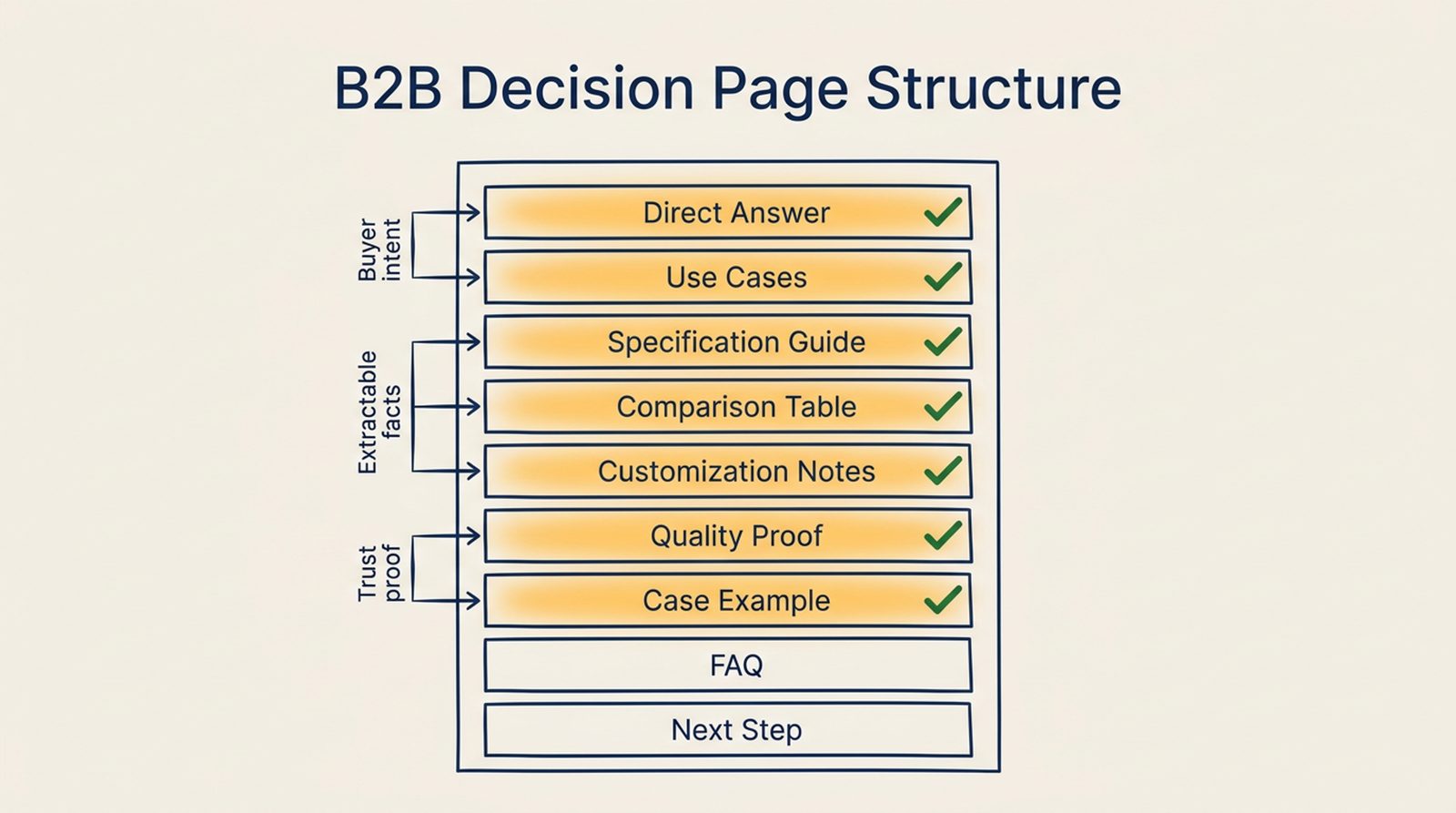
A 2026 B2B SEO page should help a buyer make a decision, not just repeat a target keyword.
Build content around the buyer journey
A modern SEO program should not be a pile of random articles. It should map to the way buyers learn.
Buyer stage | Search behavior | Content that helps |
|---|---|---|
Problem awareness | "Why does this keep failing?" | Guides, troubleshooting pages, symptom explainers |
Option research | "Which material/process/tool should I choose?" | Comparison pages, selection guides, trade-off tables |
Supplier evaluation | "Can this company handle our requirement?" | Case studies, capability pages, certifications, process pages |
Risk reduction | "What should we check before ordering?" | Checklists, QA details, implementation notes, FAQ |
Purchase action | "Request quote / demo / sample" | Clear landing page, specs, lead form, sales handoff content |
This is where SEO and GEO overlap. A page built around a real buyer question is easier for users to trust and easier for AI answer systems to summarize.
If you want to measure this more directly, use recurring prompts and track whether your brand, product category, and pages appear in AI answers. Auspia's AI Search Visibility Checker can help turn that into a repeatable workflow.
Multimedia and structured data are not optional extras
Search has become more visual and more multimodal. Text is still important, but product images, diagrams, videos, tables, and structured data help both users and machines understand the page.
For B2B and product-led sites, prioritize:
- Product images with real scale, angles, and details
- Application photos that show the product in use
- Short videos that demonstrate setup, operation, maintenance, or comparison
- Diagrams that explain process, structure, or workflow
- Tables that expose specs and trade-offs in text
- FAQ sections based on actual sales questions
- Product, Organization, Breadcrumb, Article, and FAQ schema where appropriate
Do not put all important information inside images. If a certification, specification, or process step matters, include it in readable page text too.
A 2026 SEO checklist for AI search readiness
Use this checklist before refreshing an important page.
Check | Pass condition |
|---|---|
Crawlability | The page is accessible to search crawlers and intended AI crawlers |
Index value | The page has unique content worth indexing, not thin duplicate text |
Search intent | The page answers a specific buyer or user decision |
Context | Related products, use cases, materials, services, and constraints are clear |
Experience | The page includes real examples, cases, testing notes, or field knowledge |
Accuracy | Claims, specs, certifications, and dates are correct and current for 2026 |
Extraction | Key answers are easy to quote in paragraphs, tables, and FAQs |
Internal links | Related pages connect in a logical topic structure |
Media | Images, video, diagrams, or tables help the user understand faster |
Trust | Company, author, policy, review, and contact signals reduce doubt |
If you fail half of these, do not rush to publish more content. Fix the pages that already matter.
Auspia take
AI search does not give SEO teams permission to skip the fundamentals. It raises the cost of shallow work.
The teams that do well in 2026 will not be the ones producing the most articles with AI. They will be the ones that make their websites easier to crawl, easier to understand, easier to cite, and easier for a real buyer to trust.
For most companies, the best next move is not another generic blog post. Pick one high-value product, service, or comparison page. Rewrite it as a decision page. Add specific use cases, trade-offs, proof, media, internal links, structured data, and a clean next step. Then test how it appears in Google, AI Overviews, and answer engines.
That is less flashy than chasing every new AI search feature. It is also the work that compounds.
FAQ
Is SEO still useful in 2026?
Yes. SEO is still useful because search and AI answer systems need source material from the web. What changed is the standard: pages need to be technically accessible, specific, trustworthy, and useful enough to be summarized or cited.
Will AI Overviews reduce website traffic?
Some informational clicks may decline when answers appear directly in search results. But stronger pages can still influence discovery, brand trust, assisted conversions, and high-intent visits. Measure citations, mentions, qualified leads, and revenue quality, not only raw clicks.
Should B2B companies use AI to write SEO content?
Yes, but AI should support experts rather than replace them. Use AI for outlines, rewrites, research organization, and metadata drafts. Human experts should add product details, customer context, constraints, examples, and accuracy checks.
What kind of content is weakest in AI search?
Generic content that repeats obvious advice is weak. Pages that say "quality matters" or "choose a reliable supplier" without specifications, examples, trade-offs, or proof are easy for users and AI systems to ignore.
What should we update first?
Start with high-value pages that already influence revenue: product pages, service pages, comparison pages, category pages, and case studies. Make them crawlable, specific, evidence-backed, and easier to quote before expanding the blog calendar.