Executive summary
Your competitors may already be getting mentioned in AI answers while your team is still measuring only Google rankings, ad clicks, and form fills. That is the uncomfortable shift behind GEO, or generative engine optimization: buyers can now ask an AI system for a shortlist and never visit the pages where you used to compete.
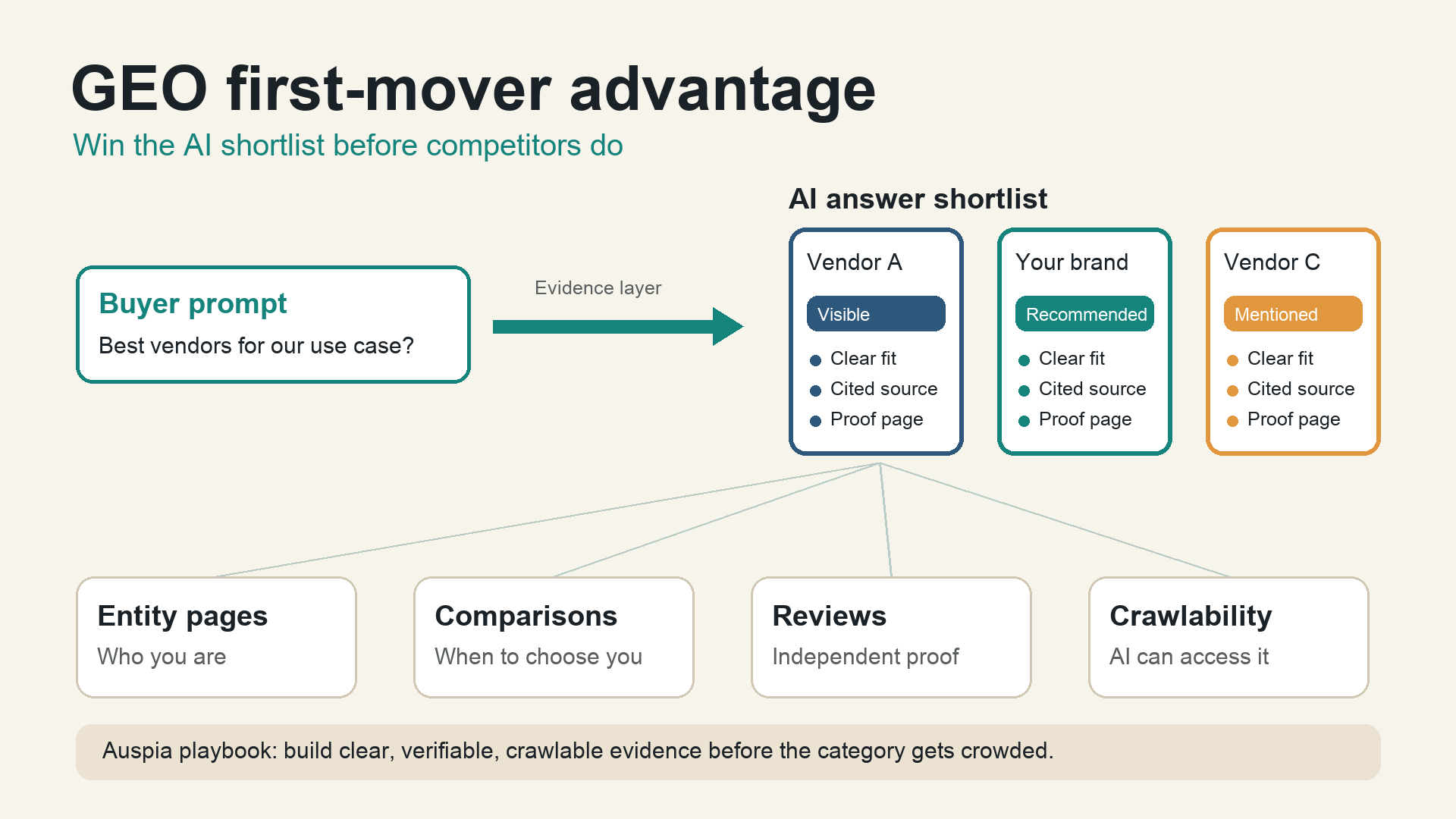
The first-mover advantage is not magic. It comes from giving AI systems enough clear, verifiable, crawlable evidence to understand what your company does, when to recommend it, and which sources support that recommendation. Teams that start early build a bigger evidence base. Teams that wait often discover the problem only after demand has already moved elsewhere.
This article breaks down where the advantage comes from, how to estimate the cost of being absent, and what to do in the next 30 days.
The invisible loss: you may not know where the buyer went
A B2B buyer used to leave a trail. They searched a keyword, clicked comparison pages, visited vendor sites, downloaded a guide, and maybe submitted a form. Even if you lost the deal, analytics showed some part of the journey.
AI search can compress that path into one prompt:
"What are the best inventory planning platforms for a mid-market ecommerce brand with Shopify, NetSuite, and seasonal demand spikes?"
The answer may include three or five vendors, a short explanation, and a few cited sources. The buyer can ask follow-up questions, compare pricing assumptions, and draft an email to the first vendor on the list. Your brand may never receive an impression in your own analytics.
That is why GEO matters. The fight is not only for a click. It is for inclusion in the buyer's first consideration set.
Auspia sees this as a new kind of visibility gap. Traditional SEO asks, "Can people find our page?" GEO asks, "Can AI systems confidently describe, compare, and recommend us when the buyer asks a decision-stage question?"
Why the window is closing
AI answers are no longer a side experiment. Gartner predicted in 2024 that traditional search engine volume would fall 25% by 2026 as users shift toward AI chatbots and virtual agents. ChatGPT reportedly reached 800 million weekly active users in 2025, and recent research on Google AI Overviews describes it as a widely encountered generative AI layer in search, reaching more than 2 billion users.
The exact percentages will move over time. The direction is harder to ignore: more buyers are asking AI systems for advice before they visit vendor websites.
There is another reason the window matters. AI systems do not build brand understanding from one landing page. They rely on repeated evidence across your website, third-party mentions, technical documentation, review content, help pages, knowledge bases, and structured product descriptions. That evidence takes time to publish, crawl, validate, and connect.
A competitor that starts today is not just writing more content. They are giving AI systems more chances to learn the shape of their brand.
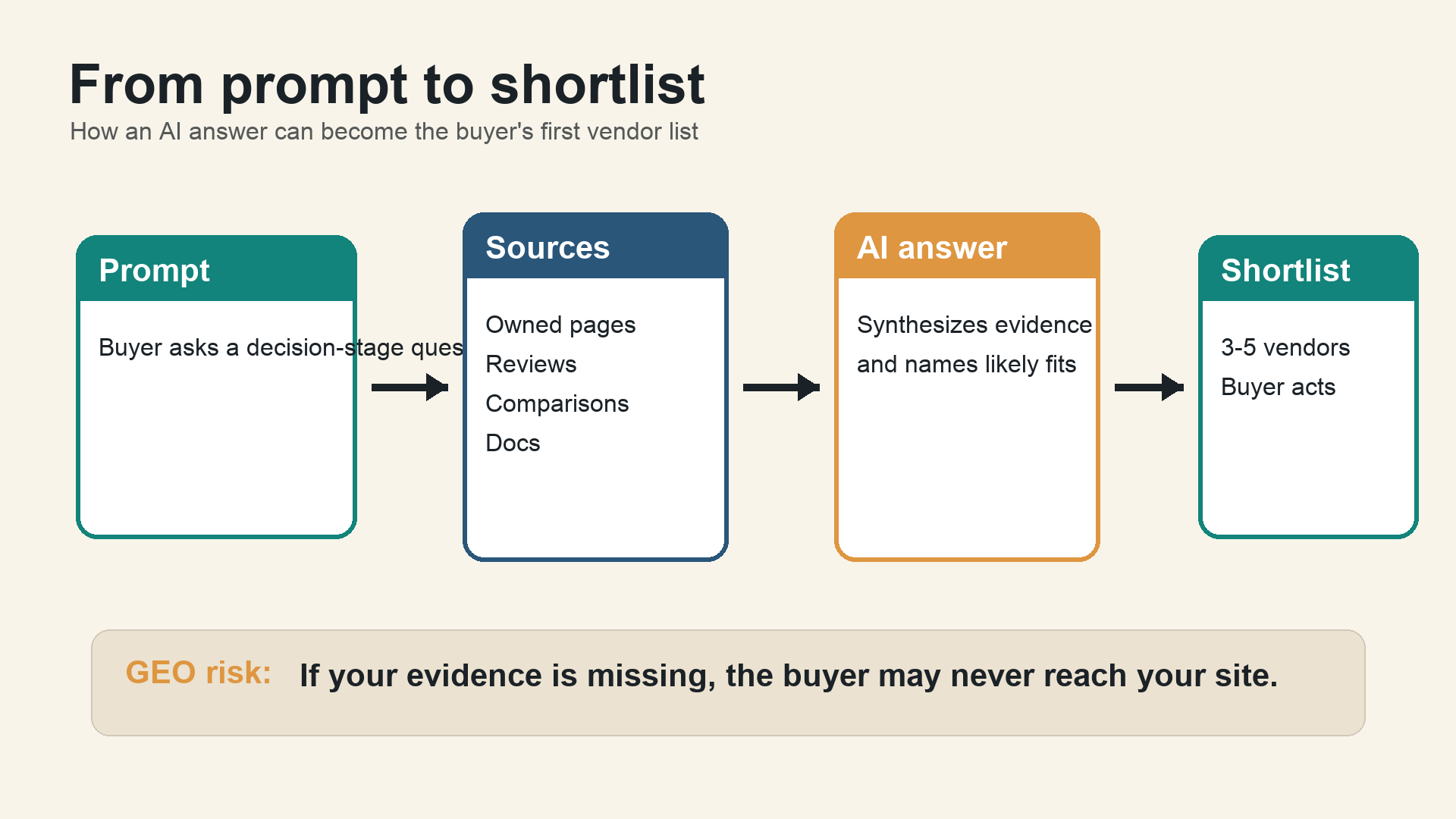
A buyer may move from one prompt to a vendor shortlist before your analytics records a visit.
The first-mover advantage is really an evidence advantage
In SEO, early movers often won by accumulating links, topical authority, and search behavior signals before the market became crowded. GEO has a similar pattern, but the assets look different.
Asset | What it does for GEO | Why early movers benefit |
|---|---|---|
Clear entity pages | Defines the company, product, category, use cases, audience, and proof | AI systems see consistent facts instead of scattered claims |
Comparison and alternative pages | Helps answer decision-stage prompts without relying on competitors | The brand can appear in "best for" and "compared with" answers |
Third-party evidence | Adds independent confirmation from reviews, partners, media, communities, and directories | More corroboration makes recommendations safer |
Structured technical access | Makes important pages easier to crawl and interpret | AI crawlers and retrieval systems find the right information faster |
Fresh expert content | Covers new buyer questions as language changes | Early content can become the source later pages cite |
The advantage is not that AI systems permanently reward the first brand they see. They do not. The advantage is that the first serious operator gets more time to build a dense, consistent evidence network while everyone else is still debating terminology.
Three battlegrounds where GEO compounds
1. Brand memory
AI systems need stable facts: what you sell, who it is for, what problems it solves, where it works, what it integrates with, and what evidence supports those claims.
Many companies make this harder than it needs to be. Their homepage says they "transform operations." Their product page says they "unlock efficiency." Their blog talks about industry trends but rarely states the product's concrete use cases. A human may infer the story. An AI system may not.
The first battleground is brand memory: publishing clear, repeated, machine-readable explanations of your entity. This includes product pages, about pages, help-center articles, schema markup, comparison pages, customer proof, and glossary content.
If you want a quick check, run your domain through an AI Search Visibility Checker and ask whether your brand appears for the questions your buyers actually ask.
2. Category prompts
Every market has prompts that sound small but shape real revenue:
- "best CRM for boutique consulting firms"
- "alternatives to HubSpot for a B2B SaaS startup"
- "which payroll software works for international contractors"
- "top tools for ecommerce demand forecasting"
These are not generic awareness searches. They are shortlist prompts. If AI systems mention your competitors repeatedly and omit you, the buyer's perceived market map changes without your involvement.
Early movers build content around these prompts before the obvious keywords become expensive. They publish practical comparison pages, use-case explainers, buyer checklists, integration guides, and credible proof pages. They make it easy for AI systems to answer, "This vendor is a fit when..."
3. Trust transfer
When a buyer sees the same brand recommended by an AI system, cited by a respected publication, reviewed in a relevant directory, and explained clearly on the company's own site, trust compounds.
This does not mean AI is always right or that AI citations equal endorsement. It means recommendation surfaces are becoming part of the buyer's trust stack. If your company is absent from those surfaces, your sales team has to do more work later to prove you belong in the conversation.
The practical goal is not to "game" AI. It is to make your public evidence strong enough that a cautious answer engine can include you without guessing.
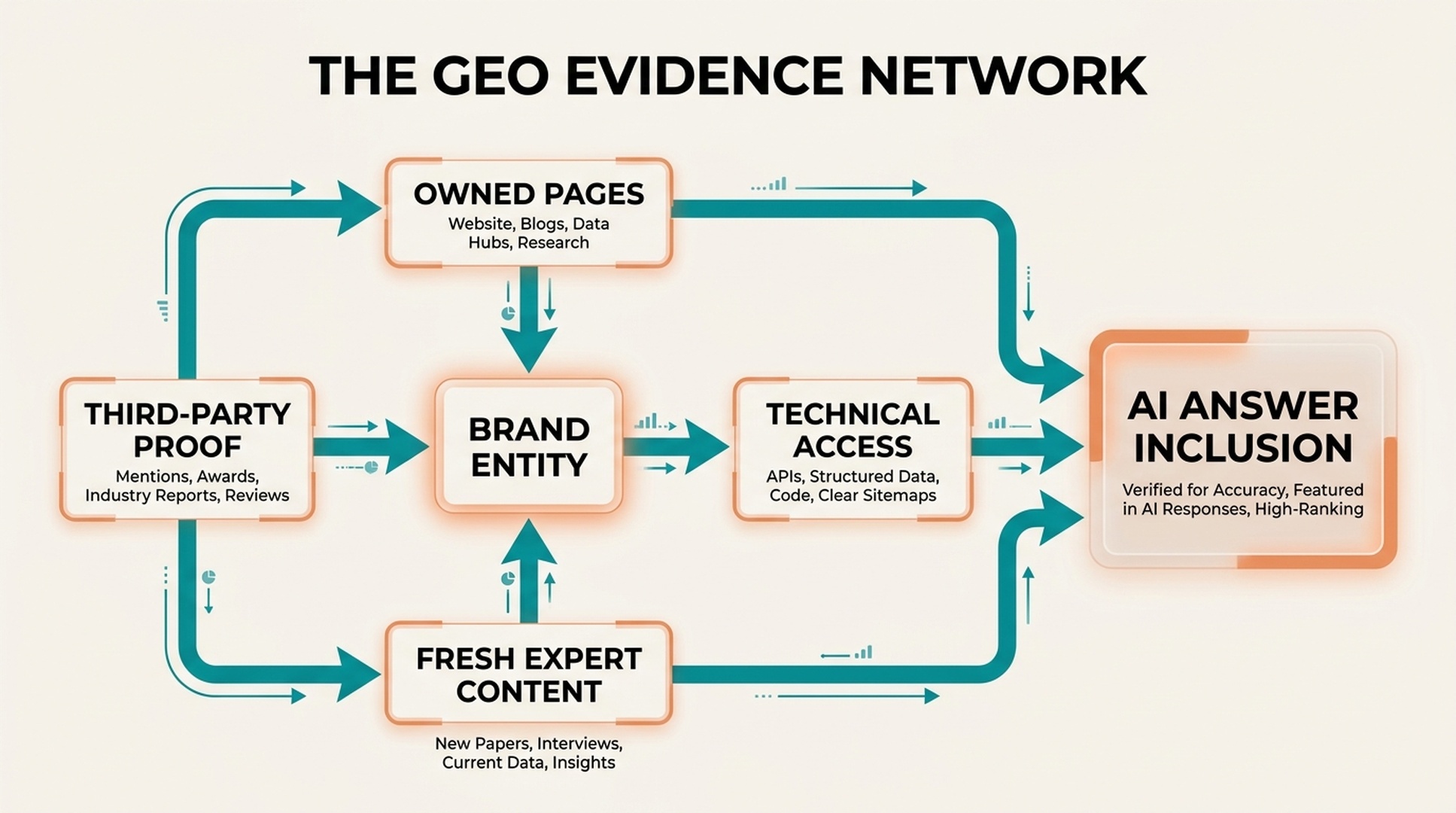
GEO compounds when owned content, third-party proof, technical access, and fresh expertise all point to the same brand facts.
A simple way to estimate the cost of absence
Use a conservative model. Do not pretend every AI mention becomes revenue.
Start with one high-intent prompt family, such as "best [category] software for [audience]." Estimate:
Question | Conservative estimate |
|---|---|
How many qualified buyers ask this type of question each month? | 200 |
How many would consider vendors mentioned in the AI shortlist? | 40% |
How many qualified opportunities might that create? | 80 |
What share goes to visible competitors if you are absent? | 50% |
What is your average close rate on qualified opportunities? | 12% |
What is your average first-year contract value? | $18,000 |
In this example, absence from one prompt family could represent roughly 4.8 lost customers a month, or $86,400 in first-year contract value. Treat the number as a planning estimate, not a forecast.
The useful part is not the exact revenue figure. It is the discipline of connecting AI visibility to the buyer moments that already matter.
What to do in the next 30 days
Week 1: map the prompts that decide your market
Collect 30 to 50 prompts a real buyer might ask before shortlisting vendors. Include alternatives, use cases, integrations, pricing concerns, regulatory requirements, company size, region, and implementation risk.
Run them across the AI systems your buyers are likely to use. Track which brands appear, which sources are cited, and which claims repeat. Do this manually at first. You need to read the answers, not just count mentions.
Week 2: fix your entity foundation
Create or update the pages that explain your company in plain terms:
- one clear "what we do" page
- product and use-case pages with specific audiences
- integration pages for the tools buyers name in prompts
- comparison or alternative pages where they are useful and fair
- customer proof with industry, problem, action, and outcome clearly stated
Also check crawl basics. Your robots.txt, sitemap, canonical tags, redirects, and public documentation should not block the pages you want AI systems to discover. Auspia's GEO tools can help turn this into a repeatable audit.
Week 3: build answer-ready content
Write pages that directly answer shortlist questions. Use specific headings, tables, constraints, and examples. Avoid vague category language.
A strong GEO page usually includes:
- who the solution is for
- when it is not the right fit
- comparison criteria
- integration and deployment details
- evidence from customers, documentation, reviews, or partners
- a concise FAQ that matches real buyer questions
Week 4: add third-party corroboration
Owned content is necessary, but not enough. AI systems often prefer claims that are supported outside your own site.
Look for legitimate places to strengthen your evidence:
- product directories and review platforms
- partner marketplaces
- industry podcasts or newsletters
- open documentation pages
- customer stories on customer sites
- credible community discussions
Do not spam the web with thin press releases. That creates noise, not trust.
Common mistakes
The most common GEO mistake is treating it as a rebranded SEO checklist. GEO still depends on technical health and useful content, but the unit of competition is different. You are optimizing for answer inclusion, citation confidence, and brand understanding, not just a blue-link ranking.
A second mistake is publishing content that sounds impressive but says little. AI systems need facts. "End-to-end platform" and "next-generation solution" are weak inputs. "Inventory planning software for Shopify Plus brands using NetSuite, with demand forecasting, purchase-order recommendations, and seasonal SKU planning" is much easier to understand.
A third mistake is waiting for perfect attribution. GEO measurement is still messy. You can track AI answer mentions, cited sources, referral traffic, branded search lift, sales-call language, and conversion paths, but no single dashboard will explain everything. Start measuring anyway.
Auspia takeaway
The GEO window is not closing because one tactic will stop working. It is closing because the evidence layer is getting more competitive.
The brands that move first will not win every prompt. But they will learn faster, publish clearer evidence, and make fewer blind bets. They will know which questions produce mentions, which sources AI systems trust, and which pages need stronger proof.
If your competitors are already present in AI answers, the next step is not panic. It is an audit. Find the prompts where you are absent, identify the missing evidence, and build the pages and third-party proof that make your brand easier to recommend.
FAQ
What is GEO?
GEO, or generative engine optimization, is the practice of making a brand, product, or page easier for AI answer systems to understand, cite, and include in generated responses.
Is GEO replacing SEO?
No. GEO builds on SEO basics such as crawlability, clear content, authority, and user intent. The difference is that GEO focuses on AI-generated answers and citations, while SEO focuses more on search rankings and organic clicks.
How long does GEO take to work?
Most teams should expect a learning period of several weeks before they see stable patterns. Building a durable evidence network can take months, especially in competitive B2B categories.
What should a company measure first?
Start with prompt-level visibility: which AI systems mention your brand, which competitors appear, what sources are cited, and what claims are repeated. Then connect that visibility to assisted conversions, branded search, sales-call mentions, and referral traffic.
Can GEO be automated?
Parts of the workflow can be automated, such as prompt tracking, content audits, schema checks, and reporting. The strategy still needs human judgment because weak claims, fake proof, or generic content can damage trust.
Sources and further reading
- Gartner, "Gartner Predicts Search Engine Volume Will Drop 25% by 2026, Due to AI Chatbots and Other Virtual Agents," 2024.
- Haofei Xu, Umar Iqbal, and Jacob M. Montgomery, "Measuring Google AI Overviews: Activation, Source Quality, Claim Fidelity, and Publisher Impact," arXiv, 2026.
- Business Insider, "Sam Altman touts ChatGPT's 800 million weekly users," 2025.