Recommendation at a glance
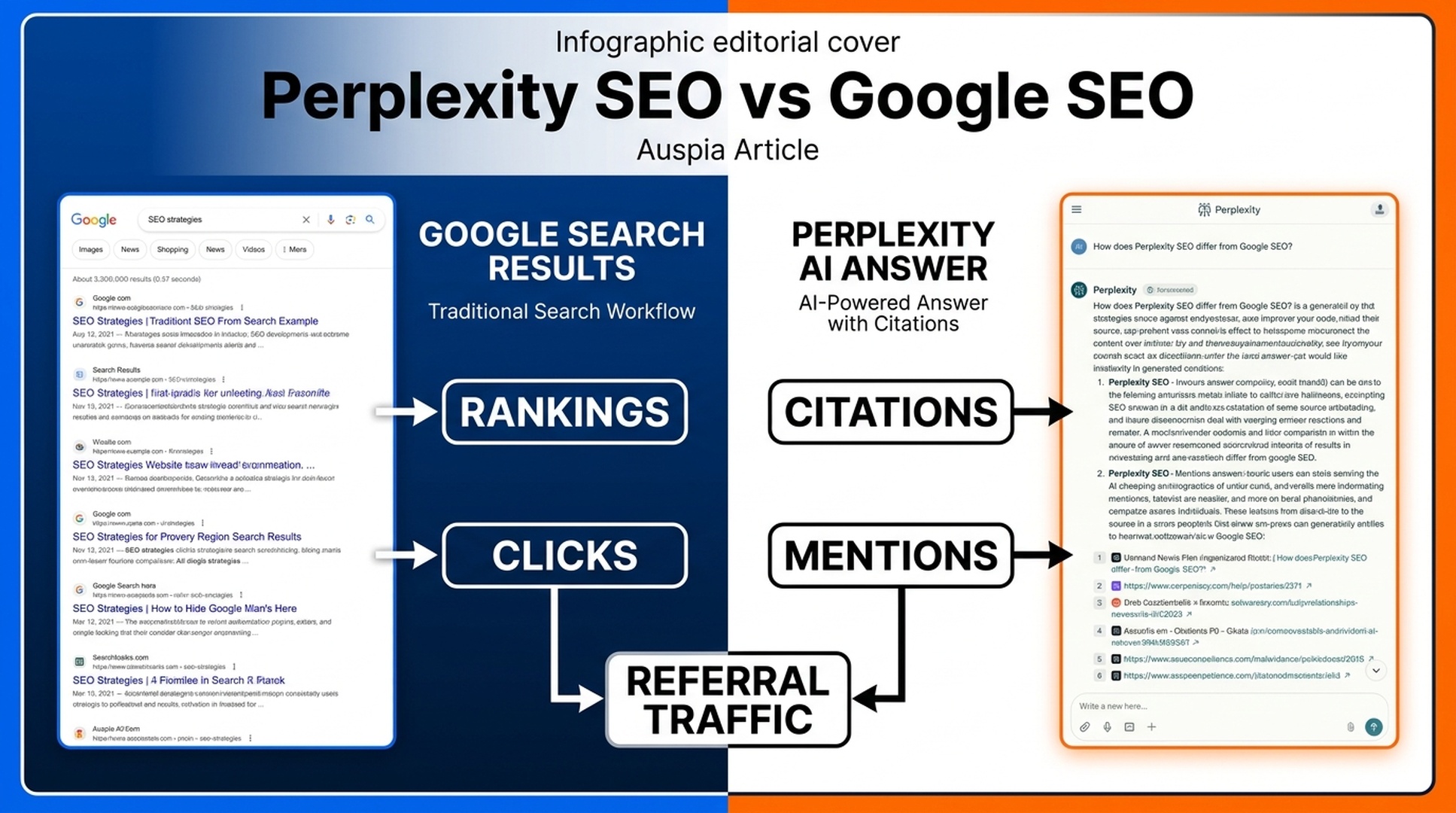
Use Google SEO when the goal is to win rankings, clicks, and demand capture from search results. Use Perplexity SEO when the goal is to become a cited source inside an AI-generated answer.
You need both, but they do different jobs.
Google SEO is still the stronger engine for scalable organic traffic. Perplexity SEO is more useful for research moments where users compare options, verify claims, and build shortlists. The overlap is real: crawlable pages, clear answers, strong sources, and brand authority help in both places. The mistake is assuming a page that ranks in Google will automatically be cited by Perplexity.
A simple rule:
If the user wants to... | Prioritize... |
|---|---|
Find a page, vendor, definition, or guide | Google SEO |
Ask a full research question and compare answers | Perplexity SEO |
Verify a claim with sources | Perplexity SEO |
Browse many options quickly | Google SEO |
Build a shortlist from summarized evidence | Perplexity SEO + GEO |
Drive large ongoing traffic volume | Google SEO, supported by AI-search optimization |
The best growth plan does not choose one. It builds pages that can rank in Google, get cited in Perplexity, and convert the visitor after either journey.
The real difference is user behavior
Google usually starts with a query and a results page. The user scans titles, snippets, ads, rich results, and sometimes an AI Overview. The click is still a major part of the journey.
Perplexity starts closer to a research conversation. The user asks a full question, reads a synthesized answer, and sees numbered citations. The click happens later, often when the user wants to verify a source or go deeper.
That changes what a page has to do.
In Google, your page needs to look like the best result before the click. In Perplexity, your page needs to be useful enough for the answer system to use as source material before the user ever sees your site.
This is why Perplexity SEO feels less like ranking optimization and more like source optimization.
Side-by-side comparison
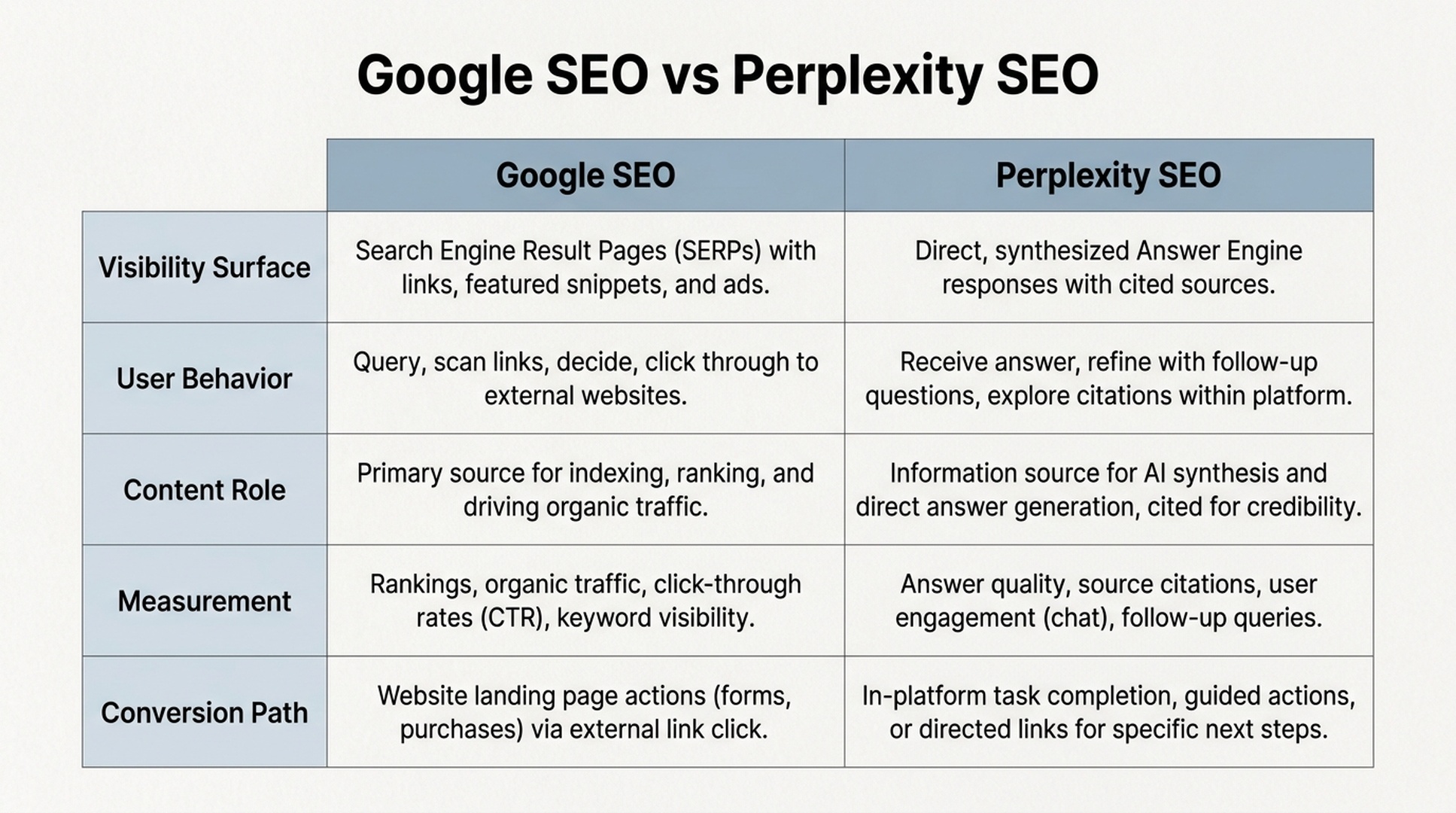
Area | Google SEO | Perplexity SEO |
|---|---|---|
Main surface | Search results page | AI answer with citations |
Primary visibility unit | Ranking URL and snippet | Cited source, brand mention, answer inclusion |
User input | Keywords and natural-language queries | Full research questions and follow-ups |
Content role | Destination page | Evidence used inside an answer |
Click path | User clicks a result to learn more | User may read answer first, then inspect sources |
Technical base | Crawlability, indexability, rendering, internal links | Crawl access, bot access, public source fetchability |
Content structure | Comprehensive, intent-matched page | Direct answers, verifiable facts, tables, concise source blocks |
Authority signal | Links, topical authority, brand demand, engagement | Source credibility, evidence consistency, third-party validation |
Measurement | Rankings, impressions, CTR, clicks, conversions | Mentions, cited URLs, citation position, answer accuracy, referrals |
Main risk | Ranking without clicks | Being mentioned inaccurately or not cited at all |
The table makes the difference look neat. In practice, the two systems blend. Perplexity can retrieve pages that already perform well in search. Google is also adding more AI answer surfaces. The operating question is not "which one wins?" It is "what does this page need to be useful in both environments?"
Where Google SEO still wins
Google SEO remains the foundation for most organic growth programs.
It is better when you need:
- large keyword coverage
- durable evergreen traffic
- product-led landing pages
- local discovery
- ecommerce category and product discovery
- programmatic pages
- comparison and alternative pages
- analytics with clearer impression and click data
Google also has stronger tooling. Search Console, rank trackers, crawl tools, and log analysis make it easier to understand what is happening. The feedback loop is imperfect, but it is mature.
For most businesses, Google is still where the measurable traffic volume lives. Ignoring it because AI search is growing would be a mistake.
The better move is to make Google pages more citation-ready without breaking their search intent. A page can still target a keyword, answer the query quickly, include comparison tables, cite sources, and provide a strong next step.
For the full framework, start with the Perplexity SEO hub. If your next question is implementation, continue with the guide on how to get cited by Perplexity.
Where Perplexity SEO changes the work
Perplexity SEO matters most when the user is in research mode.
Examples:
Prompt | What the answer needs |
|---|---|
"What are the best tools to track AI search visibility?" | Category explanation, tool comparisons, source links, recent examples |
"How do I check if Perplexity can crawl my website?" | Technical steps, crawler names, robots.txt guidance, tool path |
"Which SEO platforms mention AI citations and GEO?" | Vendor evidence, feature descriptions, third-party validation |
"How is Perplexity SEO different from Google SEO?" | Clear comparison and practical guidance |
These prompts do not behave like old keyword searches. The user expects the answer to synthesize. Your page has to give the system clean material to synthesize.
That means adding:
- direct answers near the top
- definitions that do not hide behind marketing copy
- dated facts when freshness matters
- tables that compare options or criteria
- original frameworks, checklists, or benchmarks
- clear brand facts
- external sources for claims
- pages that load without login or heavy client-side rendering
This is where many traditional SEO pages fall short. They are long, but not always usable as sources.
Optimization shifts by page type
The right adjustment depends on the page.
Page type | Google SEO priority | Perplexity SEO adjustment |
|---|---|---|
Blog guide | Match search intent and cover the topic fully | Add answer boxes, source links, summary tables, and dated facts |
Product page | Explain benefits, features, proof, and conversion path | State category, audience, integrations, constraints, and use cases clearly |
Comparison page | Capture alternative/comparison queries | Make criteria explicit and avoid vague superiority claims |
Docs/help page | Solve technical questions | Keep setup steps crawlable, specific, and source-friendly |
About page | Build trust with humans | Make entity facts consistent: name, category, market, product, locations |
Tool page | Convert high-intent visitors | Describe what the tool checks, who it is for, and what output users get |
Research page | Earn links and authority | Publish methodology, definitions, tables, and reusable data points |
The pattern is straightforward. Google SEO asks: "Will this page satisfy the searcher and earn the click?" Perplexity SEO adds: "Can this page be used as evidence inside an answer?"
Measurement: rankings are not enough
Google SEO reporting has familiar metrics:
- rankings
- impressions
- CTR
- organic sessions
- conversions
- indexed pages
- crawl errors
- backlinks
Perplexity SEO needs a different layer.
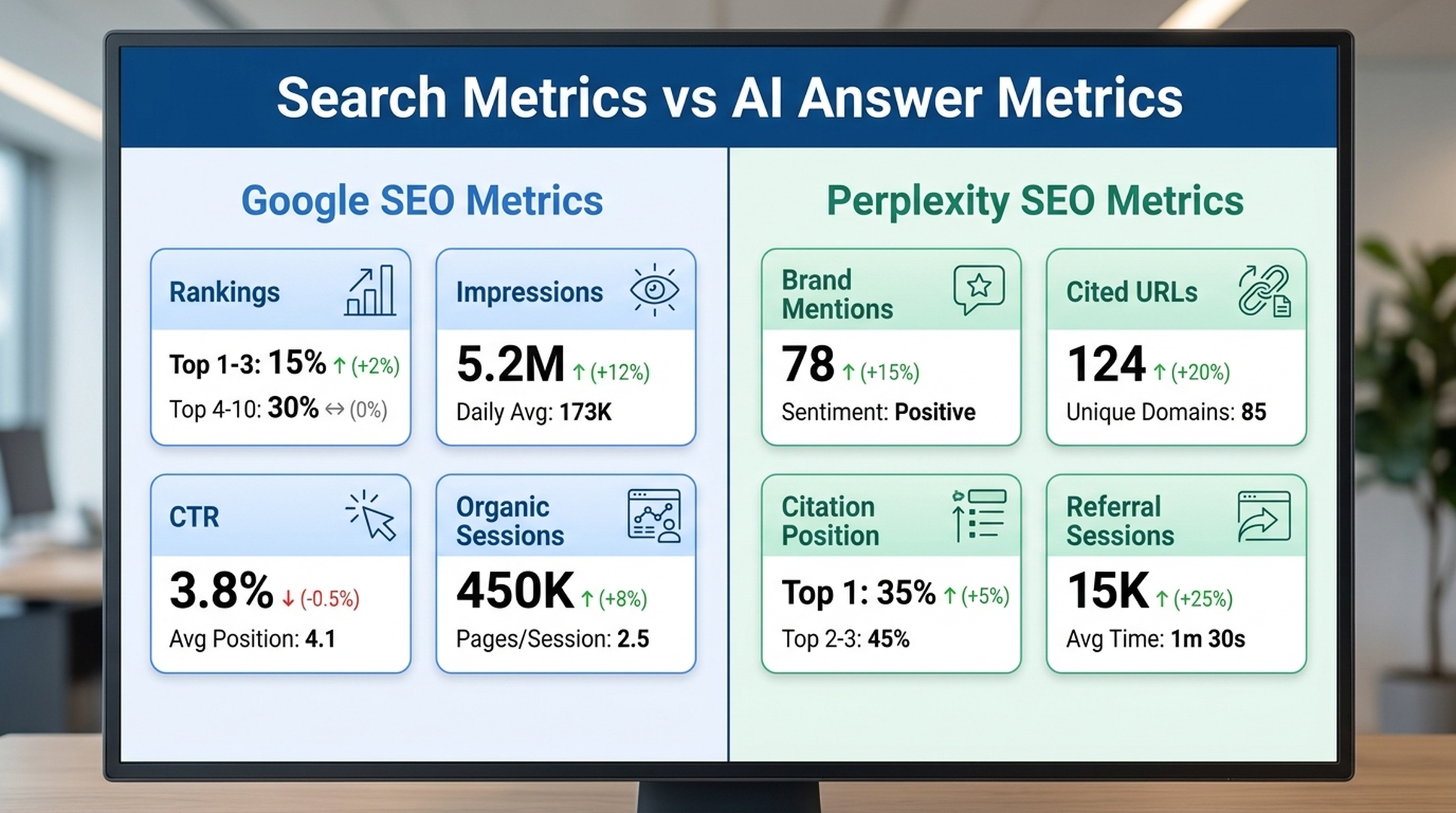
Track:
Metric | Why it matters |
|---|---|
Brand mentioned | Shows whether your brand enters the answer set |
URL cited | Shows whether your page is used as a source |
Citation position | Shows whether the source is prominent or buried |
Claim attached | Shows what Perplexity says your page proves |
Answer accuracy | Shows whether your brand is described correctly |
Competitor presence | Shows who else is shaping the answer |
Referral sessions | Shows whether citations turn into visits |
Assisted behavior | Shows whether Perplexity visitors later return or convert |
This does not replace Google SEO reporting. It extends it.
A useful report has two pages: one for classic search demand, one for AI answer visibility. If you only report rankings, you will miss brand exposure inside Perplexity. If you only report citations, you may miss the bigger traffic picture.
A blended workflow for growth teams
Here is a practical way to combine both.
Step | What to do | Output |
|---|---|---|
1 | Choose a keyword and prompt cluster | One target keyword group plus 10-20 Perplexity-style prompts |
2 | Pick the source page | The page that should rank, be cited, and convert |
3 | Audit technical access | Indexability, robots.txt, rendering, WAF/CDN, AI crawler access |
4 | Rewrite for dual use | Search intent coverage plus answer-ready sections and source blocks |
5 | Add entity and evidence signals | About page consistency, schema, third-party profiles, citations, docs |
6 | Publish and measure | Rankings, clicks, prompt mentions, cited URLs, referral quality |
7 | Refresh based on gaps | Fix missing evidence, unclear claims, weak CTAs, or blocked access |
This workflow stops teams from creating separate "SEO content" and "AI search content" calendars that compete with each other. One strong page can serve both if it is structured correctly.
What to change on an existing Google SEO page
You do not need to rewrite every page from scratch. Start with pages that already get traffic or support a buying decision.
Add these elements:
Upgrade | Example |
|---|---|
Direct answer | A 2-4 sentence answer immediately under the first |
Source summary | A short "what this page proves" section |
Facts table | Category, audience, use cases, limitations, last updated date |
Comparison criteria | Clear dimensions instead of vague "best" claims |
Entity block | Brand name, product category, audience, integrations, market |
External references | Official docs, credible data, partner pages, review sources |
Conversion path | Tool, checklist, demo, diagnostic, or next guide tied to the query |
For example, a page targeting "AI search visibility tools" should not only list features. It should define AI search visibility, explain what a tool should measure, compare measurement criteria, show how prompt tracking works, and provide a clear next step.
That page has a better chance of ranking, being cited, and converting a research visitor.
When not to prioritize Perplexity SEO
Not every page deserves Perplexity-specific work.
Deprioritize it when:
- the page targets a purely navigational query
- the product is not publicly explainable
- the content is gated by design
- the topic has little research or comparison behavior
- the page has no clear claim worth citing
- the page is temporary, seasonal, or low business value
In those cases, standard SEO, paid search, lifecycle marketing, or product-led conversion work may matter more.
Perplexity SEO is strongest when the query involves evaluation, explanation, comparison, technical guidance, or evidence.
FAQ
Is Perplexity SEO replacing Google SEO?
No. Perplexity SEO does not replace Google SEO. It adds a source-visibility layer for AI answers. Google is still the larger traffic channel for most websites, while Perplexity can influence research, trust, comparison, and high-intent discovery.
Can a page rank in Google but fail in Perplexity?
Yes. A page can rank because it matches a keyword and has authority, but still be weak as a cited source. Common reasons include vague claims, poor answer structure, blocked crawler access, outdated facts, or lack of external evidence.
Can Perplexity cite pages that do not rank number one in Google?
It can. Perplexity uses web retrieval and citations, but citation selection is not the same as a Google ranking list. A specific, fresh, well-structured source can be useful even if it is not the top Google result for a broad keyword.
What should I optimize first?
Start with pages that already matter to the buyer journey: category guides, product pages, comparison pages, technical explainers, tool pages, and evidence-backed reports. Check access first, then improve answer structure and brand facts.
Should I create separate pages for Perplexity SEO?
Usually no. Start by upgrading existing high-value SEO pages so they can also work as AI-search sources. Create new pages only when there is a distinct prompt cluster or evidence asset that your current pages do not cover.
How do I measure the difference?
Use Google Search Console or rank tracking for Google SEO. For Perplexity SEO, build a prompt library and track brand mentions, cited URLs, citation position, answer accuracy, competitors, referral sessions, and downstream behavior.
Sources
- Perplexity Help Center: How does Perplexity work?
- Perplexity Docs: Perplexity crawlers
- Perplexity Docs: API overview
Auspia takeaway
Google SEO and Perplexity SEO are not enemies. They answer different parts of the same growth problem.
Google helps you capture demand at scale. Perplexity helps your brand appear inside research answers where users are comparing, verifying, and shortlisting. The shared foundation is simple: accessible pages, specific answers, clear entities, credible evidence, and a useful next step.
If you already have strong SEO pages, do not throw them away. Make them easier to cite.
Author: Simon Vale, 11-Year Search Intent Researcher at Auspia. Simon writes about buyer queries, SERP patterns, AI-search prompts, and content alignment for organic growth teams.