Commission a deliverable, not an open-ended research session
Workbubby is most useful here as an office-work agent that returns a finished packet. Give it a bounded assignment, a small source pack, and an acceptance standard. Do not ask it to roam across every available file and "find SEO opportunities."
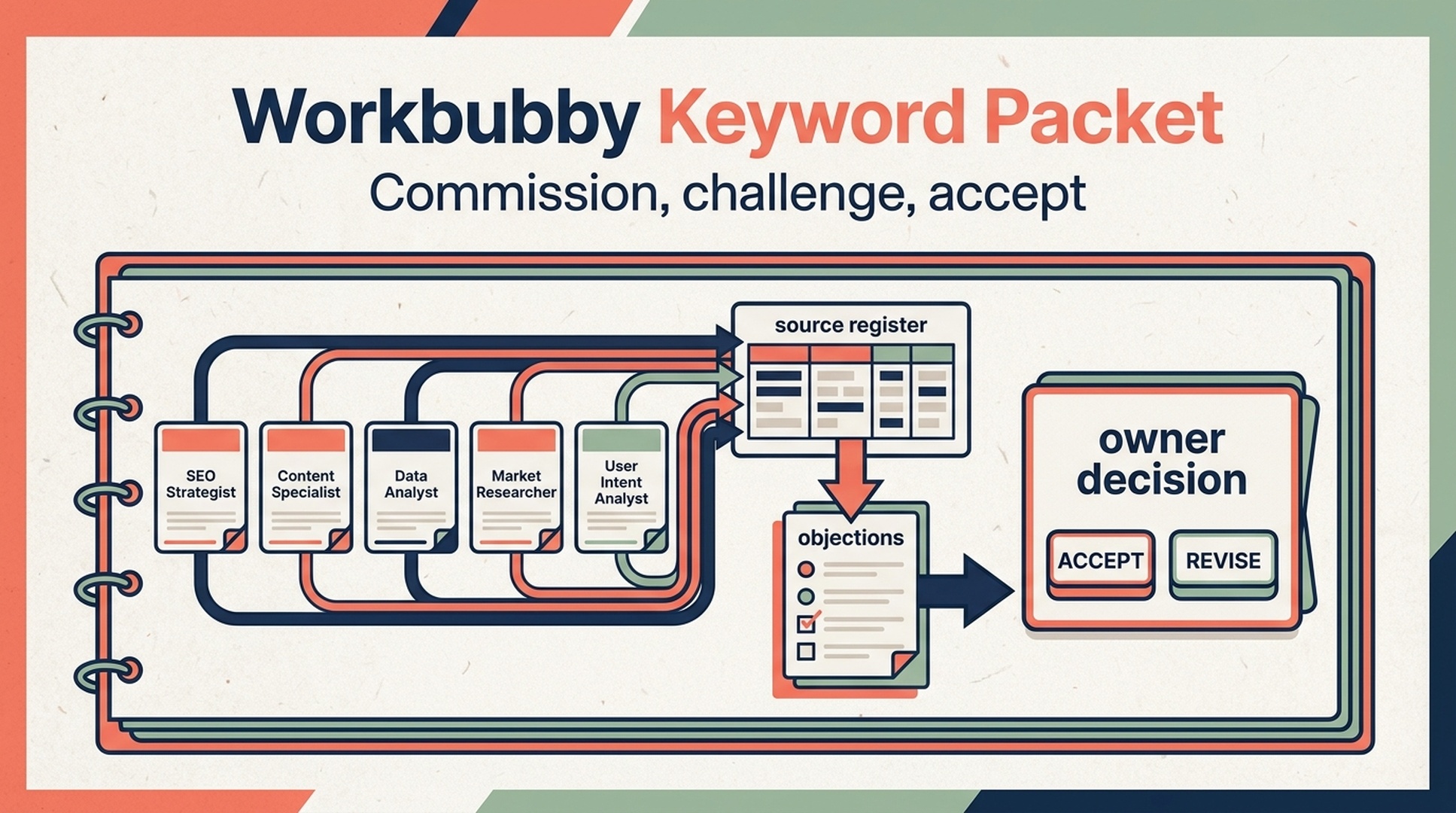
The deliverable for this workflow is a keyword acceptance packet. It contains a source register, a job map, a short list of candidates, an objection sheet, and a recommendation memo. A marketing owner reviews the packet and decides what happens next.
Who should use it: a marketing team that wants an agent to prepare the research artifact while people retain the decision.
Inputs: an approved brand brief, customer-language samples, a URL inventory, a dated keyword export, and manually collected SERP notes.
Allow: about one hour for a focused topic, plus owner review.
Done means: every recommendation can be traced to supplied evidence and has a named acceptance decision.
Write the acceptance criteria first
Start with the finished object. A precise commission keeps the agent from turning research into a sprawling report.
Prepare a keyword acceptance packet for one content opportunity.

The packet must include:
1. a source register;
2. a searcher-job map;
3. no more than five candidates;
4. an existing-page check for every candidate;
5. an objection sheet;
6. one recommendation memo.

Use only the files I authorize. Keep original metric names and dates.
Write UNKNOWN when evidence is missing. Do not publish, edit a CMS,
contact anyone, or invent product claims.
This commission gives Workbubby a clear end state. It also makes acceptance objective: if the packet omits the source register or page check, it is incomplete regardless of how polished it looks.
Assemble a five-file source pack
Do not begin with a drive dump. Use files with descriptive names and one purpose each.
File | Minimum contents | Acceptance test |
|---|---|---|
| Audience, offer, conversion, prohibited claims | States what the business can prove |
| Exact question, source type, context | Preserves original wording |
| Query, market, date, provider fields | Does not rename estimates as facts |
| URL, purpose, owner, update date | Covers likely competing pages |
| Page types, features, repeated entities | Separates observation from opinion |
Keep private or regulated data out unless the workspace and organizational policy permit it. Replace names with role or segment labels when identity is irrelevant.
Give each specialist one question
Workbubby may use multiple expert roles or parallel tasks, but parallelism is only helpful when outputs do not overwrite one another. Divide the assignment by question:
- Language reviewer: What jobs and anxieties appear in customer wording?
- Evidence clerk: Which supplied numbers and observations are usable, dated, and attributable?
- Page librarian: Which existing URL is closest to each job?
- SERP reader: Which result formats appear to satisfy the query now?
- Skeptical editor: What would make each recommendation wrong?
Each role should return a compact worksheet. The coordinator then assembles the acceptance packet without smoothing over disagreement.
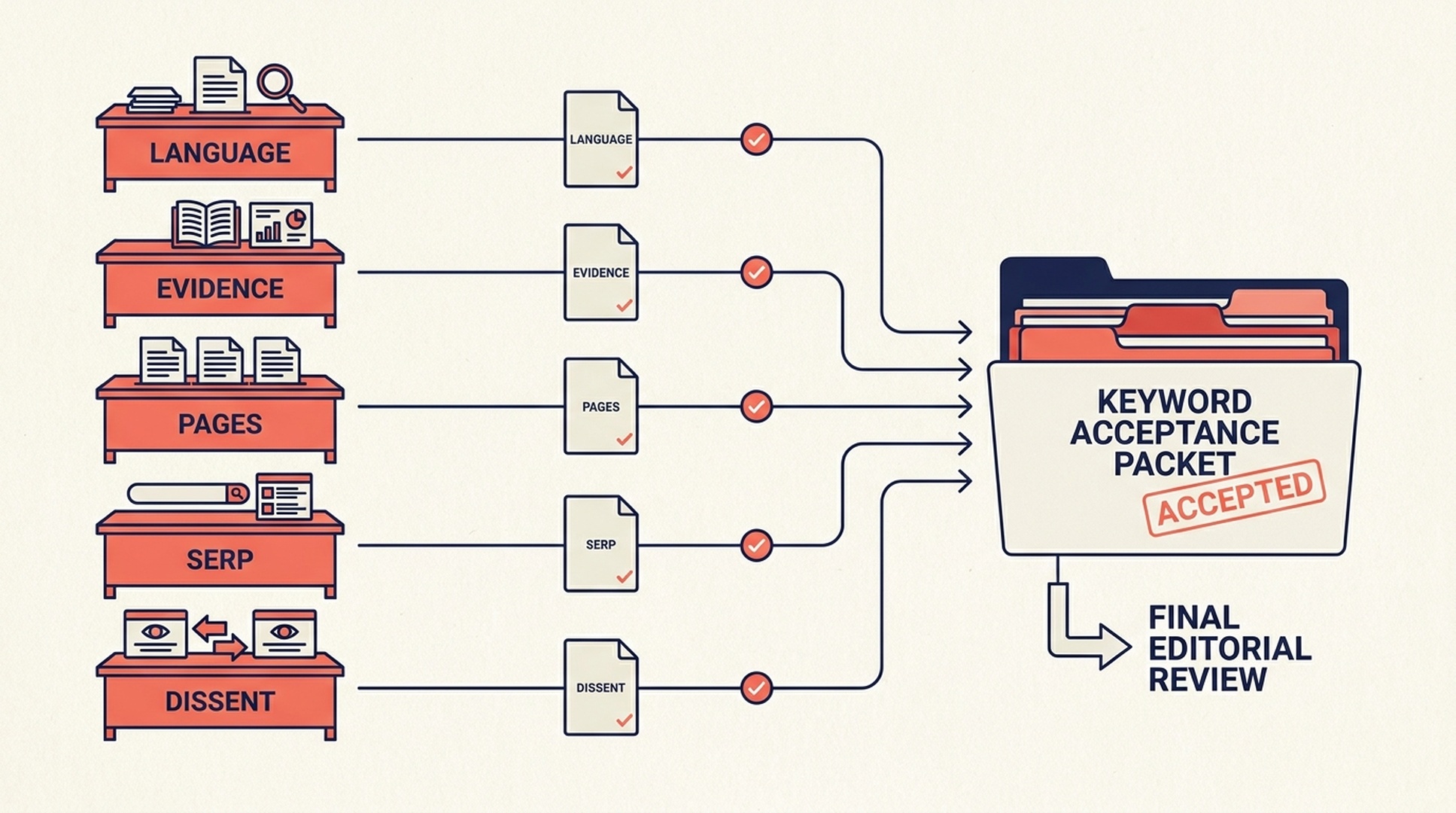
Caption: Parallel work is useful when every specialist has a separate question and a defined handoff.
Build a source register before ranking candidates
The register prevents evidence laundering. Every important field should point back to a supplied file and date.
Evidence ID | Claim or metric | Source file | Date or period | Market | Status |
|---|---|---|---|---|---|
E-01 | Query wording |
| 2026 Q2 | US | verified input |
E-02 | Provider volume field |
| 2026-07-15 | US | estimate |
E-03 | Dominant page type |
| 2026-07-29 | US | observed |
E-04 | Product capability |
| current | global | owner approved |
Do not allow a candidate table to contain more certainty than the register. If an entry is missing a market or date, the candidate memo should say so.
Translate phrases into searcher jobs
Similar wording can hide different tasks. Workbubby should group candidates by the job the visitor is trying to finish, not merely by shared nouns.
For each group, require:
- the trigger that causes the search;
- the decision or action the visitor wants;
- the proof needed to help them;
- the suitable page type;
- the closest current URL;
- the next honest action after reading.
A query such as "AI image editor" might imply a tool, category page, comparison, or tutorial depending on the SERP and product. The phrase alone does not decide the format.
Hold an objection review
Instead of letting a weighted score hide weakness, ask the skeptical editor to challenge every finalist.
For each candidate, write the strongest objection under these headings:
- intent mismatch;
- weak business evidence;
- existing-page overlap;
- unrealistic SERP fit;
- uncertain metric;
- poor conversion path.

If an objection cannot be resolved from supplied evidence, mark it OPEN.
Do not lower a numerical score to hide it.
This creates useful friction. A candidate with moderate volume but clear fit may survive. A high-volume candidate that requires claims the business cannot make should not.
Ask for an acceptance memo
The final memo should be short enough for a busy owner to review:
RECOMMENDATION
Primary query:
Searcher job:
Owner URL or new page route:
Supporting queries:

WHY THIS CANDIDATE
Evidence IDs:
SERP fit:
Business fit:

WHY NOT THE ALTERNATIVES
Candidate and rejection reason:

OPEN ITEMS
Unknown data:
Unverified claims:
Named owner:

DECISION
[ ] Accept  [ ] Reject  [ ] Revise  [ ] Defer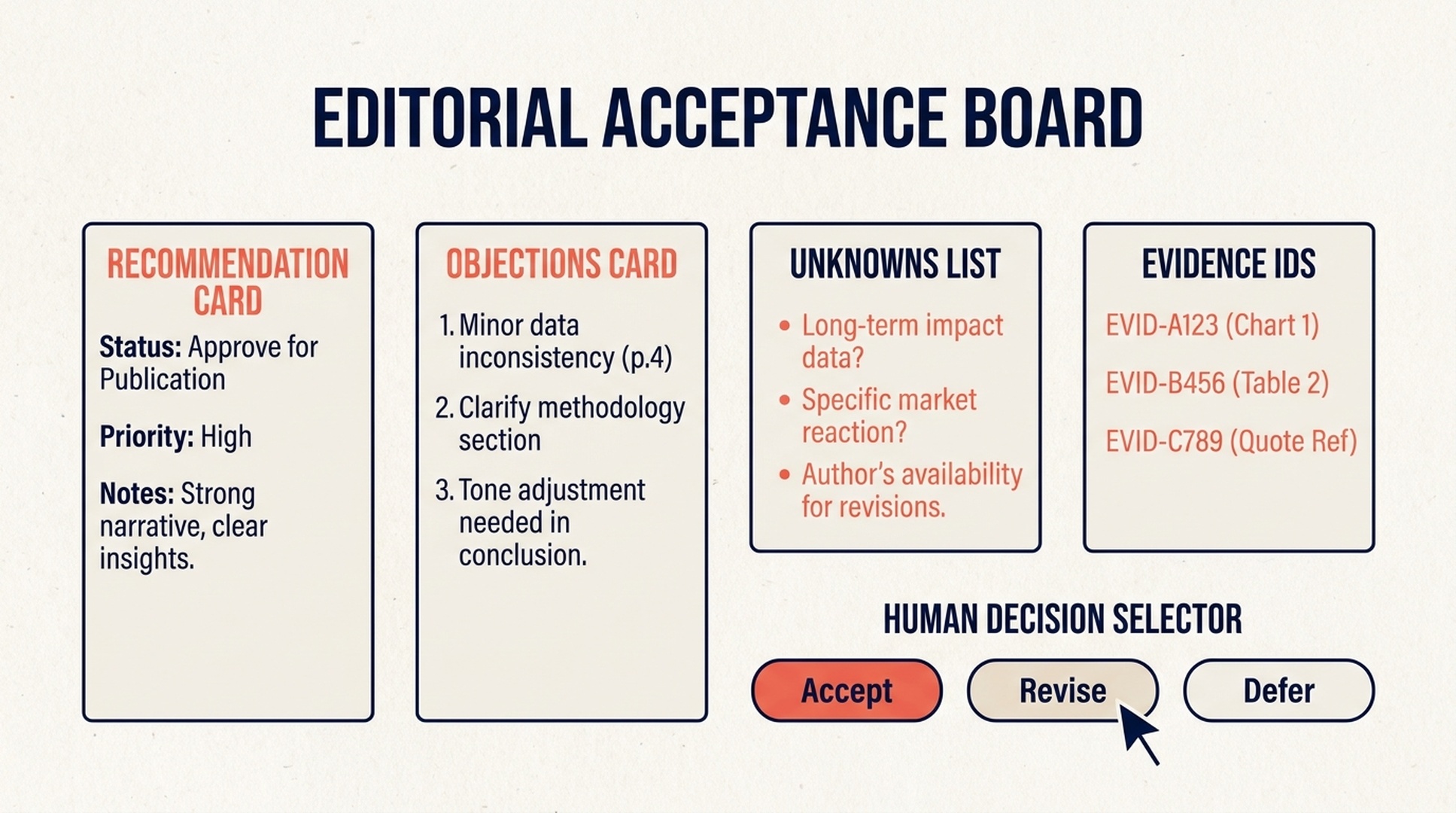
Caption: The deliverable is complete only when objections and unknowns remain visible beside the recommendation.
Convert acceptance into a writer handoff
After the owner accepts a candidate, create a separate brief. It should include the searcher job, owner URL, must-answer questions, approved facts, excluded claims, supporting queries, internal-link opportunities, and reviewer names.
Do not ask Workbubby to draft and publish during the same run that selects the keyword. The acceptance decision changes the assignment. A new page, a refresh, and a consolidation require different production instructions.
Verification checklist
- [ ] The packet contains no more than five candidates.
- [ ] Every metric points to the original source file and date.
- [ ] Every candidate has an existing-page route.
- [ ] Open objections are not hidden in narrative prose.
- [ ] The recommendation names an owner and decision state.
- [ ] No external message, CMS edit, or publication occurred.
- [ ] The writer handoff starts only after acceptance.
FAQ
Does Workbubby replace a keyword data provider?
No. It can organize authorized exports and research artifacts. The original provider remains the source for its metrics.
Should Workbubby use many expert agents?
Only when each role owns a distinct question. Five agents producing the same candidate list create duplication, not insight.
Can the packet recommend no new page?
Yes. Refreshing an existing page, consolidating overlap, or deferring the topic can be the correct outcome.
Why use an acceptance memo instead of a score?
Because hard objections matter. A single serious intent or evidence problem should remain visible rather than disappearing inside an average.
Author: Rowan Blake, Content Automation Analyst for 100+ Publishing Pipelines at Auspia. Rowan writes about bounded AI deliverables, editorial handoffs, and reviewable content operations.