Why AI Overviews Skip Tool Keywords — The 2026 SEO Playbook Backed by Data
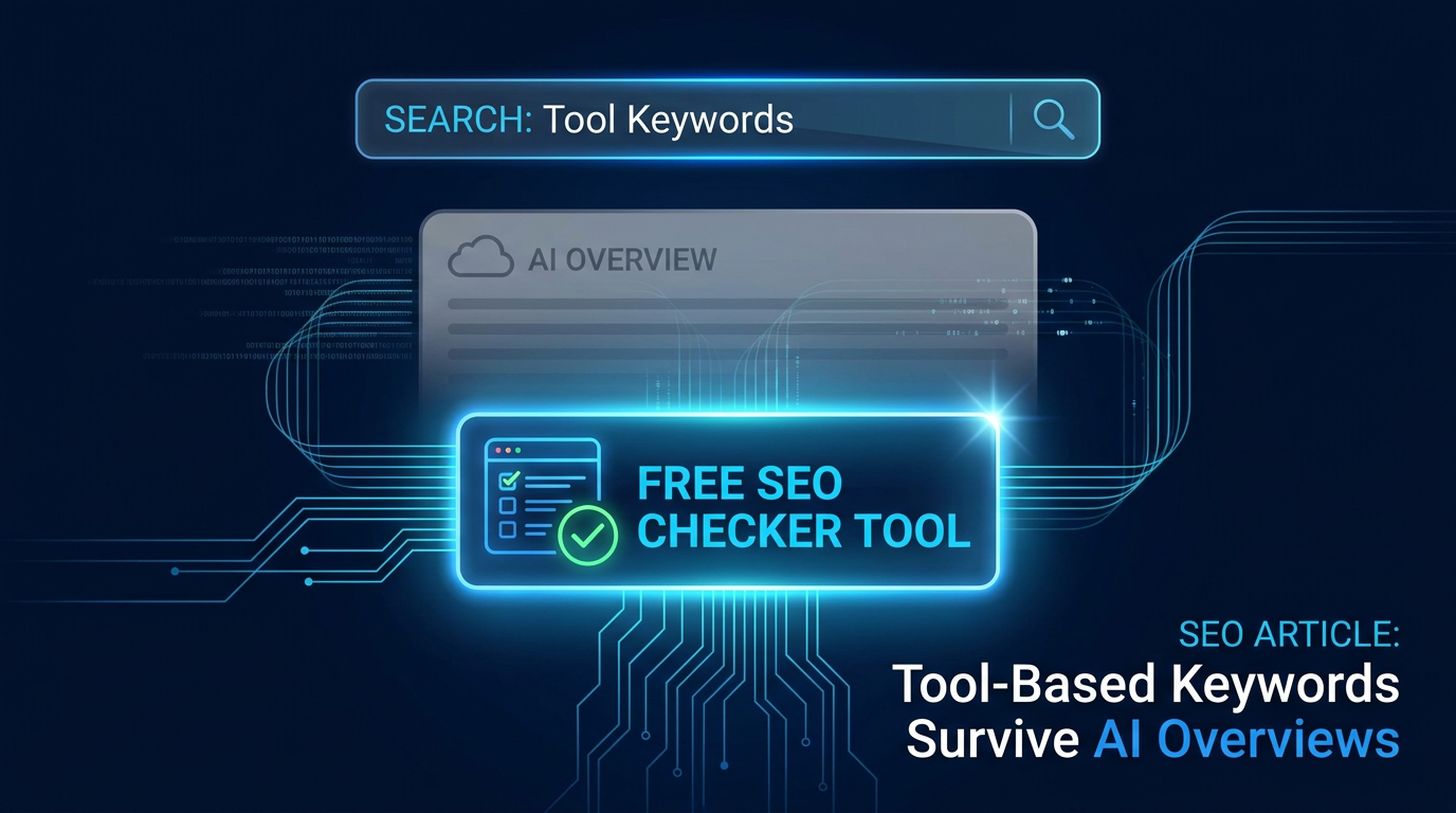
When an AI Overview shows up above your result, Google pushes the first organic listing down by roughly 1,674 pixels — past the fold, past the patience of most searchers, and often past the point where a click ever happens. That's the headline threat of 2026 SEO. But here's the part most playbooks miss: AI Overviews only appear in about 12% of searches, and for transactional, tool-driven queries that rate collapses to roughly 0.47%. In other words, the single most reliable way to survive the AI Overview era isn't to out-write the machine — it's to target the keywords the machine refuses to answer.
This article breaks down why tool-based keywords are the AI Overview blind spot, gives you a repeatable 5-step framework to find and rank for them, and shows the pattern using real tool-keyword portfolios (including Auspia's own). If you've watched your informational content lose clicks to AI-generated summaries, this is the pivot.
The AI Overview Threat Is Real — But It's Not Evenly Distributed
Two large-scale studies now anchor the conversation. Advanced Web Ranking analyzed 8,000 keywords and found AI Overviews surface in only ~12% of queries overall, with Featured Snippets actually appearing slightly more often (~17.5%). Ahrefs went bigger — 300,000 keywords — and arrived at a similar conclusion while exposing the intent skew that matters most for your strategy.
The skew looks like this:
- Informational queries (e.g., "what is GEO SEO", "how do AI citations work") trigger AI Overviews at the highest rate. These are exactly the queries an LLM can summarize from a paragraph.
- Commercial / transactional queries (e.g., "buy", "pricing", "tool", "checker", "generator") trigger AIOs at a tiny fraction of that rate. AWR pegged e-commerce queries near 1% and pure transactional queries around 0.47%.
- Health, safety, and tech-definitional topics sit in between — high AIO, because Google treats them as "snapshot-worthy."
The takeaway isn't that AI Overviews are harmless. When they do appear, they genuinely cannibalize clicks: the first organic result gets buried behind a generated summary, scroll depth explodes, and CTR falls. The takeaway is that the damage is concentrated on a specific class of keyword — the informational, paragraph-answerable kind — and that opens a clean escape route.
Why Tool Keywords Are the AI Overview Blind Spot
A "tool-based keyword" is any query where the searcher wants to do something, not just read something. The giveaway is usually a functional suffix:
- checker (e.g., "robots.txt AI crawler checker", "SEO score checker")
- generator (e.g., "llms.txt generator", "meta description generator")
- calculator (e.g., "ROI calculator", "keyword difficulty calculator")
- converter / tester / finder / comparison (when it implies an interactive comparison)
Why does Google almost never generate an AI Overview for these? Because an AI Overview is a summary of content. A user typing "robots.txt AI crawler checker" doesn't want a paragraph explaining what a robots.txt is — they want a working input box that audits their file. An LLM summary would be actively unhelpful, so Google's systems route the query to interactive results, tool pages, and apps instead. The AI Overview product was never designed to replace a tool; it was designed to replace an article.
This is the strategic asymmetry: the keywords hardest for an LLM to summarize are the keywords least likely to get an AI Overview. And conveniently, they're also the keywords with the highest conversion intent — someone searching for a checker or generator is one step from becoming a user.
The 5-Step Framework to Find AIO-Proof Tool Keywords
You don't need to guess which keywords are safe. Here's a repeatable process.
Step 1: Audit your current keywords for AIO exposure
Pull your top-impression queries from Google Search Console and sort by declining CTR. The queries losing clicks fastest are your AIO-exposed set — usually the informational "what is" / "how does" queries. Flag them. These are the keywords you'll either repurpose as supporting content or de-prioritize as primary targets.
A faster signal: run your domain through Auspia's [SEO Score Checker](https://auspia.ai/tools/website-seo-score-checker) to get a baseline technical and on-page read, then cross-reference which of your ranking pages sit under a query type that AIOs love. The goal of this step is a single list: keywords I currently rank for that are now AI-Overview-vulnerable.
Step 2: Map every informational keyword to a tool-based equivalent
This is the core move. Take each vulnerable informational keyword and ask: "What is the user actually trying to accomplish?" Then build or target the tool-keyword version.
Vulnerable informational keyword | AIO-proof tool equivalent |
|---|---|
"what is robots.txt for AI" | "robots.txt AI crawler checker" |
"how does my site rank in AI search" | "GEO rank checker" |
"what is my SEO score" | "SEO score checker" |
"how to write llms.txt" | "llms.txt generator" |
"is my site cited by Perplexity" | "Perplexity SEO checker" |
The pattern is mechanical: take the verb/noun intent and append a functional suffix. The right column is where you invest new content and new tool pages.
Step 3: Validate AIO resistance with a live SERP check
Before you commit, confirm the keyword is actually AIO-proof in your geography and niche. Open an incognito SERP for the candidate keyword and look for three things:
- No AI Overview at the top (the ideal state).
- Tool pages and app-like results ranking in the top 5 — this confirms Google reads the intent as "do," not "read."
- Low Featured Snippet density — snippets and AIOs correlate, so a snippet-free SERP is a good proxy for AIO-resistance.
Do this for 5–10 candidates and you'll quickly internalize which suffixes and intents hold up. If a candidate does show an AIO, drop it — there are plenty that don't.
Step 4: Build the tool (or tool-adjacent content)
Two paths, depending on engineering capacity:
- Build the actual tool. A lightweight, no-login utility page is the highest-converting asset you can publish. Auspia's own portfolio proves the model: the robots.txt AI crawler checker, llms.txt generator, and AI search visibility checker each target a single tool keyword, require no signup, and funnel users toward the broader platform. One tool, one keyword, one clear CTA.
- Write tool-adjacent content. If you can't ship a tool immediately, write the definitive guide to that tool keyword — a tutorial framed around the action ("how to run a GEO rank check, step by step"). Pair it with a free template or checklist so the page delivers utility, not just prose. This captures the query while you build the real thing.
Step 5: Convert the traffic you defended
The whole point of pivoting to tool keywords is that they convert. Don't waste the advantage. Every tool page should end with a single, obvious next step: upgrade to the full platform, book a demo, or run a deeper audit. Auspia's tool pages, for example, flow naturally into the [GEO Checker leaderboard](https://auspia.ai/geo-checker/leaderboard) and full visibility reports — turning a free keyword-targeted utility into a pipeline entry.
Don't Abandon Informational Content — Layer It
A common misread of this strategy is "stop writing informational content entirely." That's wrong. Informational content is what feeds the topical authority that lets your tool pages rank. The fix is intent layering, not deletion.
Think of it as a funnel where each layer has a different AIO risk profile:
- Top of funnel (informational): High AIO risk, low conversion. Use these as cluster/supporting pages that build entity coverage and internal-link into your tool pages. Accept that some will lose clicks to AIOs — their job is authority, not direct revenue.
- Middle of funnel (commercial/comparison): Low AIO risk, medium conversion. "Best X" and "X vs Y" pages where a tool or interactive element can be embedded.
- Bottom of funnel (transactional/tool): Near-zero AIO risk, high conversion. Your checker/generator/calculator pages. This is where you concentrate new investment.
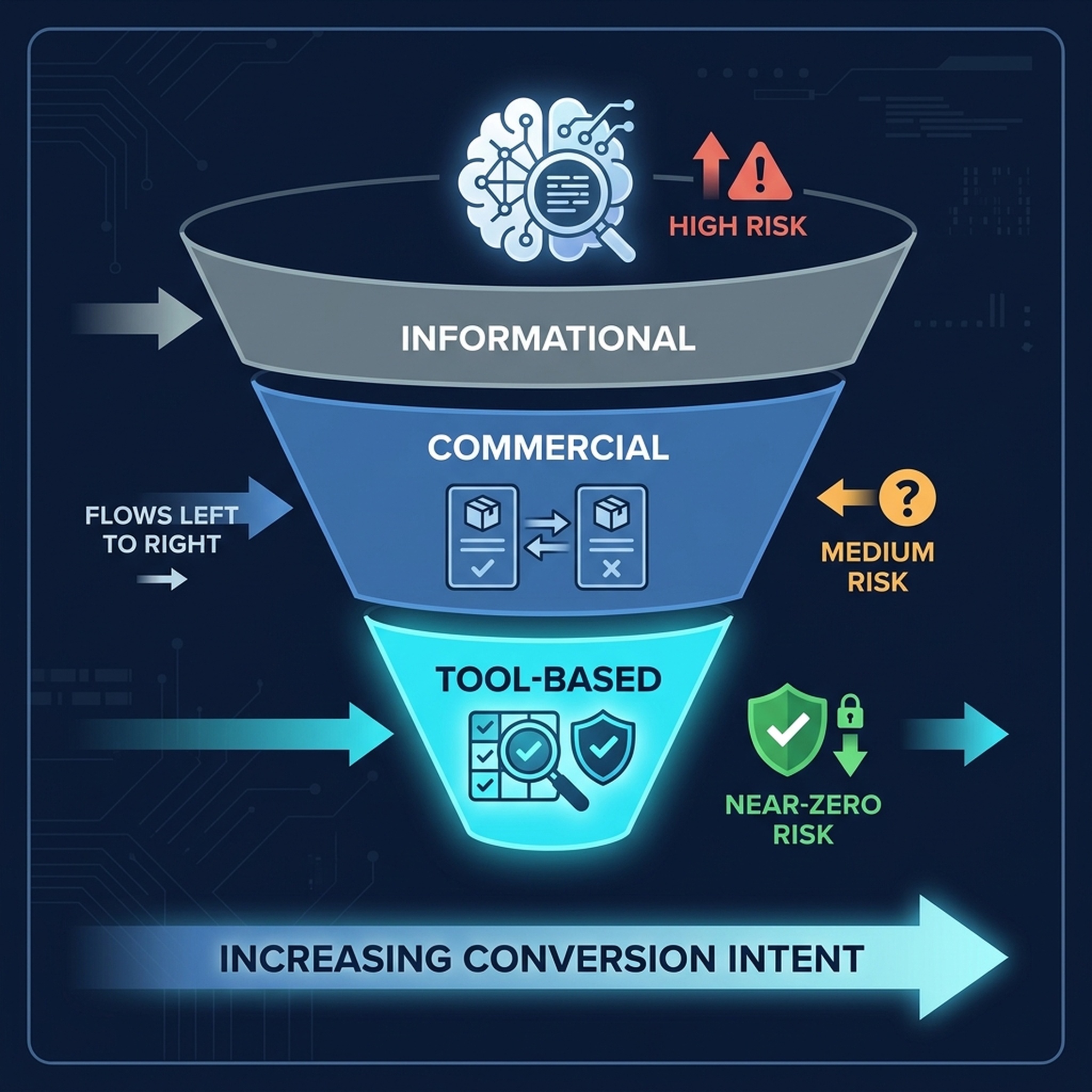
The critical discipline is intent mapping to avoid cannibalization: each page targets one distinct intent, and you never let two pages compete for the same query. If your informational "what is robots.txt" page and your "robots.txt checker" tool page both try to rank for "robots.txt," Google gets a confused signal and you split link equity. Map one query → one page, always.
How to Measure Whether Your Pivot Is Working
Ranking for a tool keyword is only half the job — you need to confirm it's actually AIO-proof and converting. Track three metrics, not just rank:
- AIO presence over time. Re-check your target SERPs monthly. If an AI Overview creeps in, that keyword is degrading and you should shift effort. Tools like Otterly and Auspia's GEO Checker can automate AIO/visibility monitoring so you're not manually spot-checking.
- CTR from Search Console. Tool-keyword pages should hold a higher CTR than your informational pages. If a tool page's CTR is collapsing, suspect either an AIO appeared or a competitor shipped a better tool.
- Conversion rate from organic. The real proof. Tool-keyword traffic should convert at a multiple of informational traffic because the intent is explicit. If it doesn't, your CTA or on-page tool experience is the bottleneck, not the keyword.
For the AI-visibility side specifically — how often your brand gets cited inside AI Overviews and AI search engines, even when you're not getting the click — run a baseline with Auspia's [GEO Checker](https://auspia.ai/geo-checker). Tool keywords defend your click traffic; GEO tracking tells you whether your brand is still winning the citation war on the queries where AIOs do appear. You need both signals in 2026.
The Takeaway
The SEO discourse of 2026 is obsessed with the question "how do I get cited by AI Overviews?" — and that's a legitimate question for brand visibility. But it's the wrong primary question if your goal is clicks and customers. The more durable play is simpler: target the keywords AI Overviews structurally cannot answer. Tool-based keywords — checkers, generators, calculators, testers — are where intent is highest, AIO risk is lowest, and a well-built utility page can compound traffic for years.
You don't need to win a fight with the summarizer. You need to pick battles the summarizer won't show up to. Audit your keyword list today, map every vulnerable informational query to its tool equivalent, validate the SERP, and start building. The competitors still publishing 2,000-word definitional articles are feeding the machine that's eating their traffic. Be the page the machine sends people to instead.
Run your own AIO-resistance check now — start with Auspia's SEO Score Checker for a technical baseline, then use the GEO Checker to see where your brand already appears (or doesn't) across AI search engines. The keywords the AI won't summarize are the keywords that will still pay you in 2027.